

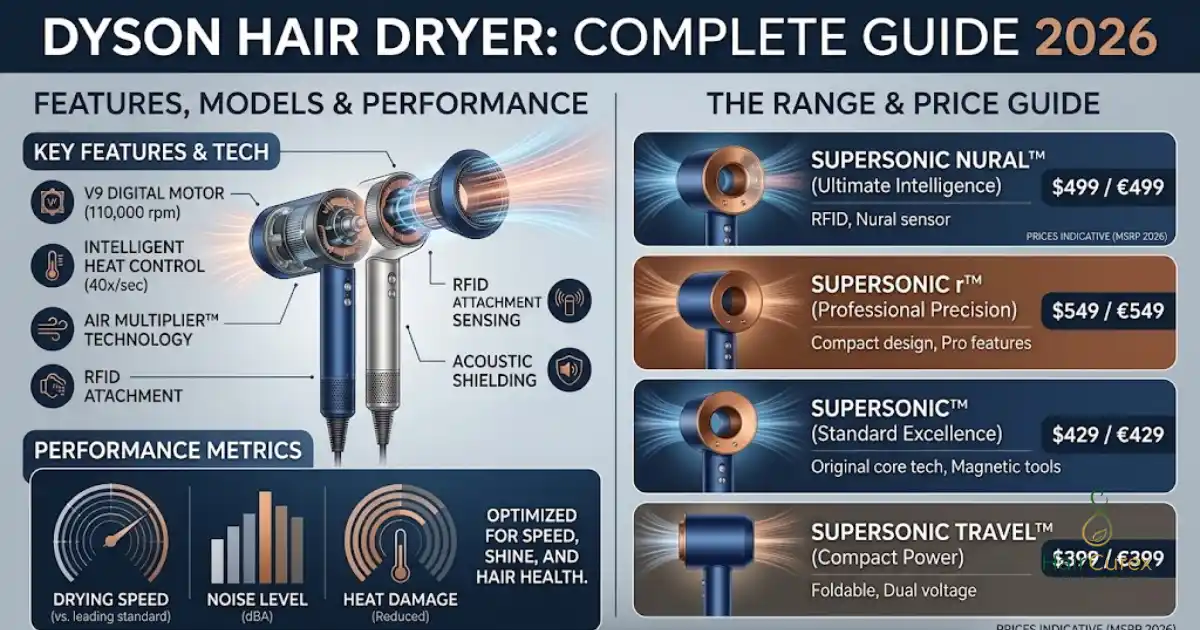
A Dyson hair dryer is a modern hair styling tool. It dries hair fast without heat damage. It uses smart airflow technology to protect your hair.
If you’ve spent any time scrolling through beauty videos or wandering the aisles at Ulta, you’ve probably seen someone gushing over their Dyson hair dryer. It’s sleek, it’s futuristic-looking, and it costs a lot more than the drugstore dryer sitting in your bathroom drawer. So what’s the big deal? In this guide, we’ll walk through everything you need to know about the Dyson hair dryer lineup, from how the technology actually works to which model fits your hair type and budget. By the end, you’ll know exactly whether this device deserves a spot on your bathroom counter.
What Is a Dyson Hair Dryer and Why Is It So Popular?
At its core, a Dyson hair dryer is a high-performance blow dryer built around a tiny, incredibly fast motor and a completely different approach to airflow. At its core, a Dyson hair dryer is a high-performance blow dryer designed around a compact, high-speed motor, controlled airflow, and intelligent heat regulation.This shifts the weight down low and leaves the barrel light and easy to maneuver, which sounds like a small detail until you’ve held a blow dryer over your head for fifteen minutes straight.
Dyson didn’t stumble into hair care by accident. The company spent years studying hair damage at a microscopic level, using high-speed cameras to see exactly what happens when hot air hits a strand of hair. That research led to the first Dyson Supersonic hair dryer in 2016, and it changed how people thought about what a blow dryer could be. Suddenly, a category that hadn’t seen real innovation in decades had a genuine disruptor.
Part of the popularity comes down to results. But honestly, a big part of it is also the experience. The Dyson hair dryer feels different in your hand. It sounds different, it dries faster, and it doesn’t leave your scalp feeling scorched. Add in a design that wouldn’t look out of place in a modern art museum, and you’ve got a product that people are genuinely excited to show off. When you search for a Dyson hair dryer review, you’ll notice a pattern: reviewers rarely talk about it like a boring appliance. They talk about it like a gadget worth bragging about.
How Does the Dyson Hair Dryer Work?
The magic behind every Dyson hair dryer starts with something called the Dyson digital motor V9. This motor is roughly the size of a golf ball, yet it spins at up to 110,000 revolutions per minute, which is far faster than the motors found in conventional dryers. Because the motor is so small and powerful, Dyson could move it into the handle instead of the head, creating a much more balanced tool.
That motor drives what Dyson calls Air Multiplier technology. Rather than blasting air directly through a heating element like a standard dryer, the Dyson hair dryer draws in air and amplifies it, pushing out a smooth, high-velocity stream through a narrow gap in the barrel. This produces powerful airflow without the turbulent, inconsistent blast you get from cheaper dryers. The result is a more controlled airflow that dries hair evenly instead of whipping strands around in every direction.
Then there’s the intelligent heat control system, which is arguably the most talked-about piece of Dyson’s fast drying technology. A glass bead thermistor measures the air temperature more than 40 times per second and regulates the heat to help prevent extreme heat damage.
This keeps the airflow within a safe range so you’re far less likely to damage hair with excess heat. Think of it like cruise control for temperature. Instead of you guessing which heat setting is safe, the dryer does that thinking for you, constantly recalibrating so your hair doesn’t get exposed to extreme heat during a normal blow-dry.
Best Dyson Hair Dryer Models Compared
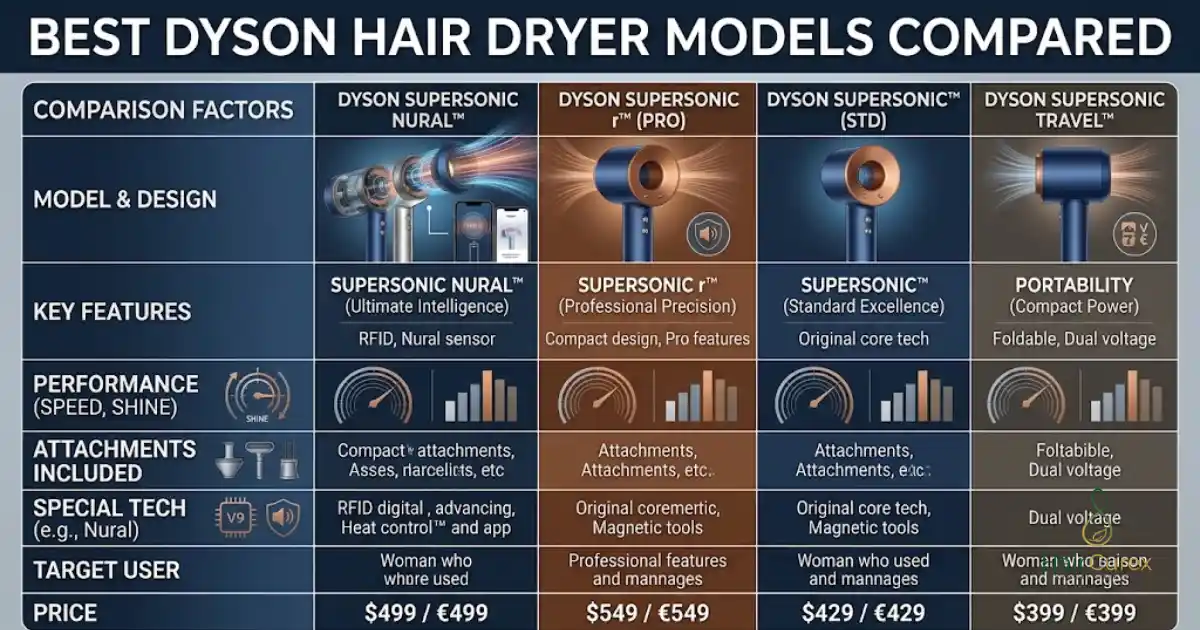
Dyson currently offers a small but distinct lineup, and picking the right one depends on your priorities, whether that’s price, portability, or the newest technology available. Below is a quick comparison to help you get oriented before we go deeper into the differences.
| Dyson Model | Best For | Key Highlight |
|---|---|---|
| Dyson Supersonic | Everyday drying & styling | Proven high-speed drying |
| Dyson Supersonic Nural | Scalp-focused intelligent styling | Attachment learning & Scalp protect features |
| Dyson Supersonic r | Lightweight precision styling | Compact design and intelligent attachments |
| Dyson Supersonic Travel | Travel | Compact design and Supersonic attachment compatibility |
The Dyson Supersonic hair dryer remains the brand’s flagship and the model most people picture when they hear the name. It set the standard the entire lineup is built on, and it’s still an excellent choice if you want proven performance without paying for the newest bells and whistles.
The Dyson Supersonic Nural, on the other hand, is the newer, more refined version, built with an even greater focus on reducing harsh, high-pitched noise while improving heat consistency. If you’ve ever been annoyed by the whine of a hair dryer, this is the model Dyson designed specifically to address that complaint.
Rounding out the Dyson hair dryer models lineup are more compact or limited editions, which trade a bit of raw power for portability, making them appealing if you travel often or have limited bathroom counter space.
Dyson Supersonic vs Supersonic Nural: What’s the Difference?
The Dyson Supersonic Nural builds on the original Supersonic with more intelligent features designed to personalize the drying experience. Its attachment-learning system recognizes compatible attachments and can automatically adjust to preferred heat and airflow settings. It also offers features such as Scalp protect mode and Pause detect, making it particularly appealing to users who want more automated control.
Heat control also gets an upgrade in the Nural. While both dryers use intelligent heat control to protect hair, the Nural’s sensors and airflow shaping work together more precisely, which can mean slightly more consistent results, especially for people who blow-dry daily and are particular about frizz control.
Price is where the decision usually gets made. The Supersonic Nural typically costs more than the original, so if budget matters and you don’t mind a bit more noise, the classic Supersonic still gets the job done beautifully. But if you want the most current version of Dyson’s fast drying technology and don’t mind paying extra for refinement, the Nural is worth considering.
Key Features of the Dyson Hair Dryer
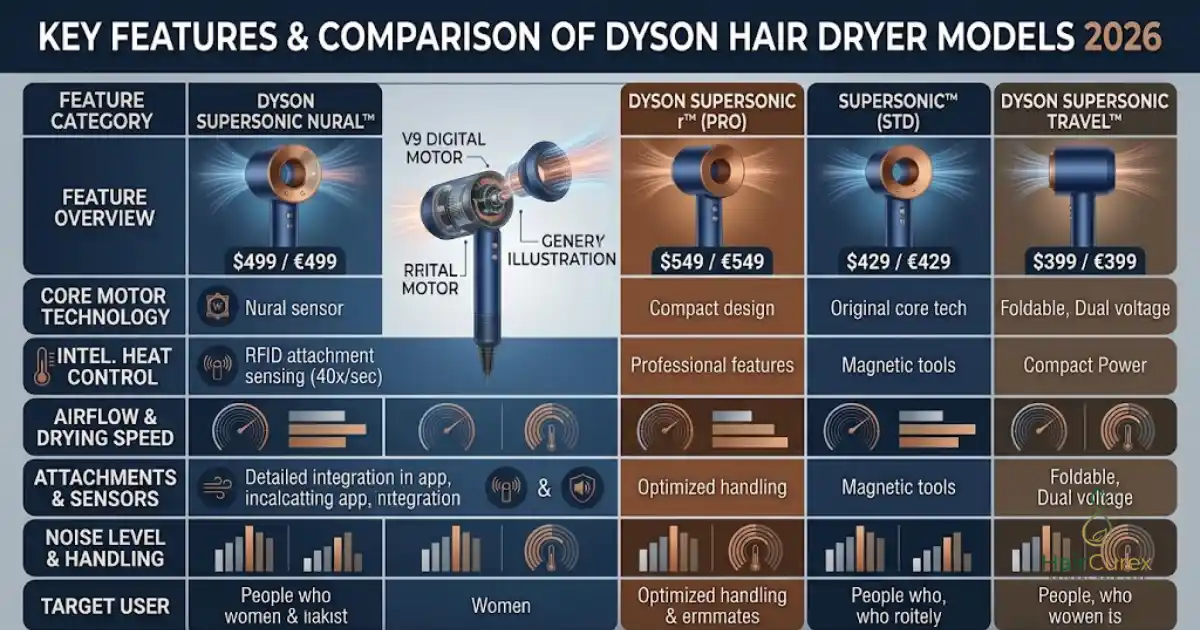
There’s a reason people keep coming back to this device even after the initial hype fades. The Dyson hair dryer packs in a handful of features that genuinely change the day-to-day experience of drying your hair.
First, there’s the lightweight hair dryer design itself. Because the motor sits in the handle, the weight is distributed toward your palm rather than out at the end of the barrel, which reduces arm fatigue during longer styling sessions. Second, the magnetic attachments click on and off instantly, no twisting or forcing required, so switching between a diffuser and a smoothing nozzle takes about two seconds. Third, most models offer multiple heat and airflow settings, giving you granular control instead of the vague “high, medium, low” dial found on cheaper dryers.
Digital motor technology is really the backbone of everything else. Because the V9 motor is so compact and fast, it can move a large volume of air without needing a bulky housing, which is part of why the whole unit stays quiet and light relative to the airflow it produces. And finally, Dyson designed a filter cleaning feature that lets you remove built-up hair and lint, which keeps airflow strong and helps the dryer last longer over time.
How Fast Does a Dyson Hair Dryer Dry Your Hair?
This is probably the single most common question people ask before buying. The honest answer: it depends on your hair length and thickness, but most users report noticeably faster hair drying compared to a standard dryer, often cutting drying time by a third or more.
For shoulder-length, fine hair, many users report drying times of around five to seven minutes. Thick, long hair naturally takes longer, sometimes closer to twelve to fifteen minutes, but that’s still considerably quicker than the twenty-plus minutes many traditional dryers require for the same hair type. The difference comes down to powerful airflow. Because the Air Multiplier technology produces a strong, consistent stream of air rather than a weak, scattered blast, water evaporates from each strand faster and more evenly.
One hairstylist who reviewed the Supersonic for a beauty outlet noted, “It’s not that it feels hotter, it’s that the air moves so much faster that your hair is just dry before you expect it to be.” That captures the experience well. It’s not about blasting your scalp with heat. It’s about efficient, powerful airflow doing the heavy lifting.
Is the Dyson Hair Dryer Safe for Your Hair?
Heat damage is a real concern for anyone who blow-dries regularly, and it happens when hair is exposed to temperatures that are too high for too long, causing the outer cuticle layer to lift, crack, or become porous. Over time, this leads to dullness, frizz, and split ends, which is exactly the outcome most people are trying to avoid when they invest in a premium dryer.
The Dyson hair dryer addresses this with its intelligent heat control system, which actively monitors and regulates temperature control throughout your entire drying session. Rather than letting the heat climb unchecked, the sensors keep the airflow within a range that Dyson’s research identified as safer for hair health. Several independent stylists and dermatologists have noted that consistent, moderate heat combined with strong airflow tends to be gentler than the inconsistent blasts of heat from cheaper dryers, where temperature spikes are common.
That said, it’s worth setting realistic expectations. No hair dryer, no matter how advanced, completely eliminates the risk of heat damage protection failing if you hold the dryer too close to your hair for too long or skip a heat protectant product. The Dyson hair dryer reduces risk significantly, but good habits still matter. Using the cool shot button to set your style at the end, keeping the dryer moving instead of holding it in one spot, and applying a heat protectant beforehand all add an extra layer of protection.
Dyson Hair Dryer Attachments: What Does Each One Do?
One of the most practical parts of owning a Dyson hair dryer is the range of attachments included, each designed for a different styling outcome. The magnetic connection means you’re not wrestling with a stiff, hard-to-remove nozzle every time you want to switch things up.
The styling concentrator narrows the airflow into a focused stream, which is ideal for smoothing sections of hair and creating a sleek, polished finish. The diffuser attachment spreads air out gently and evenly, making it the go-to choice for anyone with curly or wavy hair who wants to enhance natural texture without creating frizz. The gentle air attachment slows the airflow down and diffuses the heat, which works well for finer hair or for anyone drying a child’s hair, since it reduces the intensity considerably.
Then there’s the flyaway attachment, a newer addition designed specifically to smooth down those stubborn baby hairs and static-prone strands along the hairline, using a wrapped airflow pattern instead of a direct blast. A wide-tooth comb attachment, included with some models, helps detangle while drying, which is especially useful for thicker or curlier hair types that tend to knot up.
| Attachment | Best Use Case |
|---|---|
| Styling Concentrator | Sleek, smooth blowouts |
| Diffuser | Enhancing natural curls and waves |
| Gentle Air Attachment | Fine hair or sensitive scalps |
| Flyaway Attachment | Taming baby hairs and static |
| Wide-Tooth Comb | Detangling thick or curly hair |
Dyson Hair Dryer for Different Hair Types and Textures
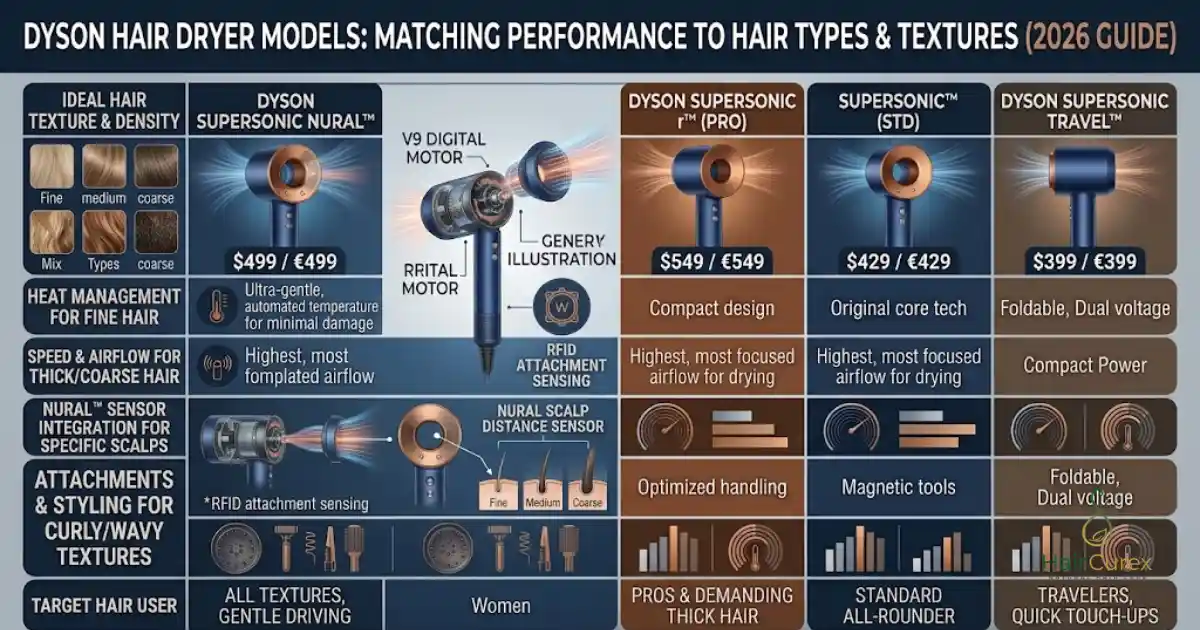
No two heads of hair are the same, and Dyson clearly designed its attachment system with that in mind. If you have fine hair, the Dyson hair dryer for fine hair setup typically means using the gentle air attachment on a lower heat setting, since fine strands are more prone to heat stress and can look flat if over-dried.
For thick hair, the Dyson hair dryer for thick hair approach usually involves the styling concentrator on a higher airflow setting, since thicker hair needs more raw drying power to get through fully without leaving damp sections underneath. People with curly hair tend to reach for the diffuser, since a Dyson hair dryer for curly hair setup helps distribute air gently across curls, reducing frizz while letting natural shape and bounce shine through.
If your hair is straight, a Dyson hair dryer for straight hair routine often centers on the concentrator attachment paired with a round brush, giving you the smooth finish and shiny hair look that straight hair styling usually aims for. Frizz-prone hair benefits enormously from the combination of intelligent heat control and the diffuser or gentle air attachments, since consistent temperature control is one of the biggest factors in frizz control. And for anyone dealing with damaged or color-treated hair, the Dyson hair dryer for damaged hair approach usually means sticking to lower heat settings and using the cool shot function more frequently to minimize further stress on already fragile strands.
This adaptability is a big part of why Dyson markets itself as a hair dryer for different hair types rather than a one-size-fits-all tool.
Dyson Hair Dryer Pros and Cons: Is It Worth It?
Every product has trade-offs, and being upfront about them is the only way to make a fair judgment. On the plus side, the Dyson hair dryer genuinely delivers fast hair drying, powerful airflow, and a quiet hair dryer experience compared to most competitors in its price range. The lightweight, front-heavy design reduces wrist and arm strain, the attachments make it genuinely versatile, and the heat protection features are backed by real research rather than marketing fluff.
On the downside, the price is steep, there’s no getting around that. Some users also mention a short learning curve, since the light barrel and heavy handle feel unusual compared to a traditional dryer at first. Replacement attachments and filters, while not frequently needed, can also add to the long-term cost if something gets lost or worn out.
So, is the Dyson hair dryer worth it? For people who blow-dry their hair several times a week, style professionally, or simply want to reduce heat damage over the long run, the investment tends to pay off in both hair health and daily convenience. For someone who air-dries most days and only uses a blow dryer occasionally, a more affordable option might make more practical sense.
How Much Does a Dyson Hair Dryer Cost?
Let’s talk numbers, since Dyson hair dryer price is probably the deciding factor for most shoppers. As of the most recent pricing, the original Dyson Supersonic hair dryer generally runs between $429 and $479 in the United States, depending on the color and included attachments. The newer Dyson Supersonic Nural price sits a bit higher, typically between $479 and $529, reflecting its upgraded acoustic engineering and refined heat control.
You can find the Dyson hair dryer for sale directly through Dyson’s official website, as well as through major retailers like Ulta Beauty, Sephora, and Best Buy. Buying directly from Dyson often gives you access to bundle deals, free attachments, or seasonal Dyson hair dryer deals around events like Black Friday or Mother’s Day. If you’re looking to buy a Dyson hair dryer online at a lower cost, refurbished or open-box units sold directly through Dyson’s certified refurbished program can save you anywhere from fifty to one hundred dollars while still including a warranty.
When you compare this Dyson hair dryer cost to professional salon-quality hair dryers used by stylists, the price actually lines up fairly closely, which helps explain why so many people see it as bringing salon-level results home rather than as an overpriced gadget.
Is the Dyson Hair Dryer Worth Buying? Final Verdict
After digging through the technology, the models, the attachments, and the price, here’s the honest takeaway. The Dyson hair dryer earns its reputation. The engineering behind fast drying technology, intelligent heat control, and thoughtful attachment design isn’t just marketing talk, it shows up in the actual experience of using the thing every single day.
That said, it’s not the right purchase for everyone. If you’re on a tight budget or only style your hair occasionally, there are solid For frequent blow-dryers who value fast drying, precise airflow control, and a premium styling experience, Dyson can justify its higher price. For occasional users, a less expensive dryer may offer better value. But if you want the best Dyson hair dryer experience available, care about long-term hair health, and use a blow dryer regularly, this is one of those rare cases where the premium price actually matches the premium performance.
FAQs
How long does a Dyson hair dryer last?
With normal use and regular filter cleaning, most Dyson hair dryers last well beyond five years, and many owners report using the same unit for seven years or longer without performance issues.
Can I use a Dyson hair dryer with international voltage?
Some models are dual-voltage and can be used internationally with the correct adapter, but always check the specific model’s voltage rating before traveling, since not every version supports this.
Does the Dyson hair dryer work on wet or damp hair only?
It works best on towel-dried, damp hair rather than soaking wet hair, since starting with excess water can extend drying time even with powerful airflow.
How do I clean the filter on my Dyson hair dryer?
The filter cage at the base of the handle twists off and can be cleaned with the included brush or rinsed under water, and Dyson recommends doing this regularly to maintain strong airflow.
Is the Dyson hair dryer covered by warranty in the USA?
Yes, Dyson hair dryers purchased in the United States typically come with a two-year limited warranty covering manufacturing defects, and you can register your product directly on Dyson’s official site for warranty tracking.