
An ingrown hair cyst happens when a hair curls back into the skin instead of growing outward the way it should. The body treats that trapped hair like an intruder, so it fights back with inflammation, swelling, and sometimes a pocket of fluid or pus. That reaction is what turns a simple ingrown hair into a painful ingrown hair cyst.
Picture this: you shave before a big event, feeling smooth and confident, and by the next morning there’s a tender, angry-looking bump sitting right where your skin used to be clear. It stings when your shirt brushes against it. You didn’t do anything wrong, exactly, but now you’re stuck wondering whether it’s just irritation or something that needs real attention.
This guide walks through everything worth knowing about an ingrown hair cyst, from what causes it and how to spot one, to home remedies, medical treatments, and the exact moment you should stop DIY-ing it and call a dermatologist.
What Is an Ingrown Hair Cyst?
An ingrown hair cyst forms when a hair follicle gets blocked and the hair inside it starts growing sideways or curls back underneath the skin rather than pushing through the surface. Your immune system doesn’t recognize this trapped hair as normal, so it responds the way it would to any foreign object: with redness, swelling, and inflammation. Over time, dead skin cells, oil, and white blood cells can collect around that trapped hair beneath the skin, forming a firm, sometimes fluid-filled lump.
This is different from a garden-variety ingrown hair, which usually just looks like a small red bump on the skin that resolves on its own within a few days. A cyst goes a step further. The swollen hair follicle becomes larger, harder, and more persistent, and it can sit under the skin for weeks if nothing intervenes. Dermatologists sometimes describe this as a form of localized hair follicle inflammation that has escalated past the point of simple irritation.
In the United States, this condition is extremely common among people who shave, wax, or tweeze regularly. Areas with coarse or curly hair are especially prone to it, since curved hair shafts are more likely to re-enter the skin after being cut short. It’s not a sign of poor hygiene or anything to be embarrassed about. It’s simply a mechanical and immune response that anyone with hair and skin can experience.
What Causes an Ingrown Hair Cyst?
Several everyday habits and skin factors combine to create the perfect environment for an ingrown hair cyst. Shaving against the grain is one of the biggest culprits, because it cuts the hair at a sharp angle that makes it easier for the tip to pierce back into the skin as it regrows. Waxing and tweezing carry a similar risk, since they pull the hair out from the root, and the new hair that grows in can struggle to find its way back through the follicle opening, especially if the skin’s surface has thickened or scarred slightly from repeated hair removal.
People with naturally curly or coarse hair face a higher risk here, and that’s simply due to biology rather than technique. Curved hair follicles produce hair that grows in a curved pattern, which makes it far more likely to loop back into the skin instead of extending outward. Add in tight clothing that rubs against freshly shaved or waxed skin, and you’ve got extra friction pushing hairs sideways rather than letting them grow freely.
Dead skin cell buildup plays a major role too. When dead cells aren’t exfoliated regularly, they can clog the follicle opening like a cork in a bottle. The hair underneath has nowhere to go, so it curls and grows beneath the surface instead. Genetics, hormonal changes, and even certain skin conditions like keratosis pilaris can make some people more prone to this cycle than others.
| Common Cause | Why It Happens |
|---|---|
| Shaving against the grain | Cuts hair at an angle that pierces skin easily |
| Waxing or tweezing | Removes hair from the root, disrupting natural growth path |
| Curly or coarse hair | Hair curves back into the follicle naturally |
| Tight clothing | Creates friction that pushes hair sideways |
| Dead skin buildup | Blocks the follicle opening |
| Genetics | Some skin and hair types are simply more prone |
Ingrown Hair Cyst Symptoms You Should Know
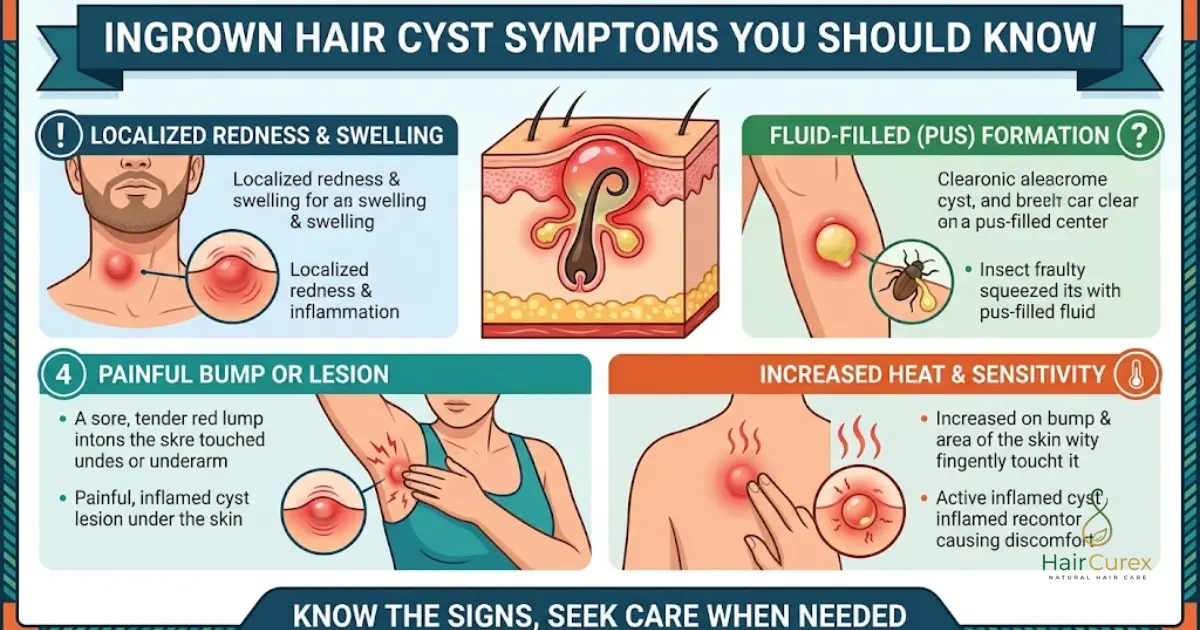
Recognizing the early signs of an ingrown hair cyst can save you a lot of discomfort down the line. Most people notice a small red bump on the skin first, and at this stage it can be easy to mistake for a regular pimple. Within a day or two, though, the area often becomes tender, and the bump may grow firmer and larger than a typical blemish.
A painful ingrown hair cyst usually feels sore to the touch, and the skin surrounding it may look swollen or slightly discolored. Some people describe a throbbing sensation, particularly if the cyst has become infected. Speaking of infection, an infected ingrown hair often develops a pus-filled center, and the surrounding skin may feel unusually warm. If you look closely, you might even spot the hair itself trapped just beneath the skin’s surface, visible as a dark thread-like line under the bump.
Itching is another common complaint, and it tends to show up either right before the bump forms or during the healing process afterward. While mild itching and tenderness are normal, certain symptoms suggest something more serious is going on. Fever, spreading redness, red streaks moving away from the bump, or a rapidly growing lump are all signs that the infection may be moving beyond what home care can handle.
How to Tell an Ingrown Hair Cyst From a Pimple or Boil
Because an ingrown hair cyst, a pimple, and a boil can all look strikingly similar at first glance, telling them apart takes a closer look at a few key details.
| Feature | Ingrown Hair Cyst | Pimple | Boil |
|---|---|---|---|
| Visible hair | Often visible under the skin | Rarely visible | Not usually visible |
| Cause | Trapped or curled hair | Clogged pore with oil/bacteria | Bacterial infection of hair follicle (usually staph) |
| Pain level | Moderate to severe | Mild | Severe, often intense |
| Size | Small to medium | Small | Can grow quite large |
| Typical location | Areas that are shaved or waxed | Face, back, chest | Anywhere with hair follicles |
| Healing time | Days to a couple of weeks | A few days | One to three weeks, sometimes longer |
A boil, medically known as a skin abscess, tends to be deeper, more painful, and more likely to require medical drainage than either a pimple or a straightforward ingrown hair. If you’re ever unsure which one you’re dealing with, a dermatologist can identify it in seconds and recommend the right course of action.
Where Do Ingrown Hair Cysts Commonly Appear?
Ingrown hair cysts show up most often in areas that get shaved, waxed, or otherwise groomed on a regular basis. The face and neck are frequent trouble spots for men who shave daily, particularly along the jawline and chin where hair tends to be thicker and curlier. This specific pattern in men is sometimes called pseudofolliculitis barbae, a condition closely related to ingrown hairs that disproportionately affects those with curly facial hair.
The underarms are another hot spot, thanks to the combination of frequent shaving, friction from arm movement, and warm, moist conditions that can encourage follicle blockage. The bikini area and groin see a lot of cases too, especially after waxing or shaving in preparation for swimwear season, since the skin there is thin and sensitive. Legs are commonly affected among people who shave regularly, and the scalp, back, and chest can develop these cysts as well, though somewhat less frequently than the areas mentioned above.
How to Treat an Ingrown Hair Cyst at Home
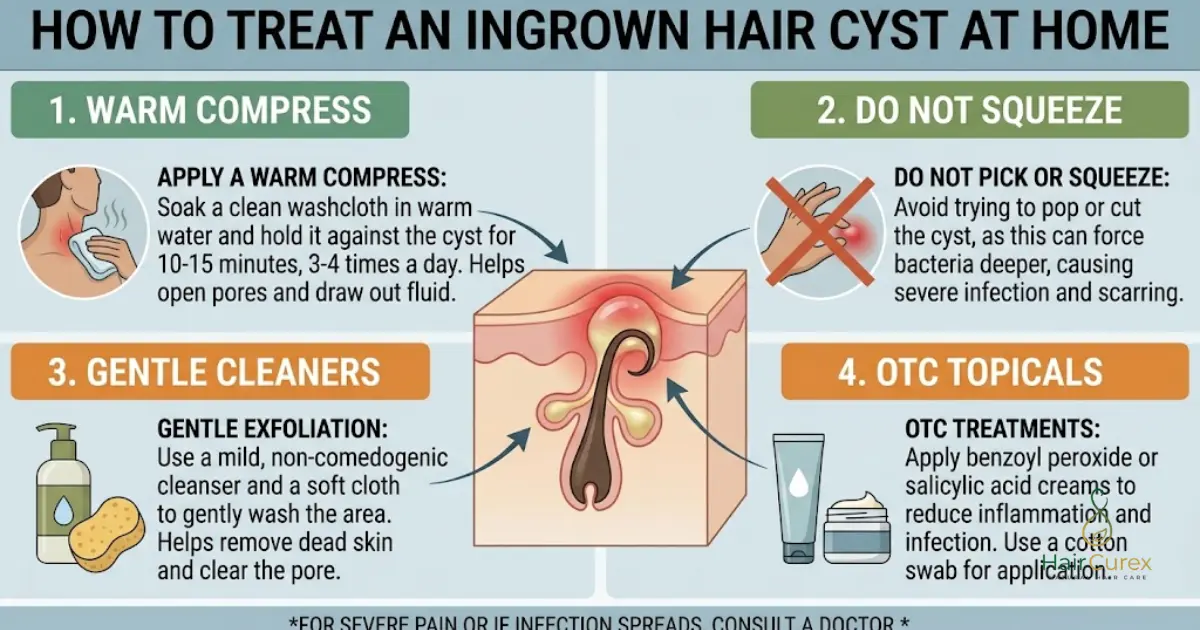
For mild to moderate cases, ingrown hair cyst treatment often starts right at home, and many people find relief within a few days using simple, gentle methods. A warm compress for ingrown hair is one of the most effective first steps you can take. Soak a clean washcloth in warm water, wring it out, and hold it against the affected area for ten to fifteen minutes, two or three times a day. The heat helps soften the skin, opens up the follicle, and encourages the trapped hair to work its way back to the surface on its own.
Exfoliation for ingrown hairs is another cornerstone of home care. Gently exfoliating the area with a soft washcloth, a mild scrub, or a chemical exfoliant containing salicylic acid or glycolic acid helps clear away the dead skin cells sitting on top of the follicle opening. Just don’t overdo it, since scrubbing too hard can irritate already-inflamed skin and make things worse rather than better.
Several ingrown hair cyst home remedies have earned their reputation for a good reason. Diluted tea tree oil has natural antibacterial properties and may help calm inflammation when applied carefully to the area. Over-the-counter topical treatments for ingrown hairs, particularly those containing benzoyl peroxide or salicylic acid, can reduce bacteria and gently unclog the follicle. Aloe vera gel is another gentle option that soothes tender skin bumps without introducing harsh chemicals.
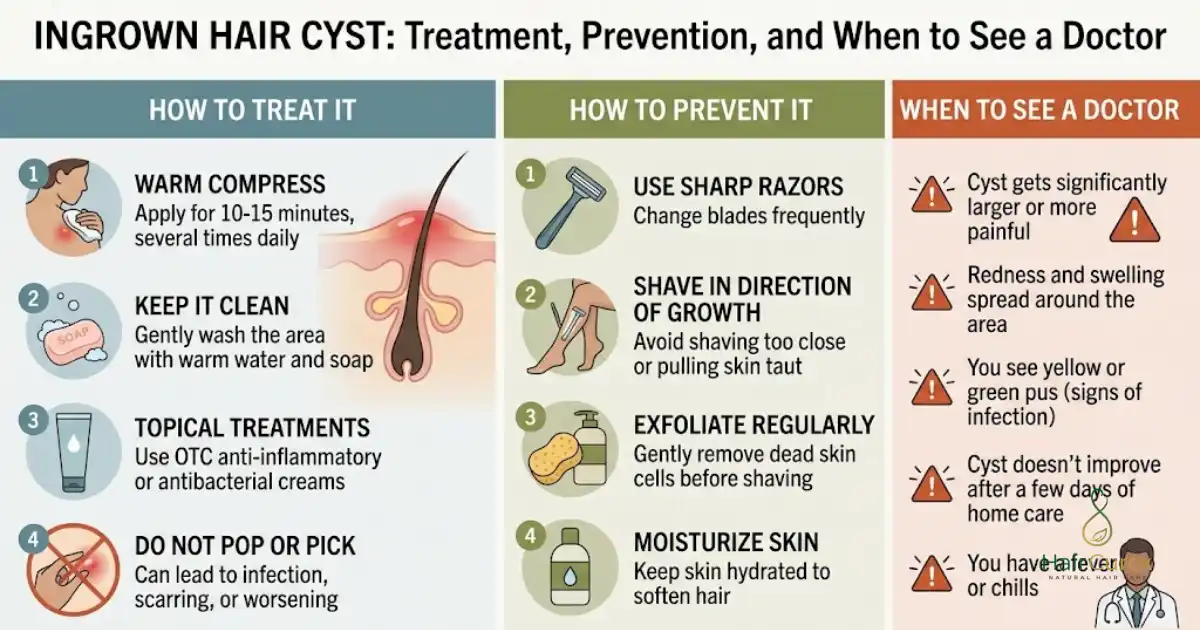
What you shouldn’t do matters just as much as what you should. Avoid picking, squeezing, or digging at the bump with tweezers or needles, since this dramatically raises the risk of turning a manageable ingrown hair into a full-blown infection. Skip harsh scrubs and abrasive tools, and resist the urge to keep shaving over the area until it has fully healed.
Can You Drain or Pop an Ingrown Hair Cyst?
This is one of the most common questions people ask, and the honest answer is: it’s risky, and in most cases, you shouldn’t try it yourself. Popping an ingrown hair cyst at home can push bacteria deeper into the skin rather than releasing it, which increases the chance of a more serious infection. It can also lead to scarring, dark spots, or a keloid, especially on skin that scars easily.
There are exceptions. If the trapped hair has clearly worked its way close to the surface and is easily visible, some dermatologists say it’s reasonable to use a sterilized needle or tweezers to gently lift the hair loop free, without squeezing the surrounding tissue. That said, ingrown hair cyst drainage of a cyst that’s deep, firm, or clearly infected should always be left to a medical professional. A dermatologist can drain it safely, using sterile tools and techniques that minimize scarring and prevent the infection from spreading further.
Medical Treatments for Ingrown Hair Cysts
When home care isn’t cutting it, dermatologist treatment for ingrown hairs offers several effective options depending on how severe the cyst has become. For persistent or recurring cysts, doctors often prescribe topical treatments such as retinoids, which help normalize skin cell turnover and prevent dead skin from clogging the follicle in the first place. Prescription-strength antibacterial creams may also be used if there are early signs of infection.
For cysts that are particularly inflamed and swollen, a dermatologist might recommend a steroid injection directly into the area. This can dramatically reduce swelling and pain within a day or two, which is especially helpful for cysts that have been lingering for weeks. When a cyst has become large, hard, or filled with pus, incision and drainage performed by a doctor is often the fastest path to relief. This is a simple, in-office procedure where the doctor makes a small, sterile incision to release trapped fluid and pus, then cleans the area thoroughly.
For those who deal with ingrown hair cysts again and again in the same spot, laser hair removal is worth considering as a long-term solution. By reducing hair growth in the affected area over a series of sessions, laser treatment tackles the root cause rather than just managing flare-ups as they happen. If a cyst has become clearly infected, antibiotics for infected ingrown hair may be prescribed, either as a topical cream for mild cases or an oral course for more widespread infection.
“Recurring ingrown hairs in the same location are often the body’s way of signaling that the hair removal method being used isn’t compatible with that particular skin and hair type,” notes dermatological guidance commonly shared in skin clinics across the country. Switching methods, rather than just treating each flare-up, tends to be the more lasting fix.
How Long Does an Ingrown Hair Cyst Take to Heal?
Healing time varies quite a bit depending on the severity of the cyst and how it’s treated. A mild ingrown hair bump that hasn’t progressed into a full cyst often clears up within three to seven days with basic home care. A true ingrown hair cyst, especially one that’s become inflamed or infected, can take anywhere from one to three weeks to fully resolve, and larger or deeper cysts may take even longer.
Several factors influence this timeline. Cysts that are treated early with warm compresses and gentle exfoliation tend to heal faster than ones that are left alone or, worse, picked at. Skin type matters too, since some people are simply prone to slower healing or more noticeable scarring. Signs that a cyst is healing properly include gradually decreasing size, less redness, reduced pain, and the eventual release of the trapped hair. On the other hand, a cyst that keeps growing, becomes more painful, or develops spreading redness is heading in the wrong direction and likely needs medical attention.
How to Prevent Ingrown Hairs and Cysts From Coming Back
Preventing ingrown hairs largely comes down to adjusting hair removal habits and giving the skin some extra care along the way. Proper shaving techniques make a huge difference here. Always shave in the direction the hair grows rather than against it, use a sharp, clean razor every time, and never shave on dry skin. A good shaving cream or gel creates a protective barrier that reduces friction and irritation after shaving.
Waxing and ingrown hairs go hand in hand for a lot of people, so if waxing consistently causes problems, it might be worth switching to a different method altogether. Exfoliating dead skin cells regularly, ideally two to three times a week, keeps follicles clear and gives new hair a straighter path out of the skin. Moisturizing after shaving or waxing helps keep skin supple and less prone to trapping hair beneath a layer of dry, flaky cells.
For those who deal with frequent hair removal bumps or razor bumps no matter what they try, laser hair removal offers one of the most reliable long-term solutions available, since it reduces the amount of hair regrowth altogether. Loose-fitting clothing after hair removal also helps prevent friction-related irritation, particularly in the bikini area, underarms, and thighs. Simple changes like these, made consistently, can cut down on flare-ups significantly over time.
When Should You See a Doctor?
While most cases of an ingrown hair cyst can be managed at home, certain warning signs mean it’s time to stop self-treating and book an appointment. Fever, chills, or a rapidly spreading area of redness around the bump are all signals that the infection may be moving beyond the local area. Severe pain that doesn’t improve with warm compresses, or a cyst that continues to grow larger over several days, also warrants professional evaluation.
Cysts that keep coming back in the exact same spot are worth discussing with a dermatologist as well, since repeated inflammation in one area raises the risk of permanent scarring or a darkened patch of skin known as post-inflammatory hyperpigmentation. If a bump hasn’t improved at all after one to two weeks of consistent home care, that’s another clear sign it needs a professional look. Some cysts that seem minor at first can actually be something else entirely, such as an epidermoid cyst or a more serious skin abscess, both of which typically need different treatment than a simple ingrown hair.
Frequently Asked Questions About Ingrown Hair Cysts
Can an ingrown hair cyst go away on its own?
Yes, many mild cases resolve without any treatment as the trapped hair eventually works its way to the surface. Larger or infected cysts, however, usually need some form of intervention to heal properly.
Is an ingrown hair cyst contagious?
No, an ingrown hair cyst is not contagious. It results from a hair growing back into the skin rather than from a virus or bacteria spreading between people, though the area can become infected with bacteria already living on the skin.
Why do I keep getting ingrown hair cysts in the same spot?
This usually points to a hair removal method that isn’t well-suited to that skin and hair type in that particular area. Scar tissue from previous cysts can also make the follicle opening more prone to blockage going forward.
Can ingrown hair cysts turn into boils?
Yes, if bacteria enter the follicle and cause a deeper infection, what started as an ingrown hair cyst can develop into a boil or skin abscess that requires medical drainage.
Does shaving make ingrown hair cysts worse?
Shaving over an active cyst can irritate the area further and slow healing. It’s best to avoid shaving directly over the bump until it has fully resolved.
Is it safe to use a needle on an ingrown hair cyst?
Only if the needle is sterilized and the hair loop is clearly visible near the surface. For deeper or infected cysts, a needle should never be used at home, since it raises the risk of infection and scarring significantly.
What’s the difference between folliculitis and an ingrown hair cyst?
Folliculitis refers to inflammation or infection of the hair follicle in general, which can be caused by bacteria, fungi, or irritation. An ingrown hair cyst is a specific type of follicle inflammation caused directly by a trapped or curled hair.
Conclusion
An ingrown hair cyst might feel like a small, stubborn annoyance, but it’s a condition that responds well to the right combination of patience, gentle care, and, when needed, professional treatment. Understanding what causes it, from shaving technique to hair type to skin care habits, puts you in a much better position to prevent it from happening again and again. Warm compresses, gentle exfoliation, and resisting the urge to pick at the bump go a long way for most mild cases.
When a cyst becomes painful, infected, or simply won’t quit, there’s no shame in calling in a dermatologist who can drain it safely or prescribe treatment that clears it up faster than home care alone. With a few adjustments to your hair removal routine and a little extra attention to your skin, ingrown hair cysts don’t have to be a recurring part of your life.