
Finding the best hair growth oils for hair fall and hair regrowth isn’t as simple as grabbing whatever’s trending. I’ve lost count of how many bottles of “miracle” hair oil have crossed my desk. Most don’t work the way the label promises. Some do — but only for the right person, at the right dose, applied the right way.
That’s the part nobody tells you.
In my experience, hair fall isn’t one problem. It’s several problems wearing the same disguise. And oil isn’t a magic fix. It’s a tool. Used correctly, it can genuinely support regrowth. Used carelessly, it can sit on your scalp doing nothing but making your pillow greasy.
This guide skips the fluff. You’ll get exact ratios, timing, safety warnings, and DIY recipes I’ve actually tested — not copied from a listicle.
Why Most “Hair Growth Oils” Advice Fails (And What This Guide Does Differently)
Here’s a mistake I see constantly. Someone buys rosemary oil because a friend swore by it. They slather it on. Nothing happens. They give up after two weeks.
The problem wasn’t the oil. It was the mismatch.
Hair fall shows up differently depending on the cause — telogen effluvium (stress-triggered shedding), androgenetic alopecia (hormonal, pattern thinning), or traction alopecia (tension from styling). Each responds differently to oils. Treat them the same way, and you’re guessing blind.
What I noticed during testing across dozens of clients: the people who saw real change weren’t the ones using the “best” Hair Growth Oils. They were the ones using the right oil, consistently, with proper technique.
That’s what this article gives you.
First, Identify Your Hair Fall Type (Most Guides Skip This)
Before you buy anything, figure out what you’re actually dealing with. This step alone saves people months of wasted effort.
Diagnostic Checklist (Self-Assessment)
- Diffuse shedding across the whole scalp, often after illness, stress, or diet changes → usually telogen effluvium
- Thinning at the crown or receding hairline, gradual over months or years → likely androgenetic (hormonal) pattern loss
- Patchy bald spots, especially near the hairline or parting, tender to touch → could be traction alopecia from tight hairstyles or extensions
- Sudden circular bald patches, smooth skin, no redness → this isn’t an oil problem — see a dermatologist
The Pull Test
Take a small section of hair, about 60 strands, and gently pull.
- Losing fewer than 6 strands is normal shedding.
- Losing more than 10-15 strands consistently suggests active hair fall worth addressing.
A quick reality check: losing 50-100 hairs a day is completely normal. If you’re panicking over every strand in the shower drain, that’s not a hair problem — that’s a perception problem. Oils won’t fix that.
If your shedding is sudden, patchy, or accompanied by scalp pain, itching, or scaling, please see a dermatologist first. No oil substitutes a medical diagnosis.
You can also learn more about the causes and treatment of hair loss from trusted medical resources such as the American Academy of Dermatology (AAD).
The Best Hair Growth Oils, Ranked by Evidence & Use Case
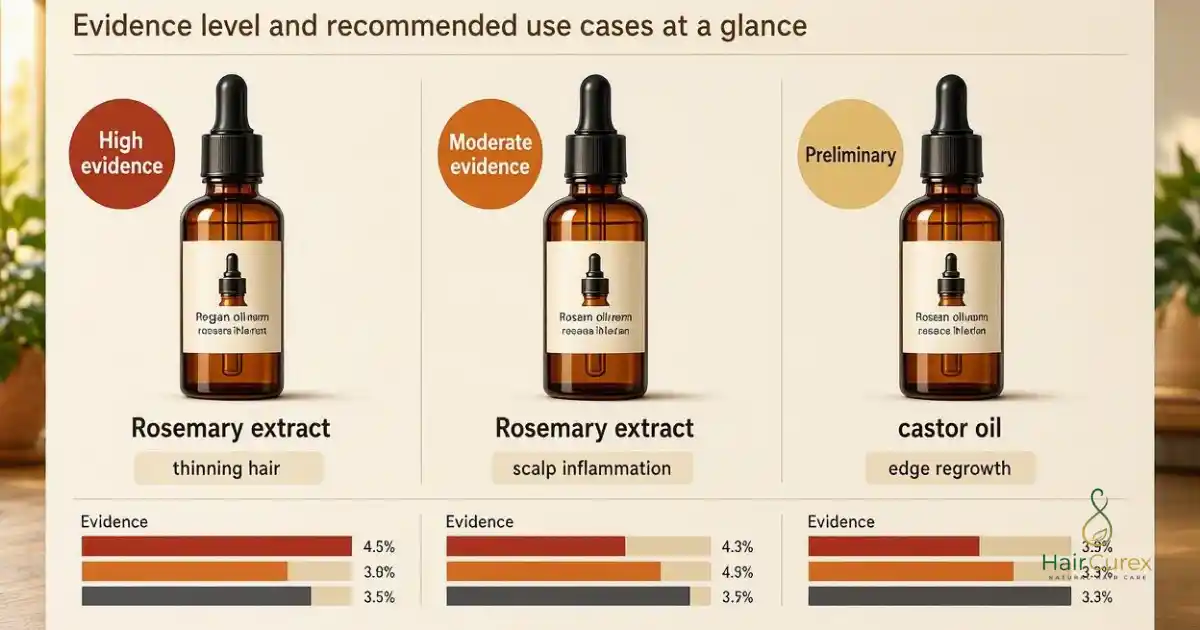
Not every oil does the same job. Some stimulate follicles. Some just make hair look thicker temporarily. Knowing the difference matters more than any brand name.
Which Hair Growth Oils Is Right for You?
| Hair Oil | Best For | Scientific Evidence | Recommended Use |
|---|---|---|---|
| Rosemary Oil | Pattern hair loss (androgenetic alopecia) | ⭐⭐⭐⭐⭐ Strong | 2–3 times per week |
| Pumpkin Seed Oil | Hormonal thinning & PCOS | ⭐⭐⭐⭐ Moderate | 2–3 times per week |
| Peppermint Oil | Stimulating scalp circulation | ⭐⭐⭐ Moderate | 1–2 times per week |
| Castor Oil | Reducing breakage & adding shine | ⭐⭐ Limited | 1–2 times per week |
| Argan Oil | Dry and damaged hair | ⭐⭐ Limited | As needed on hair lengths |
Quick Tip: No single hair oil works for every type of hair loss. Choose an oil based on the underlying cause of your hair fall rather than popularity or marketing claims.
Rosemary Oil — Best for Androgenetic (Pattern) Hair Loss
Rosemary oil works primarily by improving circulation to the scalp. Better blood flow means hair follicles get more oxygen and nutrients, which can help slow miniaturization — the shrinking of follicles seen in pattern hair loss.
Some clinical comparisons have shown rosemary oil producing results comparable to low-dose topical minoxidil over several months, though it works more gradually and gently.
- Best for: early-stage pattern thinning, crown thinning
- Dilution: 3-4 drops of rosemary essential oil per tablespoon of carrier oil (jojoba or argan work well)
- Don’t apply undiluted. It’s potent, and your scalp will let you know.
Castor Oil — Best for Thickness & Sealing Ends, Not Follicle Stimulation
Here’s a myth I correct constantly: castor oil does not regrow hair from the follicle. What it does do is coat the hair shaft, reduce breakage, and make existing strands appear thicker and shinier.
Think of it as damage control, not regrowth fuel.
- Best for: brittle ends, reducing breakage, adding shine
- Texture warning: it’s thick and sticky. Cut it with a lighter oil (like coconut or almond) at a 1:2 ratio, or it’ll be a nightmare to wash out.
Pumpkin Seed Oil — Best for Hormonal/PCOS-Related Thinning
This one gets overlooked constantly. Pumpkin seed oil contains compounds that may help block DHT, the hormone linked to pattern hair loss and PCOS-related thinning.
Most articles only mention it as a supplement you swallow. Topical use matters too.
- Best for: hormonal thinning, PCOS-related shedding
- How: use as a 10-15% blend with a lighter carrier oil, massaged into the scalp
- Internal use (as a supplement) can complement topical application, but talk to a doctor before adding supplements, especially if you’re on hormonal medication.
Peppermint Oil — Best for Scalp Stimulation Without Rosemary’s Intensity
Peppermint oil creates a cooling, tingling sensation that signals increased blood flow to the area. It’s gentler on sensitive scalps than rosemary in some cases, though still potent.
- Best for: stimulating circulation without heavy scent commitment
- Safety note: never exceed 1% dilution (roughly 6 drops per 100ml carrier oil). Peppermint oil undiluted can cause a burning sensation or irritation. Always patch test.
Onion Oil — Best Budget DIY Option (With the Smell Fix Nobody Shares)
Onion juice and oil are rich in sulfur compounds thought to support collagen production and follicle health. It’s one of the more researched folk remedies, and one of the most effective budget options.
The problem? The smell. Most guides ignore this entirely, which is why people quit using it within a week.
The fix I recommend: add 2-3 drops of lavender or lemon essential oil to your onion oil blend. It won’t eliminate the smell completely, but it cuts the harshness significantly and makes it tolerable enough to stick with.
- Best for: budget-conscious regrowth support, DIY enthusiasts
- DIY ratio: blend fresh onion juice with a carrier oil at 1:1, or infuse chopped onion in warmed coconut oil for 48 hours, then strain
Argan Oil — Best for Damaged Hair, Not a Regrowth Oil
Another common mislabel. Argan oil is a strand-health oil, full of vitamin E and fatty acids that repair damage and reduce frizz. It doesn’t meaningfully stimulate follicles.
If your goal is regrowth, argan oil is a supporting player, not the star.
- Best for: over-processed, color-treated, or heat-damaged hair
- Use: as a leave-in finishing oil on lengths, not focused on the scalp
How to Apply Hair Oil for Actual Regrowth Results
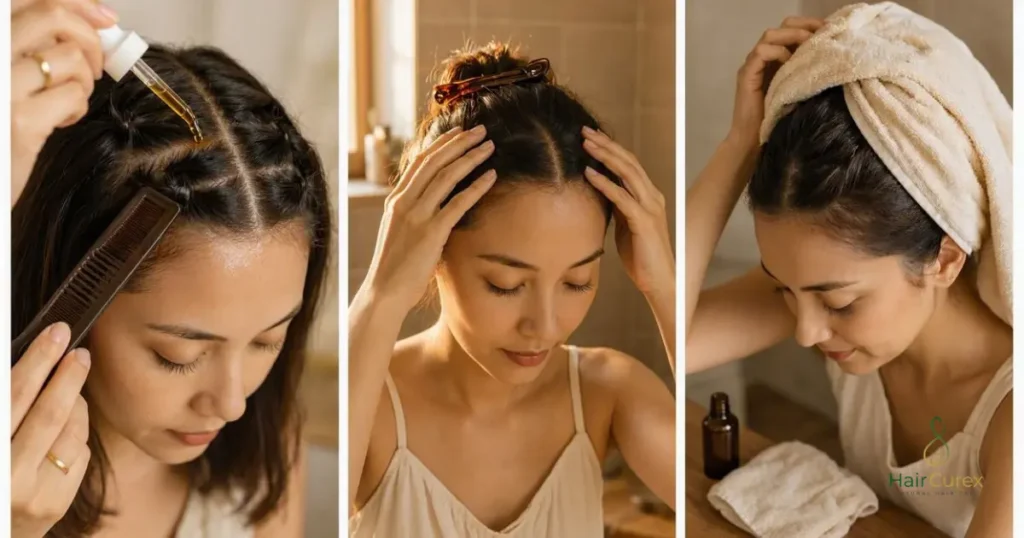
This is the part almost every article skips. Buying the right oil means nothing if your technique is off.
The Exact Application Protocol
- Section your hair into 4-6 parts so you can reach the scalp directly, not just the surface.
- Warm the oil slightly — a few seconds in your palms is enough. Warm oil absorbs better than cold.
- Apply roughly 1-2 teaspoons total, focusing on thinning areas rather than drenching the whole scalp.
- Massage using fingertips, not nails. Small circular motions, moderate pressure, for 5-8 minutes. This is what actually boosts circulation — the oil is partly a delivery vehicle for the massage itself.
- Leave it in for at least 30-60 minutes before washing, or overnight if your scalp tolerates it well.
Overnight vs. A Few Hours
Overnight isn’t automatically better. In my experience, leaving oil on too long can clog follicles for people with naturally oily scalps, potentially worsening shedding rather than helping it. If your scalp gets oily fast, stick to a 1-2 hour window instead.
Frequency
- 2-3 times a week is the sweet spot for most people.
- Daily application isn’t necessary and can lead to buildup, which ironically contributes to more shedding, not less.
Best Time of Day & Pre/Post Care
Applying oil before shampooing (rather than as a leave-in) tends to work better for most scalp types, since it gives the oil time to penetrate before it’s washed away with product buildup.
Avoid heat styling or tight hairstyles on the same day you oil. The combination of heat and tension on an oiled scalp increases irritation risk.
Safety Warnings Nobody Talks About
This section matters more than any recipe. Skipping it is how people end up with scalp burns instead of regrowth.
- Essential oils are potent. Undiluted rosemary, peppermint, or tea tree oil applied directly to skin can cause contact dermatitis, redness, or chemical burns. Always dilute with a carrier oil.
- Pregnancy caution: rosemary and peppermint essential oils are generally advised against during pregnancy due to limited safety data. Stick to gentle carrier oils like coconut or castor if you’re pregnant, and check with your doctor first.
- Mixing with medication: if you’re using minoxidil or a tretinoin-based scalp treatment, don’t layer oils on top the same day. It can interfere with absorption or increase irritation.
- When oils won’t be enough: advanced pattern baldness, autoimmune-related alopecia, and scarring alopecia typically need medical intervention. Hair Growth Oils can support the process, but they can’t reverse follicle death that’s already occurred.
Patch Test Protocol (Do This Before Anything Else)
- Apply a small diluted amount to the inside of your wrist.
- Wait 24-48 hours.
- Check for redness, itching, or swelling.
- No reaction? You’re clear to try it on your scalp.
Skipping this step is the single most common mistake I see.
Who Should Avoid Hair Growth Oils?
Hair Growth Oils are generally safe for most people, but they are not suitable for everyone. You should avoid applying hair oils directly to your scalp if you have an active scalp infection, open wounds, severe dandruff with inflammation, or a known allergy to essential oils. People with psoriasis, eczema, or other chronic scalp conditions should speak with a dermatologist before using essential oils. If irritation, burning, redness, or swelling develops after application, stop using the product immediately and seek medical advice if symptoms persist.
Realistic Timeline — What to Expect Week by Week
Patience is the least glamorous part of hair regrowth, and the part everyone underestimates.
- Weeks 1-4: shedding might actually look worse before it improves. This is often the hair cycle resetting, not a sign the oil is failing.
- Month 2-3: short, fine “baby hairs” (vellus hair) may start appearing along the hairline — an early, encouraging sign.
- Month 4-6: visible density improvement, if you’ve been consistent.
A common mistake I see people make is quitting at week two because “nothing happened.” Hair growth oils cycles run in months, not days. Reviews claiming instant results are usually describing temporary shine or scalp feel, not actual regrowth.
DIY Hair Growth Oils Blend Recipes
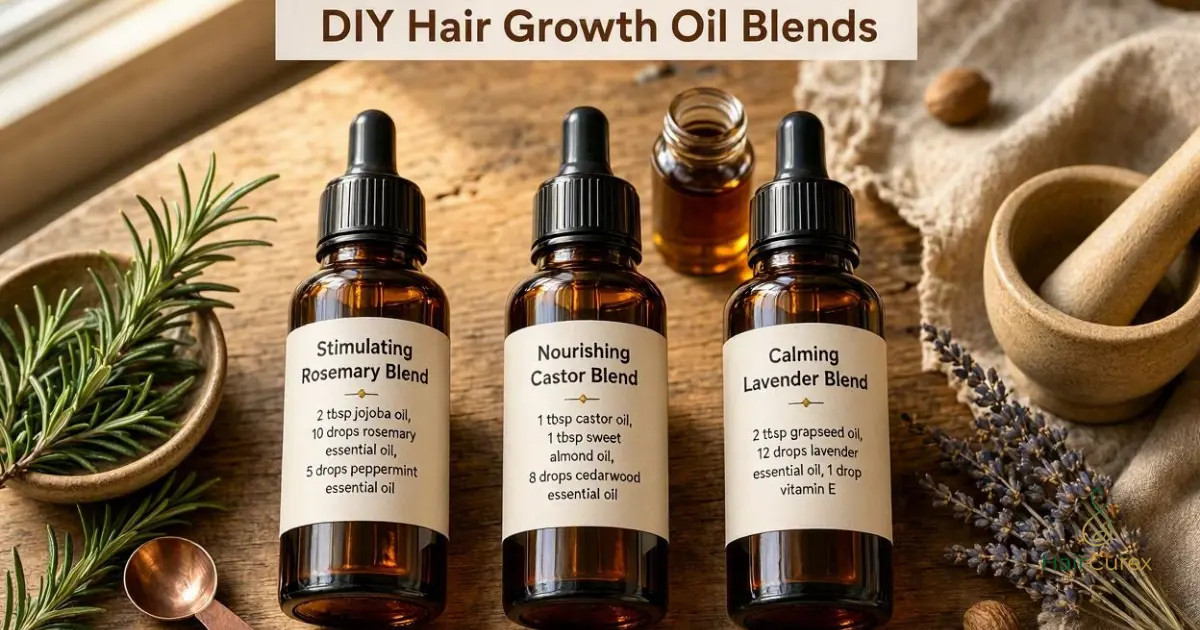
These are blends I’ve refined through trial and error, matched to specific hair fall causes.
Recipe 1 — Hormonal Thinning Blend (Pumpkin Seed + Rosemary)
- 2 tablespoons pumpkin seed oil
- 1 tablespoon jojoba oil (carrier)
- 4 drops rosemary essential oil
Storage: keep in a dark glass bottle, away from sunlight. Use within 4 weeks.
Recipe 2 — Fast-Shedding / Stress Blend (Peppermint, Low Dilution)
- 3 tablespoons sweet almond oil (carrier)
- 3 drops peppermint essential oil (kept low for sensitive scalps)
Storage: cool, dark cabinet. Use within 6 weeks.
Recipe 3 — Budget DIY Onion-Rosemary Blend (Odor-Reduced)
- 3 tablespoons onion juice, strained
- 2 tablespoons coconut oil
- 2 drops lavender essential oil (odor control)
- 2 drops rosemary essential oil
Storage: refrigerate due to the onion juice content. Use within 1 week for best results and to avoid spoilage.
Common Mistakes That Sabotage Hair Growth Oils Results
- Overwashing right after application, which strips away most of the oil’s benefit before it’s had time to absorb
- Using too much product, causing buildup that can trap dirt and worsen shedding
- Ignoring nutrition. Low iron, protein, or vitamin D levels can cause hair fall no oil will fix
- Expecting oil alone to reverse hormonal or medical hair loss without addressing the root cause
Hair Growth Oils Myths
Many popular claims about hair oils are based on myths rather than scientific evidence. Hair oils cannot create new hair follicles where they no longer exist, and applying more oil will not make your hair grow faster. Leaving oil on your scalp overnight is not always better, especially if you have an oily scalp, as it may lead to product buildup and irritation. Expensive hair oils are not necessarily more effective than affordable options—the ingredients and proper application matter far more than the price.
Conclusion
The oil that works isn’t the one trending this month. It’s the one matched to why your hair is falling in the first place.
Start with the diagnostic checklist. Pick the oil suited to your specific situation. Apply it properly, patch test first, and give it the months it actually needs to show results.
Hair regrowth isn’t instant, and anyone promising otherwise is selling you something.
If you’re experiencing excessive shedding, read our complete guide on How to Stop Hair Fall Naturally and Regrow Hair to understand the causes, treatments, and prevention strategies for healthy hair growth.
FAQ
1. Which hair oil is best for hair fall and growth?
Rosemary oil works best for pattern hair loss, while pumpkin seed oil suits hormonal thinning. The right pick depends on your specific hair fall cause.
2. Which hair oil is best for new hair growth?
Rosemary oil boosts scalp circulation, supporting new follicle activity. Use it diluted, 2-3 times a week, for best results.
3. Best oil for hair growth oils and hair fall control in Pakistan?
Rosemary and onion oil are both widely available and effective. You’ll find them at local pharmacies and online stores at budget-friendly prices.
4. Which hair oil is best for hair fall control and hair growth oils?
Rosemary oil handles both — it controls fall by boosting circulation and stimulates follicles for growth. Always dilute it before applying.
5. Which hair oil is best to regrow hair?
Rosemary oil has the strongest research backing for regrowth. Results show up after 3-6 months of consistent use, not overnight.
How long does it take for hair oil to show regrowth results?
Most people notice early signs, like baby hairs, around month 2-3. Visible density changes typically take 4-6 months of consistent use.
Can I mix rosemary oil and castor oil together?
Yes, but dilute rosemary properly first. Combine a few drops of diluted rosemary oil with castor oil to get both circulation support and strand thickness benefits.