

This guide walks you through everything you need to know about hair oil, from how it works on a biological level to the best hair oil options for your specific hair type and concern. By the end, you’ll have a clear, practical hair oiling routine you can actually stick to.
If you’ve ever stood in the hair-care aisle staring at a dozen bottles labeled “hair oil,” you already know how confusing this topic can get. Some oils promise faster growth. Others claim to fix dryness, calm an itchy scalp, or rescue brittle, damaged strands. So which one actually works, and how do you use it without making a greasy mess of your morning routine?
What Is Hair Oil and How Does It Work?
Hair oil is a lipid-based product, usually extracted from plants, seeds, or nuts, that’s applied to the scalp and hair strands to add moisture, reduce friction, and protect the hair’s outer layer. Unlike a lotion or serum that sits mostly on the surface, many natural hair oils can actually slip into the hair shaft itself, filling in gaps in the cuticle and reducing water loss from within. That’s why a good hair oil treatment often leaves hair feeling smoother almost instantly, while still delivering benefits that build up over weeks of consistent oiling hair.
The science behind this comes down to molecular size and polarity. Oils with smaller molecules, like coconut oil, can pass through the cuticle and bind with the hair’s protein structure. Larger, heavier oils, like sunflower or mineral oil, tend to stay on the surface, forming a protective coating instead. Neither approach is “better” across the board; it simply depends on what your hair needs.
Carrier Oils vs. Essential Oils — What’s the Difference?
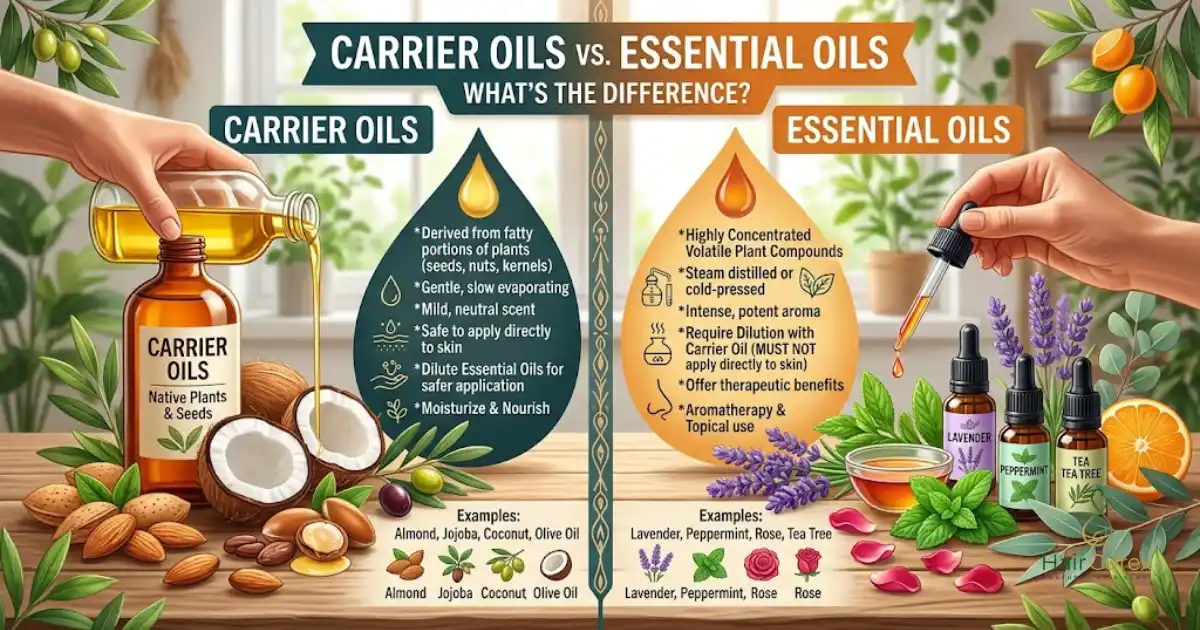
This distinction trips up a lot of people, so let’s clear it up. Carrier oils, such as coconut, jojoba, or argan oil, are the base oils you apply directly to hair and scalp in meaningful amounts. Essential oils for hair, like rosemary or peppermint, are highly concentrated plant extracts that are too potent to use alone. They get diluted into a carrier oil, usually just a few drops per ounce, to add targeted benefits like scalp stimulation or dandruff control. Think of the carrier oil as the vehicle and the essential oil as the passenger giving it direction.
1. What Are the Benefits of Using Hair Oil?
The appeal of hair oil goes well beyond shine. A consistent hair oil treatment supports scalp health, strengthens hair follicles, and helps hair hold onto moisture instead of losing it to dry air, heat styling, or harsh shampoos. Nourished hair also tends to resist breakage better, since the oil reduces friction between strands during brushing and styling.
According to a widely cited 2003 study published in the Journal of Cosmetic Science, coconut oil was the only tested oil that significantly reduced protein loss in both damaged and undamaged hair, whether applied before or after washing. Mineral oil and sunflower oil, by comparison, did not penetrate the hair shaft in the same way. This single study is part of why coconut oil for hair remains one of the most recommended natural hair oil options worldwide, including across the USA.
Beyond moisture and strength, many people use hair oil massage as a form of stress relief. The physical act of massaging oil into the scalp increases blood circulation to hair follicles, which some dermatologists believe may support a healthier environment for hair growth over time, even if oil alone isn’t a guaranteed growth solution.
Scalp Benefits of Hair Oil vs. Strand Benefits
It helps to think of hair oil’s benefits in two separate categories. On the scalp, oil can soothe irritation, reduce flakiness, and support a healthy scalp environment where hair follicles can function properly. On the strands themselves, oil primarily works to reduce breakage, add shine, and lock in hydration. A well-rounded hair oiling routine typically addresses both areas rather than focusing on just one.
2. Best Hair Oils for Hair Growth
No oil can single-handedly make hair grow faster than your biology allows, but several oils for hair growth have real research behind them for supporting a healthier scalp, which is the foundation hair actually grows from.
Rosemary oil for hair has become one of the most talked-about options in recent years, largely thanks to a 2015 study that compared it directly to minoxidil, a common over-the-counter growth treatment. The results showed rosemary oil produced comparable improvements in hair count after six months, with less scalp itching reported by participants. That’s a notable finding for a natural hair oil going head-to-head with a pharmaceutical option.
Castor oil for hair is another long-standing favorite, prized for its thick, ricinoleic-acid-rich formula that many believe improves circulation at the scalp. Peppermint oil for hair has also gained traction, with animal studies suggesting it may increase the number of hair follicles and follicle depth. Black seed oil, or nigella sativa, and onion oil round out the list, both linked to anecdotal reports and small studies suggesting benefits for scalp health and reduced shedding.
| Oil | Primary Growth-Related Benefit | Best For |
|---|---|---|
| Rosemary oil | Comparable results to minoxidil in studies | General thinning, scalp stimulation |
| Castor oil | Improves scalp circulation, thickens appearance | Sparse brows and edges too |
| Peppermint oil | May increase follicle count (animal studies) | Combination with a carrier oil |
| Onion oil | Traditionally used for shedding | Those open to a stronger scent |
| Black seed oil | Anti-inflammatory scalp support | Sensitive or irritated scalps |
What Does the Research Actually Say About Hair Growth Oils?
It’s worth being honest here: most hair growth oil research is still limited, and results vary by individual. Dr. Michele Green, a New York-based dermatologist, has been quoted saying that “consistency matters more than the specific oil you choose, since hair growth is a slow biological process that takes months to show visible change.” That’s a fair summary of where the science currently stands. Oils can create favorable scalp conditions, but they work best alongside a healthy diet, stress management, and patience.
3. Best Hair Oil for Dry and Damaged Hair

Dry, damaged hair usually means the cuticle layer is lifted or worn down, letting moisture escape faster than it should. This is where a good hair oil for dry hair earns its keep. Argan oil for hair, often called “liquid gold,” is rich in vitamin E and fatty acids, making it lightweight enough for daily use while still delivering serious hydration.
Coconut oil for hair remains a top pick for damaged strands specifically because of its proven ability to reduce protein loss. Olive oil for hair, a heavier option, works well for very dry or coarse textures that need extra richness. Avocado oil for hair is another strong contender, packed with monounsaturated fats and biotin, both of which support a hair oil for brittle hair routine aimed at rebuilding resilience over time.
Hair porosity plays a big role in which oil for damaged hair works best. Low porosity hair, where the cuticle lies flat and resists moisture, generally does better with lighter oils like argan or jojoba oil for hair. High porosity hair, where the cuticle is more open and loses moisture quickly, tends to benefit from heavier oils like castor or olive oil that can help seal that moisture in.
4. Best Hair Oil for Hair Fall and Breakage
Hair fall and breakage often get lumped together, but they’re not the same problem. Hair fall for hair oil purposes usually refers to shedding from the root, while breakage happens mid-strand due to weakness or damage. A hair oil for hair fall, like castor oil or bhringraj oil, targets the scalp and follicle health, while an oil for hair breakage, like almond oil for hair, focuses on strengthening the strand itself.
Bhringraj oil, a staple in Ayurvedic hair care, has been used for centuries in India and is now gaining popularity across the USA as more people explore natural hair oil traditions. Amla oil for hair, rich in vitamin C, is another Ayurvedic classic believed to strengthen the hair shaft and support follicle health from within. Biotin-infused hair oils have also become popular, since biotin plays a role in keratin production, the protein that makes up the structure of each strand.
It’s worth noting that persistent hair fall, especially if it’s sudden or comes in clumps, can sometimes signal an underlying issue like thyroid imbalance, stress, or nutritional deficiency. Oil for weak hair can support your routine, but it isn’t a substitute for seeing a dermatologist if shedding feels excessive.
5. Best Hair Oil for a Dry or Itchy Scalp
A dry, flaky, or itchy scalp is one of the most common reasons people start oiling hair in the first place. Tea tree oil, used as an essential oil diluted into a carrier, has natural antibacterial and antifungal properties that make it a popular oil for dandruff. Jojoba oil for hair is unique because its molecular structure closely mimics the scalp’s natural sebum, which makes it an excellent oil for dry scalp without feeling heavy or greasy.
Peppermint oil for hair also shows up here again, this time for its cooling, soothing sensation that can calm an itchy scalp almost immediately. Neem oil, though strong-smelling, has a long history of use as a scalp oil for dandruff and irritation, thanks to its antimicrobial compounds.
That said, not every itchy scalp responds to oil alone. Conditions like scalp psoriasis or eczema often need a dedicated medical treatment plan, and applying oil on top of an already inflamed scalp can sometimes make irritation worse rather than better. If over-the-counter oils for dandruff and itching aren’t helping after a few weeks, it’s a good sign to check in with a dermatologist.
6. Which Hair Oil Is Best for Your Hair Type?
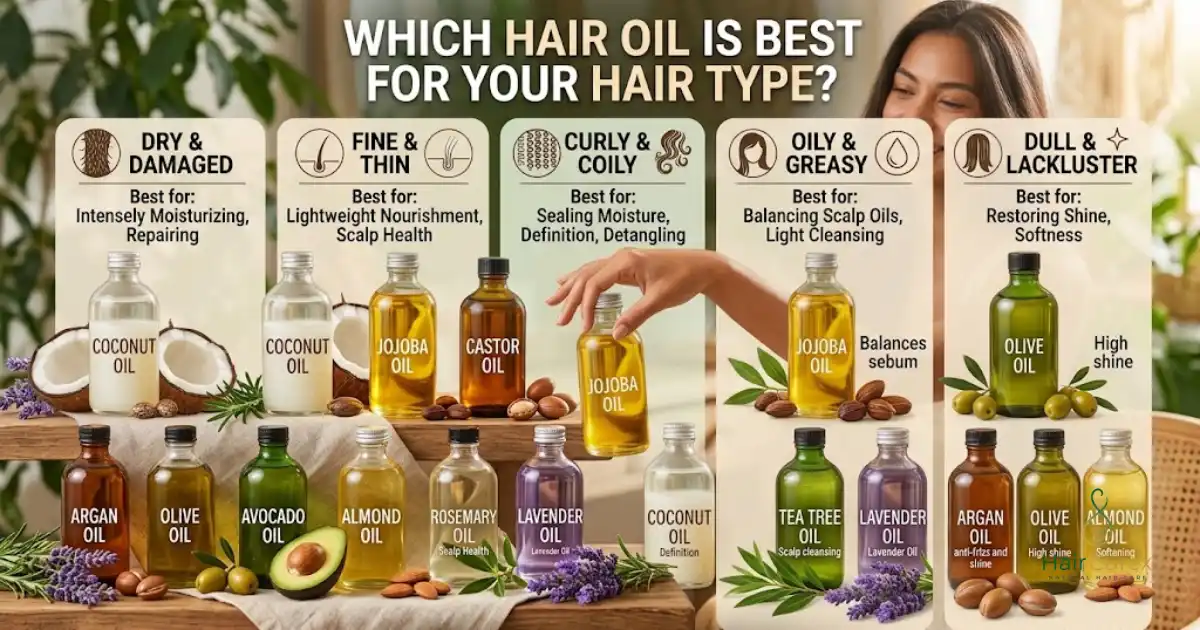
There’s no single “best hair oil” that works for everyone, because hair type changes everything about how oil behaves once it’s applied. Fine or thin hair usually does better with lightweight oils like jojoba or grapeseed, since heavier options can weigh strands down and make hair look flat. Hair oil for curly hair and hair oil for wavy hair, on the other hand, often benefits from richer formulas like coconut or shea-infused oils, since curl patterns tend to trap less natural oil along the length of the strand.
Hair oil for straight hair usually needs a lighter touch, applied mostly at the ends to avoid a greasy scalp. If you’re dealing with an oily scalp but dry ends, a dual approach works well: a lightweight scalp oil, or skipping scalp application altogether, paired with a richer oil for hair breakage focused just on the mid-lengths and tips.
Quick Hair Type-to-Oil Matching Chart
| Hair Type or Concern | Recommended Oil | Why It Works |
|---|---|---|
| Fine or thin hair | Jojoba, grapeseed | Lightweight, won’t weigh hair down |
| Curly or coily hair | Coconut, castor | Richer texture matches natural dryness |
| Wavy hair | Argan, almond | Balanced moisture without heaviness |
| Straight hair | Argan, jojoba (ends only) | Prevents greasy roots |
| Oily scalp, dry ends | Light scalp oil + rich end oil | Targets each zone differently |
| Low porosity hair | Argan, jojoba | Penetrates without buildup |
| High porosity hair | Castor, olive | Seals in moisture longer |
7. How to Apply Hair Oil Correctly
Knowing how to apply hair oil correctly makes a bigger difference than most people realize. Start by sectioning your hair into four to six parts, so the oil reaches your scalp evenly rather than pooling in one spot. Warm a small amount of oil between your palms first; this helps it spread more smoothly and absorb faster once it touches your scalp.
For the actual hair oil massage, use your fingertips, not your nails, and work in small circular motions across the scalp. Spend at least five minutes on this step if you can, since it’s the part that supports circulation to your hair follicles. Once the scalp is covered, work any remaining oil through the mid-lengths and ends, where hair tends to be driest.
If you’re doing a pre-shampoo oil treatment, apply the oil to dry hair before you shower rather than after. This gives the oil time to penetrate the cuticle before water and shampoo have a chance to strip moisture away.
8. How Long Should You Leave Hair Oil On?
There’s no universal rule for how long to leave hair oil in, since it depends on the oil’s weight and your hair’s needs. A quick treatment with a lightweight oil like argan or jojoba can work in as little as thirty minutes. Heavier oils, like coconut or castor, often perform best with more time, anywhere from one hour up to an overnight hair oiling session.
Overnight oiling has become especially popular because it gives the oil hours to fully absorb, though it does come with trade-offs. On the plus side, you’ll likely wake up with noticeably softer, more moisturized hair. On the downside, oil can transfer onto your pillowcase, and very oily hair types may find it harder to fully rinse out the next morning. A simple test: if your scalp still feels heavy or greasy more than a day after washing, you’ve likely left the oil on too long or used more than your hair actually needs.
9. How Often Should You Oil Your Hair?
How often to oil hair really comes down to your hair type, scalp condition, and the climate you live in. As a general guideline, most people benefit from oiling hair one to three times per week. Dry, coarse, or curly hair types can often handle oil more frequently, sometimes even daily on just the ends, while fine or oily hair types usually do better sticking to once or twice weekly.
Season matters more than people expect. Dry winter air pulls moisture from hair fast, so many people increase their hair oiling routine during colder months. In humid summer conditions, cutting back slightly can prevent hair from feeling weighed down or greasy. Overdoing it, regardless of season, can lead to product buildup, clogged follicles, and a scalp that struggles to stay balanced.
10. Common Hair Oiling Mistakes to Avoid
Even with the right oil, a few common habits can quietly undo your results. Using too much product is the most frequent mistake; a little truly goes a long way, and excess oil mostly ends up on your pillow instead of doing anything for your hair. Applying oil to hair that’s already loaded with styling products can also block absorption, since the oil has nothing to bind to on the strand’s surface.
Skipping hair type and porosity when choosing an oil is another common slip-up, one that often leads to disappointing results even when the oil itself is high quality. Rushing the scalp massage, or skipping it altogether, means missing out on one of oil’s biggest circulation benefits. And finally, not rinsing thoroughly enough during washing can leave a dull, waxy buildup that makes hair look greasy well before it actually needs another wash.
11. FAQs About Hair Oil
Does hair oil really help hair grow faster?
Hair oil doesn’t directly speed up the biological rate of hair growth, but it can create a healthier scalp environment and reduce breakage, which allows existing hair to retain length rather than snapping off before it reaches its full potential.
Can hair oil cause hair loss if overused?
Excessive oiling can clog follicles and trap dirt or product buildup at the scalp, which may contribute to irritation over time. Moderation and thorough rinsing are key to avoiding this.
Is coconut oil good for all hair types?
Coconut oil for hair works exceptionally well for many people, but its rich, heavy texture can weigh down very fine or low-porosity hair. In those cases, a lighter oil like jojoba is usually a better fit.
Should I apply hair oil to wet or dry hair?
Both approaches work, but they serve different purposes. Applying oil to dry hair before washing works well as a pre-shampoo oil treatment, while applying a small amount to damp hair after washing can help seal in moisture as a finishing step.
Can I mix two hair oils together?
Yes, and many people do. Combining a lightweight oil with a heavier one, such as jojoba and castor, can balance absorption speed with deeper nourishment.
Is natural hair oil better than store-bought formulas?
Natural, single-ingredient oils give you more control over what touches your scalp, but well-formulated store-bought hair oil treatments often combine multiple oils and actives for a more targeted result. Neither is automatically superior; it depends on your specific goals.
How long does it take to see results from hair oiling?
Most people notice improved softness and shine within a few uses, but structural benefits like reduced breakage or improved scalp health typically take six to eight weeks of consistent use to become clearly noticeable.
Conclusion
Hair oil isn’t a miracle cure, but it’s one of the simplest, most versatile tools you can add to a healthy hair care routine. Whether you’re chasing stronger strands, calming an itchy scalp, or repairing damage from heat and color treatments, there’s likely a hair oil suited to exactly what you need. The key is matching the right oil to your hair type, applying it correctly, and giving your routine enough time to actually show results. Start simple, pay attention to how your hair responds, and adjust from there. A consistent hair oiling routine, even just once or twice a week, can genuinely transform how your hair looks and feels over the coming months.