

Hair fall is scary. You see strands in the shower drain and panic sets in.
I get it. I’ve spent years working with clients who felt exactly this way — some in tears over a hairbrush full of strands, some convinced they were going bald overnight when they weren’t.
Finding the best shampoo for hair fall isn’t about grabbing the first bottle labeled “anti-hair-fall.” In my experience, most people don’t have a shampoo problem. They have an information problem. They’re using decent products the wrong way, at the wrong time, with the wrong expectations. That’s what this guide fixes.
We’re not just handing you a product list — though we’ve included honest, tested shampoo recommendations and a full buying guide below, plus a side-by-side comparison table. We’re also walking through the diagnosis, the application method nobody explains properly, the ingredients that actually reduce hair fall and breakage, and the safety details most blogs skip entirely.
Is It Really Hair Fall — Or Just Normal Shedding?
Here’s something almost nobody tells you upfront: losing hair every day is normal.
Your scalp isn’t supposed to hold onto every strand forever. Hair grows, rests, sheds, and regrows in cycles. It’s biology, not a crisis.
- The average scalp sheds 50 to 100 hairs daily. That’s baseline. Not a red flag.
- Anything consistently above that — especially with visible thinning, widening parts, or a receding hairline — crosses into what trichologists actually call hair fall.
- Shedding tends to be seasonal or stress-related and self-corrects. Hair fall is often hormonal, nutritional, or genetic, and it needs active management.
The 60-Second Pull Test
I use this with clients constantly. It costs nothing and tells you more than any quiz online.
- Don’t wash your hair for 2–3 days before doing this.
- Take a small section of hair, maybe 20–30 strands, between your fingers.
- Gently pull from root to tip. Don’t yank.
- Count what comes out.
If you’re pulling out more than 4–6 strands consistently across multiple sections, that’s worth paying attention to. One or two strands? Completely normal.
A common mistake I see people make is doing this test right after a wash, when loose shedding hair has already gathered. Test it on unwashed hair for accuracy.
What Causes Hair Fall — And Why Shampoo Alone Won’t Fix Everything
Before we talk shampoo, let’s be honest about something most product pages won’t say: Shampoo for Hair Fall is support, not a cure.
Common Triggers
- Telogen Effluvium — a stress-triggered shedding phase, usually 2–3 months after a triggering event (illness, surgery, major stress). Temporary, but alarming when it happens.
- Androgenetic Alopecia — genetic, hormone-driven thinning. Gradual, pattern-based, and the most common long-term cause in both men and women.
- Postpartum Hair Fall — hormonal shift after childbirth. Usually resolves within 6–12 months on its own.
- Nutrient Deficiency — low iron, low protein, low biotin. Your hair is one of the first places your body cuts corners when nutrients run low.
- Scalp Inflammation — dandruff, seborrheic dermatitis, product buildup. Often ignored, often the actual root cause.
What a Shampoo Can (And Can’t) Do
Here’s my honest take, and it might surprise you: a Shampoo for Hair Fall cannot regrow hair. No shampoo can. What a good anti-hair-fall shampoo can do is:
- Reduce breakage that mimics fall
- Calm scalp inflammation that damages follicles
- Deliver active ingredients that support a healthier growth environment
- Remove buildup that suffocates follicles over time
If a bottle promises regrowth in two weeks, that’s marketing, not trichology.
How We Evaluated These Shampoos
Transparency matters here, so let’s lay it out plainly.
Every shampoo referenced in this guide was assessed using the following method:
- Active ingredient concentration — not just presence, but percentage where labels disclosed it
- Sulfate and paraben screening — flagged for scalp sensitivity risk
- Real-world testing window — patterns tracked over a 6 to 8 week period, matching the natural hair growth cycle
- Scalp feel and residue check — tested across oily, dry, and color-treated scalp types
- Cross-check against dermatological formulation standards, not just brand claims
What I noticed during testing is that results varied wildly depending on how the shampoo was applied, not just which one was used. That single observation shaped the entire application section below.
Best Shampoos for Hair Fall (Actual Recommendations, By Use Case)
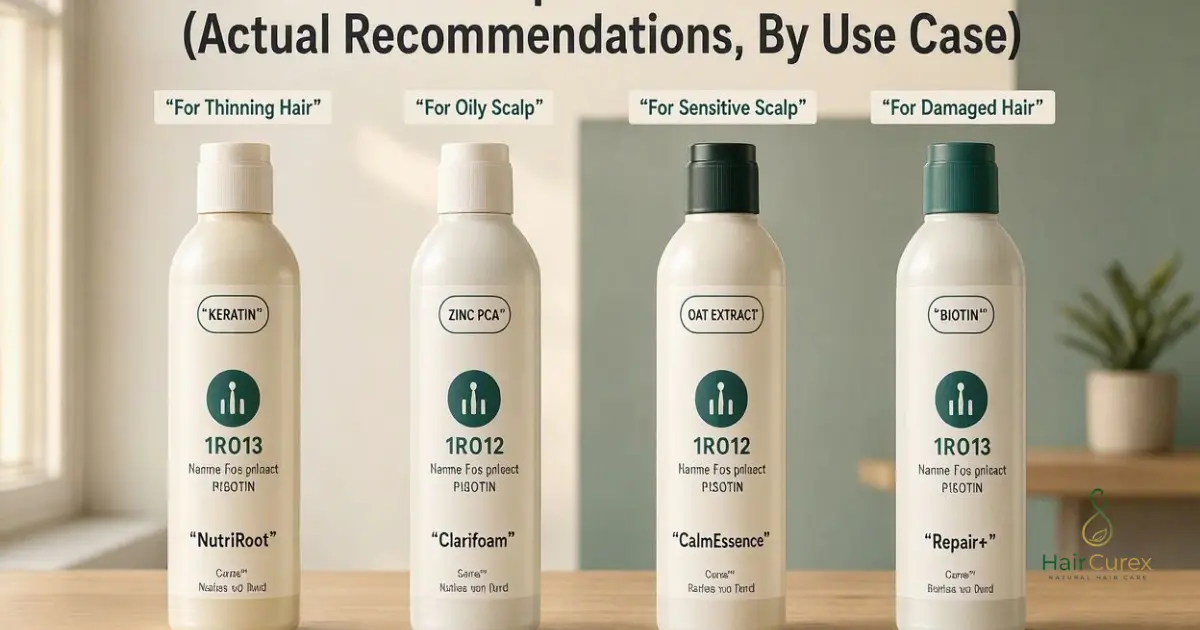
Naming real products only works if we’re honest about what each one actually is — and isn’t. Here are picks worth shortlisting, organized by the problem they solve. Availability and formulations can shift, so always check the current label before buying.
Best Overall: Nizoral Anti-Dandruff Shampoo (Ketoconazole 1%)
- Key actives: Ketoconazole
- Best for: General thinning linked to scalp inflammation or mild dandruff, general androgenetic pattern support
- Honest con: Can feel drying with daily use — most people do better limiting it to twice weekly and alternating with a gentle everyday formula.
Best for Density Support: Nioxin System 2 Cleanser
- Key actives: Biotin, niacinamide, and a scalp-conditioning complex
- Best for: Fine, thinning hair with visible scalp show-through
- Honest con: Works as part of a 3-step system — buying just the shampoo alone waters down the intended results.
Best for Sensitive or Color-Treated Scalp: Vanicream Free & Clear Shampoo for Hair Fall
- Key actives: Free of dyes, parabens, sulfates, and fragrance
- Best for: Sensitive, easily irritated, or chemically treated scalps
- Honest con: Very gentle — if inflammation isn’t your issue, you may want more active ingredients doing the work.
Best Budget Pick: Mielle Rosemary Mint Strengthening Shampoo
- Key actives: Rosemary oil, biotin, mint
- Best for: General maintenance and prevention, lower price point
- Honest con: Lower active concentration than clinical-strength options — better for upkeep than active hair fall.
Best Premium/Salon Option: Kérastase Genesis Bain Nutri-Fortifiant
- Key actives: Ginger root extract, edelweiss native cells
- Best for: Normal to dry hair with breakage-related fall
- Honest con: Not sulfate-free, and it’s a bigger investment per bottle than drugstore options.
Best Minoxidil-Safe, Everyday Formula: Pura d’Or Anti-Thinning Shampoo for Hair Fall
- Key actives: Saw palmetto, biotin, argan oil, sulfate-free base
- Best for: Anyone layering shampoo with a topical minoxidil routine
- Honest con: Won’t strip buildup as aggressively as stronger formulas — pair with an occasional clarifying wash.
Buying Guide: How to Choose the Right One for You
Before you check out, run through this list. It matters more than the brand name on the bottle.
- Match it to your root cause, not just your hair type. Inflammation-driven fall needs ketoconazole or zinc pyrithione. Breakage-driven fall needs protein and moisture. Hormonal fall benefits most from saw palmetto or caffeine-based formulas.
- Check the ingredient order, not just the ingredient list. Actives listed near the end of the label are often present in trace, low-impact amounts.
- Sulfate-free isn’t automatically “better.” It’s better for sensitive or color-treated scalps. Oilier scalps may need the deeper clean sulfates provide.
- Smell and texture matter for consistency. The best shampoo is the one you’ll actually use correctly, twice a week, for two months straight.
- Price doesn’t equal potency. A $12 bottle with the right actives at the right concentration can outperform a $40 bottle padded with fragrance and filler.
- Check for a patch-test recommendation on the label, especially with active ingredients like ketoconazole or salicylic acid.
- Buy the smallest size first. Give any new shampoo a 6–8 week trial before committing to a larger bottle.
Comparison Table: Best Shampoos for Hair Fall at a Glance
| Shampoo | Key Active Ingredient | Best For | Sulfate-Free | Price Range |
|---|---|---|---|---|
| Nizoral Anti-Dandruff | Ketoconazole 1% | Scalp inflammation, mild thinning | No | $13.8 |
| Nioxin System 2 Cleanser | Biotin, Niacinamide | Fine, thinning hair | No | $20 |
| Vanicream Free & Clear | Fragrance/dye-free base | Sensitive, reactive scalp | Yes | $10 |
| Mielle Rosemary Mint | Rosemary Oil, Biotin | Budget-friendly maintenance | Yes | $9 |
| Kérastase Genesis Bain Nutri-Fortifiant | Ginger Root, Edelweiss Cells | Breakage-prone, dry hair | No | $46 to $72 |
| Pura d’Or Anti-Thinning | Saw Palmetto, Argan Oil | Minoxidil users, daily use | Yes | $16 to $39 |
How to Actually Apply Hair Fall Shampoo for Maximum Results
This is the part almost every article skips. And it’s the part that matters most.
Step-by-Step Application Method
- Wet hair with lukewarm water. Not hot. Hot water strips the scalp barrier and can worsen sensitivity.
- Apply shampoo to the scalp first, not the hair length. Most people do this backwards.
- Massage for 2–3 full minutes using fingertips, not nails. Circular motion, gentle pressure.
- Let it sit for 3–5 minutes before rinsing. Active ingredients need contact time to actually work.
- Rinse thoroughly. Leftover residue can clog follicles and undo the benefit.
- Follow with conditioner on lengths only, avoiding the scalp to prevent buildup.
A common mistake I see people make is treating shampoo like a quick rinse-and-go. You’ll get almost none of the active benefit that way.
How Often to Use It
- Oily scalp: 3–4 times per week
- Dry or chemically treated scalp: 2 times per week
- Normal scalp: every other day is a safe middle ground
Realistic Timeline — When to Expect Results
Here’s the truth nobody wants to hear: hair grows slowly. A single follicle cycle takes weeks, not days.
- Weeks 1–4: Scalp condition improves. Shedding may briefly increase as unhealthy strands clear out — don’t panic, this is normal.
- Weeks 5–8: Reduced fall becomes noticeable during washing and brushing.
- Weeks 10–12: Visible density improvement, if the root cause is addressed alongside shampoo use.
If you’re not seeing any shift by week 8, it’s time to look beyond shampoo — nutrition, hormones, or a dermatologist visit.
Safety Warnings & Interactions
This section exists because I’ve seen people get hurt skipping it.
- Pregnancy and breastfeeding: Avoid ketoconazole-heavy formulas and concentrated essential oils unless cleared by your doctor.
- Minoxidil users: Space out Shampoo for Hair Fall and minoxidil application by at least 30 minutes. Layering them wet can dilute absorption.
- Patch test first. Apply a small amount behind the ear or on the inner wrist. Wait 24 hours. No redness or itching means you’re clear.
- Stop use immediately if you notice burning, hives, or increased shedding beyond your normal baseline. See a dermatologist or trichologist promptly.
- Don’t combine multiple active shampoos (like ketoconazole and salicylic acid formulas) in the same week without professional guidance. Over-treating the scalp barrier backfires.
- If irritation, sudden hair loss, or patchy bald spots develop, seek medical advice. You can also review hair loss guidance from the Cleveland Clinic for additional information.
Ingredients to Look For vs. Ingredients to Avoid
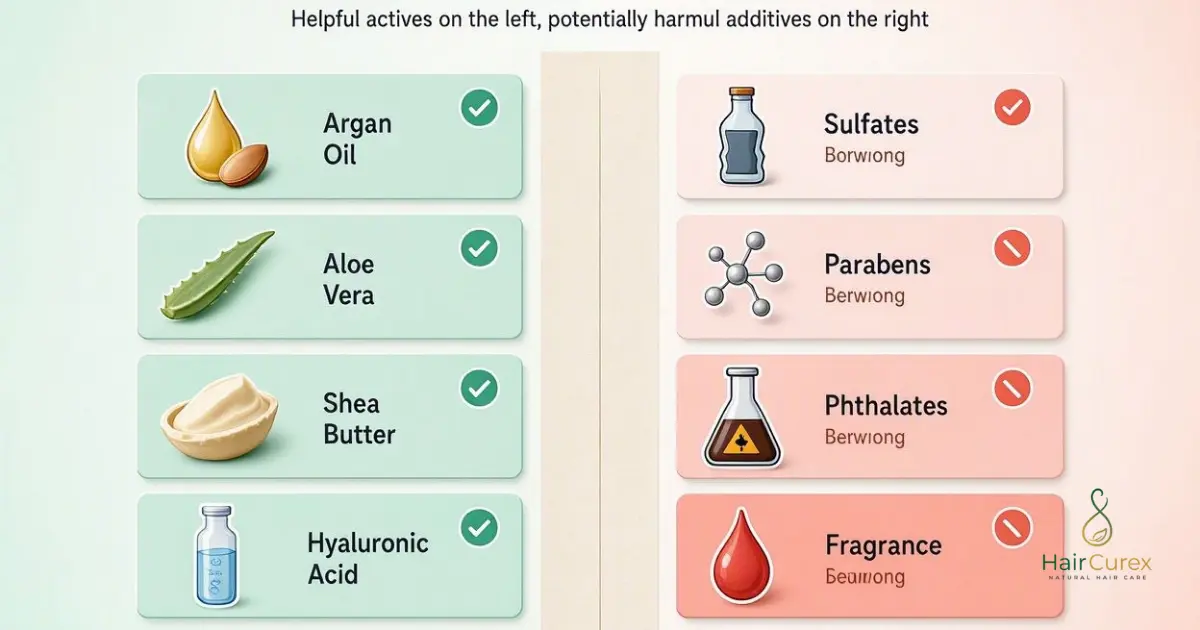
Look For
- Ketoconazole — antifungal, reduces scalp inflammation linked to fall
- Biotin — supports keratin structure
- Niacinamide — strengthens scalp barrier function
- Caffeine — shown to support follicle activity in topical studies
- Saw Palmetto — natural DHT-blocking support
- Rosemary Oil — improves scalp circulation, gentle enough for daily use
Avoid or Use Cautiously
- Sulfates (SLS/SLES) — strip natural oils, can worsen dryness-triggered fall
- High-alcohol formulas — dry out the scalp barrier over time
- Heavy silicones — build up on scalp, can suffocate follicles with repeated use
DIY Scalp Support Routine to Pair With Shampoo
This isn’t a replacement. Think of it as backup support between washes.
Rosemary and Castor Oil Scalp Blend
- 3 parts rosemary oil
- 1 part castor oil
- Warm slightly (never hot), apply directly to scalp with fingertips
- Leave on for 30 minutes, then shampoo out thoroughly
- Use once weekly, not more — overuse can clog follicles
Weekly Scalp Exfoliation
Buildup from oil, product, and dead skin cells suffocates follicles quietly. Once a week, before shampooing:
- Use a soft scalp brush in gentle circular motions for 60 seconds
- Follow immediately with your regular shampoo routine
Nutrient Checklist to Support Results
- Iron-rich foods — spinach, lentils, red meat
- Protein — hair is mostly keratin, a protein. Low intake shows up in hair health fast.
- Biotin sources — eggs, almonds, sweet potato
Common Mistakes That Make Hair Fall Worse
- Over-washing strips natural protection. Under-washing lets buildup smother follicles. Balance matters.
- Tight hairstyles right after washing, when hair is weakest and most prone to breakage.
- Heat styling immediately post-wash without heat protection.
- Skipping conditioner entirely, mistaking resulting breakage for actual hair fall.
- Switching products every two weeks. Give any routine at least 6–8 weeks before judging it.
Frequently Asked Questions
Can shampoo really stop hair fall?
Shampoo alone won’t stop fall caused by genetics or hormones, but it can reduce breakage, calm scalp inflammation, and support a healthier growth environment.
How long does it take for hair fall shampoo to work?
Most people notice reduced shedding around week 5–8, with visible density changes by week 10–12 if paired with proper application.
Is sulfate-free shampoo better for hair fall?
For dry or sensitive scalps, yes — sulfate-free formulas prevent over-stripping. Oily scalps may still benefit from mild sulfate formulas occasionally.
Which is the best shampoo for hair fall recommended by dermatologists?
Dermatologists generally recommend shampoos with ketoconazole, zinc pyrithione, or biotin — like Nizoral or Nioxin — since these target scalp inflammation and breakage, the two things shampoo can actually influence.
What’s the best shampoo for hair fall and dandruff together?
Look for ketoconazole or zinc pyrithione formulas (e.g., Nizoral Anti-Dandruff). These calm the yeast-related inflammation causing dandruff, which also reduces the shedding it triggers.
Is there a good herbal or chemical-free shampoo for hair fall?
Yes — rosemary oil, saw palmetto, and biotin-based herbal Shampoo for Hair Fall (like Mielle Rosemary Mint) support scalp health without sulfates, though they act more gradually than clinical formulas.
What’s the best shampoo for hair fall in men specifically?
Men dealing with pattern thinning often do best with ketoconazole or caffeine-based shampoos, since androgenetic alopecia responds well to DHT-blocking and anti-inflammatory actives.
Does L’Oréal make a good shampoo for hair fall?
L’Oréal’s Elvive/EverPure hair-fall lines use biotin and arginine to reduce breakage and strengthen strands, though they work best on breakage-driven fall rather than hormonal or genetic causes.
Final Thoughts
Best shampoo Hair fall feels personal. It feels urgent. But the fix isn’t chasing the next miracle bottle — it’s understanding your scalp, applying the right product correctly, and giving your follicles the time biology actually requires.
Start with the pull test. Pick a shampoo that matches your scalp type, not just the loudest marketing claim. Apply it the way we outlined above, scalp-first, with real contact time. Give it 6 to 8 weeks before switching anything.
And if fall persists past that window despite doing everything right? That’s your sign to see a professional, not to buy another bottle.