
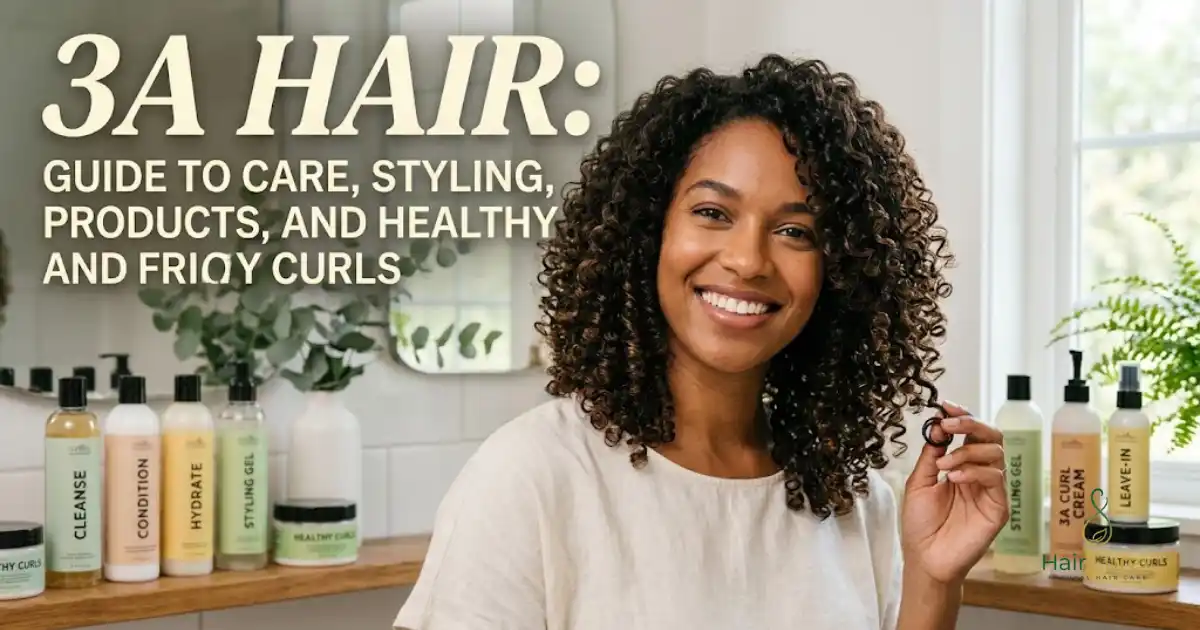
3a hair is a type of curly hair. It has loose, springy curls shaped like a corkscrew. These curls are about the size of a piece of sidewalk chalk. This hair type sits between wavy and very curly hair.
If you’ve ever looked in the mirror and wondered why your curls look different from your friend’s curls, you’re not alone. Curly hair comes in many shapes and sizes, and figuring out where you fit can feel like solving a puzzle. This guide focuses on 3A hair, one of the most common and most loved curl patterns out there. By the end, you’ll know exactly what type 3A hair is, how to care for it, and which products actually work.
Let’s jump in.
What Is 3A Hair?
Type 3A hair sits in the middle of the curly hair family. Hair typing usually runs from straight (type 1) to wavy (type 2) to curly (type 3) and finally to coily (type 4). Within the curly category, there are three subtypes: 3A, 3B, and 3C. Of these, 3A curls are the loosest and largest. Think of a curl pattern that spirals gently, almost like a corkscrew that’s been stretched out a bit.
This classification system came from hairstylist Andre Walker back in the 1990s. It’s not perfect—hair is messy and doesn’t always fit neatly into boxes—but it still gives people a useful starting point. Many folks with natural 3A hair actually have a mix of curl types on one head. You might find looser 3A curls near the crown and slightly tighter ones underneath. That’s completely normal.
What makes 3A curly hair stand out is its springiness. The curls have real body. They bounce. They catch light in a way that straighter hair simply can’t. And because the curl is looser than 3B or 3C, this hair type often has a shinier appearance, since light travels more easily along the length of the strand.
What Does 3A Hair Look Like?
Picture a piece of sidewalk chalk. Now imagine wrapping a strand of hair around it in a loose spiral. That’s roughly the size and shape of a 3A curl. Compare that to a plastic drinking straw for 3B hair, or a pencil for 3C hair, and you start to see how curl diameter changes as you move through the curly hair spectrum.
The 3A curl pattern typically forms a well-defined “S” shape rather than a tight ringlet. When it’s healthy and properly moisturized, it clumps together naturally, creating those Instagram-worthy spirals people often chase. Without enough moisture, though, those same strands can separate and puff up, leading to frizz instead of definition.
One helpful comparison: 2C hair is wavy with a slight curl at the ends, while 3A curls are curly from root to tip, though the “S” bend is wide and relaxed. On the other end, 3B hair has a tighter, springier curl with less shine. If your curls look loose, glossy, and spiral-shaped throughout, chances are you’re dealing with type 3A hair.
3A Hair Characteristics You Should Know
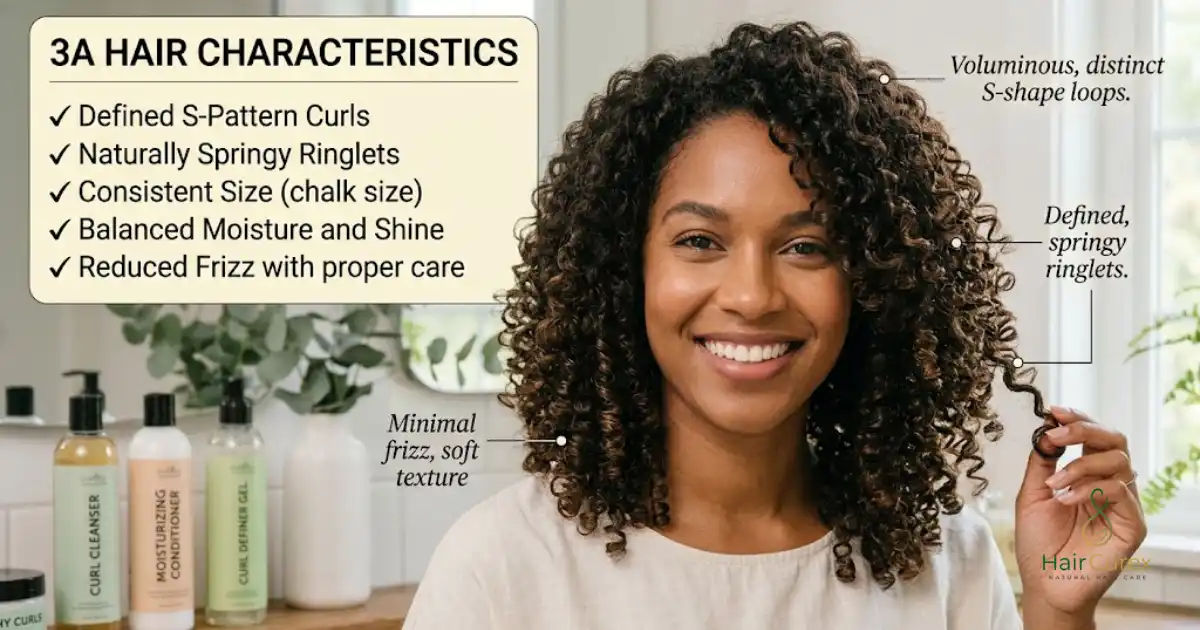
Every curl type comes with its own personality, and 3A hair type is no exception. Here’s what tends to set it apart.
Curl pattern and diameter matter most. As mentioned, 3A curls are wide, loose spirals. They’re often the loosest curls that still qualify as “curly” rather than “wavy.”
Porosity plays a huge role in how this hair behaves. Many people with 3A hair have low to medium porosity, meaning the hair cuticle lies fairly flat. This can make it harder for moisture to get in, but once it does, the hair holds onto it fairly well. Low porosity hair often benefits from lighter products and gentle heat during deep conditioning, since heavy creams can just sit on top of the strand instead of soaking in.
Density and thickness vary a lot from person to person, even within the same curl type. Some people have thick, densely packed 3A curls, while others have fine strands that need extra volume.
Frizz tendency is probably the biggest complaint among people with this curl pattern. Because the curl is loose, it’s more prone to separating in humid weather or after too much touching. This is why frizz control becomes such an important part of any 3A hair routine.
Elasticity refers to how well the hair stretches and bounces back. Healthy 3A curls should stretch when wet and spring back into shape as they dry—a good sign that the hair is properly hydrated and structurally sound.
| Characteristic | Typical Trait in 3A Hair |
|---|---|
| Curl shape | Loose, S-shaped spiral |
| Curl diameter | Similar to sidewalk chalk |
| Porosity | Often low to medium |
| Shine | Naturally glossy |
| Frizz risk | Moderate to high in humidity |
| Elasticity | Good when properly hydrated |
How to Tell If You Have 3A Hair
Not sure if you actually have type 3A hair? Try this simple test. Wash your hair, apply a lightweight leave-in conditioner, and let it air dry without touching, brushing, or scrunching it. Once it’s fully dry, look closely at the curl shape.
If your curls form loose, wide spirals about the width of a piece of chalk, you’re likely working with 3A curly hair. If the curls look tighter and springier, closer to a straw’s width, you may actually have 3B hair. And if your hair only bends slightly at the ends without forming a full spiral, that’s more consistent with 2C waves.
Here’s a comparison to make things clearer:
| Curl Type | Curl Shape | Diameter Comparison |
|---|---|---|
| 2C | Loose wave, slight curl at ends | Wide wave, no full spiral |
| 3A | Loose, defined spiral | Sidewalk chalk |
| 3B | Springy, tighter spiral | Drinking straw |
Keep in mind that most heads of hair aren’t just one type. You might have 3A curls up top and something tighter or looser elsewhere. That’s not a mistake in your hair—it’s just how curl patterns naturally grow.
Best Hair Care Routine for 3A Hair
A solid 3A hair routine doesn’t need to be complicated, but it does need consistency. The general order goes like this: cleanse, condition, detangle, apply styling products, then dry.
Most people with this curl pattern do well washing their hair every two to three days rather than daily. Washing too often can strip natural oils, leaving curls dry and prone to frizz. On non-wash days, a light mist of water mixed with leave-in conditioner can refresh curls without a full wash.
Nighttime matters just as much as daytime care. Sleeping on a silk or satin pillowcase reduces friction, which means less frizz and fewer broken curls in the morning. Many people also use the “pineapple method,” gathering hair loosely at the top of the head with a scrunchie before bed to preserve curl shape overnight.
As curly hair expert Diane Da Costa once put it, “Curls are not the enemy—dryness is.” That single idea captures most of what a good 3A curly hair routine is trying to solve.
How to Wash and Condition 3A Hair
Washing 3A hair correctly makes a bigger difference than most people realize. Start with lukewarm water rather than hot, since hot water strips moisture and can leave curls parched. A sulfate-free 3A hair shampoo is usually the better choice, because sulfates can be harsh and drying, stripping away the natural oils this hair type needs to stay soft and shiny.
Some people skip shampoo altogether on certain wash days and use a method called co-washing, where a cleansing conditioner replaces traditional shampoo. This works well for those with drier 3A curls, though it’s smart to still use a clarifying shampoo occasionally to remove product buildup.
When it comes to a 3A hair conditioner, application technique matters. Try the “praying hands” method: rub conditioner between your palms, then smooth it down the length of your hair in a downward motion. Follow that with “raking,” running your fingers through the conditioner from roots to ends to distribute it evenly and detangle at the same time.
Detangling itself should always happen while hair is wet and coated in conditioner, never dry. A wide-tooth comb or your fingers work best, and you should always start detangling from the ends and work your way up to the roots. This reduces breakage significantly compared to yanking a brush through dry curls from top to bottom.
Best Products for 3A Hair
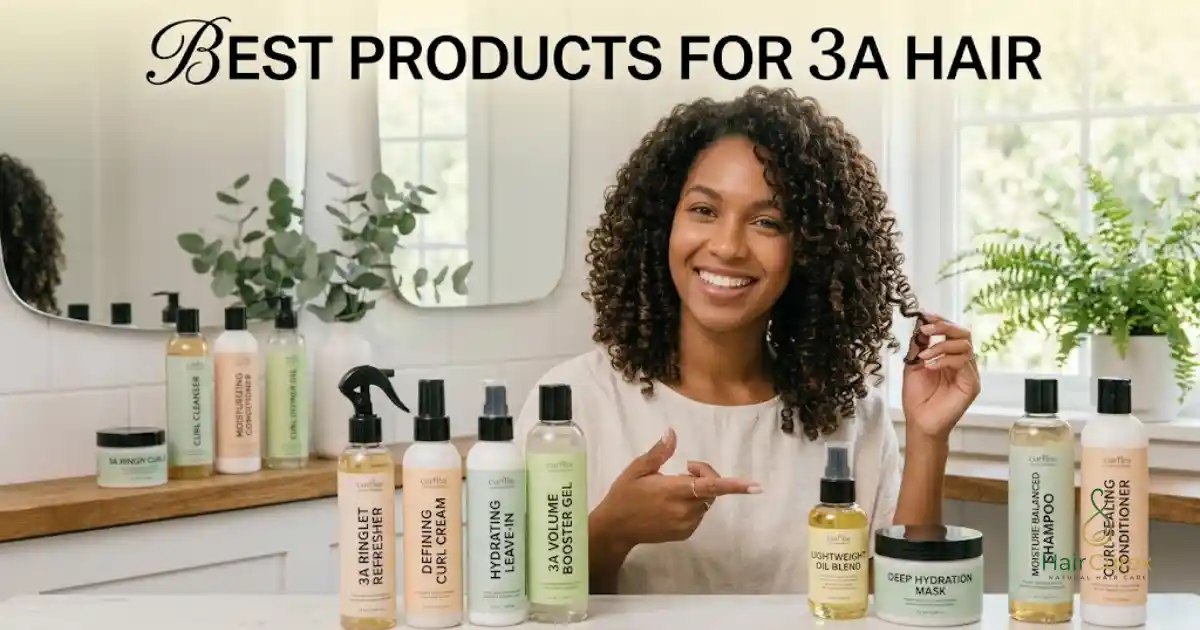
Choosing the right 3A hair products can feel overwhelming with so many options on shelves. The good news is that once you understand what your curls actually need, shopping becomes much easier.
Look for ingredients like glycerin, aloe vera, and lightweight oils such as argan or grapeseed oil. These ingredients for a 3A hair moisturizer draw in and lock down hydration without weighing curls down. Avoid heavy silicones that don’t wash out easily, along with sulfates and drying alcohols, since these ingredients tend to build up over time and leave curls dull and stiff.
Here’s a breakdown of what a full lineup of curl-friendly products might look like:
| Product Type | Purpose | Example Ingredients to Look For |
|---|---|---|
| Sulfate-free shampoo | Cleanses without stripping | Coconut-derived cleansers, aloe |
| Moisturizing conditioner | Softens and detangles | Shea butter, glycerin |
| Leave-in conditioner for curly hair | Adds lasting hydration | Aloe vera, panthenol |
| Curl cream | Defines and smooths | Lightweight oils, glycerin |
| Curl gel | Locks in shape, fights frizz | Flaxseed extract, aloe |
| Hair oil | Seals in moisture | Argan oil, jojoba oil |
For those on a budget, drugstore brands like Shea Moisture and Cantu offer solid options among the best products for 3A curls. If you’re willing to spend more, brands like DevaCurl and Ouidad are well known within the curly hair community for formulas built specifically around curl patterns like this one. For deeper research on ingredient lists and reviews, sites like NaturallyCurly and Curl Centric offer detailed breakdowns worth checking out.
How to Keep 3A Curls Defined and Bouncy
If you want to know how to define 3A curls, it starts with the Curly Girl Method, a popular approach that avoids sulfates, silicones, and heat styling in favor of gentler techniques. This method has become something of a movement within the curly hair community, and for good reason—it genuinely works for many curl types, including this one.
Scrunching is one of the simplest techniques you can use. While hair is still soaked in product, cup your hands underneath sections of hair and gently squeeze upward. This encourages curls to clump together rather than fall flat.
Plopping curly hair takes things a step further. After applying your leave-in conditioner and curl cream, flip your head over and wrap your hair in a microfiber towel or cotton t-shirt, securing it on top of your head for ten to twenty minutes. This method reduces drying time while enhancing curl clumping and definition.
Diffusing curly hair with a blow dryer attachment speeds up drying without disturbing the curl pattern the way regular airflow from a nozzle would. Keep the diffuser on a low, cool setting, and cup sections of hair into the diffuser bowl rather than moving it around too much.
Layering products correctly also plays a role. Many people follow the LOC method—liquid, oil, cream—or the LCO method, swapping the order of oil and cream. Testing both will show you which order your particular curls respond to best.
How to Reduce Frizz in 3A Hair
Frizzy 3A hair usually comes down to one of three culprits: not enough moisture, too much manipulation, or high humidity in the air. Since the hair cuticle lifts when it lacks hydration, moisture becomes your best defense against frizz control problems.
Ditch the regular bath towel. Rubbing hair dry with a rough towel roughs up the cuticle and creates frizz almost instantly. Switch to a microfiber towel or an old cotton t-shirt, and pat curls dry instead of rubbing them.
During humid months, an anti-humidity spray or a slightly heavier curl gel can create a barrier against moisture in the air. In drier winter months, switching to a richer 3A hair moisturizer and cutting back on clarifying shampoo can help prevent the opposite problem—overly dry, frizzy strands from indoor heating.
Touching your hair throughout the day is another sneaky frizz trigger. Once your curls dry and set, resist the urge to run your fingers through them. Doing so breaks up the curl clumps and creates the frizzy halo effect so many people try to avoid.
Best Hairstyles for 3A Hair
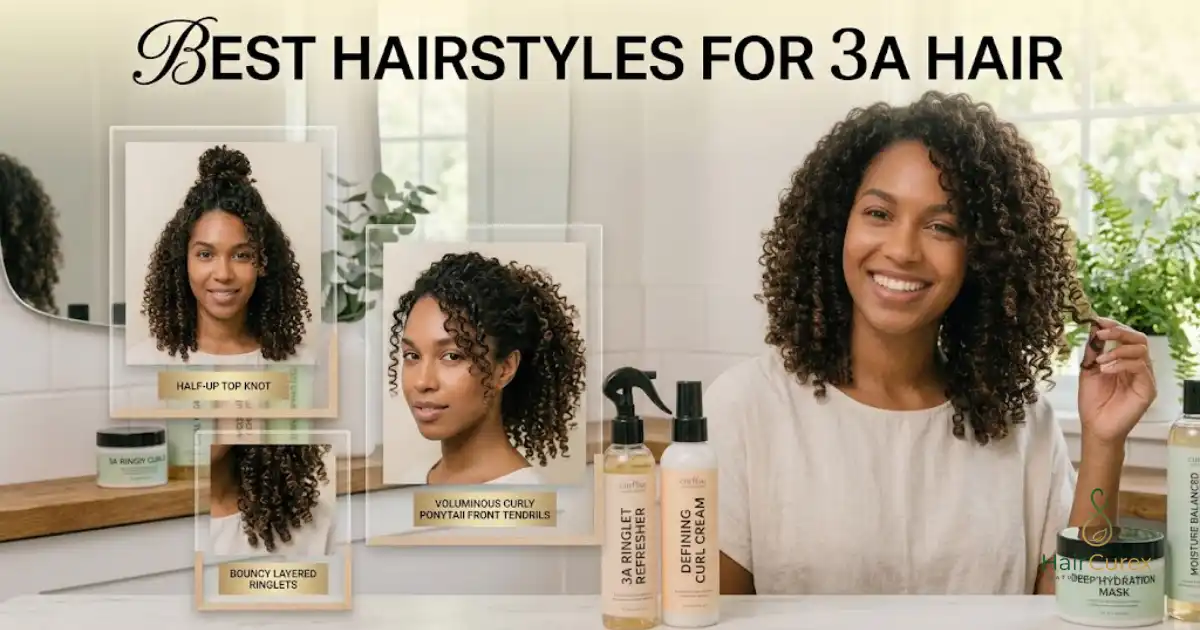
There’s no shortage of options when it comes to 3A hair hairstyles, whether you want something for everyday wear or a special occasion.
The wash-and-go remains the most popular everyday style, letting natural curls shine with minimal effort. A half-up style works beautifully too, pulling back the top section while letting the rest of the curls flow freely, which helps prevent flat roots.
For low-manipulation days, a loose braid or twist-out can protect curls from friction while still looking polished. These styles also work well before bed to preserve curl definition overnight.
For special occasions, curls can be pinned into a low bun with face-framing tendrils left out, or half of the hair can be twisted back for an elegant, undone look. Shorter 3A hair often styles beautifully into a curly bob, which tends to bounce more due to the shorter length supporting tighter, more defined curl formation. Longer hair, on the other hand, may need extra product to prevent the weight of the length from loosening the curl pattern.
Common 3A Hair Problems and How to Fix Them
Even with a solid routine, problems pop up. Here’s a rundown of the most common ones and how to solve them.
| Problem | Likely Cause | Fix |
|---|---|---|
| Frizz and flyaways | Low moisture, humidity, friction | Use anti-humidity spray, switch to microfiber towel |
| Flat roots | Product weight, hair type, lack of volume | Clip roots while drying, use volumizing mousse |
| Curls clumping too much | Excess product | Cut back on product amount, use lighter formulas |
| Curls not clumping at all | Not enough product, dry hair | Increase leave-in conditioner and curl cream |
| Product buildup | Heavy silicones, infrequent clarifying | Clarify weekly, avoid heavy silicone products |
| Dryness and breakage | Overwashing, harsh detangling | Reduce wash frequency, detangle only when wet |
If you notice one issue that just won’t go away no matter what you try, it might be worth looking at your water quality too. Hard water, common in many parts of the country, leaves mineral deposits on hair that can mimic product buildup and dryness. A chelating shampoo used occasionally can help reset things.
How to Keep 3A Hair Healthy and Hydrated
Long-term health for 3A hair moisture comes down to balance. Curls need both moisture and protein, and leaning too far in either direction causes problems. Too much protein makes curls feel stiff and brittle. Too much moisture without protein makes curls feel limp and gummy.
Deep conditioning once a week helps maintain that balance. Applying heat, such as sitting under a warm towel or hooded dryer for fifteen to twenty minutes, opens the cuticle and allows the conditioner to penetrate more deeply than it would at room temperature.
Regular trims, ideally every eight to twelve weeks, prevent split ends from traveling further up the hair shaft and causing more damage. Skipping trims might seem like the path to longer hair, but it often backfires when split ends force stylists to cut off more length later.
Hydration isn’t just about what goes on your hair—it’s also about what goes into your body. Drinking enough water and eating a diet with healthy fats can support hair health from the inside out, even though products still do most of the heavy lifting for surface-level moisture.
Finally, if you use a diffuser or blow dryer regularly, a heat protectant spray is worth adding to your routine. Even low heat settings can cause damage over time without one.
Is 3A Hair Rare?
Not particularly. Type 3A hair is one of the more common curl patterns, especially compared to tighter coily types. It’s frequently seen across a wide range of ethnic backgrounds and hair textures, which is part of why so many product lines are formulated with this curl pattern in mind.
Conclusion
Type 3A hair brings loose, bouncy spirals that can look stunning with the right care. From choosing a gentle 3A hair shampoo to mastering techniques like plopping and diffusing, healthy curls come down to consistency more than perfection. Pay attention to what your hair is telling you, adjust your products and routine as needed, and don’t be afraid to experiment until you find what works. Your curls are worth the effort—and once you get the hang of caring for them, you might just fall in love with every spiral.
Frequently Asked Questions About 3A Hair
Is 3A hair curly or wavy?
It’s curly. While it’s the loosest of the curly subtypes, 3A hair still forms a full spiral shape rather than just bending at the ends like wavy hair does.
Can 3A hair be straightened without damage?
Occasional straightening is generally fine as long as a heat protectant is used and heat tools are kept on lower settings. Frequent straightening, however, can weaken the curl pattern over time and lead to heat damage.
What’s the difference between 3A and 3B hair?
The main difference is curl diameter and springiness. 3A curls are looser and wider, similar to sidewalk chalk, while 3B curls are tighter and springier, closer to the width of a drinking straw.
Does 3A hair get looser or curlier with age?
Curl patterns can shift over time due to hormones, health changes, and even hair damage. Some people notice their curls loosen with age, while others find their pattern stays fairly consistent throughout life.
Can I use the curly girl method on 3A hair?
Absolutely. The Curly Girl Method works especially well for this hair type, since it focuses on gentle cleansing, deep hydration, and avoiding ingredients that weigh down or dry out loose curl patterns.