
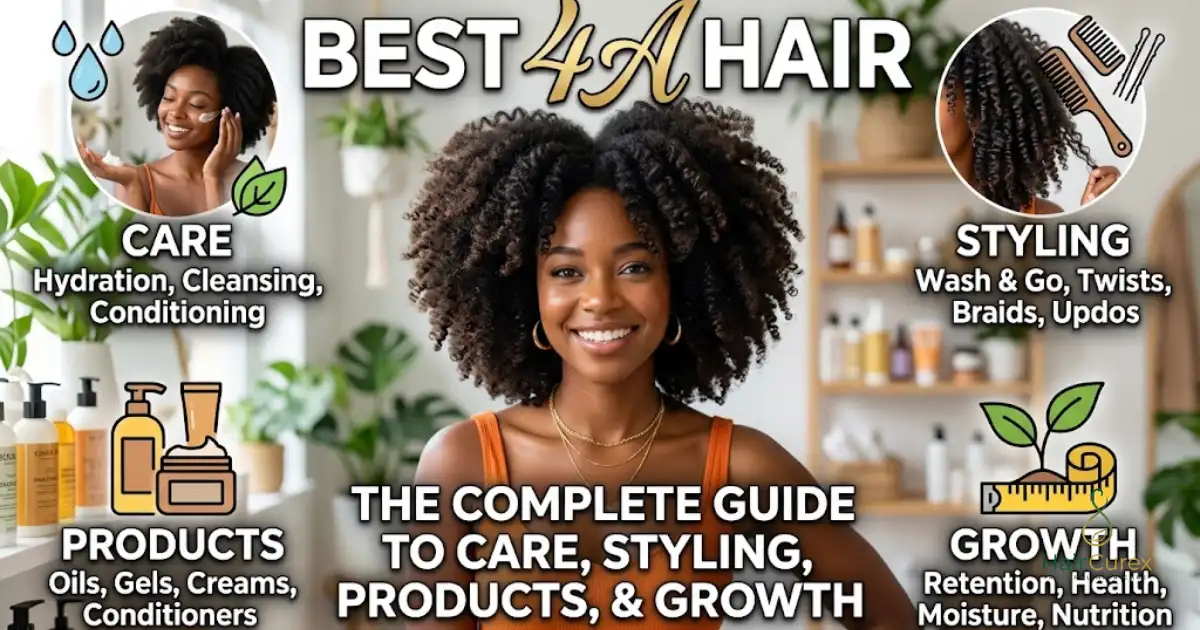
Explore the guide breaks down everything about 4A hair, from what it actually looks like to how you should be washing, moisturizing, styling, and growing it. Whether you’re new to your natural hair journey or you’ve been rocking curls for years and just want better results, you’ll find real, usable information here not vague tips that could apply to anyone.
If you’ve ever stood in front of a mirror wondering why your curls behave the way they do, there’s a good chance you’re working with 4A hair. This curl pattern sits right in the middle of the natural hair spectrum, and it’s one of the most common — yet most misunderstood hair types out there. Some days your curls look like perfectly sprung coils. Other days, humidity turns everything into a puff of frizz before you even leave the house. Sound familiar?
What Is 4A Hair?
4A hair belongs to the type 4 category on the Andre Walker Hair Typing System, which classifies hair into four broad groups based on curl shape: straight, wavy, curly, and coily. Type 4 hair is the coiliest of them all, and within that category, 4A hair type represents the end of the spectrum with the most visible and defined curl pattern.
What makes 4A natural hair distinct is its “S” shaped curl. Picture the letter S written over and over, tightly, down the length of each strand — that’s essentially what a single coil of 4A hair looks like under a microscope or when stretched out. This is different from the tighter zigzag pattern found in 4B hair or the almost curl-less, densely packed coils of 4C hair. People often describe 4A curly hair as springy, bouncy, and full of natural body, especially when properly moisturized.
It’s worth noting that hair typing systems are useful guides, not strict rules. Many people have more than one curl pattern on their head — tighter curls at the nape, looser curls at the crown. That’s completely normal. Think of “4A” as a helpful starting point for understanding your hair’s needs, not a rigid label you have to squeeze yourself into.
What Does 4A Hair Look Like?
When you look closely at 4A curls, you’ll notice tightly coiled, well-defined spirals that hold their shape even without product. The curl diameter is usually compared to a crochet needle or a pencil — small, springy loops rather than loose waves. When the hair is wet, the curls often look longer and more relaxed. Once it dries, though, shrinkage kicks in, and the hair can appear significantly shorter than its actual stretched length.
This shrinkage is one of the most talked-about traits of 4A kinky hair, and it can be surprising if you’re not used to it. It’s not uncommon for 4A hair to shrink anywhere from 50 to 75 percent of its true length. So don’t panic if your hair looks like it “disappeared” overnight — it’s just doing what coily hair naturally does.
Visually, 4A coily hair tends to clump together fairly easily, especially with the right products, which is why wash-and-go styles work so well on this texture. The curls catch the light nicely when properly defined, giving a shiny, healthy appearance that many people love to show off.
4A Hair Characteristics and Texture
Understanding your 4A hair characteristics is the foundation for everything else — your routine, your product choices, and your styling decisions all depend on knowing your hair’s texture, porosity, and density.
Strand thickness varies quite a bit even within the 4A category. Some people have fine 4A strands, others have coarse ones, and plenty fall somewhere in between. This is separate from curl pattern, so two people can both have a 4A curl pattern while one has fine hair and the other has thick, wiry strands.
Hair porosity — how well your hair absorbs and retains moisture — also plays a huge role. Low porosity 4A hair tends to repel water and product at first, then hold onto moisture once it finally gets in. High porosity 4A hair absorbs moisture quickly but loses it just as fast. Most 4A textures fall into the low-to-normal porosity range, though this isn’t universal.
Here’s a quick breakdown of common 4A hair traits:
| Characteristic | Typical Range | What It Means for Your Routine |
|---|---|---|
| Curl pattern | Defined “S” shaped coils | Responds well to curl-defining products |
| Shrinkage | 50–75% | Style wet or use stretching techniques for length |
| Porosity | Low to normal (varies) | May need heat to help products absorb |
| Density | Medium to high | Sectioning helps during styling and detangling |
| Elasticity | Generally strong when healthy | Bounce indicates good hair health |
4A hair density is often on the higher side, meaning there are a lot of strands packed onto the scalp. This creates beautiful volume but can also make detangling and thorough moisturizing more time-consuming. Patience really does pay off here.
4A vs 4B and 4C Hair: What’s the Difference?
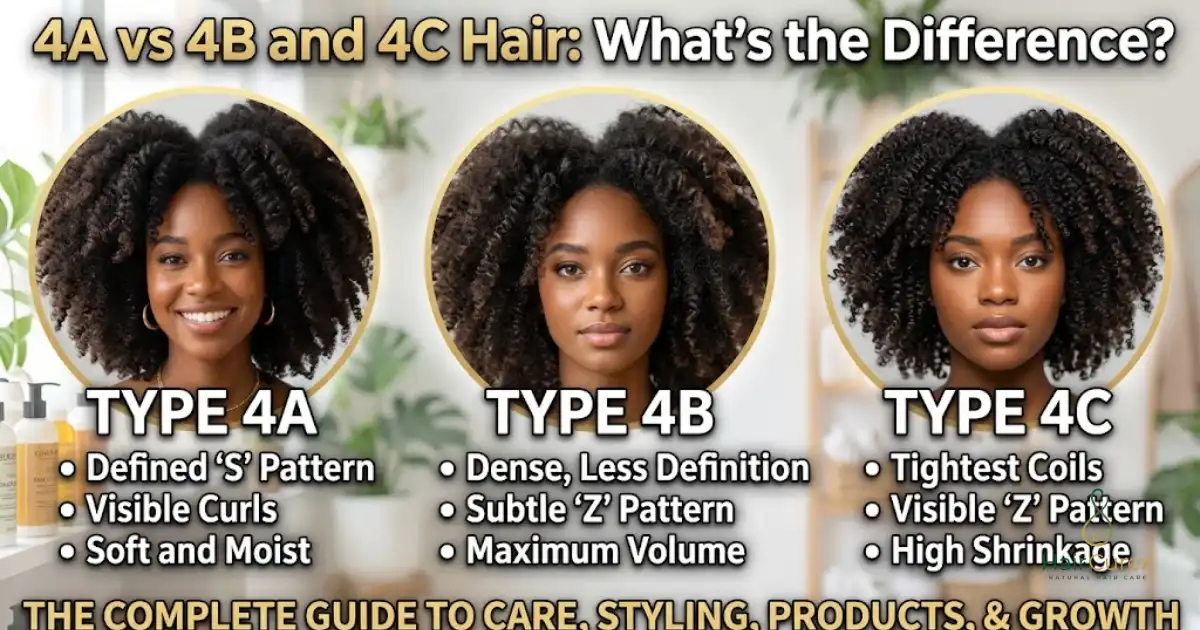
One of the most common questions people ask is how to tell the difference between 4A vs 4B hair and 4A vs 4C hair. It’s a fair question, since type 4 hair covers a wide range of textures, and the lines between categories can blur.
The clearest distinguishing factor is curl shape. 4A curls form a defined “S” pattern that’s visible to the naked eye, even without product. 4B hair has a less defined, more “Z” shaped pattern with sharper angles and bends. 4C hair has the tightest coil pattern of all, often with little to no visible curl definition, and it experiences the highest shrinkage of the three.
| Hair Type | Curl Pattern | Typical Shrinkage | Moisture Needs |
|---|---|---|---|
| 4A | Defined “S” curls | 50–75% | Moderate to high |
| 4B | “Z” shaped, less defined | 60–75% | High |
| 4C | Tight coils, minimal definition | 70–85% | Very high |
There’s also a common comparison between 3C vs 4A hair. The key difference is that 3C curls form more of a corkscrew shape and tend to be looser overall, while 4A curls are tighter and shrink more dramatically. If you’ve ever looked at a “4A hair type chart” online, you’ve probably noticed how gradual the transition is between 3C, 4A, 4B, and 4C — hair rarely fits into one box perfectly, and that’s okay.
Understanding where your hair falls among the 4A 4B 4C hair types helps you choose products and techniques suited to your actual needs, rather than following generic “curly hair” advice that might not apply to coily textures at all.
How to Care for 4A Hair
A solid 4A hair care routine starts with understanding that this hair type is naturally prone to dryness. Because the coil pattern makes it harder for natural scalp oils to travel down the length of the strand, 4A hair needs consistent, intentional moisture to thrive.
When it comes to detangling 4A hair, always start on soaked, conditioner-coated hair rather than dry strands. Dry detangling causes unnecessary breakage and can leave you frustrated with clumps of shed hair in your comb. Section your hair into four to six parts, and work through each section slowly with a wide-tooth comb or your fingers, starting from the ends and working your way up to the roots. This method, often called finger detangling, gives you more control and reduces the risk of snapping fragile strands.
Washing 4A hair doesn’t need to happen every day — in fact, over-washing can strip away the natural oils this hair type is already short on. Most people with 4A hair do well washing once a week or every ten to fourteen days, depending on their lifestyle and scalp needs. Scalp care matters just as much as strand care here; a healthy scalp, free of buildup, is the foundation for strong, healthy growth. Gently massaging the scalp during wash day boosts blood circulation, which many people believe supports better hair growth over time.
Deep conditioning is non-negotiable for this texture. A weekly or bi-weekly deep conditioning treatment, ideally with heat from a steamer or hooded dryer, helps the hair absorb moisture more effectively. This single step can make a dramatic difference in reducing dryness, breakage, and frizz.
“I used to think my hair was just impossible to manage until I started deep conditioning weekly and stopped combing it dry. My curls have never looked better.” — a common sentiment shared across countless natural hair forums and testimonials.
Preventing breakage also means being gentle during every step of the process — from washing to detangling to styling. Silk or satin accessories, low-manipulation styles, and trimming split ends regularly all contribute to stronger, more resilient 4A hair over time.
Best Hair Care Routine for 4A Hair
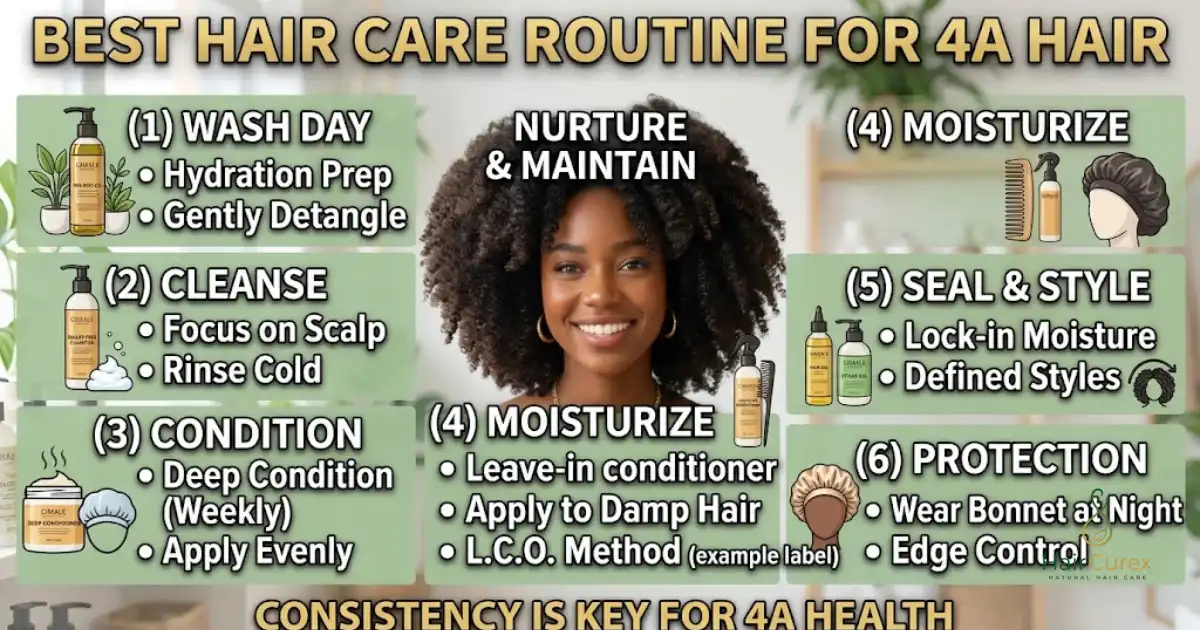
Building a consistent routine takes the guesswork out of caring for your curls. Here’s a realistic, sustainable approach that works well for most people with type 4A hair.
Start wash day with a pre-poo treatment — applying oil or conditioner to dry hair before washing — to soften strands and reduce moisture loss during cleansing. Follow this with a sulfate-free shampoo or a co-wash, depending on how much buildup your scalp has. Sulfates can be incredibly drying for coily textures, so gentler cleansers tend to work better long term.
After cleansing, apply a deep conditioner and let it sit under heat for twenty to thirty minutes. This step alone can transform dull, brittle strands into soft, manageable curls. Rinse with cool water to help seal the hair cuticle, then apply a leave-in conditioner while the hair is still soaked — this is often called the “soaking wet” method, and it dramatically improves moisture retention.
From there, follow the LOC or LCO method: Liquid (water-based leave-in), Oil, Cream (or Liquid, Cream, Oil, depending on your hair’s porosity). This layering technique locks moisture into the hair shaft and helps define curls while minimizing frizz. Finish with your preferred styling method, whether that’s a twist-out, a wash-and-go, or protective braids.
| Frequency | Task |
|---|---|
| Daily | Light misting with water or a moisturizing spray, especially at the ends |
| 2–3 times a week | Refresh curls with a curl cream or leave-in |
| Weekly | Full wash day: cleanse, deep condition, style |
| Bi-weekly | Protein treatment (if hair shows signs of over-moisture or limpness) |
| Every 6–8 weeks | Trim ends to prevent split ends from traveling up the shaft |
Consistency matters more than perfection. Missing a wash day here and there won’t ruin your progress, but a routine you can actually stick to will always outperform an ambitious one you abandon after two weeks.
Best Products for 4A Hair
Choosing the best products for 4A hair comes down to understanding ingredients rather than chasing trendy packaging. Look for sulfate-free shampoos that cleanse without stripping natural oils — ingredients like cocamidopropyl betaine are much gentler than harsh sulfates.
For deep conditioners, seek out formulas with humectants like glycerin and honey, along with emollients such as shea butter and coconut oil, which help soften and smooth the hair shaft. A quality leave-in conditioner is arguably the most important product in your entire routine, since it forms the moisture base for everything applied afterward.
Curl creams and custards help define 4A curls and combat frizz, while lightweight gels can add extra hold for styles like twist-outs and wash-and-gos without leaving a crunchy, stiff finish once the hair is scrunched out. Oils like jojoba, castor, and argan oil are excellent for sealing in moisture after applying water-based products, since oils on their own cannot moisturize dry hair — they can only lock moisture in that’s already there.
Protein treatments deserve a special mention. While moisture is essential, too much of it without balancing protein can leave 4A hair feeling mushy, weak, and prone to breakage. A monthly or bi-monthly protein treatment helps strengthen the hair’s internal structure, especially if you color, heat style, or chemically treat your hair regularly.
When shopping, avoid products high up the ingredient list with drying alcohols (like isopropyl alcohol), heavy silicones that build up over time, and synthetic fragrances that can irritate sensitive scalps.
How to Keep 4A Hair Moisturized
Moisture is the single biggest factor separating thriving 4A hair from hair that constantly breaks and struggles to grow. Because of the coil pattern’s shape, natural scalp oil — called sebum — has a harder time traveling down the length of the strand compared to straighter hair types. This is precisely why moisturizing 4A hair requires more intentional effort.
The LOC method (Liquid, Oil, Cream) remains one of the most effective moisture-locking techniques for this texture. Start with a water-based liquid, since water is the only true moisturizer — oils and creams simply help seal it in. Follow with a lightweight oil, then finish with a cream-based product for extra sealing and definition, particularly on drier ends.
Humectants like glycerin and honey attract moisture from the surrounding air into the hair, which works wonderfully in humid climates but can sometimes backfire in very dry weather by pulling moisture out of the hair instead. If you live somewhere with low humidity for part of the year, consider adjusting your product ratios seasonally rather than sticking with the exact same routine year-round.
Deep conditioning frequency plays a major role too. Hair that’s deeply conditioned weekly, with heat to help open the cuticle, absorbs and retains moisture far better than hair that’s only conditioned occasionally. Signs that your hair needs more moisture include a rough, straw-like texture, increased frizz, dullness, and hair that snaps easily instead of stretching before breaking.
Best Hairstyles for 4A Hair
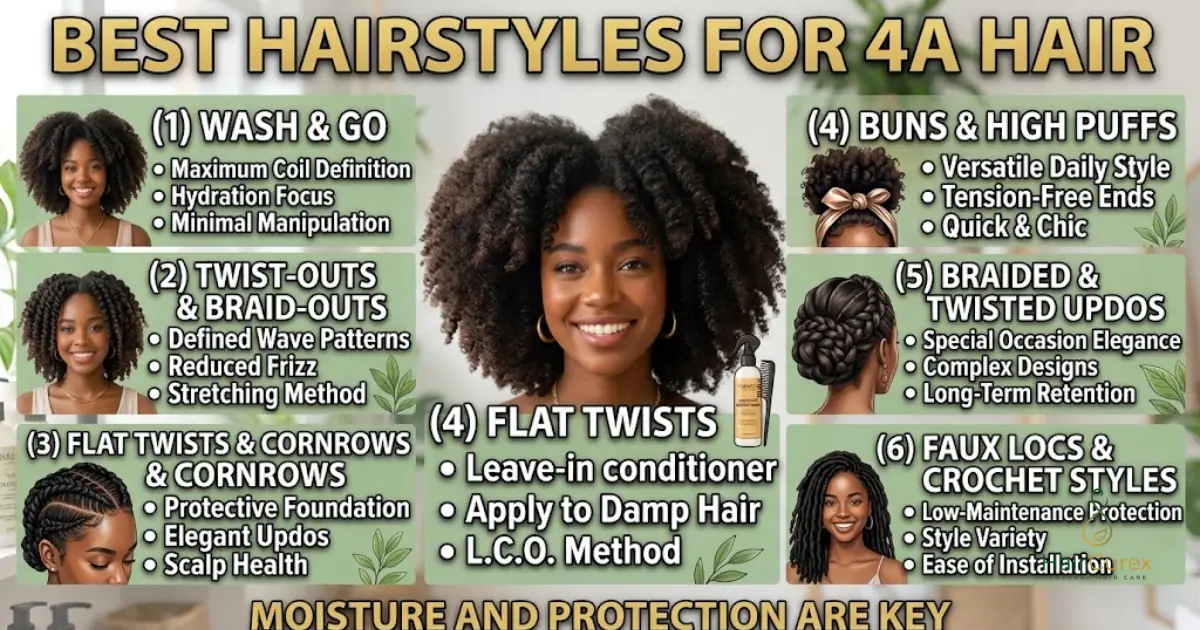
There’s an enormous range of 4A hairstyles to choose from, whether you want a low-maintenance protective style or a way to show off your natural curl definition.
Wash and go styles are a favorite for showing off natural 4A curls with minimal effort. Applying a curl cream or gel to soaking wet hair and allowing it to air dry (or diffuse) creates defined, bouncy curls without much manipulation. The twist-out remains one of the most popular styling methods, where small sections of hair are twisted while damp, then unraveled once fully dry to reveal soft, defined waves and curls. The braid-out follows a similar process using braids instead of twists, typically resulting in a slightly different curl pattern with more zigzag texture.
Finger coils work beautifully on shorter 4A hair or as a way to define individual curls, especially for special occasions or when you want extra defined, uniform curls. Flat twists are another excellent option, both as a standalone style and as a base for other looks — they lay close to the scalp and create beautiful texture once taken down.
Protective styles for 4A hair, including box braids, twists, and buns, help minimize daily manipulation, which reduces breakage and supports length retention over time. These styles are especially useful during colder months or busy seasons when daily styling simply isn’t practical.
| Style | Best For | Maintenance Level |
|---|---|---|
| Wash and go | Showing off natural curl pattern | Low, but needs frequent refreshing |
| Twist-out | Defined curls with extra volume | Moderate |
| Braid-out | Soft, wavy texture | Moderate |
| Finger coils | Short hair or special occasions | High (time-intensive to install) |
| Protective braids/twists | Length retention, low manipulation | Low daily, but installation takes time |
How to Grow 4A Hair Longer and Stronger
When people ask about 4A hair growth, it helps to separate two different concepts: growth and length retention. Hair naturally grows from the scalp at a fairly consistent rate for most people, roughly half an inch per month. The real challenge with coily hair isn’t growing it — it’s retaining the length once it grows, since fragile ends are prone to breaking off just as fast as new hair appears.
Growing natural hair successfully means minimizing breakage above all else. This starts with gentle handling during every step, from detangling to styling to sleeping. Trimming split ends every six to eight weeks prevents damage from traveling further up the strand, which would otherwise force you to cut off more hair later.
Protective styling plays a major role in retaining length, since it reduces the daily manipulation that causes breakage. Scalp massages, whether done with fingers or a scalp massager tool, may help stimulate blood flow to hair follicles, which many believe supports healthier growth conditions, though results vary from person to person.
Diet and overall health also factor into hair strength. A balanced diet rich in protein, iron, and vitamins like biotin supports the body’s natural hair growth processes. While supplements aren’t a magic fix, deficiencies in these nutrients can sometimes show up as weaker, more brittle hair.
Strengthening 4A hair ultimately comes down to balancing moisture and protein, avoiding excessive heat styling, being gentle during manipulation, and staying consistent with a routine that actually works for your specific texture — not someone else’s.
Common 4A Hair Problems and How to Fix Them
Even with a great routine, certain issues tend to pop up repeatedly with 4A hair, and knowing how to address them quickly prevents small problems from becoming bigger setbacks.
Dryness is probably the most frequent complaint, and the fix almost always comes back to consistent deep conditioning, proper use of the LOC method, and sealing moisture in with oils regularly rather than occasionally.
Frizz, while sometimes just a natural part of coily hair texture, can be minimized by avoiding dry detangling, using anti-humectant products in very humid weather, and applying products to soaking wet rather than damp hair for better curl clumping.
Single-strand knots — those tiny knots that form along individual strands — are extremely common in 4A and other coily hair types. While they can’t be completely prevented, keeping hair moisturized and well-detangled reduces how often they occur, and trimming them out during regular sessions prevents them from causing bigger tangles.
Preventing hair breakage requires looking at your entire routine holistically: Are you using too much heat? Are you detangling roughly? Is your hair balanced between moisture and protein? Often breakage is a symptom of one small habit that, once corrected, makes a noticeable difference within a few weeks.
Product buildup happens when heavy creams, oils, and gels accumulate on the scalp and strands without being properly washed out. A monthly clarifying wash helps reset the hair and scalp, allowing subsequent products to work more effectively.
And finally, shrinkage frustration is more about mindset than an actual problem to “fix.” Once you understand that shrinkage is a natural, healthy sign of strong curl elasticity, it becomes far less frustrating — and stretching techniques like banding, braid-outs, or blow-drying on low heat with a diffuser can help showcase length when you want it.
4A Hair FAQs
How do I know if I have 4A hair?
Look at your curl pattern when your hair is clean and product-free. If you see a clear, defined “S” shape about the width of a pencil or crochet needle, you likely have 4A hair. Comparing wet versus dry length is also a good indicator, since noticeable shrinkage points toward a coily texture.
Can 4A hair grow long?
Absolutely. 4A hair grows at the same average rate as any other hair type. The key to achieving noticeable length is minimizing breakage through gentle care, regular moisture, and protective styling, since retention — not growth speed — is usually the bigger challenge.
How often should I wash 4A hair?
Most people find once a week or every ten to fourteen days works best. Washing too frequently can strip natural oils, while going too long between washes can lead to buildup and scalp issues.
What’s the best product for 4A hair?
There’s no single universal answer, since porosity and strand thickness vary. Generally, a good leave-in conditioner paired with a sealing oil and a curl-defining cream covers the essential bases for most 4A textures.
Is 4A hair dry or oily?
4A hair tends to lean dry by nature, since natural scalp oils struggle to travel down tightly coiled strands. This is why consistent moisturizing is such a central part of any 4A hair care routine.
Can 4A hair be straightened?
Yes, though it requires proper heat protection and technique to avoid damage. Occasional straightening is generally considered safer than frequent heat styling, which can weaken the curl pattern over time.
How do I stop my 4A hair from shrinking?
You can’t stop shrinkage entirely — and you shouldn’t want to, since it’s a sign of healthy elasticity. Stretching methods like banding, twist-outs, or low-heat blow-drying with a diffuser can showcase more length when desired without permanently altering the curl pattern.
Conclusion
Caring for 4A hair isn’t about following a rigid formula — it’s about understanding your unique texture, porosity, and density, then building habits that genuinely support healthy growth and definition. From gentle detangling and consistent deep conditioning to choosing the right balance of moisture and protein, small, consistent choices add up to noticeably stronger, healthier curls over time.
Your 4A curls are capable of incredible things, whether that’s a perfectly defined wash-and-go, a fluffy twist-out, or long, retained length after months of protective styling. The journey looks a little different for everyone, and that’s part of what makes natural hair so personal. Stick with what works for your specific texture, stay patient through the trial and error, and your curls will reward you for it.