

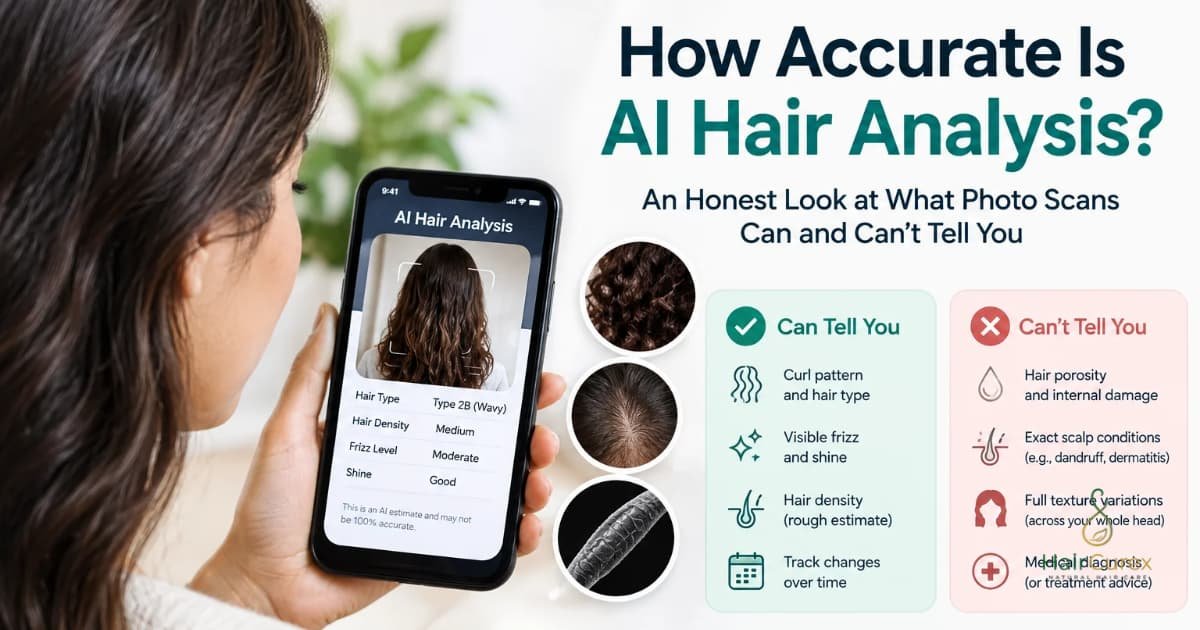
Open the App Store today and you’ll find dozens of apps promising to scan your hair and scalp with artificial intelligence. Take a few photos, wait a few seconds, and get a verdict on your hair type, density, damage level, and the products you should buy. It sounds almost too convenient. So the question worth asking before you trust one with your routine is simple: how accurate is AI hair analysis?
The honest answer is that it depends on what you’re asking the tool to do. AI is genuinely good at some jobs and unreliable at others. This guide breaks down how these tools work, what they do well, where they fall short, and how to get better results if you decide to use one. That is why AI hair analysis can feel impressively accurate one day and oddly off the next.
What Is AI Hair Analysis?
AI hair analysis is a form of computer vision. You upload one or more photos of your hair or scalp, and a trained model compares what it sees against thousands of labeled images. From that comparison, it estimates things like curl pattern, thickness, frizz, shine, density, and sometimes scalp condition.
These tools show up in a few different places:
- Consumer apps that scan your hair and build a personalized routine, often behind a subscription.
- Retail and brand tools that recommend shampoos, conditioners, and styling products on a store’s website.
- Salon technology that helps stylists classify a client’s texture before a consultation.
Industry providers describe their hair type models as being trained on thousands of images covering the full range from straight to extremely coily, typically sorting results into several curl categories. That training data is the foundation of everything the tool can and can’t do.
What AI Hair Analysis Does Well
1. Classifying Curl Pattern
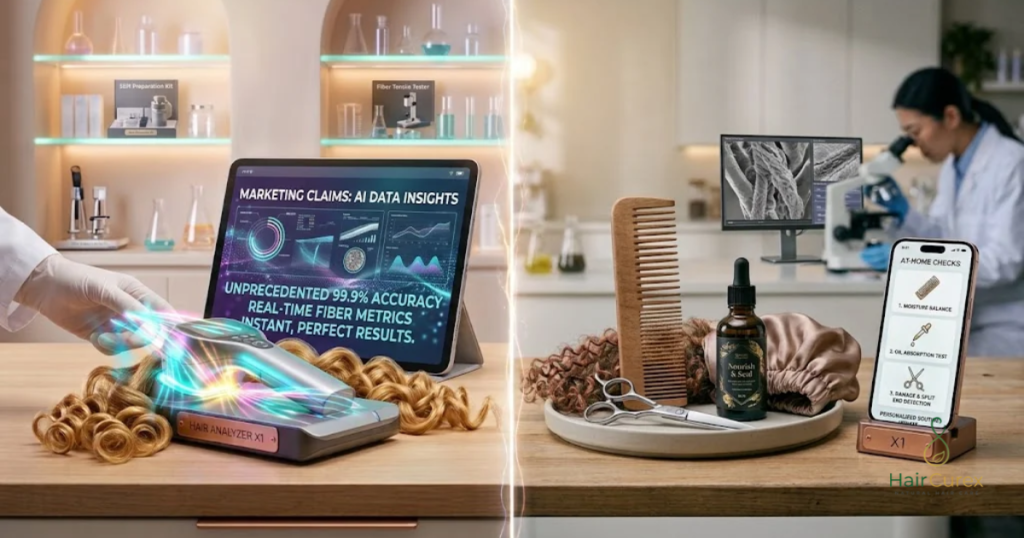
Curl pattern is the strongest use case. It’s a visual trait, and the difference between straight, wavy, curly, and coily hair is something a camera can capture. Many tools use the familiar Type 1 to Type 4 system, and some break that down further into subtypes such as 3A or 4C. If your hair is clearly one pattern and you take a clear photo, the result is usually a reasonable starting point.
2. Estimating Visible Frizz and Shine
Frizz and luster show up in images, so models can score them in a consistent way. That consistency is useful if you want to track whether a new routine is making your hair look smoother over several weeks.
3. Spotting Visible Density Changes
Some apps assess how much scalp is visible through your hair. This can give a rough sense of density and help you notice changes over time, as long as your photos are taken the same way each time.
4. Making Tracking Easier
Even when a single scan isn’t perfect, repeated scans under the same conditions can reveal trends. A tool that saves your past photos and compares them can be more valuable as a progress journal than as a one-time diagnosis.
Where AI Hair Analysis Falls Short

1. Mixed Textures
Many people don’t have one curl pattern. You might have tighter curls at the nape, looser waves at the crown, and straighter hair near the front. Photos capture a limited slice of your head, so a single result can oversimplify. Some tools try to handle this by scanning several sections, but results still vary from app to app.
2. Porosity and Internal Damage
Porosity describes how well your hair absorbs and holds moisture. It depends on the condition of the hair’s outer cuticle layer, and you can’t reliably judge it from a photo. Internal protein damage, chemical weakening, and heat damage are similarly hard to see. If an app claims to measure these from a selfie, treat that claim with caution. These traits are better assessed through hands-on tests or a professional’s examination.
3. Hair Color and Lighting
Photos are affected by lighting, camera quality, shadows, and filters. Very dark hair can hide texture detail in dim light, while bright light can make fine hair look thinner or shinier than it is. Dyed, bleached, or heavily styled hair adds another layer of confusion, because the model is partly judging the product or treatment rather than your natural strand.
4. Scalp Conditions
Apps that claim to evaluate scalp health are entering medical territory. Redness, flaking, and thinning can have many different causes, including dandruff, seborrheic dermatitis, psoriasis, hormonal changes, nutritional deficiencies, and stress. A photo-based tool can’t tell these apart with confidence. Notably, many of these apps include disclaimers stating that their output is informational only and not medical advice. Take that disclaimer seriously.
5. Bias in Training Data
An AI model is only as good as the images it learned from. If a dataset underrepresents certain hair types, skin tones, or ethnic backgrounds, accuracy drops for those users. This is a known challenge across computer vision, and it’s why results can feel spot-on for one person and completely off for another. Tools that explicitly train on the full range of textures, including tightly coiled hair, tend to be a better bet, but you should still verify the result against what you know about your own hair.
Marketing Claims vs. Real-World Reliability
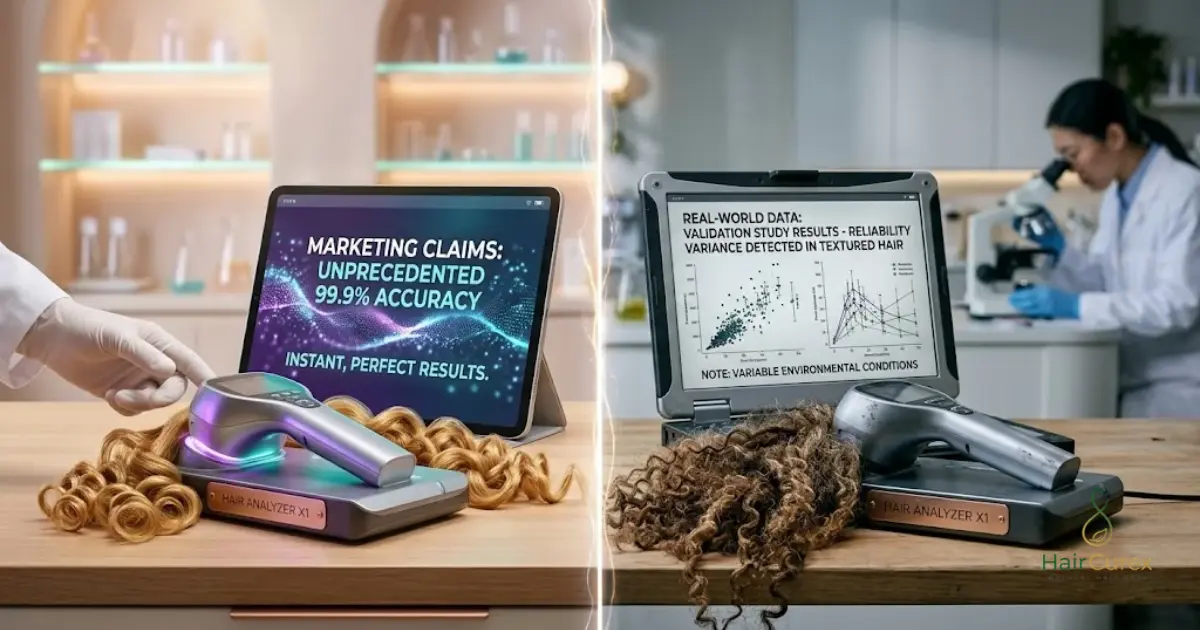
Many hair-analysis apps advertise “instant” and “comprehensive” results, but few publish independent accuracy figures. Most of what’s available is vendor-reported information about training data size and the number of categories a model can output. That tells you what the tool is built to do, not how often it’s right for a person like you.
When you evaluate any of these apps, look for:
- Transparency: Does the company explain how the model was trained and what it can’t do?
- Clear limits: Does it distinguish between cosmetic observations and medical conditions?
- Privacy practices: Hair and scalp photos are personal data. Check how long they’re stored and who can see them.
- Pricing clarity: Many apps offer a free scan but require a subscription to unlock the full report.
How to Get More Accurate Results From an AI Hair Scan
If you want to try a tool, you can improve your odds with a few simple habits.
- Use natural, even lighting. Daylight near a window works well. Avoid harsh overhead bulbs and strong shadows.
- Start with clean, product-free hair. Oils, gels, and sprays can change how your hair looks on camera.
- Take photos from several angles. Front, back, sides, and the top of the head give the model more information.
- Keep the camera steady and close enough to see strands. Blurry images lead to weak results.
- Scan different sections. If you suspect mixed textures, capture the crown, nape, and temples separately.
- Repeat under the same conditions. Same room, same time of day, same distance. Consistency makes comparisons meaningful.
- Compare against what you already know. If the result says “straight” but your hair clearly forms waves when air-dried, trust your experience.
Pair the Scan With Simple At-Home Checks
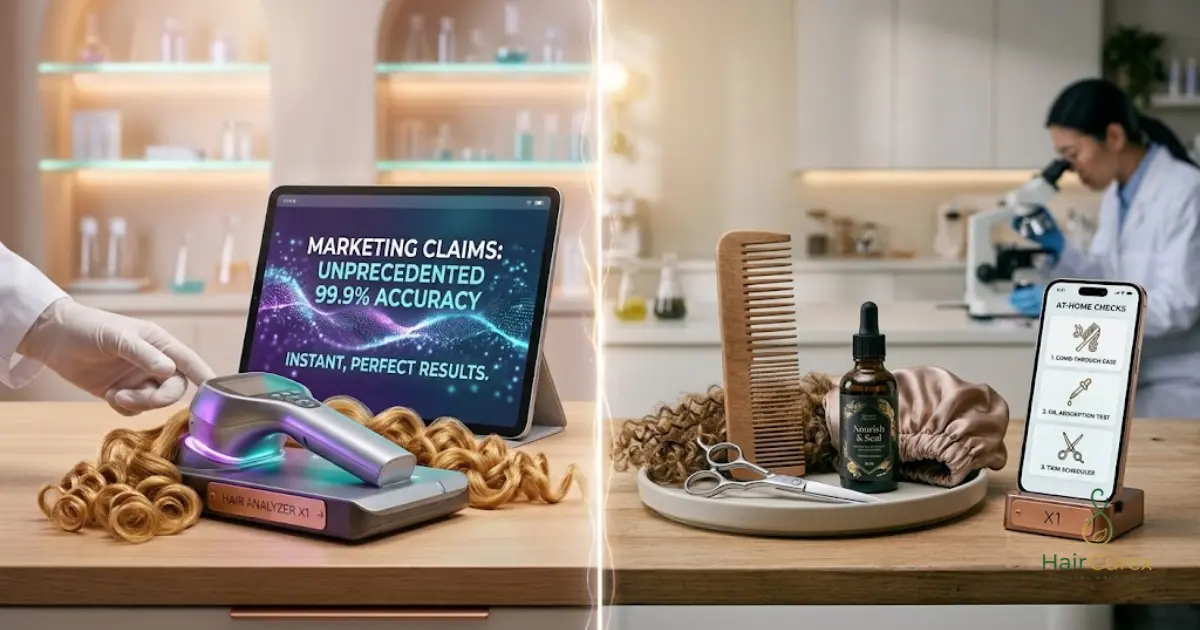
AI works best as a starting point, not the final word. You can fill the gaps with a few low-tech observations:
- Wash-day behavior: Notice how quickly your hair dries and how it responds to moisture.
- Product response: Pay attention to whether a conditioner leaves your hair soft or weighed down.
- Breakage patterns: Look at where strands snap and how often you find shorter broken pieces in your brush.
- Scalp comfort: Note itching, tightness, or flaking over several weeks rather than on a single day.
Combining these observations with an AI result gives you a much fuller picture than either one alone. That combination is where AI hair analysis earns its keep: the scan spots patterns, and your own observations add context.
When to Skip the App and See a Professional
Some situations call for a person, not an algorithm. Consider booking an appointment with a dermatologist or trichologist if you notice:
- Sudden or patchy hair loss
- A scalp that is persistently red, painful, scaly, or inflamed
- Noticeable thinning that keeps progressing over several months
- Hair changes alongside other health symptoms, such as fatigue or significant weight change
A photo-based tool can’t examine your scalp up close, review your medical history, or order tests. A professional can. If an app flags something that worries you, use it as a prompt to get checked, not as a diagnosis.
Is AI Hair Analysis Worth Trying?
For many people, yes, with realistic expectations. It can be a quick, low-effort way to put a name to your curl pattern, discover products that suit your texture, and track visible changes over time. It’s especially helpful if you’re new to hair care and don’t yet know your type.
It’s less helpful if you expect it to diagnose scalp problems, measure porosity, or predict hair loss with certainty. Those questions need more information than a photo can provide.
Final Thoughts
So, how accurate is AI hair analysis? Reasonably good at visual basics like curl pattern, frizz, and visible density, and noticeably weaker at anything that happens beneath the surface or involves your health. Lighting, hair color, mixed textures, and gaps in training data can all push results off course.
The smartest way to use these tools is as a conversation starter with your own hair. Take a clear scan, treat the output as an informed guess, test it against how your hair actually behaves, and bring in a professional when something doesn’t feel right. Used that way, AI can be a helpful part of a healthy hair routine without replacing your own judgment.
Frequently Asked Questions
Can AI really tell my hair type from a photo?
It can usually give a reasonable estimate of curl pattern when the photo is clear and well lit. Results are less dependable for mixed textures or heavily styled hair.
Can AI detect hair porosity?
Not reliably. Porosity depends on the condition of the hair cuticle, which is hard to judge visually. Hands-on observation is a better guide.
Are hair and scalp analysis apps safe to use?
The apps are generally cosmetic tools, but your photos are personal data. Read the privacy policy, and avoid relying on an app for medical decisions.
Can an app diagnose hair loss?
No. An app may track visible changes, but a dermatologist or trichologist is needed to identify the cause of hair loss.