

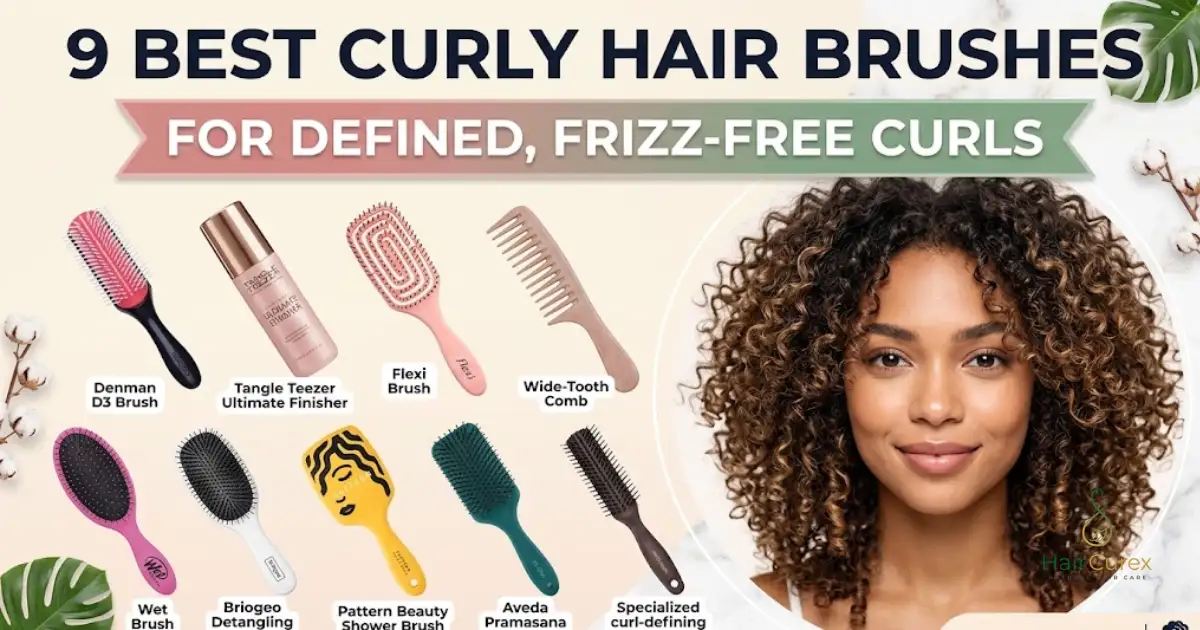
Finding the right curly hair brush can completely change your wash day. The right brush can help you detangle more easily, create better curl clumps, distribute styling products, reduce unnecessary pulling, and give your curls a more defined finish. The wrong one, however, can leave your hair puffy, tangled, stretched out, or more frizzy than when you started.
The important thing is that there is no single brush that works perfectly for every person with curly hair. A brush that gives beautiful, tight clumps on one head of hair may create too much tension on another. Your curl pattern, density, strand thickness, length, and styling goal all matter.
To make the decision easier, this guide compares 9 of the best brushes for curly hair and explains what each one is best suited for. Whether you want easier detangling, stronger curl definition, more volume, or smoother styling, you can find the right option for your routine.
Quick: There is no single best curly hair brush for everyone, and the best choice depends on your goal. For definition and styling, the Denman D3 is a versatile choice, while the Tangle Teezer Naturally Curly is better suited to detangling, and Bounce Curl is a strong option for curl definition and controlled clumping.
Best Curly Hair Brushes at a Glance
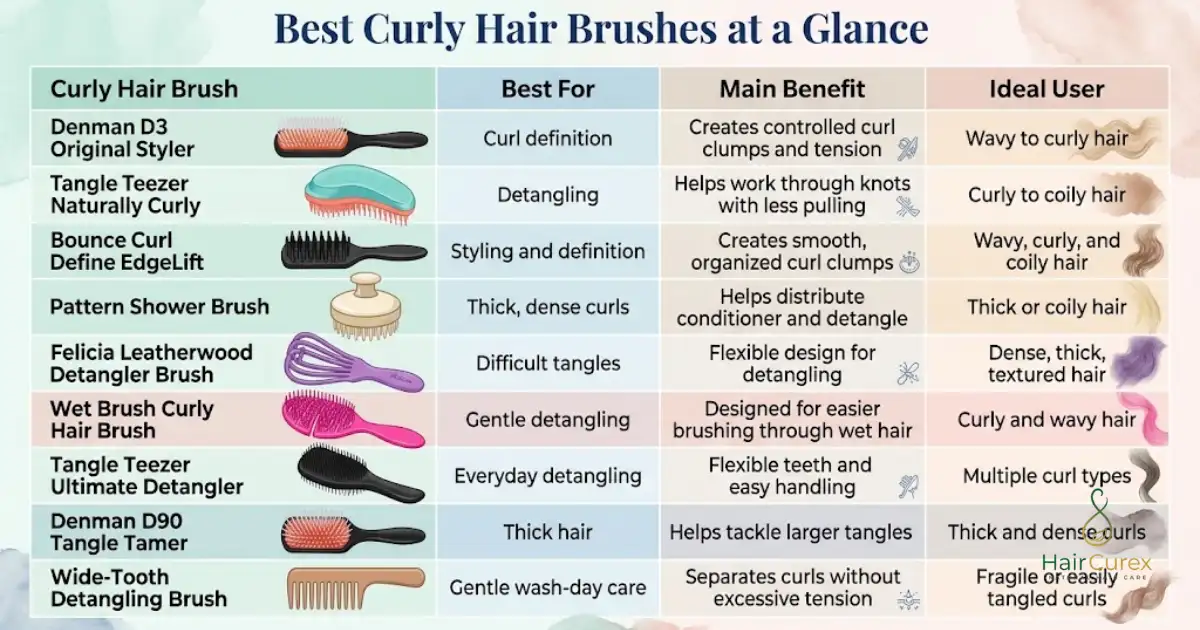
| Curly Hair Brush | Best For | Main Benefit | Ideal User |
|---|---|---|---|
| Denman D3 Original Styler | Curl definition | Creates controlled curl clumps and tension | Wavy to curly hair |
| Tangle Teezer Naturally Curly | Detangling | Helps work through knots with less pulling | Curly to coily hair |
| Bounce Curl Define EdgeLift | Styling and definition | Creates smooth, organized curl clumps | Wavy, curly, and coily hair |
| Pattern Shower Brush | Thick, dense curls | Helps distribute conditioner and detangle | Thick or coily hair |
| Felicia Leatherwood Detangler Brush | Difficult tangles | Flexible design for detangling | Dense, thick, textured hair |
| Wet Brush Curly Hair Brush | Gentle detangling | Designed for easier brushing through wet hair | Curly and wavy hair |
| Tangle Teezer Ultimate Detangler | Everyday detangling | Flexible teeth and easy handling | Multiple curl types |
| Denman D90 Tangle Tamer | Thick hair | Helps tackle larger tangles | Thick and dense curls |
| Wide-Tooth Detangling Brush | Gentle wash-day care | Separates curls without excessive tension | Fragile or easily tangled curls |
The best choice depends on what you actually need your brush to do. If detangling is your biggest problem, prioritize flexibility and easy movement through wet, conditioned hair. If your curls are already detangled and you want better definition, a styling brush with more controlled tension may be a better choice.
1. Denman D3 Original Styler — Best Overall Curly Hair Brush
The Denman D3 Original Styler is one of the most recognizable choices for curly hair because it can be used for both detangling and styling. Its multi-row design gives you more control over how your hair moves through the brush, making it particularly useful when your goal is defined, organized curls.
One of its biggest advantages is versatility. You can use it while your hair is wet and coated with conditioner or styling product, or use it as part of your curl-styling routine. The amount of tension you create while brushing can influence how tightly your curls form and how much volume you get.
The D3 is especially useful if you want to experiment with brush styling instead of simply brushing your hair from roots to ends. Working with smaller sections and rotating the brush slightly as you move through the hair can encourage curls to form into more defined clumps.
Why choose the Denman D3?
It is a strong choice if you want one brush that can help with detangling, smoothing, curl definition, and styling. It also gives you plenty of control over the final shape of your curls.
However, the same tension that helps create definition can be too much if you use it aggressively on fragile or severely tangled hair. Always make sure your hair has enough water and slip before working through difficult sections.
Best for: Definition, styling, wavy-to-curly textures, and people who want a versatile brush.
2. Tangle Teezer Naturally Curly — Best for Detangling Curly Hair
If your biggest wash-day problem is knots, the Tangle Teezer Naturally Curly deserves serious consideration. Unlike a traditional styling brush, its main purpose is to make detangling easier while working with curly and coily textures.
This distinction is important because detangling and curl styling are not exactly the same job. A brush designed to create beautiful curl clumps may not be the best tool for attacking a large knot.
The Naturally Curly version is designed specifically with curlier textures in mind. Its teeth help separate tangled hair while allowing you to work through the hair with less unnecessary pulling.
For best results, use it on wet hair with conditioner or a product that provides plenty of slip. Start at the ends and gradually work upward rather than forcing the brush from the roots through a tangled section.
Best for: Wash-day detangling, curly-to-coily hair, and people who struggle with knots.
3. Bounce Curl Define EdgeLift Brush — Best for Curl Definition
The Bounce Curl Define EdgeLift Brush is designed more specifically for curl styling. If your main goal is to create organized, smooth curl clumps rather than simply remove tangles, this type of brush can make a noticeable difference in your styling routine.
The design allows you to guide sections of hair and encourage curls to group together. This is particularly useful when your natural curl pattern looks uneven after applying your styling products.
Instead of dragging the brush randomly through your hair, divide your hair into manageable sections. Apply your leave-in conditioner, curl cream, mousse, or gel, then use the brush to shape each section. You can adjust the direction and tension depending on whether you want more definition, volume, or elongated curls.
The result depends heavily on technique. A styling brush is not a magic tool that automatically creates perfect curls. Your product application, water level, section size, and brush movement all affect the final result.
Best for: Defined curl clumps, brush styling, and polished-looking curls.
4. Pattern Shower Brush — Best for Thick and Dense Curly Hair
Thick curly hair often needs a brush that can handle a large amount of hair without making detangling feel like a battle. A shower brush can be particularly useful because conditioner and water provide the slip needed to move through dense curls.
The Pattern Shower Brush is a practical option for people who prefer to detangle while conditioning their hair. Rather than waiting until your hair is partially dry, you can work through sections while your curls are fully saturated.
This can also help distribute conditioner more evenly. When your hair is extremely dense, divide it into several sections instead of trying to brush everything at once.
Remember that density and curl pattern are different things. Someone with loose curls can have extremely thick hair, while someone with tight curls can have fine, low-density strands. Choose the brush according to both factors.
Best for: Thick, dense curls and conditioner-based detangling.
5. Felicia Leatherwood Detangler Brush — Best for Difficult Tangles
When your hair tangles easily, flexibility becomes one of the most important features to look for in a curly hair brush.
The Felicia Leatherwood Detangler Brush is known for its flexible design and is often considered by people with thick, textured, and highly curly hair who need help getting through difficult knots.
The key is not to treat a detangling brush like a regular everyday brush. Your goal is to gently separate the hair rather than repeatedly forcing the brush through resistant areas.
Apply plenty of conditioner or detangling product, divide your hair into sections, and work from the ends upward. If you encounter a knot that does not move, add more slip and gently separate the section with your fingers before brushing again.
Best for: Dense curls, coils, stubborn tangles, and wash-day detangling.
6. Wet Brush Curly Hair Brush — Best for Gentle Wet Detangling
For people who prefer to detangle their curls while they are wet, a brush designed for wet hair can be much more comfortable than using a stiff traditional brush.
The Wet Brush Curly Hair Brush is a good option when you want a simple detangling tool that fits naturally into your shower routine.
Wet curly hair is not automatically protected from damage. If you pull aggressively, repeatedly brush through dry areas, or start at the roots when the ends are heavily tangled, you can still create unnecessary mechanical stress.
Use the brush slowly and let your conditioner provide the slip. The less resistance you feel, the easier the detangling process becomes.
Best for: Wet detangling and people who want a straightforward wash-day brush.
7. Tangle Teezer Ultimate Detangler — Best Everyday Detangling Brush
The Tangle Teezer Ultimate Detangler is another useful choice if you want a flexible brush for regular detangling rather than a specialized curl-defining tool.
Its biggest advantage is convenience. You can use a detangling brush like this during your wash routine when your hair is wet and conditioned, helping separate knots before you move on to styling.
It can also be useful if you have different curl patterns throughout your head. Instead of trying to force every section into the same curl pattern, you can focus on gently detangling first and then allow your natural texture to form during styling.
For tighter curls, however, make sure you choose a version appropriate for your density and texture rather than assuming every detangling brush will perform the same way.
Best for: Everyday detangling, mixed curl patterns, and easy wash-day maintenance.
8. Denman D90 Tangle Tamer — Best for Thick Hair
If your main problem is not curl definition but getting through a thick head of hair, the Denman D90 Tangle Tamer is worth considering.
A detangling-focused brush can make more sense than a curl-defining brush when your hair has a lot of density. Trying to create perfect curl clumps before your hair is properly detangled can make the styling process much harder.
The D90-style approach is about getting through tangles efficiently while reducing the need to repeatedly pull through the same area.
Once your hair is detangled, you can switch to a curl-defining brush if you want more controlled clumps. This two-brush approach can be especially useful for people with thick curls.
Best for: Thick, dense hair and larger tangles.
9. Wide-Tooth Detangling Brush — Best for Gentle Curl Care
Sometimes the best curly hair brush is the one that creates the least resistance.
If your hair is fragile, frequently colored, damaged, or prone to breakage, a wide-spaced detangling tool can be a sensible choice. Wider spacing allows you to separate sections without aggressively compressing the curl pattern.
This type of brush is especially useful for people who care more about gentle detangling than highly polished curl definition.
You may not get the same tight, uniform clumps that you can achieve with a specialized styling brush, but that can actually be an advantage if your goal is soft, natural-looking curls.
Best for: Fragile curls, gentle detangling, and minimizing unnecessary manipulation.
Curly Hair Brush: Detangling Brush vs Styling Brush
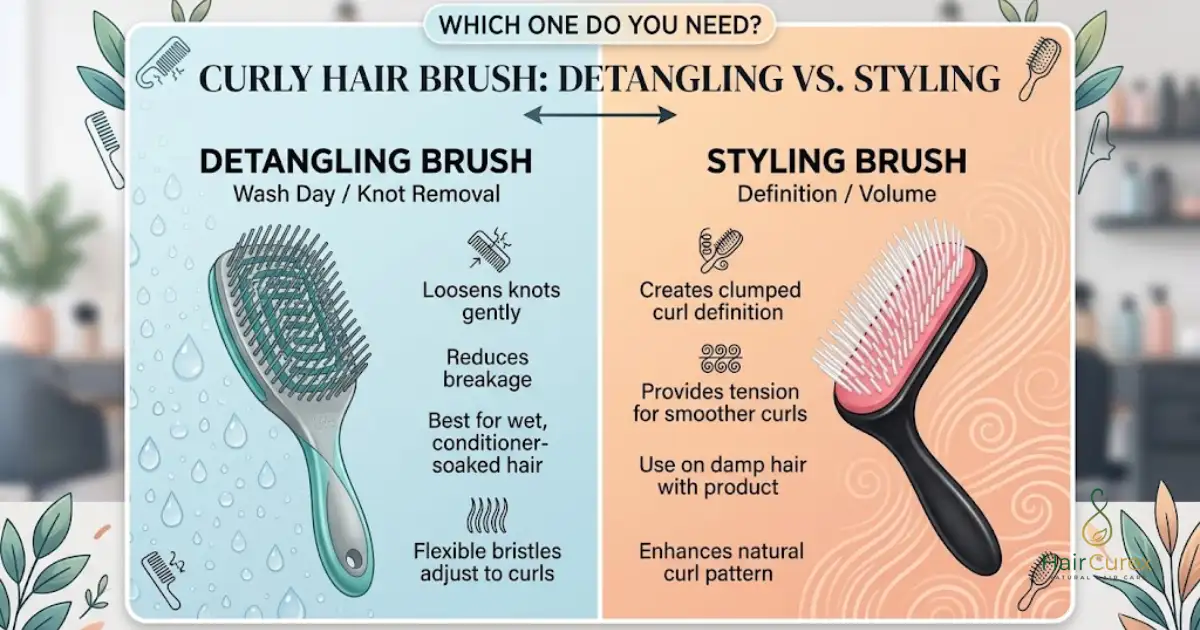
This is one of the most important decisions you can make before buying a brush.
A detangling brush is primarily designed to help remove knots and separate your hair. A styling brush is designed to shape sections, encourage curl clumps, smooth the hair, and influence the final appearance of your curls.
Trying to use one brush for everything is not always the best approach.
If your hair becomes extremely tangled during wash day, start with a detangling brush. Once your hair is smooth and separated, use a styling brush if you want stronger definition.
For some people, having two brushes actually makes more sense than trying to find one “perfect” brush.
Which Curly Hair Brush Is Best for Your Curl Type?
Your curl pattern can help narrow down your options, but it should not be the only thing you consider.
Best Brush for 2A–2C Wavy Hair
Wavy hair can lose volume easily when you use too much tension. A flexible detangling brush or a styling brush used lightly can work well.
If you want more definition, apply your styling product to wet hair and use a brush only on small sections. Avoid repeatedly brushing the entire head because that can separate natural wave clumps and make the finished style look fluffy.
Best Brush for 3A–3B Curls
For loose to medium curls, a styling brush such as a Denman-style or curl-defining brush can help create more organized ringlets.
The key is finding the right balance between definition and volume. More tension and smaller sections generally create a more controlled appearance, while less manipulation can leave you with a softer, fuller finish.
Best Brush for 3C Curls
3C hair often benefits from a combination of effective detangling and careful styling.
If your hair tangles easily, prioritize a flexible detangling brush during conditioning. Once the knots are gone, use a curl-defining brush if you want more uniform clumps.
Best Brush for 4A–4C Hair
For tighter coils, gentle detangling becomes especially important. Look for a brush that works well with wet, conditioned hair and does not require excessive force.
A brush specifically designed for curly-to-coily textures can be more appropriate than a standard styling brush. Work in small sections and keep enough moisture and slip in the hair.
How to Choose the Best Curly Hair Brush
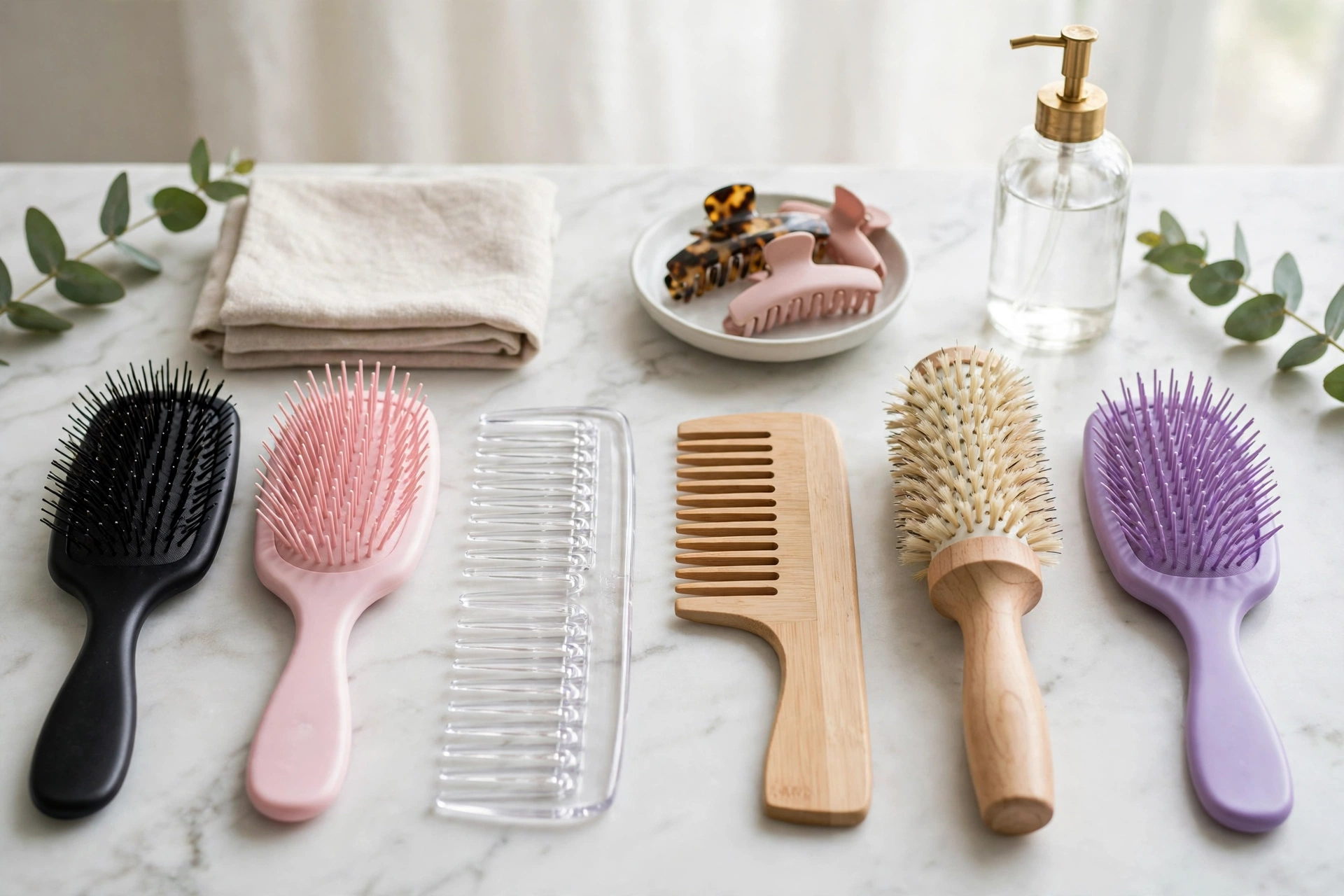
Before buying a curly hair brush, think about what you want it to accomplish.
| Your Main Problem | What to Look For |
|---|---|
| Tangled hair | Flexible detangling teeth |
| Frizz during styling | Smooth, controlled brush movement |
| Weak curl definition | Styling brush with controlled tension |
| Thick hair | Brush that can handle dense sections |
| Fine curls | Lightweight, gentle brush |
| Coily hair | Curl-friendly detangling design |
| More volume | Less tension and larger sections |
| Smaller curl clumps | More controlled styling and smaller sections |
| Product distribution | Brush that works well on wet, conditioned hair |
You should also consider hair density, strand thickness, length, porosity, and damage level. Two people with the same curl pattern can need completely different brushes.
For example, fine 3B hair may need much gentler handling than thick 3B hair. Likewise, long curls may need more sectioning than short curls.
How to Use a Curly Hair Brush Without Creating Frizz
The brush itself is only part of the equation. Technique matters just as much.
Start with sufficiently wet hair. Curly hair generally becomes easier to manipulate when it has plenty of moisture and product slip.
Apply your conditioner or styling product evenly, then divide your hair into manageable sections. Avoid taking an enormous section and expecting one pass to detangle or style it perfectly.
When detangling, begin at the ends. Work upward gradually as the lower portion becomes smooth. This prevents you from pushing an existing knot farther down the hair.
When styling, use the brush on smaller sections. Keep the hair wet enough for the brush to glide through instead of dragging across dry strands.
If you want defined curls, brush the section in the direction you want it to fall and gently encourage the hair into a curl clump. After releasing the brush, scrunch the section if your routine calls for it.
Finally, leave the curls alone while they dry. Constantly touching or brushing them after they begin drying can disrupt the curl pattern and increase frizz.
How to Get More Defined Curls With a Brush
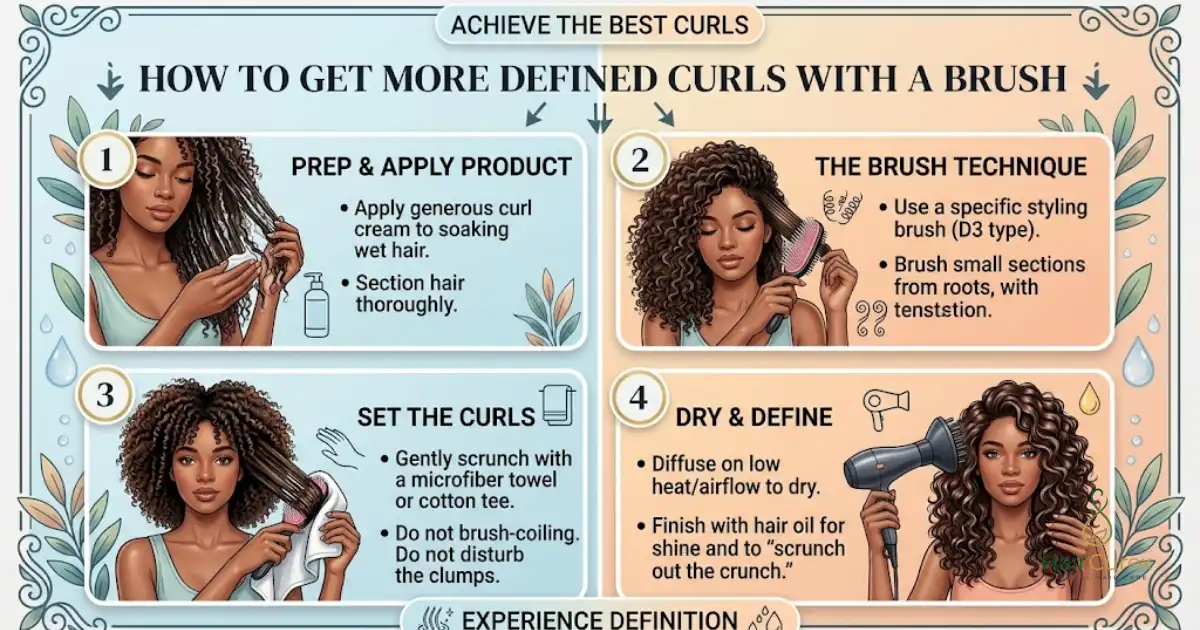
Brush styling works best when your hair already has enough moisture and product.
Start by applying your preferred leave-in conditioner or styling product. Then separate your hair into sections.
Take one section and brush from near the roots toward the ends while keeping the hair under controlled tension. Depending on your brush, you can slightly rotate or curve the brush as you move through the section.
Watch what your curls are doing rather than blindly repeating the same motion.
If the section forms a curl clump naturally, leave it alone. If it looks too stretched, reduce the tension. If it looks too fluffy, try a smaller section or slightly more product.
Once the entire head is styled, scrunch gently and allow your curls to dry.
How to Use a Curly Hair Brush for Volume
More definition does not always mean more volume.
If you want bigger, fuller curls, avoid making every section extremely small. Larger sections can create a softer, more natural look.
You can also reduce the amount of tension used while brush styling. Excessive tension can stretch curls and make them appear longer and less voluminous.
After styling, allow your hair to dry completely before separating or fluffing the roots.
The goal is to create definition without flattening the natural shape of your hair.
Can You Brush Curly Hair Every Day?
You can brush curly hair when your routine requires it, but you generally do not need to repeatedly brush dry curls every day.
Dry brushing can separate curl clumps and turn a defined style into a much puffier one. It can also create unnecessary mechanical manipulation.
For most curly routines, brushing is most useful during wash day or styling when the hair is wet and has enough slip.
Between wash days, you can refresh curls with water and a small amount of styling product instead of completely brushing the hair from root to tip.
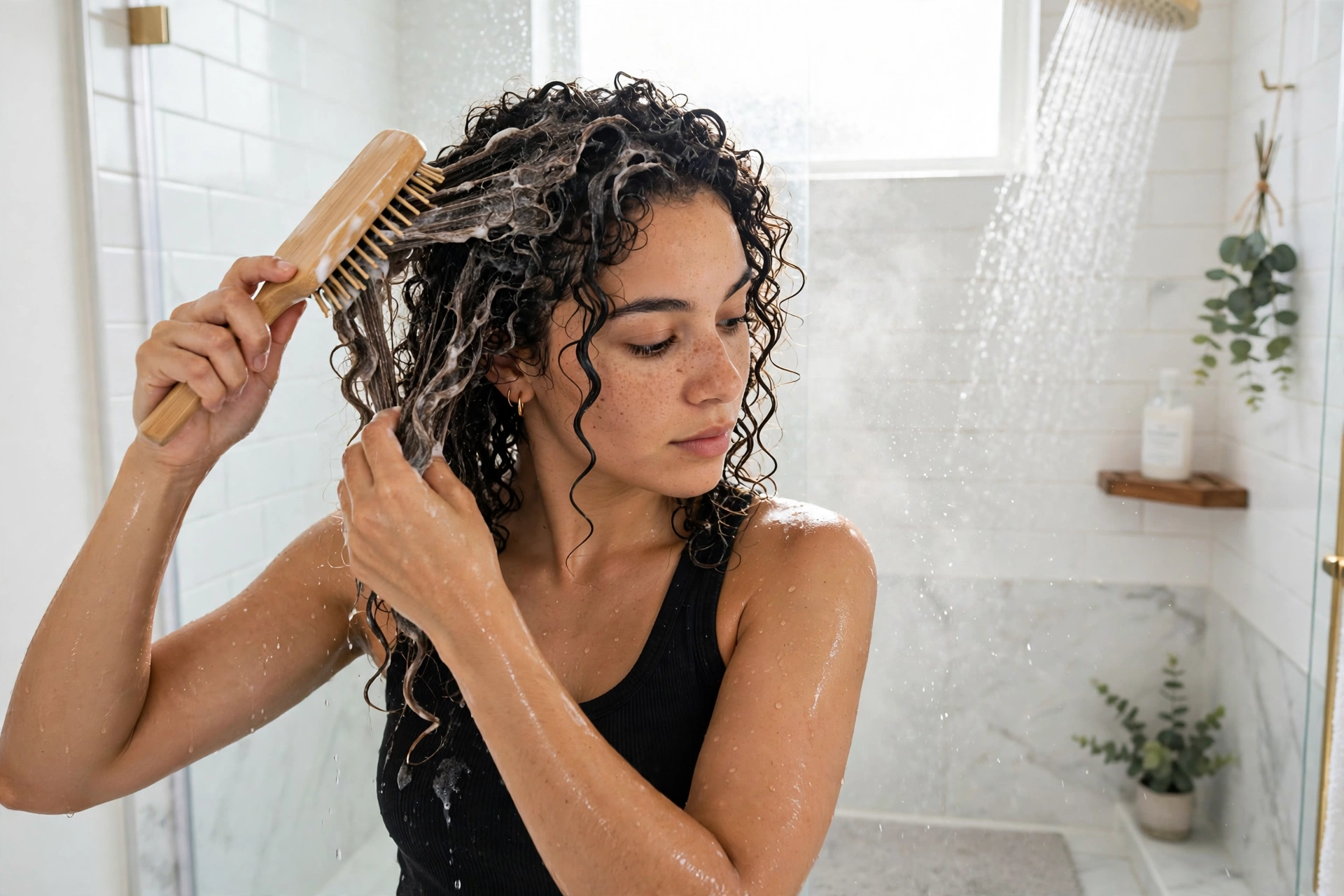
Should You Brush Curly Hair Wet or Dry?
For most detangling routines, wet or very damp hair with sufficient conditioner or product slip is easier to manage than dry, tangled curls.
This does not mean every curly-haired person must brush soaking-wet hair. Your ideal moisture level depends on your texture and routine.
The important point is to avoid forcing a brush through hair that feels dry, rough, or resistant.
If the brush catches repeatedly, stop and add more moisture or product rather than increasing force.
How Often Should You Replace a Curly Hair Brush?
There is no universal replacement schedule.
Instead, inspect the brush regularly. If teeth become bent, cracked, sharp, damaged, or uneven, it is time to replace it.
Product buildup also matters. A brush used frequently with conditioner, gel, cream, mousse, or oil should be cleaned regularly.
A clean brush performs more predictably and prevents old product residue from being repeatedly transferred back onto freshly washed hair.
Common Curly Hair Brush Mistakes
One of the biggest mistakes is choosing a brush based only on what looks popular online.
A viral brush may produce beautiful results on one curl pattern and still be completely wrong for your hair.
Another mistake is brushing through large knots with excessive force. If the brush is not moving, the solution is usually more moisture, more slip, smaller sections, or finger detangling—not more pressure.
Using a styling brush on severely tangled hair is another common problem. Detangle first, then style.
Finally, do not assume that more brushing creates better curls. Brush styling is about controlled manipulation. Once the curl clump looks good, continuing to brush it can actually make the result worse.
Denman vs Tangle Teezer vs Bounce Curl: Which Is Better?
These three brushes are often compared because they serve overlapping but different purposes.
The Denman D3 is a strong choice when you want versatility and controlled curl definition. It can be used for both detangling and styling, depending on your technique.
The Tangle Teezer Naturally Curly makes more sense when your priority is detangling curly or coily hair. Its role is less about creating a specific curl shape and more about helping you get through knots with less struggle.
The Bounce Curl Define EdgeLift is more focused on styling and curl definition. It is a good choice when you already understand your curl routine and want more control over the shape and clumping of individual sections.
So there is no universal winner.
Choose Denman for versatility, Tangle Teezer for detangling, and Bounce Curl for dedicated curl definition.
Frequently Asked Questions
What is the best curly hair brush?
The best curly hair brush depends on your goal. The Denman D3 is a versatile choice for definition and styling, while a Tangle Teezer Naturally Curly is better suited to detangling. Bounce Curl is a strong option when curl definition and controlled clumping are your main priorities.
Is a Denman brush good for curly hair?
Yes. A Denman-style brush can be useful for detangling and defining curls, particularly when used on wet hair with enough product slip. The amount of tension and section size can change the final result.
What brush is best for detangling curly hair?
A flexible detangling brush is generally a better choice than a stiff styling brush when knots are your main concern. Tangle Teezer, Felicia Leatherwood, Wet Brush, and other curl-friendly detangling designs can work well depending on your hair’s density and texture.
Should I brush curly hair before or after applying products?
For many curl routines, applying conditioner or a styling product before brushing provides additional slip and makes detangling or styling easier. The exact order depends on your routine and the products you use.
Can brushing curly hair cause frizz?
Yes, especially if you repeatedly brush dry curls or use too much tension. Brush styling on wet hair with adequate product slip can help you create more controlled curl clumps.
Can I use the same brush for detangling and styling?
You can, but you do not have to. A versatile brush can handle both jobs, while using a separate detangling brush and styling brush can give you better control if your hair is thick or difficult to detangle.
What is the best brush for thick curly hair?
Thick curly hair generally benefits from a brush that can handle density without excessive pulling. Flexible detangling brushes are useful for wash day, while a separate styling brush can be used afterward for curl definition.
What is the best brush for fine curly hair?
Fine curls usually benefit from gentle handling and controlled tension. Avoid repeatedly pulling through the same section, and choose a brush that can detangle without requiring excessive force.
Final Verdict: Which Curly Hair Brush Should You Choose?
The best curly hair brush is not necessarily the most expensive, most viral, or most popular option. It is the one that matches what your hair actually needs.
If you want an all-around option for styling and curl definition, the Denman D3 Original Styler is an excellent place to start. If tangled hair is your biggest problem, choose a dedicated detangling brush such as the Tangle Teezer Naturally Curly. If your priority is polished curl clumping and brush styling, the Bounce Curl Define EdgeLift is worth considering.
For thick or highly textured hair, focus first on gentle detangling and adequate moisture. For fine curls, prioritize low tension and avoid unnecessary brushing. And if you want maximum definition, remember that your technique, water level, styling products, and section size can matter just as much as the brush itself.
Ultimately, the right brush should make your routine easier, not harder. When your brush glides through your hair instead of fighting it, your curls have a much better chance of looking defined, soft, healthy, and naturally full.