


Quick answer: Pink hair looks best when the shade matches your skin tone and your starting hair colour: pastel pink and rose gold suit fair to medium skin, while hot pink and magenta flatter deeper skin tones and darker hair. Most pink shades need lightened, pale-blonde hair underneath, so dark hair usually needs bleach first. Semi-permanent pink dye is the safest way to try it at home — it washes out in about 4 to 8 weeks — and it lasts longest when you wash with cold water and sulfate-free shampoo, and wash only 2 to 3 times a week.
Pink hair has gone from a bold statement to one of the most-searched fantasy hair colours, and for good reason: there is a pink for almost everyone, from a soft pastel that reads like a whisper of colour to a vivid hot pink that turns heads from across the street. The reason so many pink dye jobs disappoint is not the colour itself — it is the preparation. Pink is a translucent colour, which means it sits on top of your hair rather than covering it up, so whatever is underneath shows through. Get the base right, pick a shade that works with your skin tone, and follow a colour-safe routine afterwards, and pink hair can look salon-fresh for weeks. This guide covers all three steps: the shades, the dyeing, and the care that makes it last.
Pink Hair Shades: Which Pink Suits You?

Choosing a pink hair shade starts with two things: your skin tone and how light your hair is now. Fair skin with cool undertones suits icy pastel pink and dusty pink, because the cool tones match. Warm or olive skin suits rose gold and peach pink, because the warm gold in those shades flatters the skin. Medium and deep skin tones can carry the boldest pinks — hot pink, magenta and neon pink — because the contrast makes both the colour and the skin glow. If you are unsure of your undertone, look at the veins on the inside of your wrist: blue or purple veins usually mean cool undertones, green veins usually mean warm undertones, and a mix of both means neutral, which can wear almost any pink.
Your starting hair colour matters just as much. Pastel and light pinks only show up true on very light, pale-blonde hair — on medium brown hair they barely register, and on dark hair they do not show at all. Deeper pinks like magenta and hot pink are more forgiving and will show on light brown hair, though they still look richer and truer on a lightened base. The table below is the fastest way to narrow it down.
| Shade | Best for | Base hair needed | Typical lasting time |
|---|---|---|---|
| Pastel pink | Fair, cool skin; soft, romantic look | Pale blonde (level 9–10) | 2–4 weeks |
| Rose gold pink | Warm and olive skin; most wearable pink | Light blonde (level 8–9) | 4–6 weeks |
| Bubblegum pink | Fair to medium skin; playful, bright | Light blonde (level 8–9) | 3–5 weeks |
| Hot pink | Medium to deep skin; bold statement | Light brown to blonde (level 7+) | 4–6 weeks |
| Magenta pink | Deep skin tones; rich, jewel-toned | Light brown to blonde (level 7+) | 4–8 weeks |
| Dusty pink | Cool skin; muted, grown-up pink | Light blonde (level 8–9) | 3–5 weeks |
| Peach pink | Warm skin; soft sunset tones | Light blonde (level 8–9) | 3–5 weeks |
| Pink ombré / balayage | Anyone wanting low commitment | Any, pink on the ends only | 6–8 weeks |
| Neon pink | Boldest look; festivals and photos | Pale blonde (level 9–10) | 3–5 weeks |
| Rose pink | Neutral skin; classic pink | Light blonde (level 8–9) | 4–6 weeks |
If you cannot decide between two shades, go with the deeper one. Pastel pink is the hardest pink to keep looking good: it fades fastest, shows uneven patches most easily, and needs the lightest base. A rose gold or bubblegum pink gives you the same pink feeling with far less upkeep, and it fades into a pretty pastel on its own as it washes out. If pink feels like a big leap, try a pink ombré or balayage first — the colour sits on the ends, your roots stay natural, and you can cut it off if you change your mind. And if you love warm, wearable colour in general, our guide to strawberry blonde hair covers another pink-toned shade that suits a similar range of skin tones.
Do You Need to Bleach Your Hair for Pink Hair?

For most people, yes — pink hair needs bleach first, because pink dye is translucent and cannot lift your natural colour. On dark brown or black hair, pink dye applied directly will barely be visible in daylight and invisible indoors. On medium brown hair, a deep magenta may show as a subtle tint, but a pastel or rose gold will not. The only people who can skip bleach are those whose hair is already light blonde, or those using a very deep pink on light brown hair and happy with a subtle result.
The rule is simple: the lighter and more even your base, the truer and brighter the pink. A pale, even blonde base (about level 9 or 10) is what pastel pink needs. A level 8 blonde is enough for rose gold, bubblegum and dusty pink. Level 7 — a light brown — works for hot pink and magenta. If your hair has old dark dye on it, that matters too: dye does not lift dye, so previously coloured hair usually needs a colour remover or extra lightening before pink will take evenly. This is the step where most at-home pink jobs go wrong, and it is also the step where a salon earns its fee — a colourist can lift your hair evenly without the patchiness and breakage that come from overlapping bleach at home.
Bleach is the most damaging part of the whole process, so be honest about your hair’s condition before you start. If your hair is already fragile, very fine, or has been bleached or relaxed recently, get a professional opinion first — a strand test will tell you in 20 minutes whether your hair can handle the lift. Healthy hair that has never been coloured usually lightens well; hair that has been coloured many times, or that snaps easily when wet, may need a slower approach over two sessions, or a deeper pink shade that needs less lift. Whatever you decide, do not bleach the same section twice in one day, and never leave bleach on longer than the product instructions say in the hope of getting lighter — it will not get lighter, it will only get weaker.
How to Dye Your Hair Pink at Home
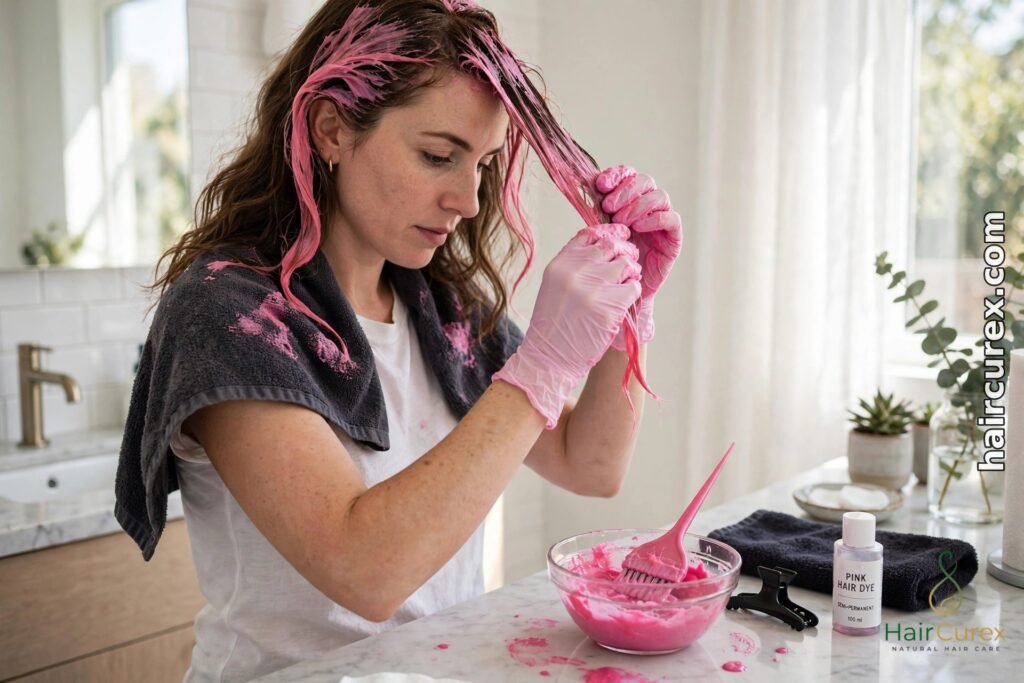
Semi-permanent pink dye is the best choice for dyeing at home: it needs no developer, it deposits colour without lifting your natural pigment, and it washes out gradually instead of growing out with a hard line. That makes it the lowest-risk way to try pink hair, and it is also why most pink dyes sold for home use are semi-permanent. L’Oréal Paris has a step-by-step guide to dyeing hair pink at home that covers the same preparation and application order used below: L’Oréal Paris on how to dye hair pink.
Start with clean, dry hair that has not been washed for a day — the natural oils protect your scalp, and dye grips better on hair that is not freshly conditioned. Do a patch test 48 hours before, on the inside of your elbow or behind your ear, and a strand test on a hidden section, so you know both that you are not allergic and what the colour will actually look like on your base. Protect your skin with petroleum jelly around the hairline and ears, wear the gloves that come with the dye, and wear an old dark towel and shirt, because pink dye stains skin, clothes and bathroom grout with enthusiasm. If any dye gets on your skin, our guide to how to get hair dye off skin covers the methods that actually work.
Work in sections, starting at the back of your head and moving forward, and apply the dye generously — pink is unforgiving about missed spots, and a thin, patchy application is the most common reason home pink jobs look uneven. Saturate each section fully, comb the dye through with a wide-tooth comb, and check the roots and the hairline in a mirror, because those are the places people miss. Leave the dye on for the full time on the packet — usually 20 to 30 minutes — and do not rinse early: semi-permanent dye keeps depositing colour the whole time it is on. Rinse with cool water until it runs mostly clear, skip the shampoo for that first rinse, and condition as usual. Then wait at least 48 hours before your first proper wash, so the colour has time to settle into the hair.
Two mistakes are worth avoiding. First, do not mix different brands of pink dye hoping for a custom shade unless you have tested the mix on a strand — different formulas can react differently and the result can be patchy. Second, do not apply pink dye over hair that still has old colour in it and expect an even result: the pink will look different over the old colour than over your natural hair, so the ends and the roots will not match. If your hair is not one even colour to start with, the pink will not be one even colour either.
Pink Hair at the Salon: What to Ask For
A salon is the right choice if your hair is dark, previously coloured, very long, or fragile — or if you want a pastel, an ombré, or a multi-tone pink that is hard to do evenly at home. Bring photos of the exact shade you want, in daylight if possible, because salon lighting makes colours look different from how they look outside. Ask whether the colourist will do a strand test first, how many lightening sessions your hair will need, and what the total price includes — lightening, toning, the pink application and a bond treatment are often priced separately, so a quote for “pink hair” can mean different things. A full pink transformation at a U.S. salon typically runs from about $150 to $400 or more depending on your hair length, your starting colour and your city, with pastel work at the higher end because it needs the lightest base.
Ask three specific questions before they start: what level will they lift your hair to, what will they do if the pink fades unevenly, and how should you care for it at home. A good colourist will tell you the lift level honestly — if they promise pastel pink on dark hair in one session without a test, be cautious. Also ask about maintenance appointments: most salons offer a cheaper colour refresh or gloss between full appointments, which is usually the best value way to keep pink hair looking fresh. And if you are comparing pink with other fashion colours, our guide to red hair dye covers the closest cousin to pink — red fades in a similar way, and the care routine is almost identical.
How to Make Pink Hair Last Longer

Pink is one of the fastest-fading hair colours, because the pink pigment molecules are large and sit near the surface of the hair, so every wash lifts some of them out. That is not a flaw in the dye — it is how pink works — and the care routine below is what stands between pink that lasts two weeks and pink that lasts six.
Wash less, and wash cold. Every wash fades pink, so stretching washes to 2 or 3 times a week makes the biggest single difference. When you do wash, use cool or lukewarm water — hot water opens the hair cuticle and lets the colour escape faster. Use a sulfate-free, colour-safe shampoo, because sulfates strip colour aggressively, and skip clarifying shampoos entirely while you are pink. Dry shampoo between washes keeps your roots fresh without a full wash, and a shower cap on non-wash days keeps the colour dry in the shower. The American Academy of Dermatology’s healthy-hair guidance covers the same gentle-washing basics that matter most for coloured hair: American Academy of Dermatology healthy hair tips.
Protect the colour from heat and sun. Heat styling opens the cuticle the same way hot water does, so use a heat protectant every time you use a dryer, straightener or curler, and keep the temperature as low as you can. Sunlight fades pink fast, so wear a hat or use a UV-protectant hair spray on sunny days, and rinse your hair with fresh water before and after swimming — chlorine and salt water both strip pink quickly, and wetting your hair first means it absorbs less pool or sea water. Deep condition once a week: bleached hair underneath pink dye is thirsty, and conditioned hair holds colour better than dry, porous hair. Finally, refresh the colour with a pink colour-depositing conditioner or a diluted drop of your semi-permanent dye mixed into conditioner every couple of weeks — it tops the colour back up in the shower in about five minutes, and it is the cheapest way to stretch a dye job by weeks.
How Long Does Pink Hair Last?

How long pink hair lasts depends on the shade, the dye type and how often you wash. Pastel pink is the shortest-lived, usually 2 to 4 weeks, because it is the lightest shade and has the least pigment to lose. Rose gold, bubblegum and hot pink usually last 3 to 6 weeks. Magenta and other deep pinks last longest, often 4 to 8 weeks, because they start with more pigment. Pink ombré and balayage last the longest of all in practice, because the colour is only on the ends and the fade is gradual rather than obvious at the roots.
Semi-permanent dye fades a little with every wash and never leaves a hard root line, which is why it is the most forgiving option — the colour simply gets softer over time. Demi-permanent and permanent pink dyes last longer, but they grow out with a visible line and they are harder to remove if you change your mind. The honest expectation for most people is this: your pink will look its best for the first two weeks, good for the next two, and noticeably softer after that. That is normal, and it is why a colour-depositing conditioner is worth buying at the same time as the dye — a five-minute refresh every couple of weeks keeps the colour in the “good” zone for much longer than the dye alone would.
How to Remove Pink Hair Dye
Removing pink hair dye is easier than removing most fashion colours, because pink fades on its own — but if you want it gone faster, there are safe ways to speed it up. Washing with a clarifying shampoo a few times will lift a lot of semi-permanent pink, as will hot water and a long soak. A vitamin C treatment — crushed vitamin C tablets mixed into shampoo, left on for 30 to 60 minutes — fades pink noticeably without bleach, and it is gentle enough to repeat. A colour remover made for semi-permanent dye will take out more, though it can leave the hair feeling dry, so deep condition afterwards.
What not to do: do not bleach pink out of your hair just to remove it. Bleach over pink can push the pigment deeper and turn it an odd orange or peach tone that is harder to fix than the pink was. And do not dye over pink with a darker colour expecting it to disappear — pink shows through most dark dyes as a warm tint, so the result is usually a muddy version of the new colour. If you want to go back to your natural colour, fade the pink out first with washes or a colour remover, then dye over the faded result. If the pink will not budge, or your hair is already fragile from bleaching, a salon colour correction is worth the cost — it is cheaper than fixing a home attempt that went wrong.
Is Pink Hair Damaging?
Pink dye itself is not very damaging: semi-permanent pink dye has no ammonia and no developer, so it does not lift or break down the hair the way permanent colour does. The damage in a pink hair transformation comes almost entirely from the bleach needed to lighten the hair first. Bleach opens the hair cuticle and removes pigment, which makes hair drier, more porous and more likely to break — and the lighter the base you need, the more lifting that takes. Pastel pink needs the most bleach and therefore the most damage risk; hot pink and magenta need less, and pink ombré needs the least, because only the ends are lightened.
You can keep the damage manageable. Do not bleach hair that is already damaged, and space lightening sessions at least a few weeks apart rather than doing them back to back. Use a bond-building treatment during and after bleaching — most salons offer one, and there are home versions too — and deep condition weekly once you are pink. Cut back on heat styling while your hair recovers, and get a small trim after the colour is done to remove any ends that went straw-like. If you are choosing between pink shades, remember that the deeper the pink, the less bleach you need, and the less bleach you need, the healthier your hair stays. That trade-off is the real reason rose gold and magenta are the most popular pinks: they look striking and they ask less of your hair.
Pink hair is a commitment, but it is a forgiving one. The dye itself is gentle, it fades gracefully instead of growing out with a line, and if you hate it, it washes out in weeks. Pick the shade that suits your skin tone, get the base light enough for it to show true, and wash it cold and rarely — and your pink hair will stay bright far longer than most people expect. If you are still deciding between pink and another bold colour, compare it with red hair dye or look at a warmer everyday shade like chocolate brown hair before you commit. And if you are weighing semi-permanent against permanent colour in general, our guide to semi-permanent vs permanent hair dye explains the trade-offs in full.
Pink Hair FAQs
How long does pink hair last?
Pink hair usually lasts 4 to 8 weeks, depending on the shade and how often you wash. Pastel pink fades fastest at 2 to 4 weeks, while deeper shades like magenta last 4 to 8 weeks. Semi-permanent pink fades gradually with every wash and never leaves a hard root line, and a colour-depositing conditioner can stretch it by several weeks.
Do you need to bleach your hair for pink hair?
Most people do, because pink dye is translucent and cannot lift your natural colour. Pastel and rose gold pinks need a pale blonde base, while hot pink and magenta can show on light brown hair. Only naturally light blonde hair can usually skip bleach, and previously coloured hair often needs a colour remover or extra lightening first.
What skin tone suits pink hair?
Fair, cool skin suits pastel and dusty pink; warm and olive skin suits rose gold and peach pink; medium and deep skin tones carry hot pink, magenta and neon pink best, because the contrast makes the colour glow. Neutral skin tones can wear almost any pink. Check your wrist veins — blue means cool undertones, green means warm.
Does pink hair damage your hair?
The pink dye itself is not very damaging, because semi-permanent dye has no ammonia or developer. The damage comes from the bleach needed to lighten the hair first. Deeper pinks need less bleach and are gentler on hair, while pastel pink needs the lightest base and the most lifting.
How can I make pink hair last longer?
Wash only 2 to 3 times a week with cold water and sulfate-free, colour-safe shampoo. Avoid hot water, clarifying shampoos, chlorine and heavy heat styling, and protect your hair from the sun. Refresh the colour every couple of weeks with a pink colour-depositing conditioner, and deep condition weekly so the hair holds colour better.
How do I remove pink hair dye?
Fade it with clarifying shampoo washes, hot water, or a vitamin C treatment mixed into shampoo and left on for 30 to 60 minutes. A colour remover made for semi-permanent dye works for stubborn pink. Do not bleach pink out — it can turn orange or peach — and do not dye straight over it with a dark colour, because the pink will show through as a warm tint.