

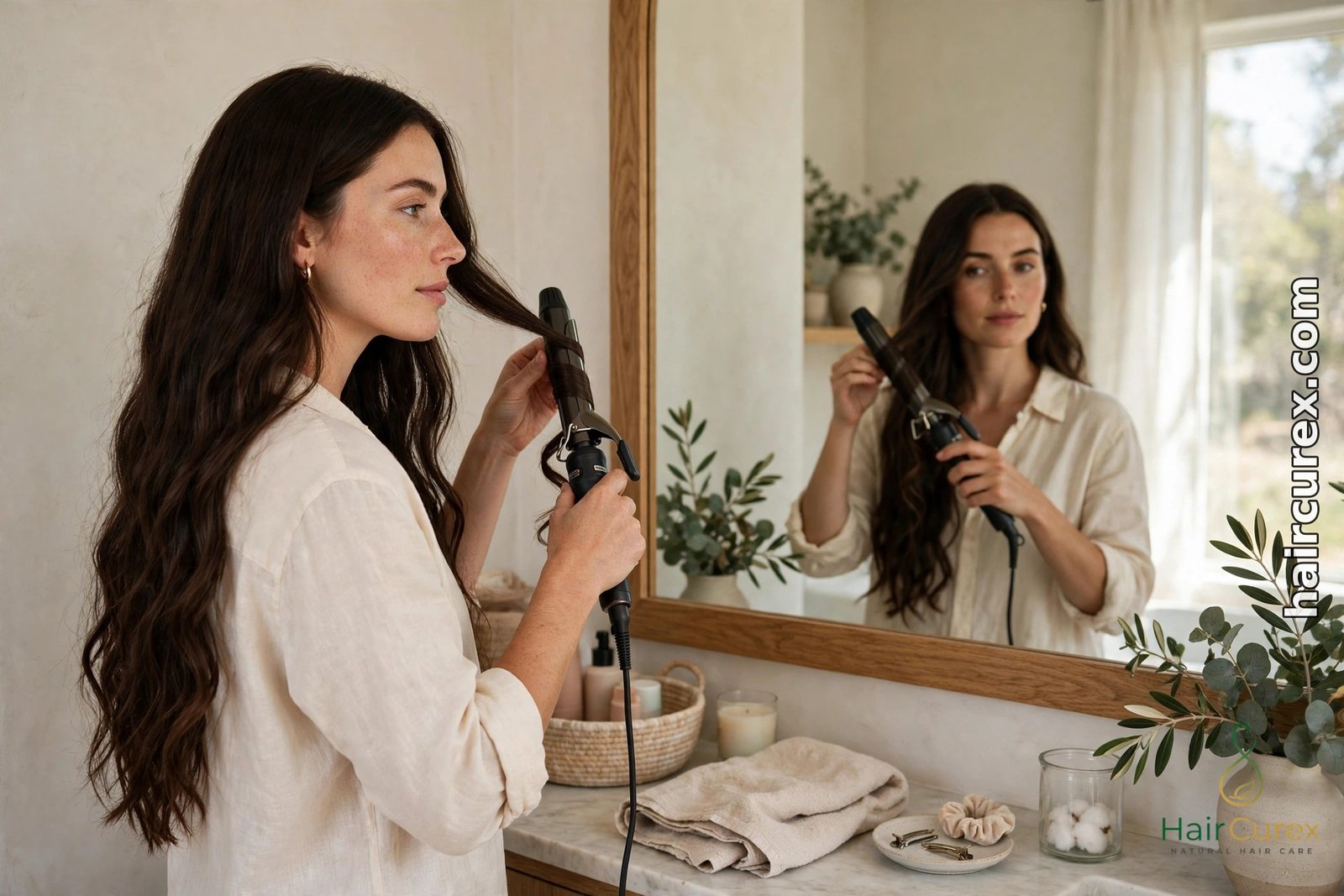
Quick answer: A hair curler is the fastest way to turn straight or wavy hair into defined curls, waves or volume — but the barrel size you pick matters more than the brand. As a rule, a 1-inch barrel is the most versatile choice for medium-length hair, a 1.25-inch barrel gives loose waves, and a 0.75-inch barrel makes tight curls. Always use a heat protectant, start at the lowest temperature that works for your hair type, and never hold the same section on the barrel longer than 8 to 10 seconds.
A good hair curler can give you salon-style curls at home in about 20 minutes — or flat, frizzy, heat-damaged hair in the same time. The difference is rarely the price tag: it is the barrel size, the material, the temperature and the technique. This guide covers all four.
How to Choose the Right Hair Curler
Choosing a hair curler starts with the barrel, because the barrel size decides the curl: a smaller barrel makes a tighter curl, a larger barrel makes a looser wave. Your hair length matters just as much — a barrel too large for short hair will not grip the ends, and one too small for long hair takes forever. Match the barrel to your length first, then to the curl you want.
Before you buy, check for adjustable temperature control. A hair curler with one fixed “on” setting forces every hair type to use the same heat — too hot for fine hair, often too cool for thick hair. Adjustable heat, a cool tip and an automatic shut-off are worth more than a famous brand name. If you only buy one curler, make it a 1-inch ceramic barrel with adjustable heat.
| Barrel size | Curl type | Best for |
|---|---|---|
| 0.75 inch (19 mm) | Tight curls, ringlets | Short to medium hair; fine hair that drops curls fast |
| 1 inch (25 mm) | Classic defined curls | Medium-length hair; the most versatile size |
| 1.25 inch (32 mm) | Loose waves, soft curls | Medium to long hair; everyday waves |
| 1.5 inch (38 mm) | Big loose waves, volume | Long hair; blowout-style volume and body |
| Tapered wand (0.75–1.25 inch) | Natural, varied curls | Medium to long hair; beachy, undone texture |
Ceramic vs Titanium vs Tourmaline: Which Barrel Material Is Best?
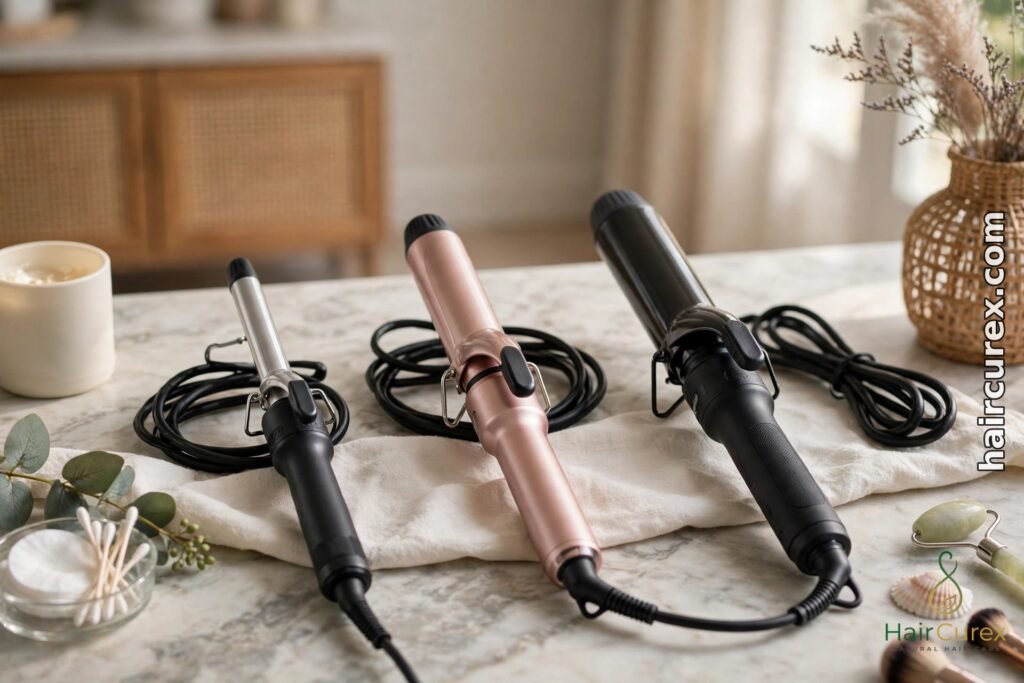
Ceramic is the gentlest of the three: it heats evenly, so there are fewer hot spots, and it is the safest pick for fine, thin or already-damaged hair. Its downside is that it heats more slowly and the coating can chip if the iron is knocked around — replace it if the surface starts flaking.
Titanium heats fast, holds a high temperature steadily and is noticeably lighter, which matters if you have thick hair and a long styling session ahead. It is the best material for thick, coarse or hard-to-curl hair — but it can get very hot very fast, so it is easy to overheat fine hair with it. If your hair is fine or fragile, titanium is usually the wrong choice.
Tourmaline is a mineral coating over a ceramic barrel that releases negative ions as it heats, smoothing the cuticle and cutting frizz. If your hair is frizzy or hard to smooth, a tourmaline-ceramic barrel is the best compromise — gentler than titanium, smoother than plain ceramic.

Clamp or Wand: Which Hair Curler Style Suits You?
A clamp iron — the classic curling iron — has a spring-loaded clip that holds the ends of your hair while you roll it up. It is the easier tool to learn: the clamp does the holding for you, and the curls come out even and polished — the best choice for defined, uniform curls or a vintage wave. Its one flaw is the clamp itself — press too hard and you get a crease, so keep it loose and let the ends sit flat.
A wand has no clamp: you wrap the hair around the barrel by hand, so a heat-resistant glove is not optional for most people. The result is more natural and varied — beachy waves and undone texture rather than uniform ringlets. Some curlers come as interchangeable sets with several barrel sizes on one handle — good value if you like to change your curl size.
What Temperature Should You Use on a Hair Curler?
The honest rule is to use the lowest temperature that still gives you a curl that holds. Fine, thin or chemically treated hair needs the least heat: start around 250 to 300°F (120 to 150°C) and only go higher if the curl falls out within an hour. Normal, medium hair usually curls well at 300 to 350°F (150 to 180°C). Thick, coarse hair may need 350 to 400°F (180 to 200°C) — but that is the ceiling for regular use.
Two habits make any temperature safer. First, use a heat protectant on every section, every time — it does not make high heat harmless, but it measurably reduces the damage. Second, never curl damp or wet hair: water trapped inside the shaft turns to steam at curling temperatures and can blister the strand from the inside. Dry your hair fully first — a round brush and a dryer, or our guide to the hair dryer brush, will get you there faster.
How to Curl Your Hair Step by Step
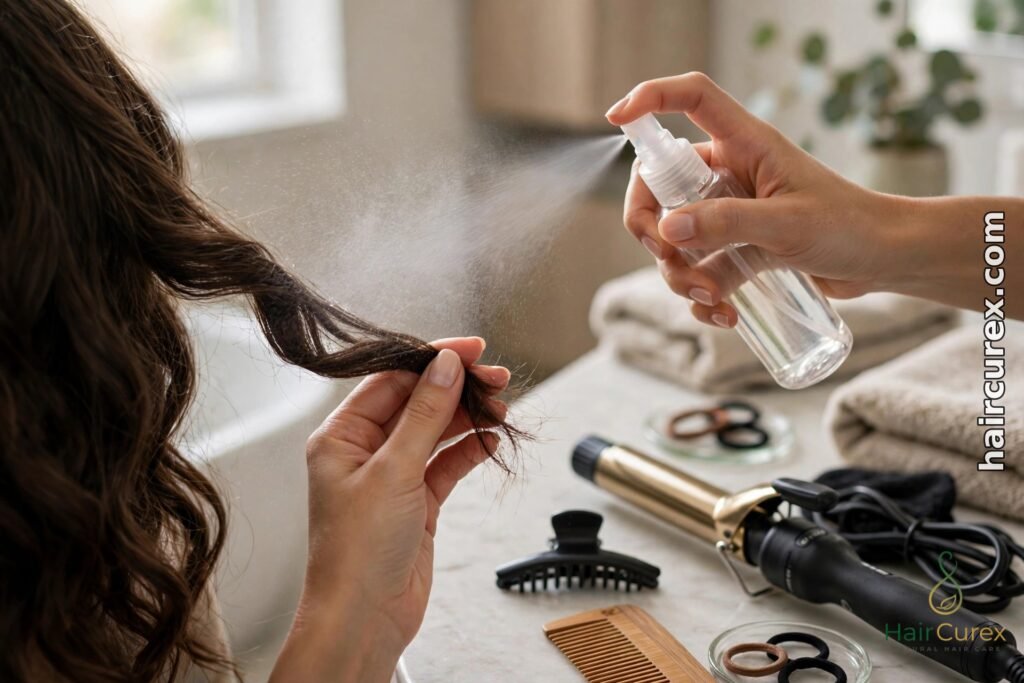
Good curls are a routine, not a talent. First, start with clean, fully dry hair and brush out any tangles. Second, spray a heat protectant evenly through your hair, section by section. Third, divide your hair into sections about 1 to 1.5 inches wide — smaller sections curl tighter and hold longer, larger sections give looser waves.
Fourth, wrap each section around the barrel away from your face, keeping the hair flat against the barrel rather than twisted — flat wrapping gives smooth, defined curls, twisting gives a beachier result. Hold for 5 to 8 seconds if your hair is fine, or 8 to 10 seconds if it is thick; longer adds damage without adding curl. Fifth, release the curl into your palm and let it cool before you let it drop — a curl sets as it cools. Sixth, repeat section by section, then finish with a light-hold hairspray.
If you want curls without any heat at all, skip the iron some days: our guide to heatless curls shows how to get defined curls overnight with a robe tie or braids. A diffuser can also add volume to curly hair without direct heat — our hair diffuser guide explains how to use one without frizz.

How to Make Curls Last Longer
The most common complaint about a hair curler is not that it fails to curl — it is that the curls fall out by lunchtime. The fix is usually in the finish: let every curl cool completely before you brush or touch it, and pin fresh curls up with clips while they cool — it takes a few extra minutes and adds hours to how long they last. Day-old hair also holds a curl better than freshly washed hair, and a light-hold hairspray after styling will usually hold a curl all day. Skip heavy oils before curling: they weigh curls down and make them drop faster.

Is a Hair Curler Bad for Your Hair? What the Evidence Says
Honestly, yes — a hair curler can damage your hair, and the damage is cumulative. Repeated high heat roughs up the cuticle, the overlapping scales that protect each strand, which is why over-curled hair looks dull, feels rough and splits at the ends. That is not a reason to throw the iron away; it is a reason to treat heat as a budget: the lowest effective temperature, a heat protectant every time, and days off from heat whenever you can.
The research backs that up. A peer-reviewed study in the Annals of Dermatology found that surface damage increased as the temperature rose — but technique mattered as much as heat: drying from 15 cm with continuous motion caused less overall damage than leaving hair to air-dry, because hair left wet for hours stays swollen and stressed. The study tested hair dryers, not curling irons, but the principle carries over — Lee et al. on heat and drying time of hair dryers. The American Academy of Dermatology makes the same point in plain terms: limit heat styling, use the lowest setting that works, and handle wet hair gently — American Academy of Dermatology healthy hair tips.
One warning sign worth knowing: if your hair breaks mid-strand, feels gummy when wet, or snaps with almost no stretch, that is heat and chemical damage, not dryness, and no conditioner will reverse it — the damaged length has to grow out and be trimmed away. If you switch between hot tools, our hair straightener guide covers the same rules for flat irons.
Common Hair Curler Mistakes to Avoid
Most curler problems come from a short list of avoidable mistakes. Curling damp hair is the worst — it steams the inside of the strand, so dry first and curl second. Using maximum heat on fine hair is a close second: fine hair curls easily and breaks easily, and 410°F will not give you a better curl than 300°F, only a weaker strand. Holding one section on the barrel for 20 seconds does not make a tighter curl — it just cooks the hair — and neither does re-curling the same section three times; if a section will not hold, make it smaller and let it cool pinned up.
Skipping heat protectant is the mistake people notice last, because the damage shows up weeks later as split ends and dullness. A dirty barrel is another quiet problem: product buildup creates hot spots, so wipe the barrel with a damp cloth once it has cooled, every few uses. Do not store the iron while it is still hot or wrap the cord tightly around the barrel — both shorten the life of the tool, and a frayed cord on a hot tool is a safety problem. If you own a multi-tool dryer with a curling attachment, the same rules apply: our Shark hair dryer guide covers its curling attachments and safe heat settings.
A hair curler is one of the most useful tools in a hair routine, and one of the easiest to misuse. Pick the barrel size for the curl you actually want, use the lowest temperature that holds, protect your hair every single time, and give it days off from heat. Do that, and you get the curls without paying for them in split ends.
Hair Curler FAQs
What size hair curler should I get?
For most people, a 1-inch barrel is the best first hair curler — it makes classic defined curls on medium-length hair and still works on shorter and longer hair. Choose 0.75 inch for tight curls or short hair, 1.25 inch for loose waves, and 1.5 inch or larger for big volume on long hair.
What temperature should I use on a hair curler?
Use the lowest temperature that gives you a curl that holds. Fine, thin or chemically treated hair usually needs only 250 to 300°F; normal hair curls well at 300 to 350°F; thick or coarse hair may need 350 to 400°F. Never go above 400°F for regular use, and never curl damp hair.
Is a hair curler bad for your hair?
A hair curler can damage hair if used too hot, too often or without a heat protectant — repeated high heat roughs up the cuticle, causing dullness, dryness and split ends. The damage is cumulative but manageable: use the lowest effective temperature, apply heat protectant every time, and take days off from heat styling.
Should I use a clamp curling iron or a wand?
A clamp curling iron is easier to learn and gives even, polished, uniform curls — the best choice for beginners and for defined or vintage styles. A wand has no clamp, so you wrap the hair by hand; it gives more natural, varied, beachy waves but has a steeper learning curve and usually needs a heat-resistant glove.
How long should I hold my hair on a hair curler?
Hold each section on the barrel for 5 to 8 seconds if your hair is fine, or 8 to 10 seconds if it is thick. Longer than 10 seconds adds damage without adding curl. Release the curl into your palm, let it cool before letting it drop, and do not re-curl the same section — if it will not hold, use a smaller section and let it cool pinned up.
How do I make curls last longer?
Let every curl cool completely before brushing or touching it — pinning fresh curls up with clips while they cool adds hours to how long they last. Curl day-old hair or use a little dry shampoo at the roots for grip, skip heavy oils before curling, and finish with a light-hold hairspray.