


A hair custard is a thick, creamy styling product that defines curls, adds moisture and gives soft hold – without the hard crunch that regular gel often leaves behind. If your wash-and-go curls fall flat by midday, frizz out as they dry, or feel stiff and sticky under gel, a hair custard may be the styler your routine has been missing. This guide explains what hair custard is, how it differs from gel and cream, how to use it step by step, how much to apply for your curl type, and the mistakes that cause flakes, crunch and weighed-down curls.
Quick answer: Hair custard is a gel-cream hybrid styler for curly and wavy hair: it clumps curls into defined ringlets and holds the pattern like a gel, but goes on creamier and dries softer because oils and butters are folded into the formula. Apply a small amount to soaking-wet hair in sections, over a leave-in conditioner, then air-dry or diffuse without touching it until it is fully dry. It suits 2C waves through 4C coils best; fine, loose waves should use a very light hand or skip it.

What Is Hair Custard?
Hair custard is a styling product with the consistency its name suggests: thick, smooth and creamy, like a dessert custard. It sits between a gel and a cream. Like a gel, it contains film-forming ingredients that hold each curl in its shape as it dries. Like a cream, it contains oils, butters and humectants that moisturize the hair while it holds. The result is definition with movement – curls that keep their shape but still feel like hair when you touch them.
OBIA Naturals describes a custard as a gel with oils folded in: creamier going on, softer when dry. That is the simplest accurate definition. A custard clumps curls into defined ringlets and holds the pattern without a hard cast, so a wash-and-go looks set and still feels touchable. Most custards are water-based and water-soluble, which means they rinse out cleanly and do not build up the way silicone-heavy stylers can.
The name became famous in the curly community through Kinky-Curly Curling Custard, a cult product among people with 3A to 4C hair. Since then, brands such as MopTop, OBIA Naturals and Mielle have made their own versions, and the category now covers a wide range of formulas – some light and gel-like, others rich and buttery. What they share is the promise of definition plus softness in one step.
What is inside a typical hair custard?
Most custards are built from the same few ingredient families, and reading the label tells you what a product will actually do:
- Film formers such as carbomer, xanthan gum or pectin thicken water into a gel that dries into a flexible film around each curl. This is where the hold comes from.
- Humectants such as glycerin, aloe vera juice, agave nectar and marshmallow root draw water into the hair and slow down moisture loss while the curl dries.
- Oils and butters such as olive oil, argan oil, grapeseed oil or shea butter soften the gel film so it dries flexible instead of crunchy, and add shine.
- Hydrolyzed protein (wheat, silk or keratin) appears in some custards and adds body to the curl. If your hair is protein-sensitive, check for it – a protein-free custard is the safer pick.
A custard is not a conditioner and not a treatment. It is a styler: it stays on your hair until your next wash day, and its job is to shape and hold the curl pattern you already have, not to repair damage or change your texture.
Hair Custard vs Gel vs Cream vs Butter
The curly-hair aisle is crowded, and custard, gel, cream and butter overlap enough to confuse anyone. The differences are real, and choosing the wrong one is the most common reason a wash-and-go disappoints. Here is how they compare:
| Product | Hold | Finish | Best for | Watch out for |
|---|---|---|---|---|
| Hair custard | Soft to medium | Defined, soft, shiny | 2C waves to 4C coils wanting definition without crunch | Can weigh down fine hair; flakes if applied to damp, not wet, hair |
| Gel | Medium to strong | Defined, can be crunchy until scrunched out | All curl types needing strong, lasting hold | Hard cast, flakes with incompatible products, can feel drying |
| Curl cream | Light | Soft, touchable, less definition | Wavy and loose curly hair, fine hair | Little hold on its own; curls can fall flat by afternoon |
| Butter | Very light hold | Heavy moisture, stretched curls | Thick, dry, coily hair; twist-outs and braid-outs | Greasy on fine or low-porosity hair; no real definition |
The practical rule: if your curls need hold but you hate crunch, start with a custard. If your curls collapse within hours, you may need a gel, or a custard layered under a light gel. If your hair is fine and easily weighed down, a cream is usually the better first step – compare the lighter options in our guide to the best curl cream for wavy hair before committing to a custard. Our roundup of the best curl gels for curly hair covers the stronger-hold end of the range, and our guide to curl enhancers explains the whole family of definition products, custards included.

Who Should Use Hair Custard?
Hair custard works best for hair that needs both moisture and hold at the same time – which is most curly and coily hair. But it is not for everyone, and curl type matters more than brand.
Wavy hair (2A-2C)
Loose waves (2A) usually find custard too heavy; a cream or a light gel gives definition without dragging the wave out. Tighter waves (2B-2C) can use a custard, but with a very small amount – a pea-sized dollop per section, smoothed over the surface rather than raked through. Apply it only to the lengths, keep it off the roots, and expect some softness in the wave pattern rather than tight ringlets.
Curly hair (3A-3C)
This is the sweet spot for hair custard. 3A curls get clumping and frizz control without the crunch that makes loose curls look stiff; 3B ringlets get definition that lasts to day two; 3C corkscrews get moisture plus hold in a single product. A leave-in conditioner underneath is still worth it for 3B and 3C hair, because the custard holds the pattern but does not replace the moisture a leave-in provides.
Coily hair (4A-4C)
Coily hair loves custard, used the right way. 4A and 4B coils get soft definition and shine, and the oils in the formula help the hair stay moisturized between wash days. 4C coils benefit most when the custard is applied to soaking-wet hair in small sections over a leave-in – the water helps the product spread evenly, and the small sections make sure every coil gets coated. For very dense hair, custard alone may not stretch the curl as much as a butter-based twist-out product, but for a defined wash-and-go it is one of the best options available.
Hair to skip or use with caution
Very fine hair, low-porosity hair and short hair with little length can all be weighed down by a rich custard. If your hair gets greasy or stringy easily, use a lighter formula, use less than you think you need, and apply it only from mid-length to ends. People with protein-sensitive hair should read the label: some popular custards contain hydrolyzed wheat protein, which adds body but can make protein-sensitive hair feel stiff and straw-like.

How to Use Hair Custard, Step by Step
Technique matters more than brand with hair custard. The same jar can give glossy defined ringlets or a flaky, sticky mess depending on how wet the hair is, how much you use, and whether you touch it while it dries. Follow these steps:
1. Start with clean, soaking-wet hair
Wash and condition as usual, then rinse. Do not towel-dry. Hair custard works best on soaking-wet hair – the water helps the thick product spread evenly and thins it just enough to coat every strand. If your hair is only damp, the custard sits on the surface, dries unevenly and flakes. If it starts to dry while you work, mist it with water from a spray bottle.
2. Apply a leave-in conditioner first (optional but recommended)
For most curl types, a light leave-in under the custard gives better results: moisture underneath, hold on top. Smooth a small amount of leave-in through your hair and detangle gently with your fingers or a wide-tooth comb. Skip this step only if your hair is fine or easily weighed down.
3. Section your hair
Divide your hair into 4 to 6 sections and clip the ones you are not working on. Small sections are the secret to even coverage – a custard applied to one big mass of hair coats the outside and leaves the inside untouched, which is why some curls define beautifully and others frizz out.
4. Smooth the custard on with praying hands
Take a small amount – start with a dime-sized dollop per section – and rub it between your palms. Smooth it over each section with your palms pressed together, the praying hands method, working from roots to ends. This coats the outside of the curl clumps without breaking them apart. For tighter curls, follow with a gentle rake or shingling: smooth each small curl clump individually between your fingers.
5. Scrunch to encourage the curl
Cup each section from the ends upward and scrunch gently toward the scalp. You should hear a soft squelching sound – that means the hair is wet enough and the product is distributed. Scrunching encourages the curl pattern to spring up and helps the custard clump the hair into defined ringlets.
6. Do not touch it while it dries
This is the hardest step and the most important. Air-dry or diffuse (see below), and keep your hands off until the hair is completely dry. Touching wet curls breaks up the clumps the custard is forming and invites frizz. Once fully dry, scrunch out any light cast with a drop of oil on your palms, and the curls will feel soft.
How Much Hair Custard Should You Use?
Custards are concentrated, and using too much is the single most common mistake. Too much product makes hair take hours to dry, leaves a sticky film, and weighs curls down. Too little gives no hold at all. Use this as a starting point, then adjust over two or three wash days:
- Short hair (above the ears): a pea-sized amount for the whole head.
- Medium hair (shoulder length): a dime-sized amount per section, roughly a quarter-sized dollop in total.
- Long or thick hair: a nickel-sized amount per section; add more only if the curls still look undefined once dry.
- Fine hair: halve the amounts above. You can always add more next time; you cannot remove product without rewashing.
Judge the result when the hair is fully dry, not while it is wet. Custard looks heavy and wet while it dries and only shows its real finish – soft, defined, shiny – once the water has evaporated.
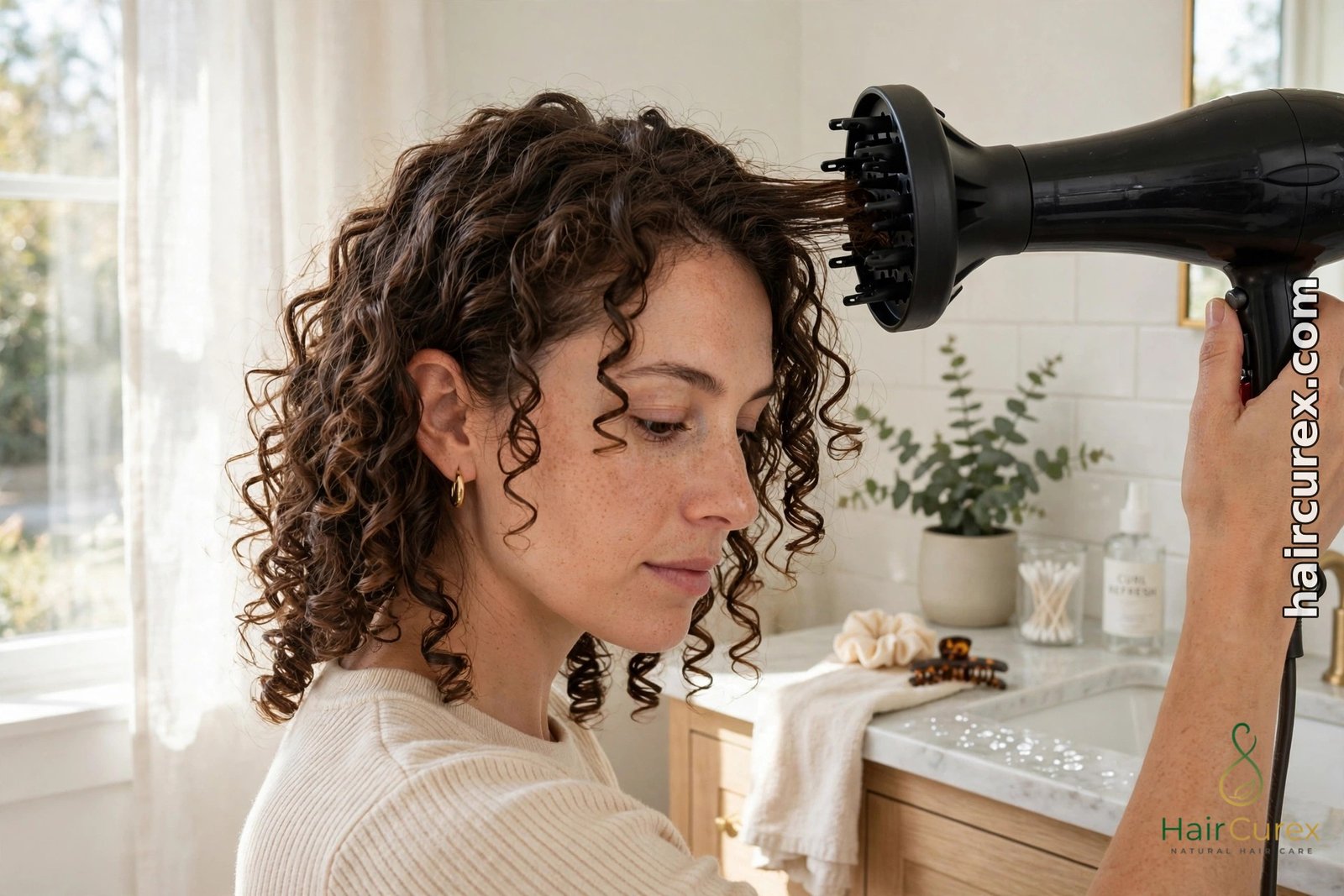
Air-Dry or Diffuse: How to Dry It
Either drying method works with hair custard, and the choice depends on your time and your curl pattern.
Air-drying is the gentlest option and gives the most natural clumping. It takes the longest – anywhere from one to four hours depending on hair thickness – and the weight of the water can stretch out looser curl patterns as it dries. If you air-dry, avoid moving around in wind or sitting under a fan, both of which disturb the curls while they set.
Diffusing speeds things up and adds volume at the roots. Use a diffuser attachment on low heat and low airflow, cupping sections of hair into the bowl of the diffuser and holding still for 30 seconds before moving on. Hover-diffusing – holding the diffuser a few inches from the hair – works well for looser curls that you do not want to disturb. Diffuse until the hair is about 80 percent dry, then let the rest air-dry; this avoids over-drying the ends.
A hooded dryer or a bonnet dryer also works, and is a good option in winter when wet hair stays cold for a long time. Whichever method you choose, wait until the hair is 100 percent dry before scrunching out the cast. Scrunching even slightly damp hair is a fast route to frizz.
Hair Custard Mistakes That Ruin the Result
Most custard complaints trace back to one of these six mistakes. Fix the technique before blaming the product:
- Applying to damp instead of soaking-wet hair. Custard needs water to spread. Damp hair causes flakes, stickiness and uneven coverage.
- Using too much product. Custard is concentrated. Start small; a little goes a long way, and excess product is the main cause of long drying times and limp curls.
- Skipping sections. Applying to one big mass of hair leaves the inner layers bare. Sectioning takes two minutes and changes the result completely.
- Touching hair while it dries. Every touch breaks a clump. Hands off until fully dry.
- Layering incompatible products. Custard can flake when mixed with certain gels or creams, especially silicone-heavy ones. Keep your styling layer simple: leave-in, then custard, then (if needed) a light gel on top.
- Expecting it to moisturize on its own. A custard holds a curl pattern; it is not a deep conditioner. If your hair is dry underneath, the result will look defined but feel rough. A leave-in underneath and a weekly deep-conditioning step in your curly hair routine fix that.

How to Refresh Curls on Day 2 and 3
One of the best things about hair custard is that it reactivates with water, so second- and third-day curls are easy to revive without a full wash:
- Mist the flattened or frizzy sections lightly with water from a spray bottle. Do not soak the hair – damp is enough.
- Smooth a pea-sized amount of custard over the sections that have lost definition, using praying hands.
- Scrunch gently and let it air-dry, or diffuse for a few minutes on low.
- Scrunch out any light cast once dry.
This works because the custard’s film-forming ingredients soften again when wet and re-set as the hair dries. If your refresh starts looking producty or flaky by day three, that is the sign to wash: buildup has overtaken the style, and no amount of misting will fix it.
Best Hair Custards to Try
You do not need the most expensive jar on the shelf. These are the custards curly-haired reviewers return to most often, with honest notes on who each one suits. Prices change, so check the current price before buying; the notes below are about the formulas, not the price tags.
- Kinky-Curly Curling Custard – the original cult custard, a curl-enhancing gel that defines waves and curls and adds shine. Botanical formula with agave nectar, aloe vera juice and vitamin E. Best for 2C to 4C hair; use sparingly, because it is highly concentrated. It must go on soaking-wet hair or it can flake.
- MopTop Curly Hair Custard – a medium-hold gel custard built on aloe, sea botanicals and honey, with a citrus kumquat scent. Our review of the MopTop Curly Hair Custard found it gives definition without crunch or flakes and rinses out cleanly, which makes it a good first custard for wavy and loose curly hair.
- OBIA Naturals Curl Enhancing Custard – an alcohol-free curl gel for 3A to 4C curls, with carbomer for hold and argan, olive and grapeseed oils for shine. A NaturallyCurly Editors’ Choice winner. It contains hydrolyzed wheat protein, so protein-sensitive hair should try the brand’s Curl Moisture Cream alone first.
- Mielle Coil Sculpting Custard – a richer custard aimed at coily hair, good for wash-and-gos and twist-outs on 3C to 4C hair where extra moisture matters as much as hold.
When choosing, match the formula to your hair, not to the hype. A light custard suits fine waves; a rich, buttery custard suits thick coils. Buy the smaller size first if you are testing a new brand – a jar lasts a long time because so little is needed per wash day, and a wrong pick is an expensive mistake at full size. For general hair health while you experiment, the American Academy of Dermatology’s healthy-hair tips are a solid baseline: gentle handling, less heat, and conditioning matched to your hair type.
Can You Make Hair Custard at Home?
Yes – a simple DIY custard is one of the easiest curly-hair recipes, and it is a good way to test whether your hair likes the custard format before buying a jar. The classic version is a flaxseed gel custard: boil a quarter cup of flaxseeds in a cup of water for 3 to 5 minutes, strain immediately, then blend the gel with a tablespoon each of aloe vera gel, honey and olive oil, plus half a tablespoon of shea butter. The result is a thick, custard-like gel that defines curls and adds shine.
Homemade custard has no preservatives, so store it in the refrigerator and use it within a week or two; throw it away if it smells off. It also has lighter hold than a commercial custard, because it lacks the film-forming polymers that give store-bought formulas their staying power. Treat it as a fun experiment and a gentle everyday styler, not as a replacement for a strong-hold product on a humid day or an important occasion.
The Bottom Line
Hair custard is the styler for curls that want definition without stiffness: a gel-cream hybrid that clumps curls, holds the pattern, and dries soft and shiny. Use it on soaking-wet hair, in small sections, over a leave-in, with a light hand – and leave it alone until it is dry. Get those four things right and most curl types from 2C to 4C will see better wash-and-gos within a wash day or two. Get them wrong and the same jar will flake, weigh hair down, or do nothing at all. The product is rarely the problem; the technique usually is.
Frequently Asked Questions
What is hair custard?
Hair custard is a thick, creamy styling product for curly and wavy hair. It is a gel-cream hybrid: film-forming ingredients hold each curl in shape like a gel, while oils and butters folded into the formula keep the finish soft, shiny and touchable instead of crunchy.
Is hair custard the same as gel?
No. A custard is similar to a gel because both are stylers with hold, but a custard contains oils and moisturizers that make it creamier going on and softer when dry. Gel usually gives stronger hold and can leave a hard cast; custard gives soft-to-medium hold with no crunch.
Can I use hair custard on wavy hair?
Yes, if your waves are 2B or 2C. Use a very small amount, smooth it over the surface rather than raking it through, and keep it off the roots. Loose 2A waves usually find custard too heavy and do better with a light curl cream or gel.
Do I apply hair custard to wet or dry hair?
Always apply hair custard to soaking-wet, freshly washed hair. The water helps the thick product spread evenly. Applied to damp or dry hair, custard can flake, feel sticky and give uneven definition.
Why is my hair custard flaking?
Flaking usually means the custard was applied to hair that was not wet enough, or it is reacting with another product underneath – often a silicone-heavy cream or an incompatible gel. Apply it to soaking-wet hair over a simple water-based leave-in, and use less product.
Can I use hair custard every day?
You can refresh with a tiny amount on day two and three by misting with water first, but you should not pile on fresh custard daily. By day three or four, buildup makes the hair look dull and producty – time to wash and start fresh.