

A hair growth shampoo can help your scalp stay healthy, reduce breakage and make thinning hair look fuller, but it cannot regrow hair on its own. No shampoo — no matter what the bottle promises — can restart a dormant hair follicle or reverse pattern hair loss, because a shampoo is a rinse-off product: it sits on your scalp for one or two minutes and then washes away, long before any active ingredient has time to do the deep work of regrowth. What a good hair growth shampoo can do is real and useful: it can calm an inflamed or flaky scalp, clear the buildup that chokes follicles, strengthen the hair shaft so less of it snaps off, and support the conditions in which the treatments that actually regrow hair — leave-on minoxidil, prescription finasteride for men, and a dermatologist’s diagnosis — can work their best. This article goes ingredient by ingredient through what the evidence actually says, shows you how to use these shampoos properly, and explains what to use instead when regrowth is what you really want.
What Is a Hair Growth Shampoo?
A hair growth shampoo is a shampoo marketed to people worried about thinning hair, shedding or slow growth. It usually looks like an ordinary shampoo, but the label highlights one or more “active” ingredients — ketoconazole, caffeine, saw palmetto, biotin, rosemary oil, zinc pyrithione, or sometimes minoxidil — and promises thicker, fuller, faster-growing hair. Some are ordinary cosmetic shampoos with a botanical extract added for marketing. Others are genuinely medicated: they contain an antifungal or anti-inflammatory drug at a dose that can change the scalp environment. The bottle rarely makes that distinction clear, which is why so many people buy the wrong product for their problem.
It helps to understand what a shampoo is actually for. A shampoo’s job is to clean: to lift oil, sweat, dead skin and styling product off the scalp and hair, and then rinse away. Everything else a shampoo claims to do is a bonus, limited by one hard fact — contact time. You lather, you rinse, and the product is gone. That is fine for cleaning, and it is fine for treating surface scalp problems such as dandruff or seborrheic dermatitis, where the medicine only needs to touch the skin briefly. It is not enough time for an ingredient to penetrate deep into a follicle and change how that follicle grows hair over months. Keep that single fact in mind and almost every claim on a hair growth shampoo bottle becomes easy to judge.
That does not make these shampoos useless. Far from it. Thinning hair is often made worse by a scalp that is inflamed, flaky or clogged with buildup, and by hair shafts that are dry, brittle and snapping off at the ends. A well-chosen shampoo can fix both of those problems. If your shedding is driven by dandruff or seborrheic dermatitis, a medicated shampoo can reduce it noticeably. If your hair looks thin because it keeps breaking, a gentle, strengthening shampoo plus conditioner can make it look and feel much fuller. What a shampoo cannot do is create new hair where a follicle has miniaturized — the slow shrinking of follicles that causes male and female pattern hair loss. Only treatments that stay on the scalp for hours, or that work from inside the body, have credible evidence for that.

What Hair Growth Shampoo Can and Cannot Do
This is the honest summary, before the detail. If you remember nothing else from this article, remember this section.
What a hair growth shampoo can do:
- Clean the scalp thoroughly and remove the oil, dead skin and product buildup that can smother follicles and make hair look flat and thin.
- Treat dandruff and seborrheic dermatitis, which are common, under-recognized causes of extra shedding. Calming that inflammation can reduce shedding to normal levels.
- Strengthen the hair shaft and reduce breakage, so the hair you already have keeps its length and looks thicker.
- Improve scalp health — less itching, less flaking, less redness — which creates better conditions for any real regrowth treatment to work.
- Make thinning hair look fuller on the day you use it, through volumizing formulas that coat the shaft or lift the roots.
What a hair growth shampoo cannot do:
- Regrow hair on bald or badly thinned areas. No rinse-off product has credible evidence of regrowing hair on its own.
- Reverse pattern hair loss (androgenetic alopecia), the most common cause of thinning in both men and women. That needs leave-on or prescription treatment.
- Change how fast your hair grows in any meaningful way. Hair grows about half an inch a month, and no shampoo has been shown to speed that up.
- Replace a dermatologist’s diagnosis. Shedding has many causes — thyroid problems, iron deficiency, medication, stress, hormonal shifts — and a shampoo cannot identify or treat any of them.
- Work if you use it wrong: rinsing a medicated shampoo off in ten seconds, or using a harsh clarifying shampoo every day on already fragile hair, wastes whatever benefit it had.
That is the frame for everything that follows. The ingredient evidence table in the next section is the heart of this article — it separates the one ingredient with strong shampoo evidence from the ones with weak, preliminary or borrowed evidence.
The Ingredient Evidence, One by One
Every hair growth shampoo is really a bet on one or two ingredients. Here is what the research actually says about each, in plain language, with the strength of the evidence stated honestly. For a broader look at how these ingredients are marketed, see this overview of hair loss shampoo ingredients.
Minoxidil: the only FDA-approved regrowth drug — but not in shampoo form
Minoxidil is the one ingredient in this whole article with real, regulatory-grade evidence for regrowing hair. It is the only over-the-counter drug approved by the U.S. Food and Drug Administration (FDA) for hair regrowth: the 2% solution was cleared for women in 1991 and the 5% solution for men in 1997, and the 5% foam later followed. It works by widening blood vessels around the follicle, prolonging the growth (anagen) phase of the hair cycle and enlarging miniaturized follicles. In clinical trials, leave-on minoxidil solution and foam slow shedding and produce visible regrowth in a meaningful share of users with pattern hair loss.
Here is the catch, and it matters: all of that evidence is for leave-on minoxidil — a solution or foam you apply to the scalp and leave there for hours, twice a day, for months. There is no comparable evidence for minoxidil in a shampoo. A shampoo containing minoxidil would be rinsed off after a minute or two, before the drug could penetrate to the follicle in any useful amount. That is why reputable dermatologists do not recommend “minoxidil shampoo” as a regrowth treatment, and why the products sold under that name should be treated with skepticism. If you want minoxidil’s proven benefit, use the leave-on solution or foam, not a shampoo that borrows its name. Our hair growth serum guide explains how leave-on treatments differ from rinse-off ones and what realistic results look like over three to six months.
Ketoconazole 2%: the strongest evidence of any shampoo ingredient
Ketoconazole is an antifungal drug, and it is the single ingredient with the strongest evidence behind it in shampoo form. It is best known as a dandruff treatment, but its effect on hair goes further than flake control. Ketoconazole reduces the yeast (Malassezia) that drives seborrheic dermatitis, calms scalp inflammation, and may also have a mild anti-androgen effect at the follicle — one reason researchers became interested in it for hair loss at all.
The key study is a 1998 trial published in the journal Dermatology. Thirty-nine men with androgenetic alopecia used either a 2% ketoconazole shampoo or a 2% minoxidil solution two to four times a week, and the ketoconazole group showed increases in hair density and in the size and proportion of growing (anagen) hairs that were comparable to the minoxidil group. That is a small, old study — 39 men is not a large trial, and it has not been replicated at scale — so it should not be read as proof that ketoconazole shampoo equals minoxidil. But it is the best shampoo-specific evidence that exists, and it is the reason dermatologists often recommend a ketoconazole shampoo as a supporting treatment alongside leave-on minoxidil, especially when dandruff or scalp inflammation is part of the picture.
In practice: ketoconazole 1% shampoo is available over the counter in the United States (the familiar dandruff shampoo brands), while the 2% strength used in the trial is prescription-only. Use it two to three times a week, leave it on the scalp for three to five minutes before rinsing, and use a gentle moisturizing shampoo on the other days. It can be drying, so always follow with conditioner on the lengths.
Zinc pyrithione: real evidence for reduced shedding
Zinc pyrithione is another antifungal and antibacterial agent used in anti-dandruff shampoos, and it has better evidence than most people realize. A 2003 study in the British Journal of Dermatology followed people using a 1% zinc pyrithione shampoo for 26 weeks and found a measurable reduction in hair shedding, along with improvements in scalp condition. The mechanism is similar to ketoconazole’s: controlling the yeast and inflammation that drive excess shedding, rather than regrowing hair directly. If your shedding is worsened by a flaky, itchy scalp, a zinc pyrithione shampoo is a sensible, cheap first step — and it is widely available over the counter.
Caffeine: promising in a petri dish, thin in people
Caffeine shampoos are marketed with an appealing story: caffeine stimulates hair follicles, counteracts the hormone DHT, and prolongs the growth phase. In laboratory studies on isolated hair follicles in a dish, caffeine does show stimulating effects. The problem is the leap from a dish to a human head. Caffeine in a shampoo is rinsed off after a minute or two, and the human trials that exist are small, short, and often funded by the companies selling the products. There is no strong, independent clinical evidence that a caffeine shampoo regrows hair or meaningfully reduces shedding in real-world use. It is not harmful, and a caffeine shampoo that is also a good, gentle cleanser is fine to use — but do not buy it expecting regrowth. The evidence is lab-level, not people-level.
Saw palmetto: preliminary and weak
Saw palmetto is a plant extract said to block DHT, the hormone that shrinks follicles in pattern hair loss. Taken orally, it has some preliminary evidence — small studies suggesting a modest benefit, though far weaker than prescription finasteride. In a shampoo, the evidence is weaker still: there are almost no controlled trials of saw palmetto shampoo for hair loss, and whatever the extract does when swallowed is no guarantee of what it does when rinsed off a scalp in two minutes. Treat it as a nice-to-have botanical in an otherwise good shampoo, not as a treatment.
Biotin: only helps if you are deficient — and you probably are not
Biotin (vitamin B7) is in almost every hair growth shampoo, and the marketing implies it feeds the hair from the outside. The truth is narrower. Biotin deficiency can cause hair loss, and correcting a true deficiency can help hair recover — but true biotin deficiency is rare in healthy adults who eat a normal diet. There is no good evidence that extra biotin, whether swallowed or rubbed on the scalp, helps hair grow in people who are not deficient. On top of that, biotin is a water-soluble vitamin with poor skin penetration, so a shampoo is one of the least effective ways to deliver it. A biotin shampoo is harmless and may be a fine cleanser, but its headline ingredient is doing very little. If you suspect a deficiency, that is a blood test and a doctor’s conversation, not a shampoo choice.
Rosemary oil: the famous study was leave-on, not shampoo
Rosemary oil is the ingredient with the most impressive-sounding citation — and the most misused one. A 2015 randomized controlled trial published in the journal SKINmed compared rosemary oil with 2% minoxidil in people with androgenetic alopecia and found similar improvements in hair count after six months, with less scalp itching in the rosemary group. That is a genuine, encouraging result. But read the fine print: the trial used leave-on rosemary oil, massaged into the scalp and left there. It did not test rosemary shampoo. A shampoo containing a little rosemary oil, rinsed off after a minute, is not the same intervention and cannot claim the trial’s results. Rosemary oil as a leave-on scalp treatment is a reasonable, low-cost option to discuss with a dermatologist; rosemary oil in a shampoo is mostly fragrance and marketing. Do not let a bottle borrow a leave-on study’s credibility.
Ingredient Evidence at a Glance
The table below summarizes everything in the section above. Use it when you are standing in the store aisle comparing bottles.
| Ingredient | Evidence level | What it does | Best format | FDA status |
|---|---|---|---|---|
| Minoxidil | Strong — for regrowth | Only proven OTC regrowth drug; prolongs growth phase, enlarges miniaturized follicles | Leave-on solution or foam, twice daily | FDA-approved for hair regrowth (2% women 1991, 5% men 1997); no shampoo approval |
| Ketoconazole 2% | Moderate — best shampoo evidence | Antifungal; reduces scalp yeast and inflammation; 1998 trial showed density gains comparable to 2% minoxidil | Shampoo, left on 3–5 minutes, 2–4x/week | 1% OTC; 2% prescription; approved as antifungal, not as a hair-loss drug |
| Zinc pyrithione | Moderate | Antifungal/antibacterial; reduced shedding in a 26-week trial; calms flaky scalp | Shampoo, regular use | OTC; approved as an anti-dandruff active |
| Caffeine | Weak — lab evidence only | Stimulates follicles in lab dishes; thin human data, small industry-funded trials | Shampoo or leave-on; evidence does not support shampoo claims | Cosmetic ingredient; no FDA hair-loss approval |
| Saw palmetto | Weak — preliminary | May mildly block DHT when taken orally; almost no shampoo trials | Oral supplement has more evidence than shampoo | Supplement/cosmetic; no FDA hair-loss approval |
| Biotin | Weak — helps only if deficient | Corrects hair loss from true biotin deficiency, which is rare; poor skin penetration | Oral supplement if deficient; shampoo is a poor delivery route | Vitamin supplement; no FDA hair-loss approval |
| Rosemary oil | Moderate — leave-on only | 2015 RCT vs 2% minoxidil showed similar hair-count gains — but as leave-on oil, not shampoo | Leave-on oil massaged into scalp | Cosmetic/botanical; no FDA hair-loss approval |
If you take one row from this table, take the ketoconazole row: it is the only ingredient where the shampoo itself — not a leave-on version, not a swallowed version — has real trial evidence behind it. Everything else in a shampoo bottle is either borrowed evidence or marketing.
How to Use a Hair Growth Shampoo Properly
Even the best hair growth shampoo fails if you use it wrong. Most people rinse a medicated shampoo off in ten seconds, which gives the active ingredient no time to work at all. The method below takes two extra minutes and makes a real difference.
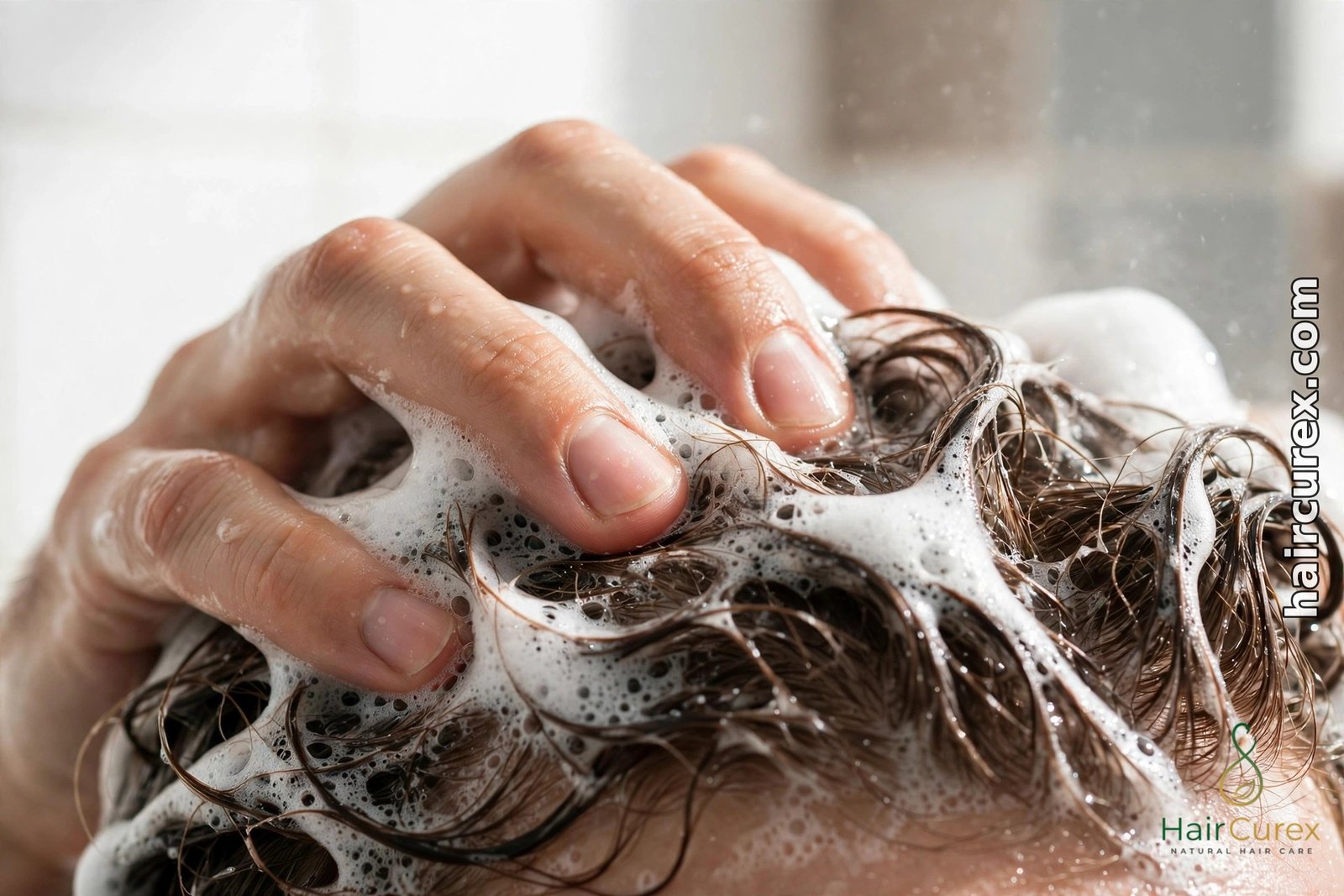
Leave it on for two to five minutes. Lather the shampoo into your scalp — not just the hair — and leave it there while you wash the rest of your body. For a medicated shampoo such as ketoconazole or zinc pyrithione, three to five minutes is the target. For an ordinary gentle shampoo, one to two minutes is enough. Set the habit: shampoo first, leave it on, do everything else, then rinse last.
Use a medicated shampoo two to three times a week, not every day. Ketoconazole and other medicated shampoos can dry the hair and scalp if used daily. On the other days, use a gentle, moisturizing, sulfate-free shampoo. Alternating is the standard dermatologist advice: medicated days treat the scalp, gentle days keep the hair healthy.
Massage with your fingertips, not your nails. Work the lather into the scalp with the pads of your fingers in small circles for a minute. This does two things: it helps the shampoo reach the scalp skin rather than sitting on the hair, and it boosts blood flow to the area. Our scalp massage for hair growth guide walks through the technique in detail, including how long to massage and how often. Do not scratch with your nails — that irritates the scalp and can increase shedding.
Always condition the lengths. Shampoo opens the hair cuticle to clean it; conditioner smooths it back down and protects the shaft. Skipping conditioner on thinning hair is one of the most common mistakes, because unconditioned hair tangles, snaps and looks thinner. Apply conditioner from the mid-lengths to the ends only, never on the scalp, leave it for two or three minutes, and rinse with lukewarm water.
Be careful with sulfates and alcohol when your hair is thinning. Strong sulfates (such as sodium lauryl sulfate) and drying alcohols strip natural oils and can leave fine, fragile hair brittle and more likely to break. That does not mean every sulfate shampoo is bad — many people tolerate them fine — but if your hair is thinning, a gentle sulfate-free formula is the safer default, especially on non-medicated days. The same goes for harsh clarifying shampoos: useful once in a while to remove buildup, damaging if used every day on fragile hair.
Rinse with lukewarm water, not hot. Hot water strips the scalp’s natural oils and roughs up the cuticle, leaving hair dull and more breakage-prone. Lukewarm water cleans just as well and is kinder to both scalp and shaft.
Give it time — and judge it fairly. A medicated shampoo needs at least eight to twelve weeks of consistent use before you can judge whether it is helping your scalp and shedding. Hair grows slowly, and the hair cycle means any change takes months to show. Take a photo of your part line and hairline in the same light once a month so you can compare honestly instead of relying on memory. Our hair washing guide covers the same frequency and technique questions in more detail, including how scalp oil production and activity level change the answer.
What Actually Works Instead (When Regrowth Is the Goal)
If your goal is genuinely to regrow hair — not just to keep your scalp healthy — a shampoo alone will not get you there. Here is what the evidence supports, in order of strength.
Leave-on minoxidil (first line, over the counter). The 2% solution for women and the 5% solution or foam for men, applied to the scalp twice a day and left on, is the best-supported over-the-counter regrowth treatment. Expect to wait three to six months for visible change, and expect shedding to increase briefly in the first few weeks — that is the old, resting hairs being pushed out as new growth begins, and it usually settles. Stopping minoxidil means the gains gradually reverse, so think of it as a long-term commitment, not a course of treatment. Talk to a pharmacist or dermatologist before starting, especially if you have low blood pressure or a sensitive scalp.
Finasteride for men (prescription). Finasteride is a prescription tablet that blocks the conversion of testosterone to DHT, the hormone that shrinks follicles in male pattern hair loss. It has strong trial evidence for slowing loss and producing regrowth in men, and it is often combined with minoxidil. It is for men only — it must not be used by women who are or may become pregnant — and it can have side effects, including sexual side effects in a small minority of users. That is a decision for you and a doctor, not for a shopping aisle.
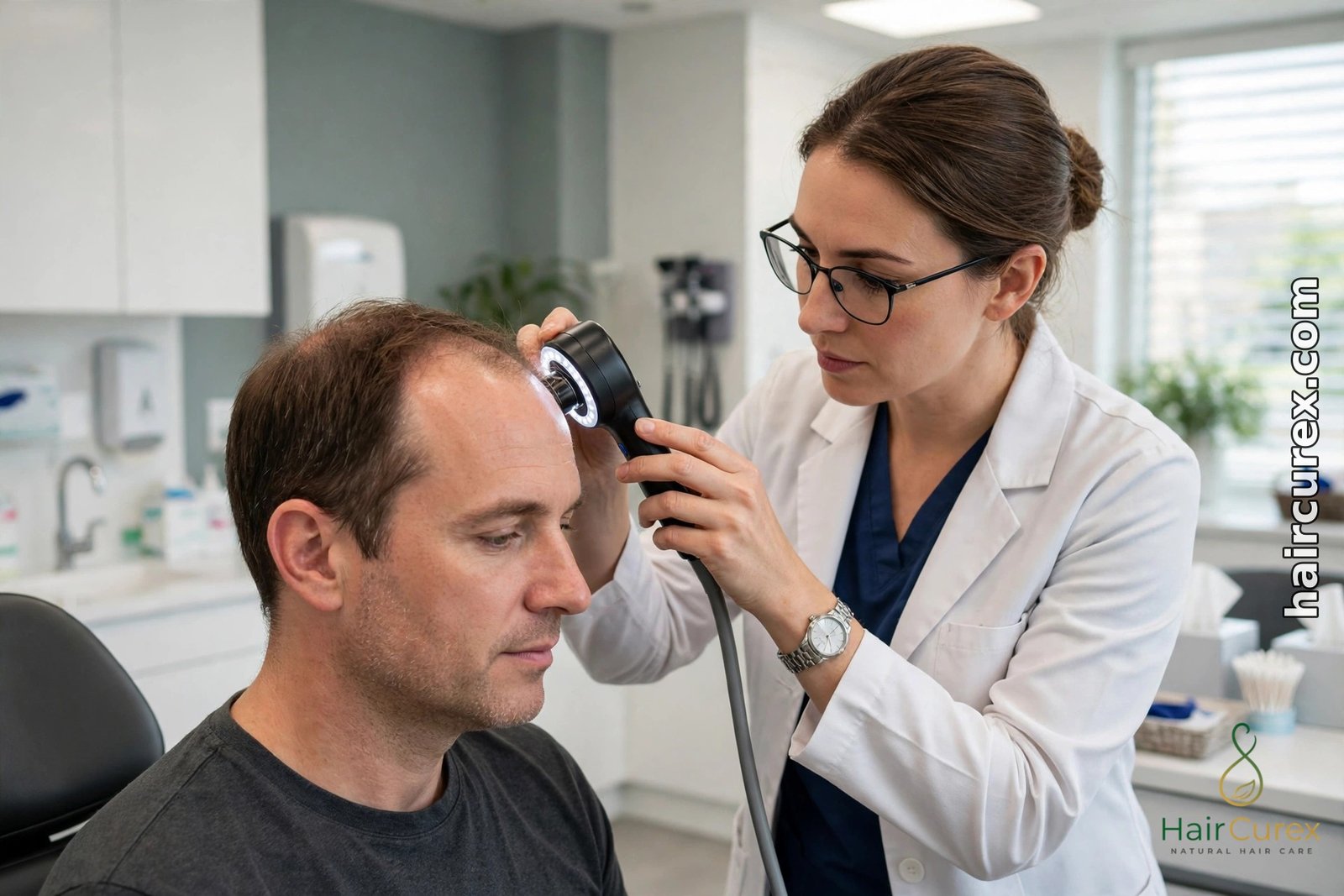
A dermatologist’s workup. This is the step most people skip and most often need. A dermatologist can look at your scalp under magnification, order blood tests for iron, thyroid function, vitamin D and hormones, and tell you whether your shedding is pattern hair loss, telogen effluvium (shedding after stress, illness or medication), alopecia areata, or a scalp condition. Each has a different treatment, and the right shampoo is only a small part of any of them. If you have been losing hair for months with no clear cause, the workup is worth more than any bottle.
Supporting habits that genuinely help. A healthy scalp and strong hair shaft support whatever treatment you use: a balanced diet with enough protein and iron, managing stress, avoiding tight hairstyles that pull on the follicles (traction alopecia is real and preventable), limiting high-heat styling, and protecting hair from harsh chemical processing. None of these regrows hair on its own, but all of them reduce the breakage and shedding that make thinning look worse. Our best shampoo for hair fall guide covers how to choose a gentle daily shampoo that protects the hair you have while a real treatment does the regrowth work.

Choosing the Right Product: What Helps vs What Doesn’t
Use this table when you are choosing between two bottles. It separates the features worth paying for from the claims worth ignoring.
| Feature or claim | Verdict | Why |
|---|---|---|
| Ketoconazole 1% or 2% as the active ingredient | Helps | Best shampoo-level evidence; treats the scalp inflammation behind extra shedding |
| Zinc pyrithione as the active ingredient | Helps | 26-week trial showed reduced shedding; good for flaky, itchy scalps |
| Gentle, sulfate-free cleansing base | Helps | Protects fragile, thinning hair from breakage; safe for frequent use |
| “Leave on 3–5 minutes” instructions on a medicated shampoo | Helps | Shows the maker understands contact time; the product is designed to work |
| Volumizing formula | Helps cosmetically | Makes thinning hair look fuller the same day; does not regrow hair |
| Caffeine, saw palmetto or biotin as the headline ingredient | Mostly marketing | Weak or borrowed evidence in shampoo form; fine if the shampoo is otherwise good |
| “Minoxidil shampoo” | Does not help as claimed | Minoxidil’s evidence is for leave-on solution/foam; a rinse-off shampoo cannot deliver it |
| “Regrows hair in 30 days” / “clinically proven regrowth” | Does not help — ignore | No shampoo has credible evidence of regrowing hair; 30 days is shorter than one hair cycle |
| “DHT-blocking shampoo” | Mostly marketing | No shampoo has shown meaningful DHT blocking at the follicle in a human trial |
| Harsh clarifying shampoo used daily | Hurts | Strips oils, dries the shaft, increases breakage on already fragile hair |
| Very expensive “luxury” growth shampoo | Usually not worth it | Price tracks branding, not evidence; a cheap ketoconazole shampoo beats a costly botanical one |
The cheapest good choice for most people is a 1% ketoconazole dandruff shampoo used two to three times a week, alternated with a gentle moisturizing shampoo, plus conditioner on the lengths every time. If your scalp is healthy and flake-free and your problem is purely breakage, skip the medicated shampoo entirely and spend the money on a gentle strengthening shampoo and a leave-on treatment instead.
Who Should See a Dermatologist
A shampoo — even a good one — is not a substitute for medical advice. See a dermatologist promptly if any of the following apply to you:
- You are shedding more than 100–200 hairs a day, persistently. Normal shedding is roughly 50–100 hairs a day, and Cleveland Clinic dermatologist Dr. Melissa Piliang puts the normal range at up to 100–200 hairs a day. If you are consistently above that for weeks, or you notice much more hair in the shower drain, on your pillow and in your brush than usual, get it checked rather than trying another shampoo.
- You have patchy hair loss. Round bald patches, or hair coming out in clumps, can indicate alopecia areata or another condition that needs specific treatment. Do not wait on this one.
- Your part is widening or your hairline is receding. A widening centre part in women, or a receding hairline or thinning crown in men, is the classic pattern of androgenetic alopecia — the earlier it is treated, the more hair can be kept.
- Your scalp is red, sore, very flaky or itchy despite treatment. Persistent scalp inflammation can itself drive shedding, and it may need a prescription-strength treatment rather than an over-the-counter shampoo.
- Your hair loss started suddenly after an illness, major stress, surgery or a new medication. This pattern — telogen effluvium — usually recovers on its own, but a doctor should confirm the cause and rule out thyroid or iron problems.
- You have tried over-the-counter options for three to six months with no improvement. That is enough time to know a shampoo is not the answer, and a dermatologist can move you to treatments with real evidence.
Bring a short history to the appointment: when the shedding started, any illness or medication changes around that time, whether hair loss runs in your family, and what products you have already tried. A photo of your part line from a few months ago, if you have one, is genuinely useful for comparison.
6 Mistakes That Waste a Hair Growth Shampoo
- Expecting regrowth from a bottle. The biggest mistake is the expectation itself. A shampoo can improve your scalp and reduce breakage, but it cannot regrow hair. People who expect regrowth give up after a month, declare the product useless, and never try the leave-on treatment that might actually have helped. Set the right goal and the shampoo can do its real job.
- Switching shampoos every week. Hair and scalp need consistency to show a change. Switching products weekly means you never give any of them the eight to twelve weeks needed to judge it, and you cannot tell which one helped or hurt. Pick one medicated shampoo and one gentle daily shampoo, and stay with them for three months.
- Rinsing a medicated shampoo off immediately. Ketoconazole and zinc pyrithione need contact time — three to five minutes on the scalp. Rinsing after ten seconds wastes the active ingredient entirely. Lather first, then wash the rest of your body, then rinse the shampoo last.
- Skipping conditioner. Unconditioned hair tangles, snaps and looks thinner. Conditioner is not optional for thinning hair; it is the product that protects the length you already have. Keep it off the scalp and on the mid-lengths and ends.
- Using a harsh clarifying shampoo every day. Clarifying shampoos strip buildup effectively, but used daily they strip the hair’s natural oils too, leaving fine hair dry, brittle and breakage-prone. Use them occasionally, not as your daily wash.
- Ignoring the cause and treating only the symptom. If your shedding is caused by low iron, a thyroid problem, a medication or a scalp condition, no shampoo will fix it. A shampoo can support the treatment, but it cannot replace the diagnosis. If shedding persists, see a dermatologist — and if you want to track your progress while you wait, our hair growth calculator estimates how many months it will take to reach your goal length, which helps set realistic expectations about how slowly visible change arrives.
The Bottom Line
A hair growth shampoo is a useful supporting player, not a star treatment. Used properly — a ketoconazole or zinc pyrithione formula left on the scalp for three to five minutes, two to three times a week, alternated with a gentle moisturizing shampoo and always followed by conditioner — it can calm an inflamed scalp, reduce excess shedding and protect the hair you have from breakage. That is a real, worthwhile benefit, and for many people it is enough to make their hair look and feel noticeably better. But if your goal is to regrow hair that pattern hair loss has thinned, you need a treatment that stays on the scalp or works from inside the body: leave-on minoxidil, prescription finasteride for men, and a dermatologist’s diagnosis of what is actually causing your loss. Buy the shampoo for what it can do, not for what the bottle promises — and spend the rest of your effort on the treatments with evidence behind them.
Frequently Asked Questions About Hair Growth Shampoo
Q: Does hair growth shampoo actually work?
A: It works for what a shampoo can do: it can calm scalp inflammation, treat dandruff, reduce excess shedding and strengthen hair so less of it breaks. It does not regrow hair on its own — no rinse-off shampoo has credible evidence of regrowing hair, because it is washed away after one or two minutes.
Q: Which hair growth shampoo ingredient has the best evidence?
A: Ketoconazole 2% has the strongest shampoo-specific evidence. A 1998 Dermatology trial of 39 men found density gains comparable to 2% minoxidil when used two to four times a week. Zinc pyrithione also has solid evidence for reduced shedding. Minoxidil has the strongest regrowth evidence overall, but only as a leave-on solution or foam, not in shampoo form.
Q: Can minoxidil shampoo regrow hair?
A: There is no good evidence for it. Minoxidil is the only FDA-approved over-the-counter regrowth drug, but all of its evidence comes from leave-on solution and foam that stays on the scalp for hours. A minoxidil shampoo is rinsed off after a minute or two, before the drug can reach the follicle in a useful amount. Use the leave-on form instead.
Q: How long should I leave a hair growth shampoo on my scalp?
A: Leave a medicated shampoo such as ketoconazole or zinc pyrithione on the scalp for three to five minutes before rinsing, and use it two to three times a week. On other days use a gentle moisturizing shampoo. Give any medicated shampoo at least eight to twelve weeks of consistent use before judging whether it is helping.
Q: Is hair growth shampoo safe to use every day?
A: A gentle, sulfate-free hair growth shampoo can be used daily, but a medicated shampoo such as ketoconazole should not be used every day — it can dry the hair and scalp. Alternate medicated days with gentle shampoo days, and always condition the lengths.
Q: When should I see a doctor instead of trying another shampoo?
A: See a dermatologist if you shed more than 100–200 hairs a day persistently, have patchy hair loss, a widening part or receding hairline, a red or sore scalp, sudden shedding after illness or a new medication, or no improvement after three to six months of over-the-counter products. A dermatologist can find the cause and prescribe treatments with real regrowth evidence.