

Scalp massage for hair growth is one of the simplest hair habits you can try: it costs nothing, takes about four minutes, and feels good. But does rubbing your scalp actually grow thicker hair, or is it just a relaxing ritual with good marketing? The honest answer sits in the middle. A small, well-measured study found that daily scalp massage increased hair thickness, and a larger survey found that most people who stuck with it felt their hair loss had stabilised or improved. Neither study proves that massage regrows hair or reverses pattern baldness, and no large randomised trial has tested it yet.
This guide explains what the research really shows, how the technique works, and a step-by-step routine you can start tonight — without overselling what four minutes a day can do.
Quick answer: Scalp massage for hair growth has modest, early evidence behind it. In a 2016 study of nine men, four minutes of standardised scalp massage a day for 24 weeks increased hair thickness from 0.085 mm to 0.092 mm, but did not change hair count or growth speed. A 2019 survey of 327 people found 68.9% reported their hair loss had stabilised or regrown slightly — but that was self-reported, with no control group. Massage is a reasonable, free addition to a hair routine, not a replacement for proven treatments.
Scalp Massage for Hair Growth: What the Studies Actually Show
The research on scalp massage for hair growth is small but real, and the details matter more than the headlines. Two studies get cited most often, and they measured different things in very different ways.
The first is a 2016 study in ePlasty by Koyama and colleagues. Nine healthy Japanese men with no obvious hair loss used a standardised scalp massage device for four minutes a day, every day, for 24 weeks, on one side of the scalp only; the other side was left alone as a control.
After 24 weeks, the massaged side showed a small but significant increase in hair thickness, from 0.085 mm to 0.092 mm — roughly 8%, enough to make hair feel slightly fuller, but not a transformation. What did not change matters just as much: the number of hairs and the speed at which hair grew stayed the same on both sides. Massage made existing hairs a little thicker; it did not grow new hairs or make hair grow faster.
The researchers also stretched human dermal papilla cells — the cells at the base of the follicle that control the hair cycle — in a lab dish, and found stretching switched on some growth-related genes and switched off a hair-loss-related one. That is a plausible mechanism, but cells in a dish are a long way from a full head of hair.
The second study is a 2019 survey in Dermatology and Therapy by English and Barazesh. The researchers surveyed 327 people with self-assessed androgenic alopecia (pattern hair loss) who had followed a demanding routine: two 20-minute scalp massages a day, using presses, pinches and stretches, for an average of about seven months. Of those 327 people, 68.9% said their hair loss had stabilised or that they had regrown some hair, and people who massaged more reported better results — on average they noticed a change after about 36 hours of total massage time.
The limits are big, though: everything was self-reported, there was no control group, and the people who answered were the ones who had bought a massage guide and stuck with it. People who got no result were far more likely to quit quietly and never reply, so 68.9% is not a success rate you can count on — it is a signal that something may be happening, and that consistency seems to matter.
Taken together, the evidence says this: scalp massage for hair growth probably helps hair thickness a little, it has not been shown to regrow hair in pattern baldness, and nobody has run the large, controlled trial that would settle the question. If you try it, do so with realistic expectations — fuller-feeling hair over months, not a new hairline in weeks.
| Study | Who and how long | What it found | Main limitation |
|---|---|---|---|
| 2016, Koyama et al. (ePlasty) | 9 healthy men, 4 min/day with a device, 24 weeks | Hair thickness rose from 0.085 mm to 0.092 mm; no change in hair count or growth rate | Tiny sample, no hair loss, men only |
| 2019, English & Barazesh (Dermatol Ther) | 327 people with pattern hair loss, ~11–20 min/day, ~7 months | 68.9% reported stabilisation or regrowth; more massage linked to better self-reported results | Self-reported, no control group, survey responders only |
| What is still missing | Large randomised controlled trial | No study has yet tested massage against a placebo in a big group | Until then, claims stay modest |
How Scalp Massage Might Help Your Hair
Researchers have a few plausible explanations for why scalp massage for hair growth might help hair, though none is proven in people yet. First, the mechanical effect: massage stretches the skin and tissue underneath, reaching the dermal papilla cells at the base of each follicle, and in the lab, stretched dermal papilla cells switched on genes linked to the hair growth phase. Second, blood flow: massage briefly increases blood flow to the skin, which in theory delivers more oxygen and nutrients to follicles — though the increase is short-lived.
Third, the practical effects: massage loosens flakes and buildup, spreads the scalp’s natural oils along the hair shaft, and reduces stress, which can trigger extra shedding. None of these mechanisms grows a new follicle, and none blocks DHT, the hormone that drives pattern hair loss. Massage is a supporting habit, not a treatment.
How to Do a Scalp Massage for Hair Growth the Right Way
Technique matters more than effort. Pressing hard enough to hurt, or dragging your nails across your scalp, does not massage better — it irritates the skin and can snap fragile hairs. The studies that showed results for scalp massage for hair growth used firm, comfortable pressure and slow, controlled movement. Here is a simple four-minute scalp massage for hair growth routine based on the 2016 study’s approach, adapted for fingertips.
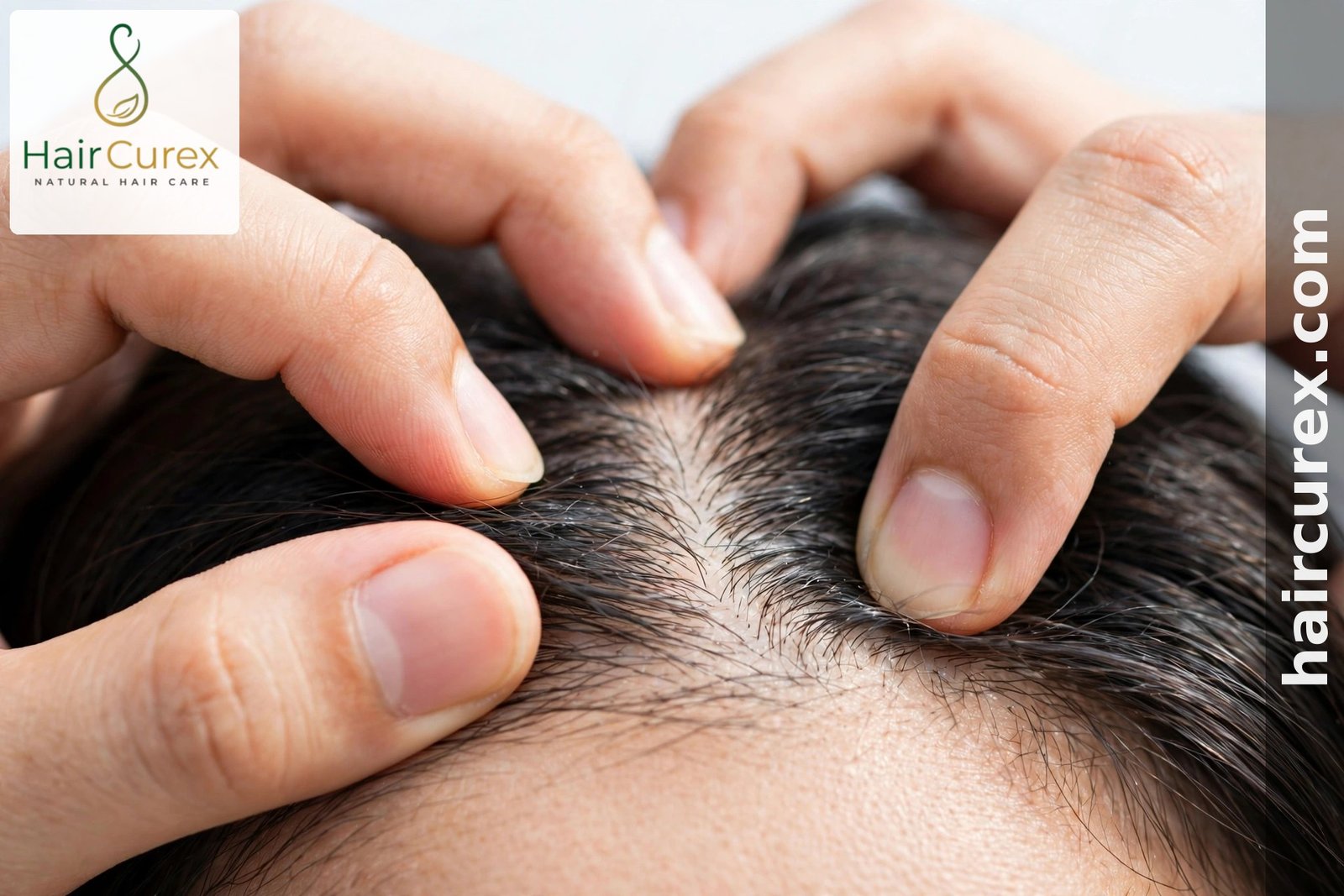
Start with clean, dry or slightly damp hair and clean hands. Place all ten fingertips (not nails) on your scalp at the front hairline and make small, slow circles, moving the skin over the skull rather than sliding your fingers through the hair. Keep the pressure firm but comfortable, about the pressure you would use to rub a sore shoulder. Work in sections: one minute on the front and temples, one minute on the crown, one minute on the sides above the ears, and one minute on the back of the head.
In each section, add ten seconds of gentle presses — push in, hold for two seconds, release — and ten seconds of gentle pinches, lifting a small fold of scalp skin between thumb and fingers. Finish by running your fingertips from the hairline back over the whole scalp, like combing with your fingers. Four minutes is enough: the only measured thickness gain in a clinical study came from four minutes a day.
If you want to follow the 2019 survey’s more intensive scalp massage for hair growth routine, the trade-off is time: two 20-minute sessions a day is 40 minutes daily for months, realistic for very few people.
A better plan for scalp massage for hair growth is four minutes a day, every day, for at least six months, then judge by photos, not memory. Take a photo of your part line and crown in the same light, once a month. Pair the massage with the basics that protect hair: a gentle shampoo that suits your scalp — our guide to the best shampoo for hair fall and dandruff can help you choose — and patience about how long it takes to grow hair, since each hair grows only about half an inch a month.
How Long Before You See Results?
Set your expectations by the hair cycle, not by social media. The 2016 study of scalp massage for hair growth measured a thickness change at 24 weeks — six months — not six days. The survey participants reported noticing a change after roughly 36 hours of total massage time, about three and a half months at 20 minutes a day, but that was self-reported.
A realistic timeline: in the first two to four weeks, your scalp may feel healthier and your hair may look shinier from spread natural oils — cosmetic, not growth. At two to three months, shedding may feel slightly reduced, though that is hard to separate from normal seasonal change, and knowing the difference between hair shedding vs hair loss helps you judge what you are seeing.
At four to six months, any real thickness change would start to show in photos, especially at the part line. If nothing has changed after six months of daily massage, the habit is not moving your hair. And do not expect scalp massage for hair growth to fill a receding hairline or bald patch: no study has shown that, and follicles shrinking under DHT are not something finger pressure reverses.
Fingertips or a Scalp Massager Tool?
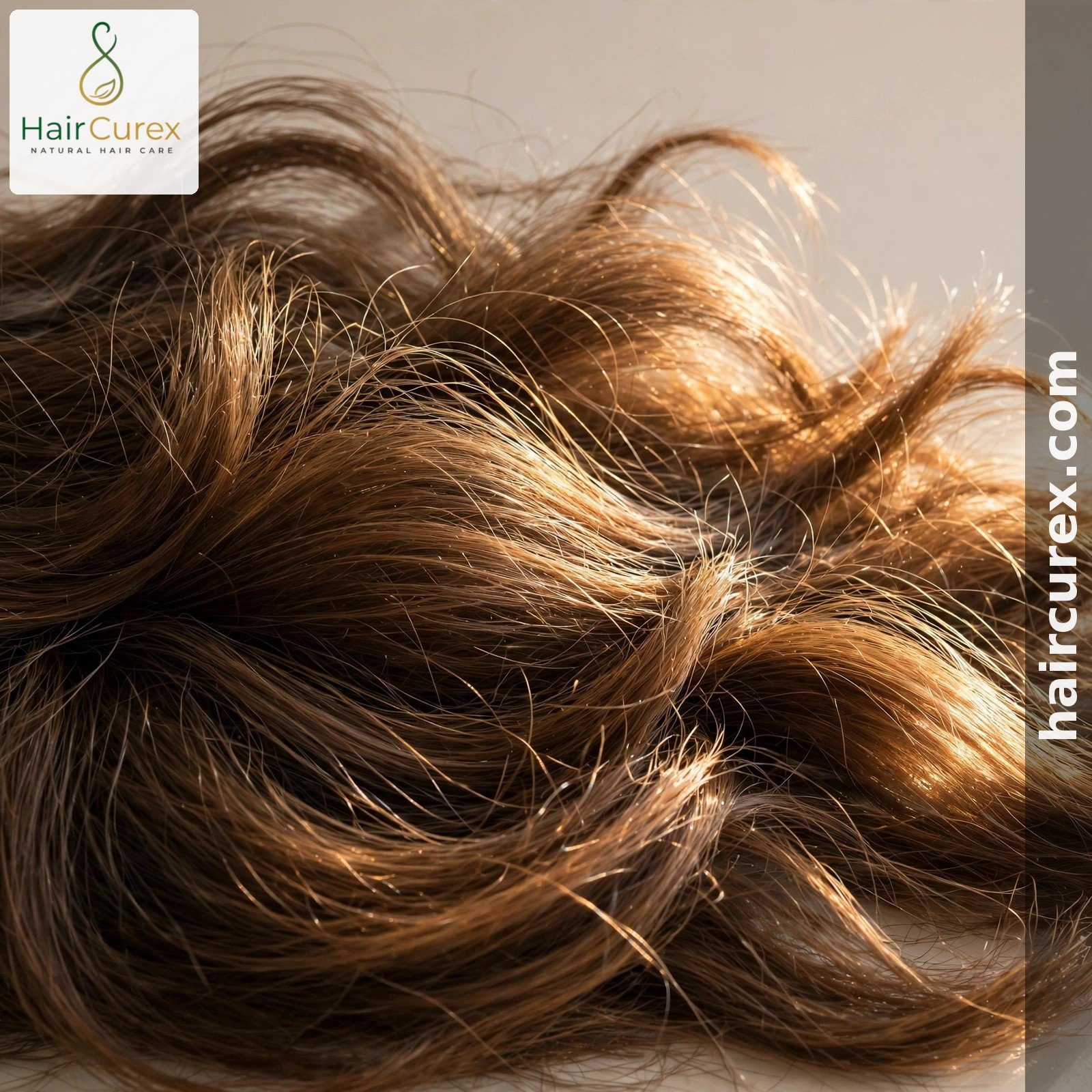
Both work for scalp massage for hair growth, and the choice is mostly about comfort and consistency. Fingertips are free, always available, and give you the best feedback on pressure. Their downside is that four minutes of circles can tire your hands, which is why many people quit. A silicone scalp massager — the soft brush with flexible bristles — solves the fatigue problem and is easy to use in the shower with shampoo. The 2016 study actually used a device, not fingers, so a tool is closer to the tested method.
Whichever you choose, keep the same rules: use the pads, not sharp points; move the skin, do not scratch; and clean the tool weekly, because a dirty massager pressed into a warm scalp grows bacteria, not hair. Avoid hard metal or spiky tools, and skip any device that promises to “stimulate follicles with vibration” — there is no evidence for those claims, and aggressive tools cause breakage. If you have a sensitive or flaky scalp, start with fingertips, because you control the pressure precisely.
Should You Massage With Oil?
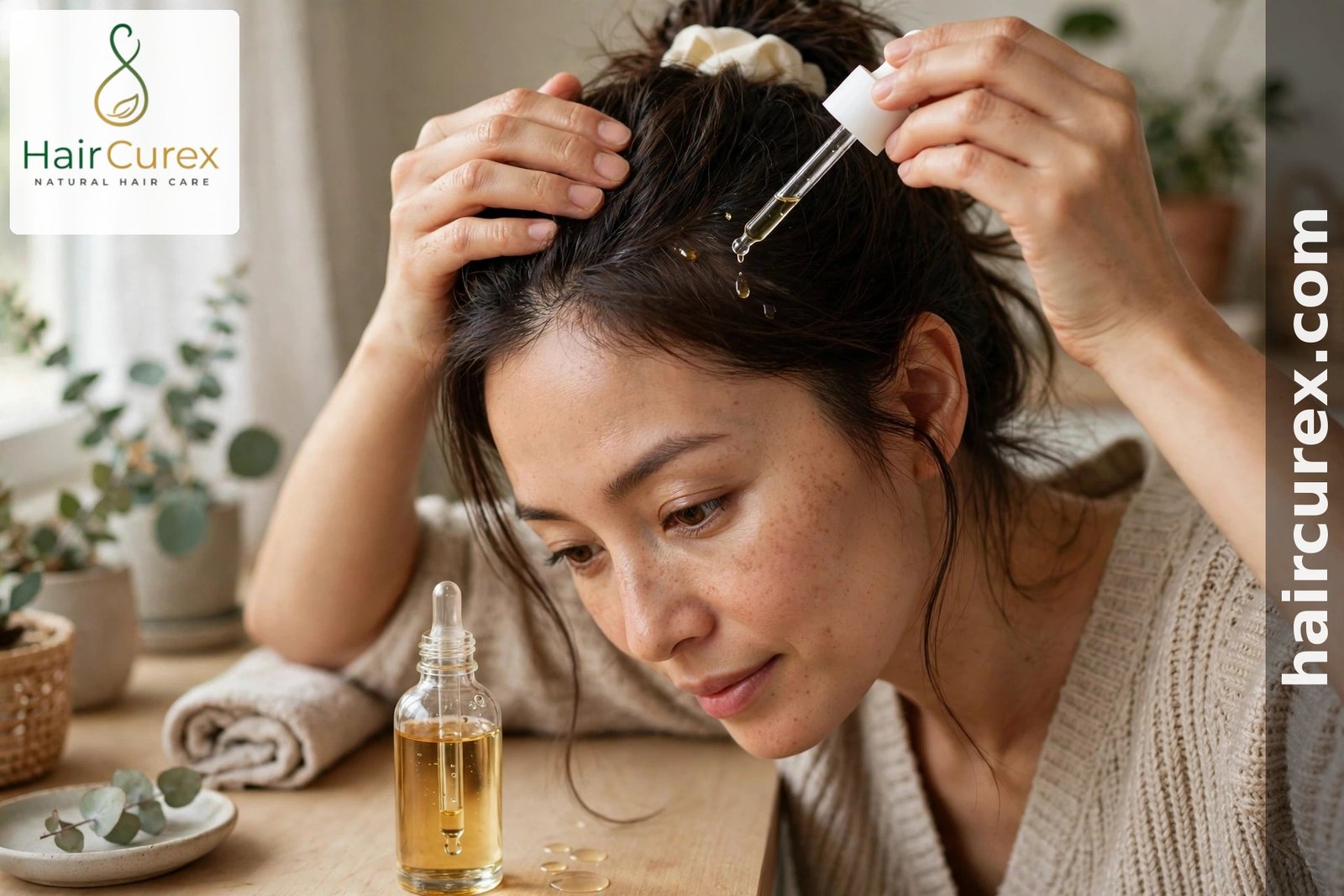
Scalp massage for hair growth and oiling are often sold together, but they do two different jobs. The massage is the active part; the oil is a lubricant that reduces friction and, depending on the oil, adds moisture to the hair shaft. A light oil such as coconut oil for hair can make the massage smoother and leave hair looking shinier, and massaging oil in before a wash can help loosen flakes.
Two cautions: do not leave heavy oil on your scalp for days — oil plus warmth plus dead skin invites clogged follicles and itching, especially if you are prone to dandruff. Apply oil, massage for four minutes, leave it for 30 to 60 minutes, then wash it out.
And do not expect the oil to add growth. Some oils have small studies behind them — rosemary oil for hair growth was tested against minoxidil in one small trial with similar results — but the oil is not the massage, and combining them does not multiply the effect. If your scalp is already oily, skip the oil and massage on a dry scalp; if it is dry, a few drops once or twice a week is plenty.
Mistakes That Make Scalp Massage Useless — or Harmful
Most people who say “scalp massage for hair growth did nothing for me” made one of these mistakes. First, using nails: nails scratch the scalp, create tiny cuts, and snap hairs at the root — always use the pads of your fingers. Second, pressing too hard: pain is not a sign it is working, it is a sign you are bruising the scalp. Third, inconsistency: massaging hard for a week, skipping a month, then declaring it failed. Hair changes take months, and the only study with measured results used daily massage for 24 weeks. Fourth, massaging wet, fragile hair aggressively after a shower; wet hair stretches and breaks more easily, so be gentler when hair is wet.
Fifth, expecting massage to replace treatment: if you have pattern hair loss and skip minoxidil or finasteride — the two treatments with large trials behind them — in favour of massage alone, you are likely to lose ground while you wait. Massage is an add-on, not an alternative. And sixth, massaging through pain, sores, or infection: if your scalp hurts, bleeds, or has open patches, stop and let it heal first.
Who Should Skip Scalp Massage, and When to See a Dermatologist
Scalp massage for hair growth is safe for most people, but not everyone. Skip it — or check with a dermatologist first — if you have scalp psoriasis, eczema, seborrheic dermatitis, ringworm or any fungal infection, open sores, a very tender scalp, or scarring hair loss. Massage can spread infection and worsen inflammation in those cases.
See a dermatologist promptly if you notice sudden heavy shedding, round bald patches, a rapidly widening part, itching with scaling that does not clear, or hair loss with pain or redness. A dermatologist can tell you whether your shedding is telogen effluvium, pattern loss, or something else — and that diagnosis decides the treatment, which massage cannot provide.
Also see a doctor if hair loss comes with fatigue, weight change, or irregular periods, since thyroid problems and iron deficiency can both cause shedding and need blood tests, not massage. For everyone else, a gentle daily scalp massage for hair growth is a low-risk habit — just keep it gentle, keep it consistent, and keep your expectations honest.
Frequently Asked Questions About Scalp Massage for Hair Growth
Does scalp massage really help hair growth?
The evidence is modest but real. One small study of nine men found four minutes of daily scalp massage for 24 weeks increased hair thickness from 0.085 mm to 0.092 mm, with no change in hair count or growth speed. A 2019 survey of 327 people found 68.9% felt their hair loss had stabilised or improved, but that was self-reported with no control group. Massage may help thickness slightly; it is not proven to regrow hair.
How many minutes a day should I massage my scalp?
Four minutes a day is the only duration tested in a measured clinical study, and it is enough to start with. The 2019 survey used two 20-minute sessions a day, but that is 40 minutes daily and unrealistic for most people. Start with four minutes daily and stay consistent for at least six months before judging results.
How long does it take for scalp massage to work?
Expect at least three to six months. The measured thickness change in the 2016 study appeared at 24 weeks, and survey participants reported noticing a change after about 36 hours of total massage time. Take monthly photos in the same light so you can judge honestly.
Is it better to use fingertips or a scalp massager?
Both work. Fingertips are free and give the best pressure control. A soft silicone scalp massager is closer to the device used in the 2016 study and is easier on tired hands. Avoid hard or spiky tools, and never scratch with nails.
Can scalp massage regrow hair on a bald spot?
No study has shown that. Massage increased the thickness of existing hairs in one small study; it did not grow new hairs or change hair count. It cannot reverse pattern baldness, which is driven by DHT shrinking follicles. It is a supporting habit, not a replacement for proven treatments such as minoxidil or finasteride.
Does massaging with oil make it work better?
Oil makes the massage smoother and can add shine, but there is no evidence it adds growth beyond the massage itself. Use a few drops, massage for four minutes, and wash it out within an hour. If your scalp is oily or dandruff-prone, massage on a dry scalp instead.