

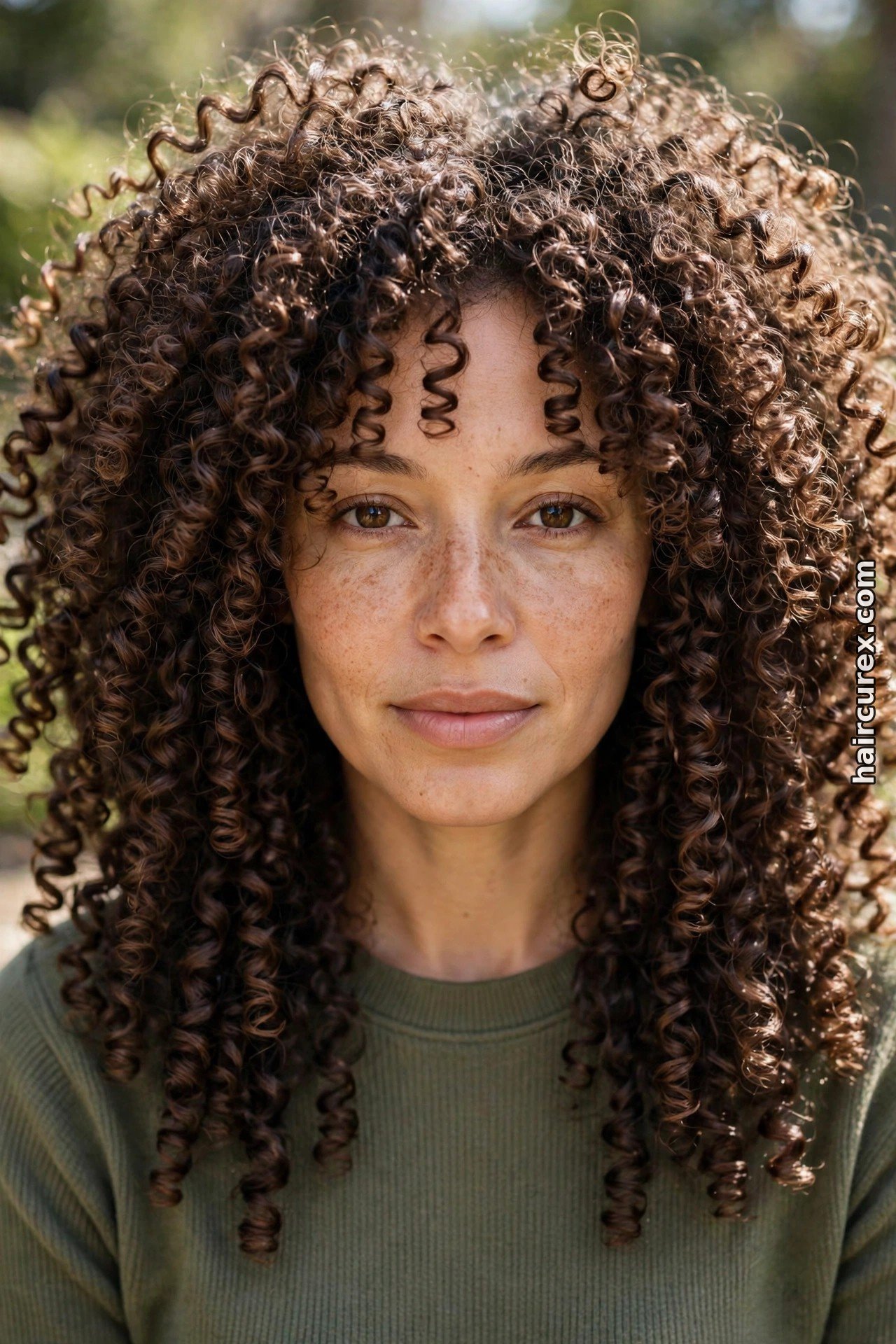
Quick answer: 3c hair is the tightest subtype of type 3 curly hair, made up of dense, well-defined corkscrew curls about the width of a pencil or a drinking straw. If your curls spring into tight spirals on their own, hold their shape when stretched, and shrink noticeably as they dry, you very likely have 3c hair. It needs regular moisture, gentle detangling while wet, and styling products applied to soaking-wet hair to stay defined and frizz-free.
What Is 3c Hair?
3c hair sits at the curly end of the well-known hair typing system, which sorts hair from straight (type 1) through wavy (type 2) and curly (type 3) to coily (type 4). Within type 3, the letters run from loosest to tightest: 3a curls are wide and loose, 3b curls are springy spirals, and 3c hair has the tightest, most densely packed curls of the three. Each curl forms a clear corkscrew or S-shape, and the curls tend to grow outward as much as downward, which is why 3c hair often looks big and full of volume even at shorter lengths.
One of the most useful things to understand about 3c hair is that the typing system describes curl shape only. It says nothing about strand thickness, overall density, or how well your hair absorbs water. Two people can both have 3c hair and need quite different routines: one may have fine strands that get weighed down easily, while another has coarse, dense hair that drinks up heavy creams. If you are still working out where your curls sit, our full curl type chart walks through every type from 1a to 4c side by side.
The structure of 3c hair also explains its most common frustrations. Because each strand twists so tightly, the natural oils from your scalp cannot travel easily down the length of the hair, so the ends are often drier than the roots. The bends in each curl also create more points where strands catch on one another, which is why small tangles and single-strand knots, sometimes called fairy knots, show up more often in tighter curl patterns. None of this means 3c hair is “difficult” hair. It simply means the routine that works for looser curls, or for straight hair, will not be enough on its own.
How to Tell If You Have 3c Hair
The easiest way to identify 3c hair is to look at a single curl when your hair is clean, wet, and free of styling product. Wash your hair, let it air-dry without touching it, and examine curls from different parts of your head. 3c hair forms tight, springy corkscrews roughly the width of a pencil or a drinking straw, and each curl keeps a clear spiral shape even after you gently stretch it and let it spring back. The curls are densely packed, so your hair has a lot of natural volume, and you will usually notice significant shrinkage: hair that reaches your shoulders when stretched may spring up several inches shorter when dry.
It is completely normal to have more than one curl pattern on your head. Many people find looser curls near the front or at the nape and tighter curls at the crown, or a mix of 3b and 3c curls throughout. In that case, style for the tightest pattern present, since products and techniques that define tighter curls rarely harm looser ones. If your curls are wider, closer to a marker or a piece of sidewalk chalk, and fall into looser S-shapes, you may be closer to 3b hair or 3a hair, and those guides will fit you better.
Two quick at-home checks add useful detail beyond curl shape. First, the strand test: take a single shed strand and roll it between your fingers. If you can barely feel it, your strands are fine; if it feels like a thread, they are medium; if it feels wiry, they are coarse. Second, the porosity check: hair that takes a long time to get fully wet and a long time to dry often has low porosity, while hair that soaks up water instantly and dries quickly often has high porosity. Our hair porosity test guide explains the simple glass-of-water test and its limits.

3c Hair Compared With 3a, 3b, and 4a
| Curl type | Curl shape and width | Volume and shrinkage | Most common concerns |
|---|---|---|---|
| 3a | Loose, open ringlets about the width of sidewalk chalk | Moderate volume; least shrinkage in type 3 | Falls flat, loses definition as it grows longer |
| 3b | Springy, defined spirals about the width of a marker | High volume; moderate shrinkage | Frizz and dryness, especially at the ends |
| 3c | Tight corkscrews about the width of a pencil or straw | Very high volume; the most shrinkage in type 3 | Dryness, tangling, single-strand knots, breakage if brushed dry |
| 4a | Tight coils about the width of a crochet needle, S-patterned | Very high volume; very high shrinkage | Dryness, shrinkage, and tangling; needs the most moisture |

The 3c Hair Wash-Day Routine, Step by Step
A good routine for 3c hair is built around one principle: add water and moisture first, then lock the curl pattern in before it dries. Most people with 3c hair wash once a week or every few days, depending on scalp oiliness, workouts, and product use. Washing every day is rarely necessary and often leaves 3c hair drier, while going too long between washes can let product build up and irritate the scalp. Dermatologists at the American Academy of Dermatology advise washing curly hair when needed, at least every two to three weeks at a minimum.
- Detangle before or during conditioning, never on dry hair. Work in sections, starting at the ends and moving upward, using your fingers or a wide-tooth comb while conditioner is still in the hair. Dry brushing breaks up the curl pattern and snaps fragile strands, so it is the single habit most worth dropping. If your hair tangles badly, detangle in the shower under running water, and be patient with knots rather than pulling through them.
- Cleanse the scalp, not the lengths. Apply shampoo mainly to your scalp and let the rinse carry it down the lengths. This cleans away oil and buildup without stripping the drier ends. If you use a lot of gels, creams, or oils, use a clarifying shampoo once every few weeks first, then follow with a moisturizing shampoo. A gentle, sulfate-free shampoo is a good default for 3c hair, but the label matters less than the result: your hair should feel clean but not squeaky after rinsing.
- Condition generously, and deep condition weekly. For dry or curly hair, conditioner belongs on the entire length of the hair, not just the ends. Apply a thick conditioner, leave it in for a few minutes, and use that slip to detangle. Once a week, swap in a deep conditioner or hair mask for 20 to 30 minutes, with a shower cap if you have time. This weekly step is where many people notice the biggest change in softness, because 3c hair is consistently thirstier than looser curl patterns.
- Apply stylers to soaking-wet hair. This is the step that makes or breaks definition for 3c hair. While your hair is still dripping wet, smooth or rake a leave-in conditioner through in sections, then follow with a curl cream, gel, or both. Working in sections keeps the product even and stops the top layer from hogging it all. Scrunch gently upward to encourage the curls to clump, and then stop touching your hair: the more you handle 3c hair while it dries, the more frizz you create.
- Let it set before you break the cast. If you use gel, your hair will dry into a slightly stiff cast, which is a good sign: the curl pattern is locked in. Once the hair is fully dry, scrunch out the crunch gently with bare hands or a drop of light oil. If the cast never forms, you may need a stronger-hold product; if the hair stays crunchy, you used too much product or skipped the scrunch-out step.

Best Products and Ingredients for 3c Hair
For 3c hair, product choice matters less than product order and amount. A simple, reliable lineup is a moisturizing shampoo, a thick rinse-out conditioner, a weekly deep conditioner, a leave-in conditioner, and one styling product with hold, such as a curl cream or a gel. Adding more products on top of that rarely improves the result and often causes buildup, which makes curls limp and dull. Start with small amounts, add more only where a section still looks dry, and give a new product two or three wash days before judging it.
Ingredients worth looking for include glycerin and other humectants, which draw moisture into the hair, fatty alcohols such as cetyl and stearyl alcohol, which soften without the drying effect of simple alcohols, and plant oils and butters such as argan oil, shea butter, and jojoba oil, which help seal moisture in. Dermatologists recommend conditioning products containing ingredients like argan oil, glycerin, or a fatty alcohol for curly hair care. Be cautious with drying alcohols, listed as alcohol denat or ethanol, high up the ingredient list, and heavy waxes or non-water-soluble silicones if you notice buildup that regular shampoo will not remove. Protein is a middle ground: some 3c hair loves it, while other hair turns stiff with too much, so if your hair feels straw-like after a protein mask, cut back and focus on moisture for a few weeks.
Drying 3c Hair Without Frizz
Air-drying gives the least frizz for most people with 3c hair, but long, dense hair can take hours. If you air-dry, blot gently with a cotton T-shirt or microfiber towel instead of rubbing with a rough terry towel, which roughs up the cuticle and creates frizz, then leave your hair alone until it is fully dry. Plopping, wrapping wet curls in a T-shirt or microfiber towel for 15 to 30 minutes, can speed up drying and boost root volume, but leaving hair wrapped for hours can create a damp, flat result, so set a timer.
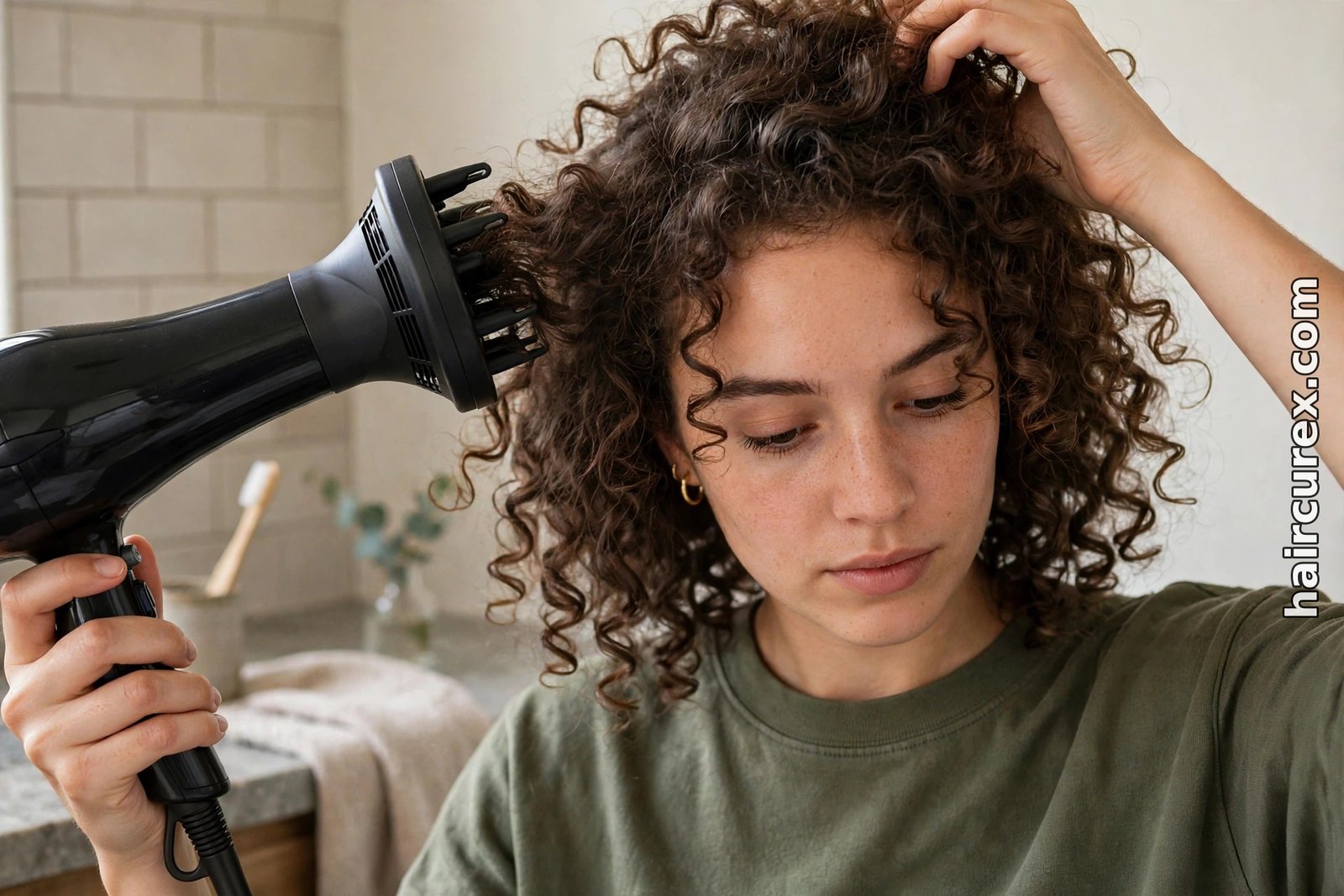
Diffusing is the faster option and works well for 3c hair when done gently. Use a diffuser attachment on low or medium heat and low airflow, cup sections of curls into the diffuser bowl, and hold still rather than moving the dryer around constantly. Finish with a short cool shot to help set the pattern. Use a heat protectant whenever you diffuse, and keep heat tools on low or medium settings. If you regularly straighten 3c hair, space out heat sessions and use the lowest effective temperature.
Nighttime Care and Refresh Days for 3c Hair
Nighttime is where many wash days are won or lost. Cotton pillowcases create friction that pulls curls apart overnight, so a satin or silk pillowcase, bonnet, or scarf makes a real difference for 3c hair. The classic pineapple method, gathering hair loosely on top of the head with a satin scrunchie, keeps curls from being crushed flat, and works best for medium to long lengths. Shorter 3c hair often does better in two or three loose twists or a single loose braid. Keep it loose: tight overnight styles cause breakage at the hairline and are not worth the extra definition.
On non-wash days, refresh rather than rewash. Lightly mist your 3c hair with water, smooth a small amount of leave-in conditioner over the frizzy sections only, and scrunch gently. If a section has gone completely flat, rewet it properly rather than piling on more product over dry hair, which causes buildup and dullness. Most people get two to four good days from one wash day this way. If your scalp gets itchy, flaky, or sore between washes, wash sooner: scalp comfort matters more than stretching a style an extra day.

Common 3c Hair Problems and Fixes
Frizz that appears as soon as hair dries. Frizz in 3c hair is usually a moisture or handling problem, not a product failure. Check that you are styling on soaking-wet hair, that you have used enough leave-in conditioner, and that you are not touching your hair while it dries. On humid days, a gel with stronger hold, or a small amount of gel layered over cream, often holds definition longer than cream alone.
Tangles and single-strand knots. Tight curls tangle because strands wrap around each other, and the tighter the curl, the more chances for that to happen. Detangle only when wet and conditioned, work in small sections, and trim regularly: split ends catch on neighboring strands and create new knots. Protective styles such as twists, braids, and buns reduce daily tangling, but hair left in one style for weeks without washing will tangle worse, not better.
Haircuts and Styling Ideas for 3c Hair
The best haircut for 3c hair is one cut dry, or at least finished dry, so the stylist can see how each curl springs up. A cut done only on wet, stretched hair often ends up much shorter than expected once it dries. Layers are usually your friend: long layers remove weight, let curls stack nicely, and stop the bottom of the hair from looking triangular. Shorter styles, from a rounded afro shape to a tapered cut, also suit 3c hair beautifully because the natural volume does the styling work.
For everyday styling, 3c hair is versatile. A wash-and-go shows off the natural curl pattern and is the lowest-manipulation option. Twist-outs and braid-outs stretch the pattern slightly and give a softer, more elongated look for second or third-day hair. Puffs, buns, and high ponytails work well for busy days, provided the tie is loose and satin-covered rather than a thin elastic that snaps strands. If you color 3c hair, expect extra dryness and add a deep conditioning session in the week after coloring; bleaching in particular raises porosity, so colored 3c hair often needs richer products than before. As a reality check, the American Academy of Dermatology advises choosing products made for your hair type, being gentle with wet hair, and limiting heat, which you can read in their dermatologist tips for curly hair at the American Academy of Dermatology, and their broader advice at the AAD’s healthy hair tips.
Frequently Asked Questions About 3c Hair
What does 3c hair look like?
3c hair looks like dense, tightly coiled corkscrew curls about the width of a pencil or a drinking straw, with lots of natural volume. The curls hold a clear spiral shape even when stretched, and the hair usually shrinks noticeably as it dries.
How do I know if I have 3c hair or 4a hair?
Look at a clean, product-free curl: 3c hair keeps a clean, traceable spiral, while 4a hair forms tighter coils with a less uniform pattern. If your curls are pencil-width spirals, you likely have 3c hair; if they are crochet-needle-width coils, you are closer to 4a. The care routines overlap heavily, so either guide is a good starting point.
How often should I wash 3c hair?
Most people with 3c hair wash about once a week, adjusting for scalp oiliness, workouts, and product use. Dermatologists advise washing curly hair when needed, at least every two to three weeks at a minimum, so once a week sits comfortably within that guidance for most people. Wash sooner if your scalp feels itchy, irritated, or weighed down by buildup.
What products are best for 3c hair?
A simple lineup works best: a moisturizing shampoo, a thick conditioner, a weekly deep conditioner, a leave-in conditioner, and a curl cream or gel for hold. Look for glycerin, fatty alcohols such as cetyl or stearyl alcohol, and oils like argan oil, and avoid drying alcohols high on the ingredient list.
Why is my 3c hair always frizzy?
Frizz in 3c hair usually comes from dryness or handling: styling on hair that is not wet enough, skipping leave-in conditioner, or touching curls while they dry. Style on soaking-wet hair, use enough leave-in, let hair dry untouched, and add a stronger-hold gel on humid days.
Can I brush 3c hair?
You can detangle 3c hair with a wide-tooth comb or your fingers while it is wet and full of conditioner, but brushing it dry breaks up the curl pattern and causes breakage and frizz. If you need a brushed-out look for a specific style, do it on damp, conditioned hair and accept that definition will be looser that day.
Does 3c hair grow fast?
3c hair grows at the same average rate as other hair types, roughly half an inch per month, but shrinkage makes growth much harder to see. Hair that looks the same length for months may have grown several inches that are hidden by tight curls. Stretching a section gently when wet, or comparing stretched lengths over time, shows true growth better than judging by how the hair hangs when dry.