

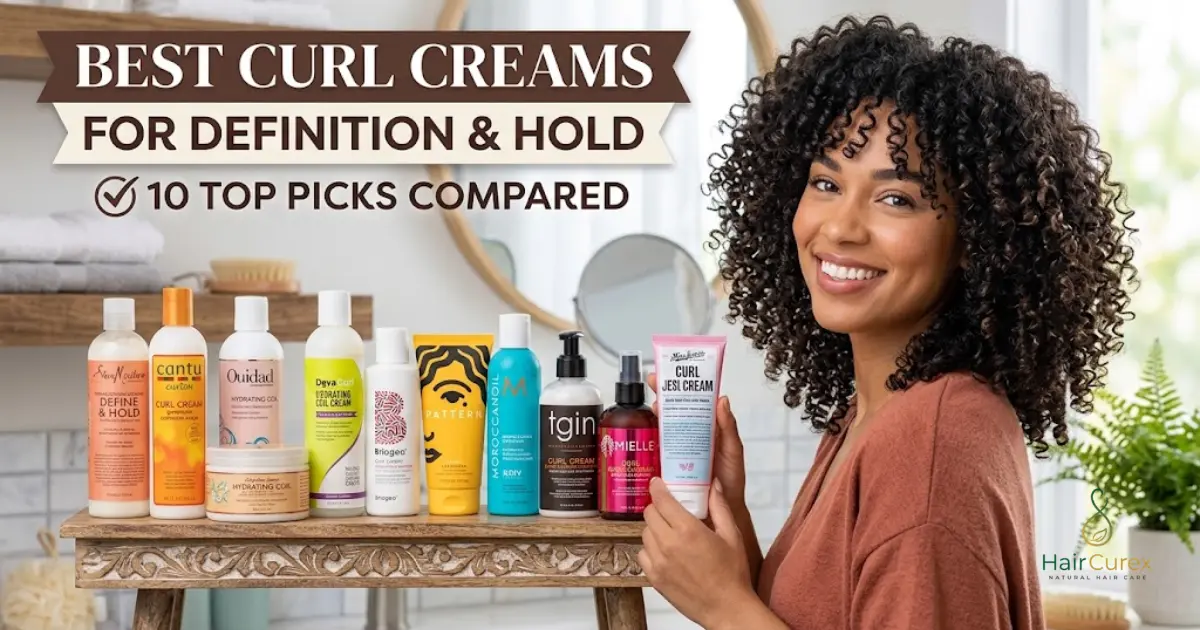
The best curl cream helps define curls without making them feel heavy.
It adds moisture, reduces frizz, and helps curls look smooth and shaped.
The right formula can also give your curls soft, lasting hold.
Tired of curls that lose their shape after a few hours?
The right curl cream can make styling easier and more effective.
But not every curl cream works well for every hair type.
The best curl cream depends on your hair type and styling needs.
Some formulas focus on moisture, while others provide more hold.
In this guide, you’ll find options for defined, soft, and lasting curls.
Quick answer: The best curl cream for definition and hold is a styling cream that enhances your natural curl pattern while giving strands enough structure to stay grouped together, and the right choice depends on your hair type and styling needs.
What Is the Best Curl Cream for Definition and Hold?
The best curl cream for definition and hold is a styling cream that enhances your natural curl pattern while giving the strands enough structure to stay grouped together. Unlike a basic leave-in conditioner, a styling-focused cream usually contains ingredients that help shape or coat the hair. Some formulas create only a soft finish, while others offer noticeably stronger control.
A good curl cream for curly hair should also match your hair’s needs. Fine waves may collapse under a rich butter-based formula, while thick coils can need more conditioning to prevent dryness and frizz. Hair porosity matters too. Low porosity strands may prefer lighter formulas that don’t leave a heavy coating, while highly porous hair may appreciate richer conditioning. In other words, the best product isn’t automatically the richest, strongest, or most expensive one. It is the one that gives you the right balance of definition, moisture, movement, and hold.
What Makes a Curl Cream Good for Hold?
Hold comes from the way a formula interacts with your hair. Styling polymers, film-forming ingredients, starches, gums, proteins, and other conditioning agents can help curls maintain their shape after drying. A cream doesn’t need to feel stiff to provide useful hold. Some formulas create a soft film that keeps curl groups together while leaving them touchable.
That’s why the phrase curl cream with hold can mean different things from one product to another. A soft-hold cream may simply help waves keep their shape. A stronger formula can create a noticeable cast or structure. If your curls lose their shape quickly, a cream alone may not provide enough staying power. In that case, layering a gel over your cream can create a stronger styling system without forcing you to give up the moisture and softness you like.
1. How We Chose the Best Curl Creams
The selection process focuses on what matters when you actually style curly or wavy hair. Hold is important because definition that disappears quickly isn’t very useful. However, hold isn’t the only factor. A formula should also distribute evenly, complement the hair’s natural texture, manage frizz, and avoid leaving an unpleasant coating behind.
The comparison also considers hair density, strand thickness, porosity, moisture needs, styling finish, and versatility. A lightweight product can make sense for fine 2A waves yet disappoint someone with dense 4C curls. Likewise, a rich cream may feel wonderful on coarse, dry hair while flattening fine curls. Price and availability also matter for a U.S. shopper because a product isn’t particularly practical if it’s difficult to replace.
What We Looked for in a Curl Cream
The most useful way to compare a curl cream is to look at several factors together rather than chasing one impressive claim.
| Factor | What It Tells You |
|---|---|
| Hold | How well the product helps curls maintain their shape |
| Definition | How clearly it encourages curl and wave formation |
| Weight | Whether it feels light or rich on the hair |
| Frizz control | How well it helps smooth the finished style |
| Moisture | How much conditioning the formula provides |
| Slip | How easily you can spread it through the hair |
| Longevity | How well the style may maintain its shape |
| Hair-type fit | Which textures and patterns are most suitable |
| Buildup potential | How likely repeated use may leave hair feeling coated |
| Value | How much useful styling performance you get for the price |
2. Best Curl Creams at a Glance
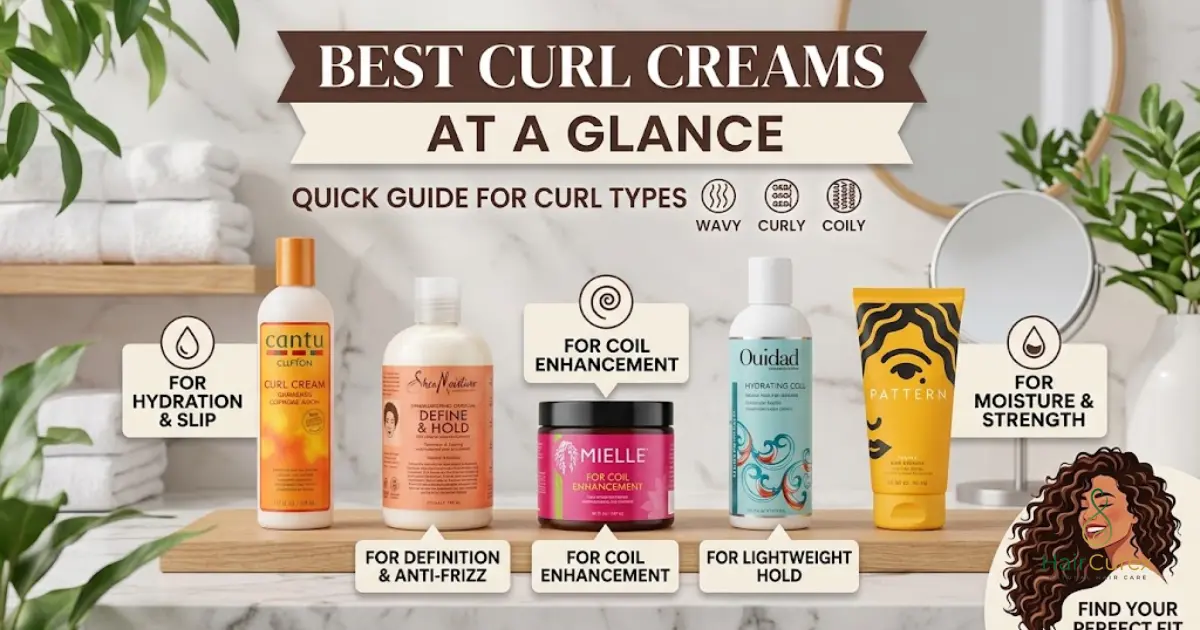
The table below gives you a quick way to narrow the field before reading the detailed sections. These categories describe the intended use of each formula rather than claiming that one cream works identically for every person. Your result can change with hair density, weather, application technique, and the other products in your routine.
| Curl Cream | Best For | Hold | Weight | Frizz Control | Best Match |
|---|---|---|---|---|---|
| Ouidad Advanced Climate Control Featherlight Styling Cream | Overall | Soft | Light | High | 2A–4C |
| Innersense I Create Curl Memory | Stronger hold | Flexible/strong | Medium | High | Coarse, curly, coily |
| Bumble and bumble Curl Light Defining Styling Cream | Fine hair | Soft | Light | Medium | Fine 2A–3C |
| PATTERN Styling Cream | Thick/coarse hair | Soft | Rich | High | Dense 3C–4C |
| Moroccanoil Curl Defining Cream | Definition | Medium | Medium | High | Wavy to curly |
| Curlsmith Awestruck Definition Cream | Definition and longevity | Medium | Medium | High | Curly and coily |
| Bumble and bumble Curl Defining Cream | Dry/thick curls | Soft | Rich | High | Medium–thick hair |
| Ouidad Featherlight Styling Cream | Lightweight styling | Soft | Light | High | Fine to medium |
| Curlsmith Feather-Light Protein Cream | Low-weight styling | Light-medium | Light | Medium-high | Fine to medium curls |
| Miss Jessie’s Pillow Soft Curls | Budget-friendly softness | Very soft | Light | Medium | Wavy to curly |
The most important thing to notice is that these products don’t all solve the same problem. A person with fine waves may want movement and volume, while someone with dense coils may prioritize moisture and control. Treat the categories as a shortcut to the formula that fits your needs rather than as a one-size-fits-all ranking.
3. Best Overall Curl Cream
Ouidad Advanced Climate Control Featherlight Styling Cream is a strong all-around option when you want flexible definition without a heavy finish. The formula is designed for all curl types from 2A through 4C and combines lightweight oils with ingredients aimed at humidity and frizz control. Ouidad describes it as providing flexible, soft hold rather than a hard or crunchy finish. That makes it especially useful when your goal is touchable curls with a polished shape rather than a rigid style.
The formula includes meadowfoam seed, olive, and soybean oils along with sericin, a silk-derived protein. It also contains conditioning and film-forming ingredients that help create a smoother styling base. For everyday curls, that combination makes sense because moisture and control need to work together. The cream can also serve as the softer part of a layered routine when you need additional hold from a gel. Ouidad specifically recommends pairing its styling cream with its Heat & Humidity Gel when stronger definition and longer-lasting frizz protection are needed.
Why It Stands Out
The biggest advantage is versatility. You don’t have to reserve this kind of formula for one specific curl pattern. It can make sense for loose waves that need polish as well as tighter curls that need softness before a stronger styler. The finish stays more flexible than a traditional strong-hold gel, which is useful if you dislike the feeling of product sitting heavily on the hair.
It also works well as an example of an important curl-care principle: soft hold and strong hold aren’t the same thing. If you want movement, a styling cream can be enough. If your curls regularly collapse in humidity or lose their shape overnight, adding a gel may give you the extra structure you need.
How to Use It
Apply the cream to damp hair rather than spreading a large amount over nearly dry strands. Work through sections so the product reaches the curls evenly. Rake the cream through the hair, then scrunch or use a curl-forming technique that suits your texture. Let the hair air-dry or diffuse it without repeatedly touching the curls.
For more hold, apply a compatible gel after the cream. Start with less than you think you need. You can always add another small amount, but removing excess styling product is much harder.
4. Best Curl Cream for Strong Hold
Innersense I Create Curl Memory takes a different approach from a traditional rich cream. The brand describes it as a hydrating styling gelee that offers flexible hold and long-lasting curls. Its formula includes a sugar complex, bamboo extract, and aloe vera. Innersense specifically positions it for coarse, curly, and coily hair. The texture sits somewhere between a conventional cream and a styling gel, which helps explain why it can provide more structure than many soft curl creams.
This makes it an interesting choice if you want a best curl cream for hold without jumping immediately to a firm gel. The formula is designed to smooth, hydrate, and support curl memory in one step. However, stronger structure doesn’t automatically mean it will suit every head of hair. Fine strands can sometimes need a lighter product, while dense curls may appreciate the extra conditioning and structure.
Who Needs a Strong-Hold Curl Cream?
A stronger cream or cream-gel makes sense when your curls tend to stretch, separate, or lose their shape shortly after styling. It can also help when you want elongated curls with a more controlled finish. Humidity is another factor. Moisture in the air can cause some curl patterns to expand and lose definition, so a formula that creates more structure may help preserve the original shape.
Still, there is a limit. If you need a very firm cast that survives a long day in extreme humidity, a dedicated strong-hold gel may outperform a cream. Think of curl cream as the flexible middle ground between conditioning and styling control.
Strong Hold vs. Crunchy Hair
A firm-looking style doesn’t have to remain stiff. Some styling products create a cast while the hair dries. Once completely dry, you can gently squeeze or scrunch the curls to soften that cast while keeping much of the structure underneath.
That technique is useful when you want definition without a helmet-like finish. The trick is patience. Touching wet curls repeatedly can disturb the curl groups before the styling film has finished setting. Let the hair dry first, then soften the finished style with clean, dry hands.
5. Best Curl Cream for Fine Hair
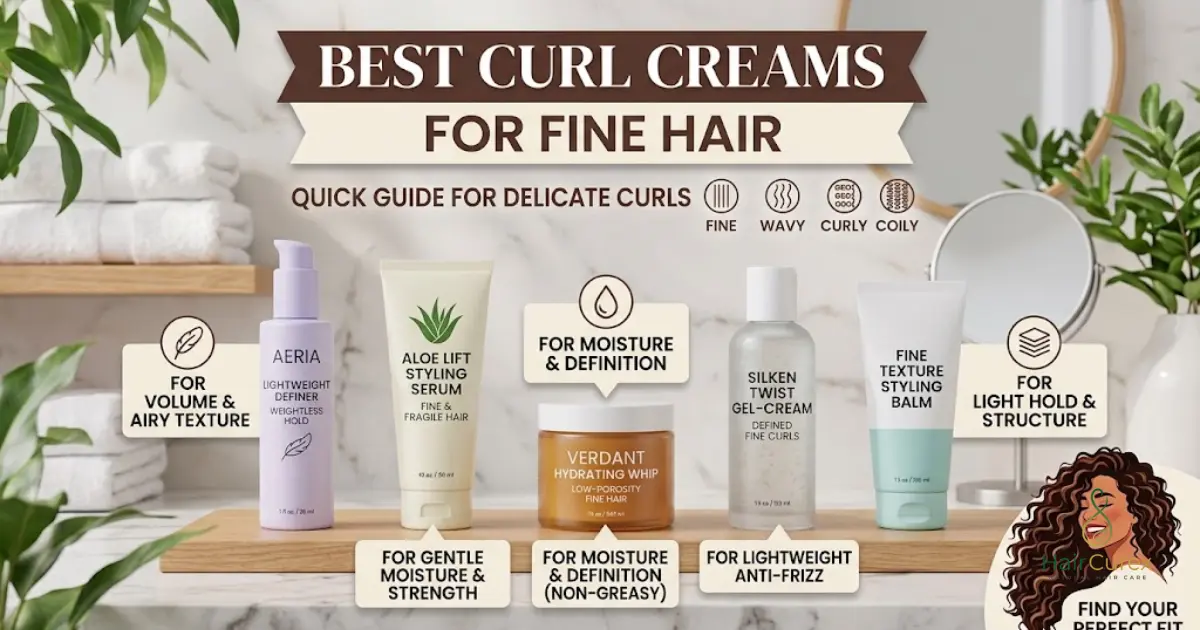
Bumble and bumble Curl Light Defining Styling Cream is designed specifically for fine-to-medium curly hair. The brand describes it as a lightweight moisturizing cream for flexible curls and waves. It targets 2A–2C waves and 3A–3C curls and provides soft hold while aiming to reduce frizz and maintain movement. That makes it a logical choice for hair that needs conditioning but tends to lose volume when you apply too much product.
Fine hair needs a different strategy from dense hair. The issue usually isn’t a lack of product. It’s distribution. A heavy layer can coat the strands, flatten the roots, and make curls look stringy. A lighter curl cream for fine hair lets you build definition gradually. You can also concentrate the product on the lengths and ends while keeping the roots relatively free.
How to Avoid Weighing Down Fine Curls
Start with wet or very damp hair and use a small amount. Spread it between your palms first. That simple step helps prevent one section from receiving a thick blob while another receives almost nothing. Add more only after you see how the first application behaves.
Fine curls also benefit from careful layering. If you apply leave-in conditioner, curl cream, oil, and gel at full amounts, the combination can become too heavy even when every product looks lightweight by itself. A better approach is to identify what your hair actually needs. If the cream provides enough moisture, skip the extra leave-in. If it provides only soft hold, add a small amount of gel rather than another rich cream.
6. Best Curl Cream for Thick, Coarse Hair
PATTERN Styling Cream is built around rich moisture and a soft, touchable hold. Its formula includes shea butter, coconut oil, cocoa butter, sweet almond oil, sunflower oil, and cacay oil. PATTERN positions it for styles such as wash-and-gos, twist-outs, braid-outs, and Bantu knots. The rich texture makes it particularly interesting for dense, coarse, or dry curls that need more conditioning during styling.
A rich curl cream for thick hair can make a dramatic difference when individual strands feel rough or when the hair expands quickly after drying. The downside is equally important: richness can become too much for fine or low-density hair. Thick hair often needs more product simply because there is more surface area to coat, but that doesn’t mean you should apply an entire handful at once. Sectioning makes a bigger difference than simply increasing the amount.
How to Apply Curl Cream to Thick Hair
Divide the hair into several sections before applying the product. Work one section at a time and spread the cream from the roots toward the ends according to your styling preference. Use your fingers, a styling brush, or the praying-hands method to distribute the formula evenly. Then scrunch the section to encourage the natural curl pattern.
Water is your friend here. If the cream feels difficult to spread, add more water before adding more product. This approach can create better coverage without leaving the hair overloaded. For especially dense curls, a cream can provide the moisture foundation while a gel supplies the stronger outer hold.
7. Best Curl Cream for Wavy Hair
Moroccanoil Curl Defining Cream is designed to define curls while helping fight frizz. Its formula contains argan oil, hydrolyzed vegetable protein, and Polyquaternium-11, which the brand identifies as a film-forming ingredient that helps hold the curl. Moroccanoil also distinguishes this product from its Intense Curl Cream, which it describes as a leave-in conditioner without hold. That distinction matters when shopping because two products can both contain the words “curl cream” while performing very different styling jobs.
For waves, the best curl cream for wavy hair should enhance the existing bend without turning it into a heavy, greasy-looking wave. The ideal result is movement with enough definition to make the pattern visible. If your 2A or 2B hair becomes flat easily, use a smaller amount and keep richer conditioners away from the roots.
Best Curl Cream for 2A, 2B, and 2C Hair
2A waves generally need the lightest touch because they can lose volume quickly. 2B waves can handle a little more styling structure, especially when humidity causes the pattern to expand. 2C waves sit closer to curls and often benefit from a more deliberate styling routine with stronger clumping.
Your wave pattern isn’t the only variable. Hair density and strand thickness matter just as much. A thick 2A head of hair may tolerate more product than very fine 2C hair. That’s why product labels provide useful starting points rather than absolute rules.
8. Best Curl Cream for Frizz Control

Ouidad Advanced Climate Control Featherlight Styling Cream is especially relevant when frizz and humidity are major concerns. The formula uses sericin and a blend of lightweight oils and humectants. Ouidad says its Anti-Frizz Nano Technology helps form a barrier that locks in moisture and helps keep humidity out. The product is designed for all curl types and offers soft, flexible hold.
A good curl cream for frizzy hair should do more than simply make strands feel oily. Frizz often becomes noticeable when individual hairs stop staying within the same curl group. Moisture balance, friction, weather, damage, and styling technique can all contribute. A cream can encourage better clumping and smooth the strands, but application still matters. If you rough-dry your curls with a towel or constantly touch them while they dry, even an excellent styling formula may struggle.
How Curl Cream Helps Control Frizz
Curl creams can reduce the rough, separated appearance of curls by adding conditioning agents and helping neighboring strands form larger curl groups. Some formulas also contain film-forming ingredients that create a light protective layer around the hair. That layer can improve smoothness and help preserve the style.
Humidity adds another challenge. In damp weather, hair can absorb water from the environment and swell. This can loosen carefully formed curl groups. For difficult weather, a cream can serve as the first styling layer while a humidity-resistant gel provides additional protection and hold.
9. Best Curl Cream for Dry or Damaged Curls
Bumble and bumble Curl Defining Cream is formulated for medium-to-thick hair and is intended for curly and wavy patterns ranging from 2A to 4C. The formula contains avocado, coconut, and jojoba oils along with shea and cocoa butters. The brand describes it as providing soft hold, moisture, shine, and frizz reduction. It also includes UV filters.
Dry or damaged curls need a careful balance. More moisture can improve softness and manageability, but adding heavy layers every styling day isn’t automatically better. Damaged hair also benefits from gentle handling. Excessive brushing, high heat, rough drying, and aggressive detangling can add mechanical stress even when the styling product itself is conditioning.
What to Look for in a Curl Cream for Dry Hair
Look for a formula that provides slip, softness, and enough conditioning for your strand thickness. Oils and butters can help reduce the dry feel of coarse hair, while conditioning agents can improve manageability. If your hair is fine despite being dry, however, a lighter formula may work better.
It’s also useful to separate styling from repair. A curl cream can improve the appearance and manageability of damaged hair, but it isn’t a substitute for reducing the source of damage. Heat protection, gentle detangling, regular conditioning, and sensible styling habits remain important parts of the routine.
10. Best Lightweight Curl Cream
A lightweight formula makes sense when your hair needs definition but refuses to cooperate with heavy products. Curlsmith Feather-Light Protein Cream is designed as a lightweight styling cream and uses a formula intended to provide soft-to-moderate styling support without the heavier feel of richer creams. Curlsmith describes its cream range as providing soft, crunch-free hold, while its Feather-Light Protein Cream is positioned as a lighter option.
The attraction of a lightweight curl enhancing cream is simple: you get some styling support without sacrificing movement. This can work particularly well for fine curls, loose waves, and hair that becomes limp after conditioning. However, “lightweight” doesn’t mean you should use unlimited amounts. Too much of even a light product can create buildup or reduce volume.
Lightweight Curl Cream vs. Heavy Curl Cream
The difference comes down to how much conditioning and coating your hair can comfortably handle. A heavy cream often contains a richer blend of butters and oils and can be useful for dense or coarse hair. A lightweight cream usually spreads more easily and leaves more movement behind.
Consider a simple example. Fine 2B hair may look beautiful after a small amount of lightweight cream but lose its lift after a heavy butter-based product. Dense 4A hair may show the opposite response, looking dry or under-conditioned when a very light formula is used alone. The product needs to match the hair rather than the trend.
11. Best Curl Cream for Low Porosity Hair
Curlsmith Feather-Light Protein Cream can also make sense when you need a lighter styling layer for low porosity hair. Low porosity hair generally has a cuticle structure that makes it harder for water and some products to move into the fiber. As a result, heavy products can sometimes sit on the surface and create a coated feeling.
The phrase curl cream for low porosity hair should therefore be treated as a formulation question rather than a marketing label. Look for products that spread easily and don’t require a thick layer to produce definition. Your individual strand thickness still matters. Low porosity fine hair and low porosity coarse hair can react very differently to the same cream.
How to Use Curl Cream on Low Porosity Hair
Apply the cream to thoroughly wet or very damp hair so it can distribute with the water already present. Start with a small amount and work it through one section at a time. If the hair feels coated after drying, reduce the quantity next time rather than immediately adding another cleansing product.
Product buildup can also become more noticeable when you repeatedly layer rich stylers. If your curls suddenly feel dull, sticky, or difficult to wet, your routine may need a reset. A suitable clarifying wash can help remove accumulated styling residue, although the right frequency depends on your products and hair needs.
12. Best Budget Curl Cream
Miss Jessie’s Pillow Soft Curls offers a softer styling approach at a comparatively accessible price point. The brand describes it as a lightweight styling lotion for wavy, curly, tight-curly, and transitioning hair. It is specifically positioned as one of the brand’s softest-hold styling products. That makes it more appropriate for people who prioritize softness, bounce, and a relaxed finish rather than maximum longevity.
A budget-friendly product doesn’t need to imitate a premium cream in every category. What matters is whether it solves your particular styling problem without requiring a complicated routine. If you have loose waves or curls and mainly want softness with some shape, a lighter styling lotion can be enough. If you need firm hold, you may need to layer a gel.
Is an Expensive Curl Cream Worth It?
Price alone doesn’t predict performance. A premium formula may offer a particular texture, ingredient combination, scent, packaging, or specialized styling technology. However, an affordable product can still work extremely well when it matches your hair’s needs.
The smarter comparison is cost versus useful performance. A $30 product that requires only a small amount may last longer than a $15 product that requires several large applications. Likewise, a budget cream that needs a separate gel isn’t necessarily more expensive overall if the combination gives you the finish you want. Look at the entire routine rather than the sticker price of one bottle.
Curl Cream vs Gel: Which Gives Better Hold?
The biggest difference in curl cream vs gel comes down to the balance between conditioning and structure. Curl creams generally focus on softness, moisture, curl enhancement, and flexible styling. Gels usually place more emphasis on creating a stronger styling film that keeps curls in position. Curlsmith describes its creams as soft, crunch-free stylers while positioning gels as the stronger option for high definition.
That doesn’t mean cream is weak or gel is automatically better. Your goal determines which one makes more sense. If you want loose, touchable waves, a cream may provide enough control. If you want highly defined curls that survive a long day, a gel can supply the extra structure. Many routines use both because they perform different jobs.
Can You Use Curl Cream and Gel Together?
Yes. Apply the cream first, then add gel while the hair is still wet or damp. The cream provides conditioning and initial definition while the gel forms a stronger styling layer around the curl groups. This combination can be particularly useful for humidity, long days, or curls that lose their pattern quickly.
The key is moderation. Too much cream underneath a large amount of gel can make the hair feel coated. Start with a small amount of cream and then apply gel gradually. If the finished curls feel heavy, reduce the cream next time. If they look beautiful but fall apart quickly, keep the cream amount similar and increase the gel slightly.
How to Apply Curl Cream for Longer-Lasting Hold
Start with freshly washed and conditioned hair, then gently remove excess water without roughing up the strands. Apply your curl cream while the hair remains wet or damp. Water helps the product spread more evenly, which means you can often use less product while still covering the hair.

Work in sections when your hair is dense or long. Smooth or rake the product through each section, then scrunch upward to encourage the natural curl pattern. If your hair responds well to a styling brush, you can brush smaller sections to create more uniform curl clumps. Once you’ve finished, air-dry or diffuse with minimal touching. Disturbing wet curls is one of the easiest ways to create unnecessary frizz.
How to Get More Definition From Curl Cream
Definition starts with water, distribution, and curl formation, not simply adding more cream. If the hair isn’t wet enough, the product may sit unevenly. If you apply everything at once, some areas can become overloaded while others receive too little. Sectioning solves much of that problem.
For tighter definition, create smaller curl clumps and use a little more styling product where the pattern needs encouragement. For softer waves, use less cream and allow the natural texture to remain loose. If the style still lacks longevity, add a gel rather than continuously increasing the amount of cream.
How Much Curl Cream Should You Use?
There isn’t one perfect measurement because hair length, density, thickness, porosity, and product concentration all change the amount needed. A useful starting point is a small amount for short or fine hair and a larger amount for long, dense, or coarse hair. The important part is to build gradually.
For many people, the best technique is to apply a little product to wet hair, distribute it completely, then assess the result. If certain sections still feel dry or fail to clump, add a small amount to those areas. This method gives you more control than applying a large handful immediately.
Signs You’re Using Too Much Curl Cream
Too much product can make curls feel coated, sticky, greasy, or unusually soft. Fine hair may lose volume at the roots. Curls can also look separated rather than springy because the strands become weighed down by excess product. Over time, repeated layers can contribute to buildup.
If your hair feels heavy after styling, don’t automatically switch products. First reduce the amount. Then test the same cream with more water. Many styling problems come from application rather than the formula itself.
Can You Use Curl Cream Every Day?
You can use curl cream frequently if your hair responds well to the formula and your routine doesn’t create excessive buildup. Some people style after every wash, while others refresh their curls between washes. The difference comes down to hair type, product weight, cleansing routine, climate, and personal preference.
Daily application isn’t automatically harmful because a product carries the word “cream.” However, repeatedly layering rich styling products can make the hair feel coated. Fine hair may show this problem faster than thick hair. If your curls start feeling dull, sticky, limp, or difficult to refresh, reconsider how much product you’re layering.
How to Refresh Curls Without Adding Too Much Product
Start with water. Lightly mist the hair or wet your hands, then scrunch the curls to reactivate their shape. You may find that yesterday’s styling product still provides enough structure to reshape the curls without another full application.
For stubborn areas, use a tiny amount of cream rather than coating the entire head again. Twist or scrunch those sections into place and let them dry. This targeted approach saves product and helps maintain volume.
Conclusion
The best curl cream depends on what your hair needs from a styling product. Fine waves often need lightweight definition, while thick curls may prefer richer conditioning. Dry hair may need softness and slip, whereas curls that lose their shape quickly may need a formula with stronger styling support.
The biggest lesson is that definition and hold aren’t the same thing. A cream can make your curl pattern look clearer without providing enough structure to keep it there all day. When that happens, layering a gel can bridge the gap. On the other hand, if your hair already holds its shape well, adding a strong gel may create more stiffness than you want.
Start with the right category for your hair, use a modest amount, and pay attention to how your curls respond. Once you understand that balance, choosing a curl defining cream, curl enhancing cream, or stronger curl cream with hold becomes much easier.
Frequently Asked Questions About Curl Creams
What is the best curl cream for definition and hold?
The right choice depends on your hair type and the level of control you want. A soft-hold cream can provide flexible definition, while a cream-gel formula may offer more structure. If your curls need maximum longevity, pairing cream with gel can provide more hold than cream alone.
Does curl cream actually hold curls?
Yes, some curl creams provide genuine styling hold. The strength varies considerably between formulas. Styling polymers, film-forming ingredients, gums, starches, and other ingredients can help curls maintain their shape. However, many traditional creams focus more heavily on moisture than hold.
Is curl cream better than gel for curly hair?
Neither product is automatically better. Curl cream generally offers more softness and conditioning, while gel usually provides stronger structure. If you want touchable curls with movement, cream may be enough. If you need long-lasting definition, gel can provide additional hold.
Can I use curl cream on wavy hair?
Yes. A lightweight curl cream can enhance waves without making them feel stiff. For 2A and fine 2B hair, start with a small amount. Heavier products may work better for thick 2C hair.
Does curl cream help with frizz?
It can. Conditioning ingredients can improve smoothness and help curls form more cohesive groups. Some formulas also contain ingredients designed to help protect against humidity. Your application technique still matters because touching wet curls or rough-drying them can increase frizz.
Can curl cream make hair crunchy?
Most traditional curl creams aim for a softer finish, but some styling creams create a light cast as they dry. You can usually soften a dry cast by gently scrunching the curls after they’re completely dry.
Should you put curl cream on wet or damp hair?
Both can work. Wet hair often makes it easier to distribute the product evenly, while damp hair can provide a slightly more concentrated application. For dense curls, thoroughly wet hair can make section-by-section distribution easier.
Can I use curl cream every day?
You can if your hair responds well and your routine doesn’t cause buildup. Refreshing with water first can help you avoid repeatedly adding more product. If your hair becomes heavy or coated, reduce the amount or clarify when appropriate.
How much curl cream should I use?
Start small and increase gradually. Fine or short hair usually needs less than long, dense, or coarse hair. The formula also matters because some creams are much more concentrated than others.
Can you use curl cream and gel together?
Yes. Apply curl cream first and gel afterward. This combination can give you the moisture and softness of cream with the stronger styling structure of gel.
Is curl cream good for fine hair?
Yes, provided you choose a lightweight formula and control the amount. Fine hair can lose volume when overloaded with rich oils, butters, or multiple styling layers.
What is the best curl cream for thick hair?
Thick or coarse curls often benefit from richer formulas that provide both conditioning and flexible hold. Sectioning the hair during application can also improve coverage without requiring excessive product.
Does curl cream work for low porosity hair?
Yes. Lightweight formulas often make a practical starting point because they can reduce the risk of a heavy coated feeling. Apply a small amount to wet hair and watch how your strands respond.
How long does curl cream last in your hair?
There is no universal number of hours or days. Longevity depends on the formula, curl pattern, hair density, humidity, application technique, drying method, and whether you layer another styler over it. A cream may maintain definition through the day for one person while another needs a stronger gel for the same result.