

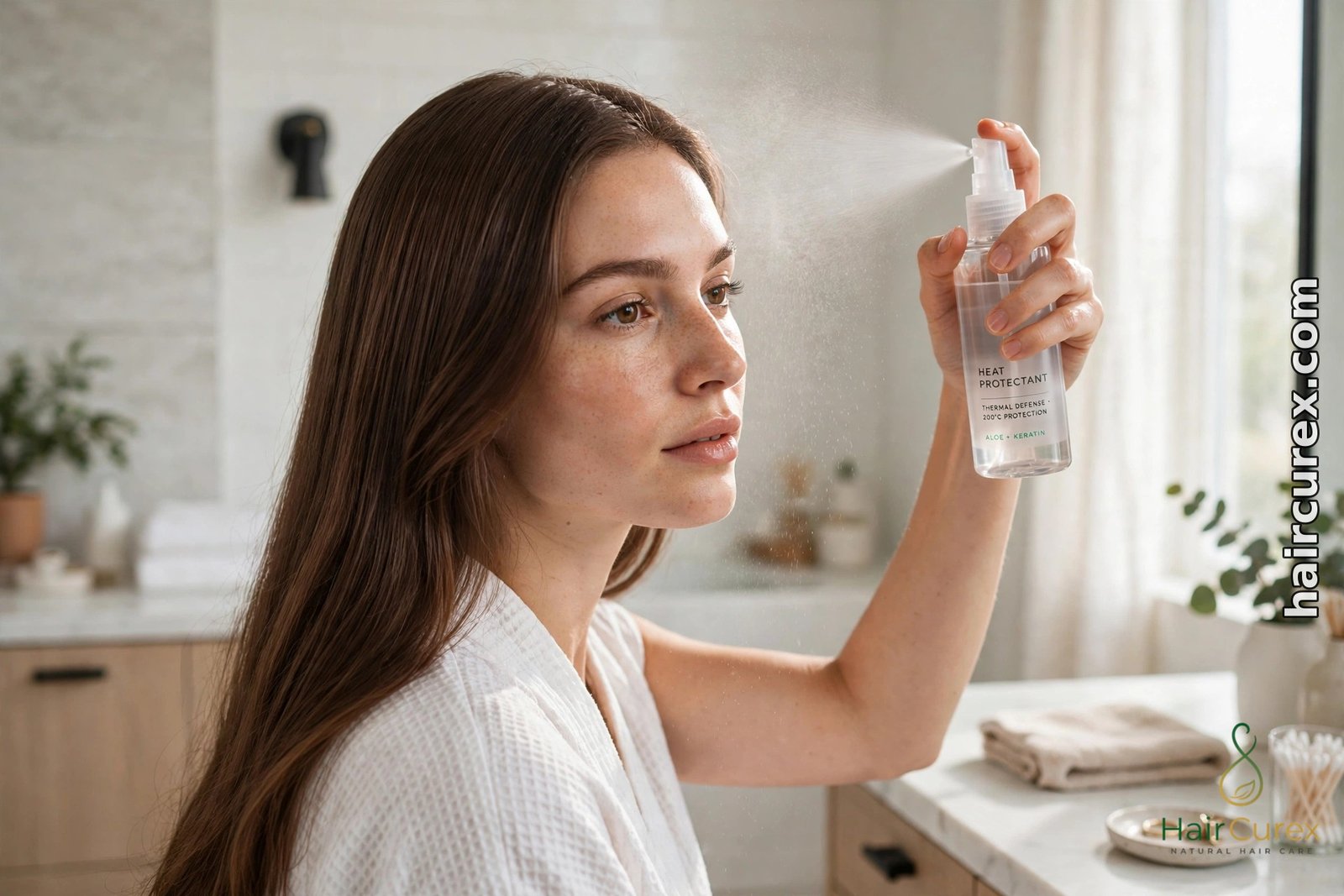
Quick answer: The best heat protectant is the one that matches your hair type and your tool: a light spray for fine or wavy hair, a cream for thick, curly or dry hair, and a serum or oil for coarse hair that needs extra smoothing. Spray or smooth it evenly through damp hair before blow-drying, or through dry hair before a flat iron or curling wand, and always let it dry before the hot tool touches your hair. No protectant makes high heat harmless, but the right one slows moisture loss, spreads heat more evenly, and leaves hair noticeably smoother — especially when you also turn the temperature down and style less often.
Every time a flat iron, curling wand or blow-dryer touches your hair, it pushes water out of the hair shaft. That is the whole point of heat styling — dry hair holds a new shape — but the same process dries the hair out, roughs up the cuticle, and over time leaves ends split, frizzy and dull.
A heat protectant does not stop that process, but it slows it down. It coats each strand with a thin layer — usually silicones, conditioning agents and sometimes polymers — that spreads the heat more evenly, reduces direct contact between the hot plates and the hair, and helps the hair hold onto more of its moisture. Used properly, it is the single easiest step you can add to a styling routine, and it costs about thirty seconds.
This guide explains how heat protectants work, when to choose a spray and when to choose a cream, which formulas suit each hair type, how to apply them so they actually work, and the mistakes that make even a good product useless. By the end, you will know how to choose the best heat protectant for your hair type and use it correctly.
What Is a Heat Protectant and How Does It Work?
A heat protectant is a leave-in product applied before hot styling to reduce the damage heat causes. Most formulas are built around silicones such as dimethicone, which form a thin, flexible film over the hair shaft.
That film does three useful things. First, it distributes heat more evenly, so no single spot on a strand takes the full blast from a 400-degree plate. Second, it slows the rate at which water escapes from inside the hair, which keeps the strand more flexible and less likely to snap. Third, it smooths the cuticle — the overlapping scales on the surface of each strand — which is why protected hair usually looks shinier and feels softer after styling than unprotected hair.
It helps to be honest about the limits, because heat protectant marketing often oversells them. A protectant reduces damage; it does not prevent it. Laboratory tests by product makers and independent researchers consistently show that protected hair loses less moisture and shows less surface damage than unprotected hair at the same temperature — but the difference is a reduction, not an elimination.
At very high temperatures, above about 400°F (around 200°C), hair protein starts to change and no spray or cream fully prevents that. That is why dermatologists advise using the lowest heat setting that still styles your hair, and why the American Academy of Dermatology recommends limiting heat styling and letting hair air-dry when you can. A good protectant plus a lower temperature is a far better combination than a great protectant used at maximum heat. For more on keeping hair healthy between styling sessions, see the American Academy of Dermatology’s healthy hair tips.
Most protectants also do a second job: they make styling easier. Sprays often add light hold, creams add smoothing and frizz control, and serums add shine. That dual role is part of why the category has grown so much — a protectant is rarely just a protectant anymore.
But the protection itself depends on coverage. A product can only protect the hair it actually touches, which is why even application matters more than the brand on the bottle. Skipping the back of your head, or spraying only the top layer, leaves the rest of your hair unprotected — and the unprotected sections are usually the ones that end up dry and split. Even the best heat protectant only works where it is applied.
Sprays vs Creams: Which Formula Should You Pick?
The biggest choice is not the brand — it is the format. Sprays and creams protect in the same basic way, but they behave differently on different hair, and picking the wrong one is the most common reason people decide heat protectants “do not work” for them. Getting the format right is the first step to finding the best heat protectant for your hair.
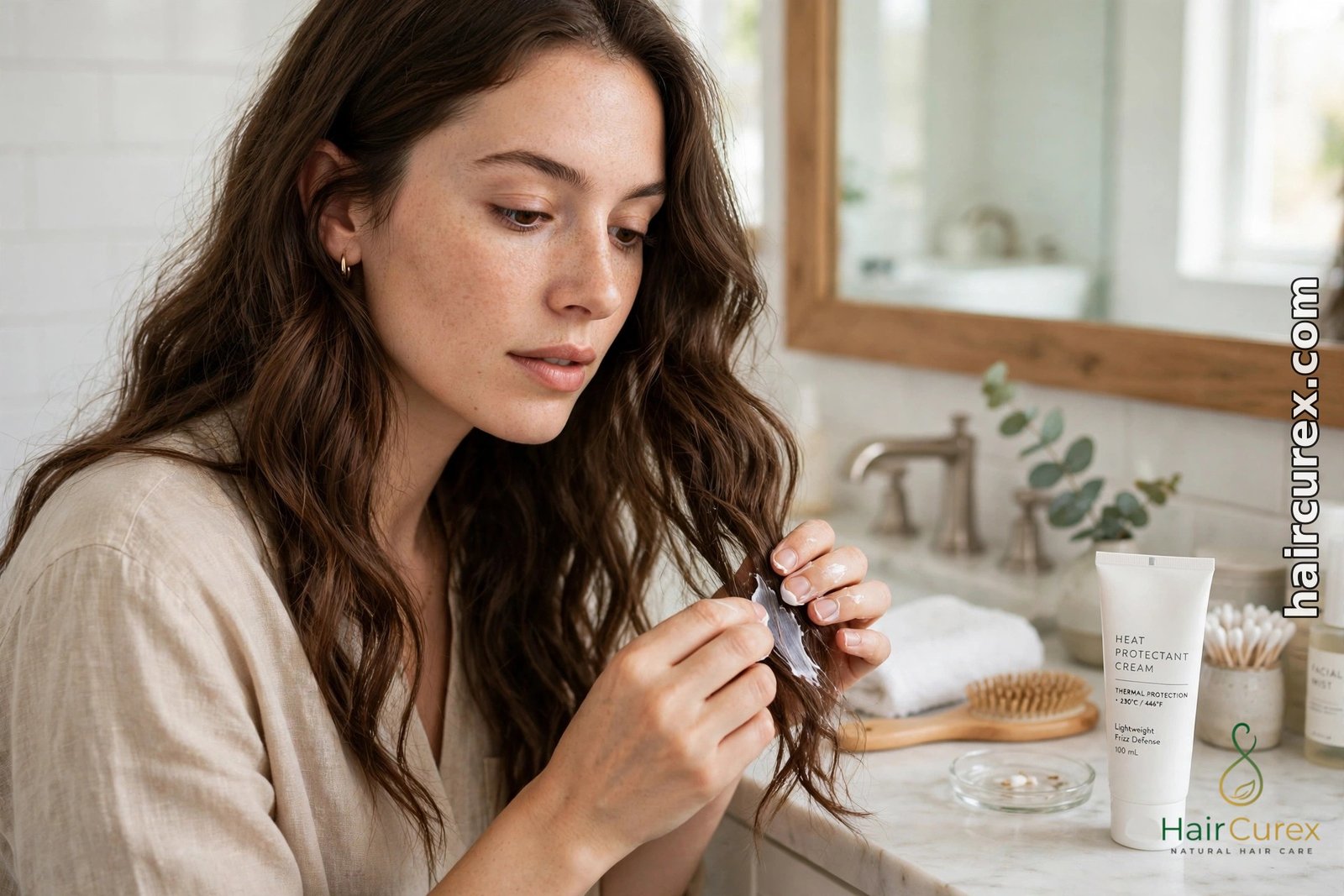
Sprays are light, watery mists that distribute evenly and dry quickly. They are the best choice for fine hair, thin hair, wavy hair and anyone who blow-dries daily, because they add almost no weight and rarely make hair look greasy. Their weakness is coverage: a light mist can miss spots, especially in thick hair, and most sprays offer little smoothing on their own. If your hair is fine and you have ever felt a cream make it limp by lunchtime, a spray is almost certainly your format.
Creams are thicker and richer, and they coat each strand more heavily. They are the best choice for thick hair, curly hair, coily hair and dry or damaged hair, because the extra coating both protects and smooths. A cream also doubles as a frizz fighter, which matters when you are straightening curly hair — the cream helps the strands stay smooth instead of puffing back up. Their weakness is weight: on fine hair, a cream can flatten volume and make roots look oily, especially if you apply it near the scalp. Use creams on the mid-lengths and ends only.
Serums and oils sit between the two. A few drops of a heat-protectant serum or a light oil smooths coarse, thick or very frizzy hair beautifully, but oils conduct heat well, so they should be used sparingly and only in products actually designed as heat protectants — plain cooking or carrier oils are not a substitute, and some can smoke on hot tools. Leave-in conditioners with heat protection built in are a useful shortcut for dry hair, combining moisture and protection in one step, though their protection is usually lighter than a dedicated spray or cream.
| Formula | Best for | Weight | When to apply | Watch out for |
|---|---|---|---|---|
| Spray | Fine, thin, wavy hair; daily blow-drying | Very light | Damp hair before blow-drying, or dry hair before irons | Can miss spots in thick hair; little smoothing |
| Cream | Thick, curly, coily or dry hair | Medium | Damp hair before blow-drying | Can weigh fine hair down; keep off roots |
| Serum | Coarse, frizzy or very thick hair | Light to medium | Damp or dry hair, ends first | Too much looks greasy; use a few drops only |
| Leave-in with heat protection | Dry or damaged hair that needs moisture too | Light to medium | Damp hair after washing | Protection is lighter than dedicated products |
| Oil-based protectant | Very coarse or textured hair | Medium | Damp hair, ends and mid-lengths | Only use products made for heat styling |
How to Choose the Best Heat Protectant for Your Hair Type
The best heat protectant for you depends on three things: your hair type, your tool, and how often you style. Work through them in that order and the choice mostly makes itself.
Fine or thin hair: choose a lightweight spray. Look for words like “weightless,” “fine mist” or “for fine hair” on the label, and avoid creams and heavy serums. Fine hair shows product buildup fast, so a spray you can mist evenly and forget about is ideal. Apply from mid-lengths to ends, and skip the roots entirely — protectant at the roots flattens volume and makes hair look oily within hours. If you blow-dry most days, a spray with a little hold also helps the style last, so you can style less often overall.
Thick hair: choose a cream, or a spray applied in sections. Thick hair’s problem is coverage: a single mist over the top layer leaves the layers underneath unprotected, and thick strands take longer to dry, so they spend more time under heat. Work in sections — clip the top half up, protect the bottom half, then switch — and use a cream for the extra coating.
A high-quality dryer does the job easier too; our Dyson hair dryer review looks at a dryer designed to limit heat damage, and our heatless curls guide shows how to skip hot tools entirely on rest days.
Wavy hair: choose a light spray or a leave-in with heat protection. Wavy hair sits in the middle: it needs protection, but heavy products pull the wave pattern out. A spray keeps the waves intact while you diffuse or loosely straighten, and a leave-in adds moisture without weight. If your waves frizz easily after heat styling, a small amount of cream on the ends only — never the roots — calms the frizz without flattening the wave.
Curly and coily hair: choose a cream, or a cream plus a serum on the ends. Curly hair is naturally drier because oils from the scalp travel slowly down a curved strand, so it needs the richest protection. Apply a cream generously through damp hair before blow-drying with a diffuser, and add a few drops of serum to the ends after styling for shine.
If you straighten curly hair regularly, a cream is close to essential — straightening without one is one of the fastest routes to heat damage, split ends and curls that stop bouncing back. Our keratin treatment guide explains another smoothing option, and how it changes what your hair needs from a protectant.
Damaged, color-treated or bleached hair: choose the richest formula your hair can carry, and turn the heat down. Damaged hair has a rougher cuticle and loses moisture faster, so it benefits most from a cream or a leave-in with heat protection, applied generously to the ends.
Bleached and color-treated hair also fades faster under high heat, so a protectant helps your color last longer — but the temperature matters more than the product. If your hair is already showing split ends, no protectant will repair them; our split ends guide explains what actually helps and what only hides the problem.
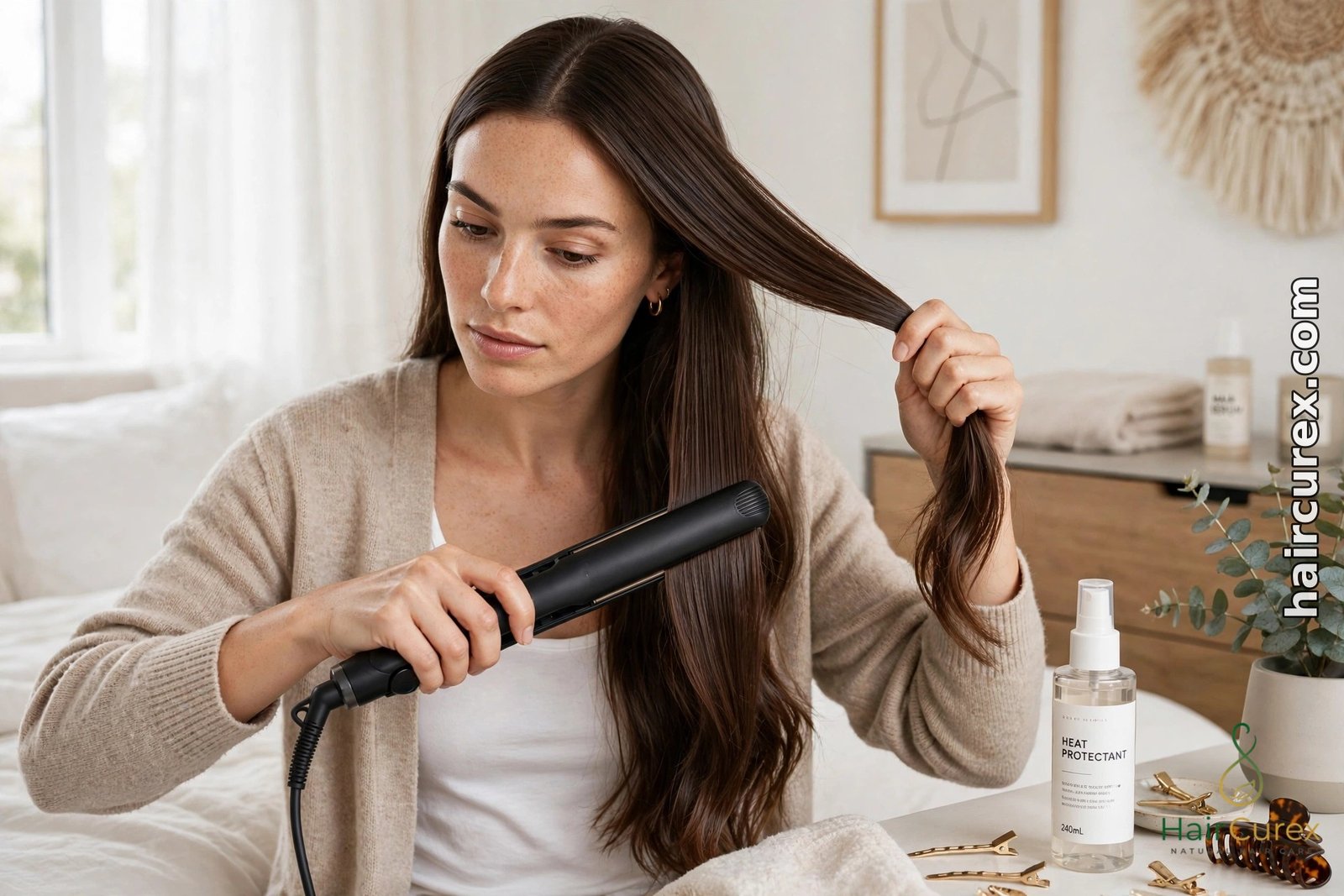
Your tool matters too. Blow-drying needs a protectant that works on damp hair and dries quickly — a spray or a light leave-in. Flat irons and curling wands need a product that works on dry hair and can handle direct contact heat — a spray or a cream applied before the iron, never a wet product sizzling on the plates. If you use a curling wand, the direction you wrap matters as much as the product; our guide to which direction to curl hair covers the wrapping direction that flatters your face shape.
How to Apply Heat Protectant the Right Way
Most heat protectant failures are application failures. The product works only where it is, so even coverage and the right timing matter more than the price of the bottle. Follow these steps and the same product will protect noticeably better. The best heat protectant in the world will not help if it is applied unevenly or at the wrong time.
1. Start with the right dampness. For blow-drying, apply to towel-dried, damp hair — about 70 to 80 percent dry. For flat irons and curling wands, apply to fully dry hair, or apply to damp hair, blow-dry it first, and then iron.
Never press a hot iron onto wet or damp hair: the water inside the strand boils, which is the sizzling sound you sometimes hear, and it damages the hair from the inside out. If you hear sizzling, stop — the hair is not dry enough.
2. Section your hair. Clip the top half up and work on the bottom half first, then switch. This takes an extra minute and is the single biggest improvement you can make, because it guarantees the hidden layers get coated. For thick hair, work in four sections instead of two.
3. Use enough — but not too much. For a spray, mist each section from about six inches away until the hair feels lightly damp, not wet. For a cream, use a coin-sized amount for medium-length hair, rub it between your palms, and smooth it through the mid-lengths and ends.
Too little leaves gaps; too much leaves hair limp, sticky or greasy. If your hair looks coated or feels heavy after styling, you used too much — use less next time rather than switching products.

4. Comb it through. Run a wide-tooth comb or a brush through each section after applying. This spreads the product evenly and stops it pooling in one spot. It also detangles, which matters because tugging a hot tool through a knot causes breakage.
5. Let it dry before the hot tool. A protectant needs a moment to form its film. After spraying or smoothing it on, wait a minute or two — or blow-dry the section first — before the iron touches the hair. Applying a protectant and immediately clamping a hot iron on top traps wet product against the strand and reduces the protection.

6. Reapply when you restyle. If you straighten your hair on Monday and curl it again on Wednesday, apply protectant again. One application does not carry over to the next styling session, and restyling without reapplying is one of the quietest ways damage accumulates.
The same applies if you go over a section twice with the iron — the second pass is hotter on the hair, so slow, single passes at a lower temperature protect better than quick, repeated passes at maximum heat.
The Best Heat Protectant Sprays and Creams to Try
There is no single best heat protectant for everyone, but a few formulas have earned their reputation across hair types and budgets, and they make a sensible starting point. Prices vary by retailer and change often, so compare current prices before buying rather than relying on any figure quoted in a guide.
Best budget spray: TRESemmé Thermal Creations Heat Tamer Spray. A long-running drugstore staple, widely available and inexpensive. It is a light spray that works well on fine to medium hair, adds a little shine, and does not weigh hair down. It is a good first heat protectant if you have never used one — if your hair starts looking smoother and holding its style better, you know the step is worth keeping.
Best classic for flat ironing: CHI 44 Iron Guard Thermal Protection Spray. A salon favorite for straightening, with a fine mist that dries fast and a light hold that helps sleek styles stay smooth. It suits medium to thick hair and is a solid pick if a flat iron is your main tool. Use it on dry hair, section by section, before ironing.
Best spray for shine: Moroccanoil Perfect Defense. A lightweight spray with argan oil that adds noticeable shine while protecting up to high temperatures. It suits medium to thick hair and is popular for blow-outs, where the extra shine shows. A little goes a long way — over-spraying can make fine hair look oily.
Best cream for thick or curly hair: Living Proof Restore Instant Protection Spray or a rich cream such as Bumble and bumble Hairdresser’s Invisible Oil Heat/UV Protective Primer. Thick and curly hair needs a formula with real coating power, and a cream or a primer-style product delivers it. The Bumble and bumble primer works as a leave-in, a detangler and a protectant in one step, which suits curly routines that already have several steps. Apply through damp hair and focus on the ends, where curly hair is driest.
Best for damaged hair: a leave-in with built-in protection, such as It’s a 10 Miracle Leave-In Product. Damaged hair needs moisture as well as protection, and a leave-in that does both saves a step. Use it on damp hair after washing, then style as normal. It is lighter protection than a dedicated spray or cream, so if you iron daily, layer a spray over it on dry hair before the iron.
Best drugstore cream: L’Oréal Paris Elvive Dream Lengths Heat Slayer or a similar supermarket cream. Drugstore creams have improved a lot, and a basic smoothing cream with heat protection is often enough for wavy or medium hair and blow-drying a few times a week. L’Oréal’s own heat protectant guide explains how their formulas work and when to use a spray versus a cream.
When you shop, read the label for two things: the maximum temperature the product claims to protect up to, and whether it is designed for damp hair, dry hair, or both. A product that claims protection up to 450°F is not a license to use 450°F — it is a sign the formula was tested at high heat.
And a spray made for damp hair will not work as well on dry hair before ironing. Match the product to how you actually style, not to the claims on the front of the bottle.
Heat Protectant Mistakes That Damage Your Hair
Skipping it on “quick” styles. A two-minute touch-up with a flat iron still exposes hair to full heat. Damage is cumulative — it is the total number of unprotected passes over months that shows up as split ends, not any single session. Keep a spray by the iron so the quick fix gets protected too.
Applying it to soaking wet hair and ironing anyway. This is the most damaging mistake on this list. Wet hair plus a hot iron means boiling water inside the hair strand, which causes bubble-like damage inside the hair shaft that cannot be repaired. Always dry hair fully first.
Using the highest temperature “to get it done faster.” Higher heat does not style better — it styles faster and damages more. Most hair straightens fine between 300°F and 350°F, and fine or damaged hair often needs less. If you find yourself needing maximum heat, the problem is usually technique or product buildup, not the temperature.
Spraying only the top layer. The hair you can see gets protected; the hair underneath does not. Section your hair every time, even when you are in a hurry.
Using a heat protectant instead of cutting back on heat. A protectant is a seatbelt, not a force field. If you iron your hair every single day at high heat, damage will still accumulate. The biggest protection of all is styling less often — alternate with heatless curls, air-dry on rest days, and let your hair recover between sessions.
Expecting it to repair damage. No heat protectant repairs split ends or restores damaged hair. It can make damaged hair look and feel smoother by coating it, but the damage underneath is still there. If your ends are splitting, the honest fix is a trim and a gentler routine, not a new bottle.
Do You Still Need Heat Protectant If You Rarely Style?
If you use hot tools less than once a week, a protectant still helps on the days you do style — even occasional high heat causes damage, and fine or bleached hair is affected by a single hot session. If you never use hot tools at all, you do not need a heat protectant; the sun is the only meaningful heat source left, and a hat or a UV-protective product covers that.
For most people, the realistic routine is simple: a spray or cream you like, applied in sections, at the lowest temperature that works, with one or two heat-free days each week. That combination — a good product, good technique, and less heat overall — is what actually keeps hair healthy through years of styling. A protectant is the easiest part of that routine to start, and it is the one step that makes every other step work better.

Frequently Asked Questions
Should I apply heat protectant to wet or dry hair?
It depends on the product and the tool. For blow-drying, apply to damp, towel-dried hair. For flat irons and curling wands, apply to fully dry hair, or apply to damp hair and blow-dry it first. Never iron wet hair — the water inside the strand can boil and damage the hair from within.
Can I use heat protectant every day?
Yes, if you style every day you should protect every day, but daily heat styling still causes cumulative damage even with a protectant. Try to build in one or two heat-free days a week, and use the lowest temperature that styles your hair. A protectant reduces damage; it does not cancel it.
Is heat protectant spray or cream better?
Sprays are better for fine, thin or wavy hair because they are light and add almost no weight. Creams are better for thick, curly, coily or dry hair because they coat each strand more heavily and add smoothing. If you are unsure, start with a spray — you can always switch to a cream if your hair still feels dry after styling.
Does heat protectant really work?
Yes, within limits. A protectant spreads heat more evenly, slows moisture loss and smooths the cuticle, which measurably reduces damage compared with styling unprotected hair. But it does not make high heat safe — damage still builds up at very high temperatures and with daily use, so lower temperatures and less frequent styling matter just as much.
Can I use leave-in conditioner instead of heat protectant?
Only if the leave-in is specifically made with heat protection. A regular leave-in conditioner moisturizes but does not form the heat-resistant film a protectant does, and some conditioners can even make hot tools drag or sizzle. Look for “heat protectant” or “thermal protection” on the label.
What temperature should I use with heat protectant?
Most hair styles well between 300°F and 350°F (about 150–175°C). Fine, thin or damaged hair often needs 300°F or less; thick or coarse hair may need up to 375°F. Avoid 400°F and above unless your hair is very thick and resistant, and never use maximum heat as a shortcut — slow, single passes at a lower temperature protect your hair better.