


Quick answer: Burgundy hair color is a deep red with purple and wine tones that sits between brown, red, and plum. It suits almost every skin tone, as long as you match the shade to your undertone: cool, violet-leaning burgundies flatter cool skin, while warmer cherry and mahogany burgundies flatter warm skin. On dark hair you can usually get a rich burgundy without bleach, but light or vivid results on very dark hair need lightening first. The catch is fading: burgundy is a red-family color, and red fades faster than any other color family, so expect the vibrancy to soften within 4 to 6 weeks unless you wash in cool water, use sulfate-free color-safe products, and limit heat. Touch-ups every 6 to 8 weeks keep it looking fresh.
Burgundy hair color is the shade people choose when they want red hair without the drama of bright red. It is deep, rich, and a little mysterious — the color of red wine held up to the light — and it works in an office, at a wedding, and on a night out without ever looking like a costume. It is also one of the most forgiving fashion colors: because it is built on a brown base, it grows out more gracefully than bright red or copper, and it flatters a wider range of skin tones than almost any other red. The reason it has become a peak fall and winter shade is that it pairs so well with the season — dark coats, warm knits, and low light all make burgundy hair look richer. This guide covers the shade range, how to pick the right one for your skin tone, how to get it on dark hair, and — the part most guides skip — exactly how to stop it fading so fast.
What Is Burgundy Hair Color?
Burgundy hair color is a deep, dimensional red made by blending a brown or dark red base with violet, plum, cherry, or mahogany tones. It is deeper and more muted than bright red and typically cooler than auburn, which leans warmer and more coppery. The name comes from Burgundy wine, and like the wine, the color shifts depending on the light: indoors it can read as a dark, almost-black cherry, and in sunlight the red and violet tones come alive. That dimension is the whole point of the shade — it is not a flat color, and a good burgundy has at least two tones working together, usually a warm red and a cool violet, which is why it suits so many people.
Because burgundy contains both warm and cool hues, it is one of the most versatile reds you can choose. L’Oréal Paris describes it the same way — a dimensional hue that pairs a rich chocolatey brown base with cherry red, mahogany, and plum tones, and one that can complement a range of skin tones once you match the undertone: L’Oréal Paris guide to burgundy hair color. The practical takeaway is simple: there is no single “burgundy.” There is a family of shades, and picking the right member of the family matters more than picking burgundy itself. A cool-toned person in a warm cherry burgundy can look washed out, and a warm-toned person in a blue-violet burgundy can look tired — while the right match makes both skin and hair look better.
It also helps to know how burgundy differs from its close cousins before you book the appointment. Auburn is warmer, browner, and more copper — think autumn leaves rather than red wine. Mahogany is burgundy’s closest relative: a reddish-brown that leans more brown than red, and often the safer choice if you want a subtle change. Plum is cooler and more purple than burgundy, with less red in it, and it reads as more of a fashion color. Cherry is brighter and redder than burgundy, with more of a statement feel. And wine red is essentially burgundy at its most vivid — same family, turned up. If you are choosing between burgundy and one of these, the question to ask is how much red you want people to see: burgundy sits right in the middle, visible but not loud, which is why it works for so many people and so many situations.
Burgundy Hair Color Shades: Picking Your Version
The shade you choose decides everything else — how it looks on your skin, whether you need bleach, and how fast it fades. Darker burgundies are the easiest to achieve and the slowest to fade; brighter ones need more lift and more upkeep. The table below covers the six shades that salons are asked for most, with the skin tones and starting hair colors each one suits best.

| Burgundy shade | What it looks like | Best skin undertone | Starting hair color |
|---|---|---|---|
| Deep wine burgundy | Dark, rich red-wine color; almost black indoors, glowing red in sunlight | Cool and neutral | Medium brown to black — no bleach needed |
| Plum burgundy | Cool burgundy with clear violet and purple tones | Cool | Dark brown to black — no bleach needed |
| Cherry burgundy | Brighter, redder burgundy with a cherry shine | Warm and neutral | Light brown to dark brown; dark hair needs lightening for full brightness |
| Mahogany burgundy | Warm reddish-brown; the subtlest burgundy, closest to natural brown | Warm and neutral | Any brown — no bleach needed; the most office-friendly option |
| Black cherry burgundy | Very dark, cool burgundy — reads nearly black with a violet-red glint | Cool and neutral | Black to dark brown — no bleach needed |
| Bright burgundy / wine red | Vivid, high-impact burgundy with strong red-violet shine | Cool and warm (depends on the mix) | Light to medium brown; dark hair usually needs lightening first |
If this is your first time with burgundy hair color, deep wine or mahogany is the safest starting point. Both work on dark hair without bleach, both fade gracefully rather than dramatically, and both are easy for a colorist to adjust at your next appointment — they can go brighter, cooler, or warmer from there once you have seen how the color behaves on your hair. Cherry and bright wine red are the shades to choose when you want the color to be noticed, but go in knowing they fade faster and need more maintenance. And black cherry is the choice if you want the most subtle version possible: it looks almost black most of the time, and the burgundy only shows in sunlight or under bright light, which some people love and others find too quiet for the money.
One more decision sits underneath the shade choice: permanent dye, demi-permanent dye, or a color-depositing conditioner. Permanent dye gives the longest-lasting, most saturated result and is the right choice if you want a real change that lasts 6 to 8 weeks. Demi-permanent dye deposits color without lifting your natural color much — it fades gradually over 4 to 6 weeks and is a good trial run if you are not sure burgundy is for you. Color-depositing conditioners and masks add a wash of burgundy that lasts a few washes; they are the lowest-commitment option and the best way to test a shade on your own hair before committing. If you are nervous, start with the mask, live with the color for two weeks, and then decide.
Which Burgundy Shade Suits Your Skin Tone?
Skin tone matching is where burgundy hair color earns its reputation as a shade for everyone — but only if you match the undertone, not just the depth. The rule is simple and it works for almost every red: match the color’s undertone to your skin’s undertone. Cool skin has pink, rosy, or blue undertones; warm skin has golden, yellow, or peachy undertones; neutral skin sits in between. If you are not sure which you are, look at the veins on the inside of your wrist in natural light: blue or purple veins usually mean cool undertones, green veins usually mean warm undertones, and a mix usually means neutral. Silver jewellery tends to flatter cool skin and gold tends to flatter warm skin, which is another quick check.
Fair skin looks best in burgundies that are either deep and muted or softly cool. Deep wine burgundy and plum burgundy are the most flattering choices, because their depth contrasts beautifully with pale skin without overwhelming it — the color reads as rich rather than harsh. Muted violet-reds also work well. What to be careful with on fair skin is a very bright, warm cherry burgundy, which can make the skin look redder than it is and draw attention to any redness or flushing. If you have fair skin with warm undertones, a mahogany burgundy is the safer warm option, because the brown in it softens the red. And if you have fair skin and want to test the color before committing, try it first with our AI hair color quiz, which matches shades to your skin tone from a photo — it is a useful reality check before you spend money at the salon.

Medium and olive skin tones have the widest choice, and burgundy hair color is one of the best reds for them. Warm olive skin glows in mahogany, cherry, and warm wine burgundies, where the red in the dye picks up the warmth in the skin. Cool olive skin suits plum and deep violet burgundies, where the purple tones balance the greenish cast olive skin can have. Medium skin can also carry the brighter burgundies — cherry and wine red — better than fair skin can, because there is enough depth in the skin to balance the intensity of the color. If you have medium skin and you want the most universally flattering option, deep wine burgundy is hard to get wrong: it is deep enough to look expensive, red enough to be interesting, and neutral enough to suit both warm and cool undertones.

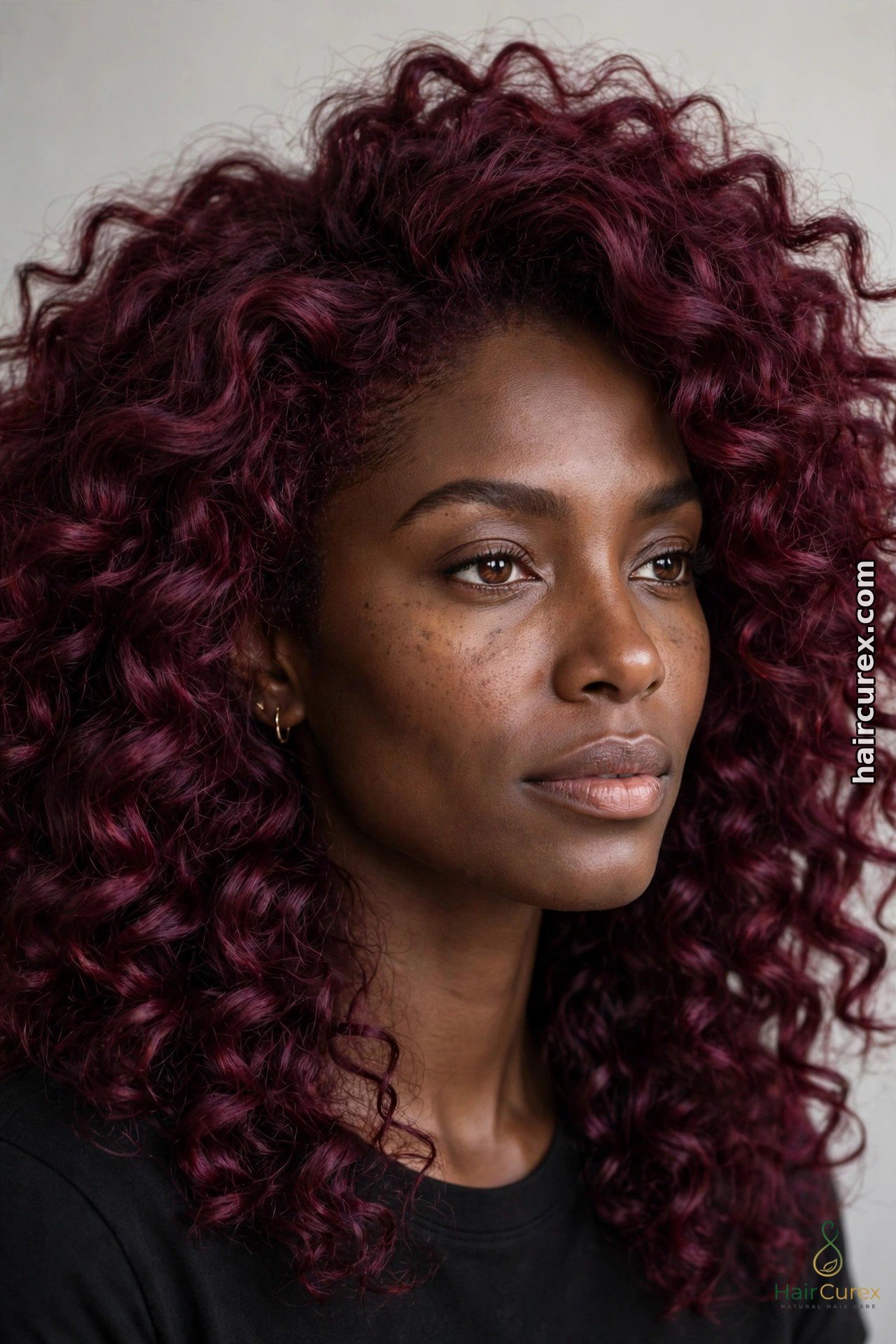
Deep skin tones look striking in burgundy hair color, and this is where the shade truly shines. Rich, saturated burgundies — deep wine, black cherry, plum, and wine red — create a beautiful contrast against deep skin and make both the skin and the hair look more luminous. Burgundy is one of the rare reds that looks natural and dramatic at the same time on deep skin, because the depth of the color matches the depth of the skin tone. The shades to be careful with are the ones that are too light or too orange: a pale or coppery burgundy can look washed out against deep skin, while a true deep burgundy looks intentional and rich. If your hair is naturally dark, you have an extra advantage — most deep burgundies show up beautifully on dark hair without any bleach, so you get the full effect with the least damage. For more ideas in the red family, our ginger hair guide covers the warmer, coppery side of red, which suits a different set of undertones.
Burgundy Hair on Dark Hair: Do You Need Bleach?
One of the best things about burgundy hair color is that dark hair usually does not need bleach. Because burgundy is a dark shade built on a brown base, it can deposit visible color onto dark brown and black hair without lifting it first — the result is a rich, dimensional burgundy that shows most clearly in sunlight and reads as a deep, glossy dark shade indoors. This is the biggest practical difference between burgundy and brighter reds or blondes, which almost always need lightening on dark hair. If your hair is naturally dark brown or black and you want a deep wine, plum, mahogany, or black cherry burgundy, you can usually go straight to color with no bleach at all, which means less damage, less money, and a faster appointment.
The exception is brightness. If you want a vivid cherry burgundy or a bright wine red that reads clearly red even indoors, dark hair will need some lightening first, because dye cannot make hair lighter than its starting color — it can only add tone. A colorist will typically lift dark hair to a medium brown first, then deposit the burgundy on top. That is a gentler process than going blonde, but it is still lightening, so it needs a professional if you want an even result. The same applies if your hair has old dark dye or henna on it, which can block new color from taking evenly; tell your colorist about anything that is already on your hair, including box dye from months ago, because it changes what they need to do.
If you are coloring at home, pick a box dye made for dark hair — most major brands now label shades that work without bleach — and do a strand test first. A strand test means coloring a small, hidden section of hair and checking the result before you commit your whole head; it takes an extra day, but it is the only way to know how the shade will actually look on your hair, because the same dye looks different on every starting color. Do a patch test on your skin 48 hours before coloring, too: apply a small amount of dye behind your ear or on the inside of your elbow and watch for redness, itching, or swelling. Hair dye allergy is uncommon but real, and a patch test is the standard precaution every professional recommends. If you have ever reacted to hair dye before, skip the box and see a professional, who can test alternatives with you.
How to Stop Burgundy Hair Fading
Here is the honest part: burgundy hair color fades faster than brown, blonde, or black, because red color molecules are larger than other dye molecules and sit closer to the surface of the hair, so they wash out more easily. Every wash takes a little color with it, and heat, sun, and chlorine take more. You cannot stop fading completely, but you can slow it down a lot — the difference between careful aftercare and no aftercare is often the difference between color that looks good for six weeks and color that looks tired after two. The habits below are the ones that actually make a measurable difference, in order of impact.

The single most important rule is to wait before the first wash. Do not wash your hair for at least 48 to 72 hours after coloring, because the dye is still settling into the hair shaft during that window and hot water will rinse out color that has not yet locked in. When you do wash, use cool or lukewarm water, never hot: hot water opens the hair cuticle and lets color escape, while cool water helps keep it closed. Wash less often — two or three times a week instead of daily — and use dry shampoo between washes if your roots get oily. When you do wash, use a sulfate-free shampoo and conditioner made for color-treated hair; sulfates are strong cleansers that strip color faster, and color-safe formulas are designed to clean without taking the dye with them. Our light brown hair guide covers the same color-safe washing routine in more detail, and the principles are identical for burgundy.
Heat is the second-biggest cause of fading. Hot tools — flat irons, curling irons, and high-heat blow-drying — open the cuticle and fade burgundy hair color faster than almost anything else. If you heat-style, use the lowest setting that gets the job done, always use a heat protectant, and try to keep heat styling to a few times a week rather than daily. Sun is the other quiet fader: UV light breaks down red dye molecules, so wear a hat or use a UV-protectant hair spray if you spend a lot of time outdoors, and rinse your hair with fresh water before and after swimming, because chlorine and salt water both strip color. Deep-condition once a week with a mask made for color-treated hair — healthy, moisturized hair holds color far better than dry, porous hair, which is why damaged hair fades fastest of all. The American Academy of Dermatology’s healthy-hair guidance covers the foundations that matter here, including gentle washing and careful handling of wet hair: American Academy of Dermatology healthy hair tips.
Between salon visits, a color-depositing conditioner or mask in a burgundy shade is the most effective maintenance product you can buy. Used once a week, it puts a small amount of burgundy pigment back into the hair and keeps the color looking freshly done for weeks longer than shampoo and conditioner alone. It is also the cheapest way to stretch the time between touch-ups: a $15 to $25 bottle used weekly can easily add two to three weeks of good color. If your burgundy starts to look brassy or orange as it fades — which happens most on hair that was lightened first — a color-depositing mask with a violet or plum tone will correct it better than a straight red one. And when the roots start to show, a root touch-up spray or powder in a matching burgundy can buy you another week or two before you need a full appointment.
How Long Does Burgundy Hair Last and What Does It Cost?
With good aftercare, burgundy hair color looks its best for about 4 to 6 weeks and remains presentable for 6 to 8 weeks before it needs a proper touch-up. The roots will usually show first — how soon depends on how fast your hair grows and how different the burgundy is from your natural color — and the lengths will gradually soften from vivid burgundy toward a muted reddish-brown. That softening is normal, and many people actually like the faded version, which looks like a natural auburn. But if you want the color to stay vivid, plan on a root touch-up and a color refresh every 6 to 8 weeks, which is the standard maintenance rhythm for any red.
Cost depends on where you go and what your hair needs. A salon burgundy hair color typically runs $80 to $200 in most U.S. salons, with the lower end for a single-process color on short to medium hair and the higher end for long hair, a color correction, or a service that includes lightening first. Root touch-ups are usually cheaper, in the $60 to $120 range, and a gloss or color refresh between full appointments can be $40 to $80. At-home box dye costs $8 to $15 per box, with most people needing one box for short to medium hair and two for long or thick hair — but remember that a box cannot fix an uneven result, and a correction at a salon costs more than the original color would have. Over a year, maintaining burgundy at a salon works out to roughly 6 to 8 appointments; maintaining it at home is far cheaper but needs more care with application and aftercare to look as good.
The other cost is time. A salon burgundy appointment usually takes 2 to 3 hours including processing time, and longer if lightening is involved. At home, plan on 1 to 2 hours including the strand test, application, processing, and rinsing. Either way, do not rush the processing time: leaving dye on for less time than the instructions say gives you patchy, underdeveloped color that fades even faster, and leaving it on longer than instructed does not make it last longer — it just increases the risk of damage and irritation. Follow the timing on the box or your colorist’s instructions exactly.
Mistakes to Avoid With Burgundy Hair
The most common mistake is washing too soon and too hot. Washing within 48 hours of coloring, or washing in hot water every day, can strip a noticeable amount of burgundy hair color in the first week alone — the exact week the color should look its best. The second mistake is using the wrong shampoo: a regular sulfate shampoo, a clarifying shampoo, or a dandruff shampoo used daily will fade burgundy far faster than a sulfate-free color-safe formula. The third mistake is skipping the strand test, especially on dark hair or hair with old dye on it. Without a strand test you are guessing at the result, and burgundy is one of the shades where the guess is most often wrong — too dark, too purple, or barely visible — because the starting color matters so much.
The fourth mistake is going too bright too fast. If your hair is dark and you want a vivid burgundy hair color, the jump needs lightening, and trying to get there with a single box of bright dye usually gives a patchy result that fades unevenly. Go one step at a time: start with a deep burgundy, see how it looks and how it fades, and go brighter at the next appointment if you want more. The fifth mistake is expecting burgundy to behave like brown. Brown is forgiving — it fades slowly, grows out invisibly, and looks fine when neglected. Burgundy is not: it needs the cool water, the color-safe products, and the regular touch-ups, and if that maintenance sounds like too much, a mahogany burgundy or a brown with a burgundy gloss is a lower-maintenance way to get most of the effect with half the upkeep.
Burgundy hair color is one of the most rewarding shades you can choose — deep, dimensional, flattering on almost every skin tone, and achievable on dark hair without bleach — as long as you go in knowing what it asks of you. Pick the shade by undertone, not by the picture on the box. Protect it with cool water, sulfate-free products, and less heat. And plan the touch-ups before the color starts to fade, not after. Do that, and burgundy will look expensive and intentional for weeks instead of days. If you are still deciding between reds, our honey blonde hair guide covers a warmer, lighter alternative, and our Arctic Fox hair dye guide walks through semi-permanent color options if you want to try burgundy tones without the commitment of permanent dye.
Burgundy Hair Color FAQs
Does burgundy hair color suit every skin tone?
Almost — burgundy hair color suits most skin tones when the shade matches the skin’s undertone. Cool skin looks best in violet-leaning burgundies like plum and deep wine; warm skin looks best in cherry and mahogany burgundies; neutral skin can wear most shades. Fair skin suits deep, muted burgundies best, while medium and deep skin tones can carry brighter and more saturated burgundies.
Does burgundy hair need bleach on dark hair?
Usually not. Deep wine, plum, mahogany, and black cherry burgundy show up well on dark brown and black hair without bleach, because burgundy is a dark shade built on a brown base. You only need lightening if you want a bright, vivid cherry or wine red that reads clearly red indoors, or if your hair has old dark dye that blocks new color.
How long does burgundy hair color last?
With good aftercare, burgundy hair color looks its best for 4 to 6 weeks and remains presentable for 6 to 8 weeks. Red color molecules are larger and sit closer to the hair’s surface, so burgundy fades faster than brown or black. Cool-water washing, sulfate-free color-safe products, and limited heat styling slow fading noticeably, and a color-depositing conditioner used weekly can add two to three weeks of vibrancy.
How do I stop burgundy hair from fading?
Wait 48 to 72 hours before the first wash, then wash in cool or lukewarm water only two or three times a week with a sulfate-free color-safe shampoo. Limit heat styling and always use a heat protectant, protect hair from sun and chlorine, deep-condition weekly, and use a burgundy color-depositing conditioner once a week to replace lost pigment between salon visits.
Will burgundy hair color cover gray hair?
Yes, permanent burgundy dye covers gray hair well, and burgundy hair color is a popular choice for gray coverage because the deep red tones blend with gray more gracefully than blonde or bright red. Gray hair is more resistant to dye, so it may need the full processing time or a slightly longer one, and roots will need touching up every 4 to 6 weeks as the gray grows back in.
Is burgundy hair color high maintenance?
More than brown, less than bright red or blonde. Expect a root touch-up and color refresh every 6 to 8 weeks, plus the daily habits that protect it: cool water, color-safe products, and limited heat. If that sounds like too much upkeep, a mahogany burgundy or a brown with a burgundy gloss gives most of the effect with noticeably less maintenance.