

Quick answer: The best haircuts for heart-shaped face shapes add volume at or below the jawline and soften the forehead, because a heart-shaped face is wider at the forehead and cheekbones and narrows to a pointed chin. Chin-length bobs, lobs, long layers that start at the chin, side-swept bangs, curtain bangs and long pixie cuts all work by putting fullness where the face is narrowest. Avoid slicked-back styles, heavy blunt bangs and lots of volume at the crown, which all make the forehead look wider and the chin look narrower.
A heart-shaped face is one of the easiest face shapes to flatter — once you know the one rule that matters. The face is widest across the forehead and cheekbones, then tapers down to a narrower jaw and a pointed chin, often with a widow’s peak at the hairline. Reese Witherspoon, Scarlett Johansson and Taylor Swift are the classic celebrity examples, and their go-to styles all follow the same logic: keep the top relatively calm, and put the movement and fullness lower down, around the jaw and chin. That single idea explains why some cuts look instantly right on a heart-shaped face and others feel slightly off, even when the cut itself is beautiful. This guide walks through how to tell if you have a heart-shaped face, the seven cuts that balance it best, the styles to be careful with, and exactly what to ask your stylist — so you leave the salon with a cut that works with your features instead of fighting them.
How to Tell If You Have a Heart-Shaped Face
Before choosing a cut, it helps to confirm your face shape, because the advice in this guide only works if the shape is right. Stand in front of a mirror with your hair pulled back and look at three things: your forehead, your cheekbones and your jawline. A heart-shaped face is widest at the forehead, slightly narrower at the cheekbones, and clearly narrowest at the jaw, ending in a pointed or slightly narrow chin. The overall outline looks like an upside-down triangle or a heart — broad on top, tapering to a point at the bottom. Many people with this shape also have a widow’s peak, the small V-shaped point in the hairline at the centre of the forehead, though not everyone does, and its absence does not rule the shape out.
The easiest way to check is to measure. Take a flexible tape measure and note the width of your forehead (temple to temple), your cheekbones (widest point), your jawline (ear to ear across the chin), and the length of your face (hairline to chin). On a heart-shaped face, the forehead measurement is the largest, the cheekbones are close behind, the jaw is noticeably smaller, and the face length is roughly one and a half times the forehead width. If your jaw is almost as wide as your forehead, you are probably looking at an oval or round face instead — our guide to which hairstyle suits your face shape walks through all six shapes side by side, and our haircuts for a round face covers the opposite balancing trick: adding length to a face that is nearly as wide as it is long.
One more thing worth saying plainly: face shape is a guide, not a verdict. A heart-shaped face does not ban any haircut, and plenty of people with this shape wear styles this guide lists under “be careful with” and look wonderful in them — usually because their stylist adapted the cut to their hair texture, hairline and personal style. Use the rule below as a starting point for the conversation with your stylist, not as a list of forbidden cuts.
Haircuts for Heart-Shaped Face: The Balancing Rule
Every flattering haircut for a heart-shaped face follows the same balancing rule: add visual width where the face is narrow — around the jaw and chin — and take visual width away where the face is already wide — across the forehead. Hair is the tool that does both jobs. Layers, waves and curls placed at chin level or below widen the lower half of the face. A side part, side-swept bangs or curtain bangs break up the forehead with a diagonal line instead of leaving it as one wide, unbroken expanse. Volume at the crown does the opposite of what you want: it adds width on top of width, so the forehead looks even broader and the chin even smaller by comparison.
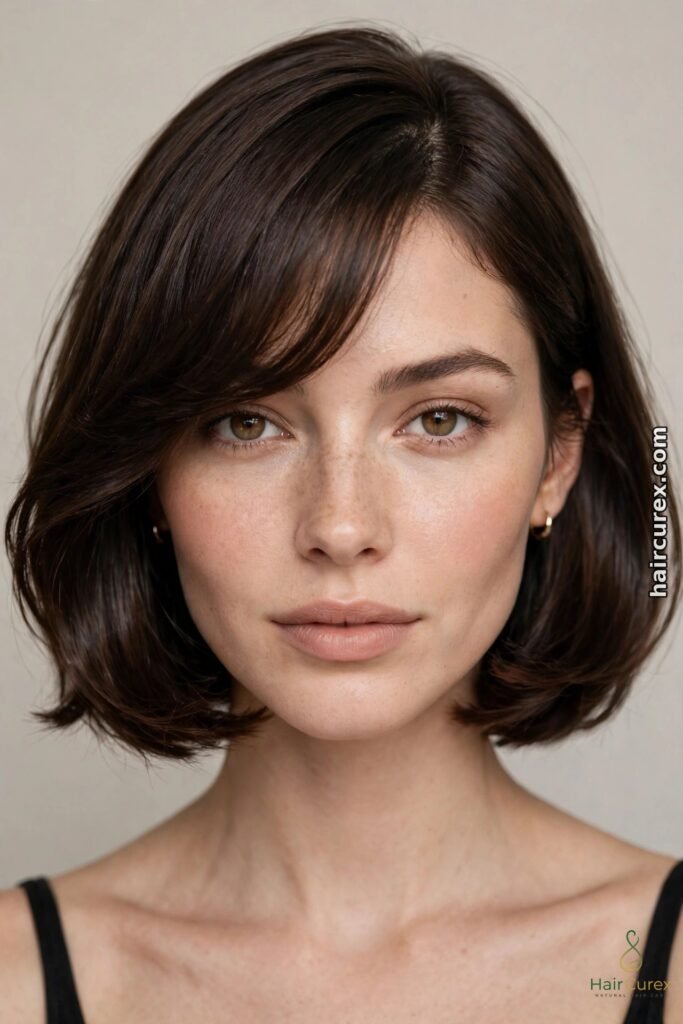
That is why the same cut can look completely different depending on where its fullness sits. A bob that ends at the chin, with the ends flicked or curled slightly outward, fills out the jawline beautifully. The same bob worn pin-straight and tucked behind the ears does far less, because it leaves the jaw exposed and the forehead bare. Long hair with layers that start at the cheekbones or chin adds movement exactly where the face narrows, while layers that start high at the crown add bulk where you do not need it. Keep this rule in mind as you read the seven cuts below and you will be able to judge any style you see — in a magazine, on a celebrity, or in your stylist’s portfolio — by asking one question: where does the volume sit?
The 7 Best Haircuts for a Heart-Shaped Face
The seven cuts below are ordered from the most universally flattering to the boldest. All seven follow the balancing rule, and each one suits a different hair length, texture and comfort level — so whether you want to keep your length or go short, there is a version here for you.
| Haircut | Best length | What it does for a heart face | Best hair type |
|---|---|---|---|
| Chin-length bob | Short | Adds width right at the jawline | Straight to wavy |
| Long bob (lob) | Medium | Volume at the collarbone, elongates the face | All types |
| Long layers from the chin | Long | Movement and fullness below the jaw | Straight to wavy |
| Side-swept bangs | Any length | Breaks up the forehead with a diagonal line | All types |
| Curtain bangs + shag | Medium to long | Softens the forehead, adds side volume | Wavy to curly |
| Long pixie cut | Short | Highlights cheekbones, keeps softness at the jaw | Fine to medium |
| Textured shag / wolf cut | Medium to long | Layers and texture fill out the lower face | Wavy to thick |
1. Long Layers With Face-Framing Pieces

If you love your length and do not want to lose it, long layers are the safest and most flattering option for a heart-shaped face. The key detail is where the layers start: they should begin at the chin or below, not at the cheekbones and certainly not at the crown. Layers that start at the chin add fullness and movement exactly where the face narrows, drawing the eye downward toward the jaw and collarbone instead of up toward the forehead. Face-framing pieces around the front do the same job in miniature — soft, longer strands that curve around the jaw soften the pointed chin without hiding it.
This is the cut Reese Witherspoon has worn for most of her career, and it is no accident: straight or softly waved long layers with a side part are endlessly versatile, easy to grow out, and forgiving on most hair textures. Ask your stylist for long layers starting at chin level, with the shortest face-framing pieces no higher than the cheekbones, and keep the top layers long so the crown stays smooth. Style it with a slight bend through the ends — a round brush blow-dry or a few passes with a flat iron, flicked outward — and the cut does the balancing work for you. The one version to be careful with is long hair that is all one length with no layers at all: it can hang flat against a narrow chin and make the face look top-heavy.
2. The Chin-Length Bob
The chin-length bob is arguably the single best haircut for a heart-shaped face, because it puts the maximum volume exactly where the face needs it: at the jaw. A bob that ends right at the chin, or just below it, creates a horizontal line of fullness across the lower face, which visually widens the narrow jaw and balances the wider forehead in one move. Add soft waves or a slight outward flick at the ends and the effect is even stronger, because the volume sits wide at the jawline rather than flat against the cheeks.
Ask for a bob that hits at the chin or a fraction below, with soft, textured ends rather than a razor-sharp blunt line — a blunt edge can look severe against a pointed chin, while textured ends keep the shape soft. A deep side part works beautifully with this cut, sweeping hair across the forehead and adding asymmetry that breaks up its width. The trade-off is maintenance: a bob loses its shape faster than long hair, so expect a trim every 6 to 8 weeks to keep the length sitting exactly at the chin. If you want to compare this cut with the ones that suit rounder faces, our haircuts for a long face guide uses the same idea in reverse — adding width to a narrow face — and the principles overlap.
3. The Long Bob (Lob)
The lob — a bob grown out to collarbone length — is the most versatile cut on this list, and celebrity stylist Jennifer Matos has called it a great haircut that works well for heart-shaped faces, recommending keeping it closer to the collarbone than the jawline so the shape stays elongated rather than boxy. At that length the ends sit below the jaw, adding fullness to the lower face while the extra length keeps the whole look soft and grown-up. It works on straight, wavy and curly hair, and on fine and thick hair alike, which is rare for a single cut.
For thick hair, long layers through the lob are essential — without them the cut can look heavy and triangular, wider at the bottom than the top in the wrong way. For fine hair, a lob with a few internal layers and a side part gives the impression of fullness without needing much styling. A wavy lob with a deep side part is one of the most flattering combinations of all: the waves add width at the jaw, the side part breaks up the forehead, and the collarbone length keeps everything in proportion. The List’s roundup of heart-face cuts notes the same combination, with stylists praising the lob’s texture and softness for this face shape: The List on 22 haircuts for heart-shaped faces.
4. Side-Swept Bangs
Side-swept bangs are less a haircut than a finishing detail — but for a heart-shaped face they might be the single most useful detail there is. A fringe swept diagonally across the forehead does two things at once: it covers part of the widest area of the face, and the diagonal line draws the eye toward the cheekbones instead of letting it rest on the forehead. Unlike heavy blunt bangs, which can make the forehead look wider by creating a hard horizontal line across it, side-swept bangs stay soft and asymmetrical, which is exactly what a heart-shaped face needs.
The beauty of side-swept bangs is that they work at any length. Add them to long layers, to a bob, to a lob, or to a pixie cut, and the balancing effect follows. Ask your stylist for bangs that start at the side part and sweep across to the opposite cheekbone, long enough to blend into the rest of the cut — usually ending somewhere between the eyebrow and the cheekbone. They need a trim every 3 to 4 weeks if you want them to stay out of your eyes, or you can let them grow into face-framing layers, which is a graceful way to grow them out. If you have a strong cowlick at the front hairline, mention it before the scissors come out: a good stylist cuts side-swept bangs with your growth pattern in mind, not against it.
5. Curtain Bangs With a Shoulder-Length Shag

Curtain bangs — parted in the middle and sweeping out to each side like curtains — are a favourite for heart-shaped faces, with one important condition: they should hit at the cheekbone or lower, not sit short across the forehead. Short curtain bangs add a boxy, horizontal line right where the face is already widest. Longer curtain bangs do the opposite: they frame the forehead softly, draw attention down toward the cheekbones and jaw, and blend into the rest of the cut so the whole shape feels connected.
Pair them with a shoulder-length shag and the effect doubles. A shag’s choppy, textured layers add volume through the sides of the hair, filling out the lower half of the face, while the curtain bangs handle the forehead. This combination suits wavy and curly hair especially well, because the natural texture does half the styling work — a little texturizing spray and a diffuser is often enough. Ask for curtain bangs that start at the cheekbone and taper longer toward the jaw, with layers through the mid-lengths rather than at the crown. Our haircuts for a square face guide recommends a similar softening trick for strong jawlines, and the same logic applies here in reverse: softness where the face is sharp, structure where it needs balance.
6. The Long Pixie Cut
Short hair can absolutely work on a heart-shaped face — the version that works best is the long pixie, not the shortest crop. A long pixie keeps length on top and around the face, with a side-swept fringe and soft volume near the jawline, which highlights the cheekbones without exposing the pointed chin the way a very short, slicked-back pixie can. Celebrity stylist Jennifer Matos has said a long pixie lends a heart-shaped face texture and softness, which together give the hair movement and versatility, and it pairs well with almost any kind of bangs, including curtain and wispy styles.
If you are considering a pixie, the long version is also the smartest first step: it is easier to grow out than a close crop, it is more forgiving while you learn to style it, and if you love it, you can always go shorter next time. Ask for a pixie with length on top and longer pieces around the ears and jaw, a side-swept or wispy fringe, and soft texture rather than a severe, slicked finish. Our full guide to the pixie cut covers face shapes, styling in about five minutes, and the honest grow-out timeline if you want the complete picture before booking the chop.
7. The Textured Shag or Wolf Cut
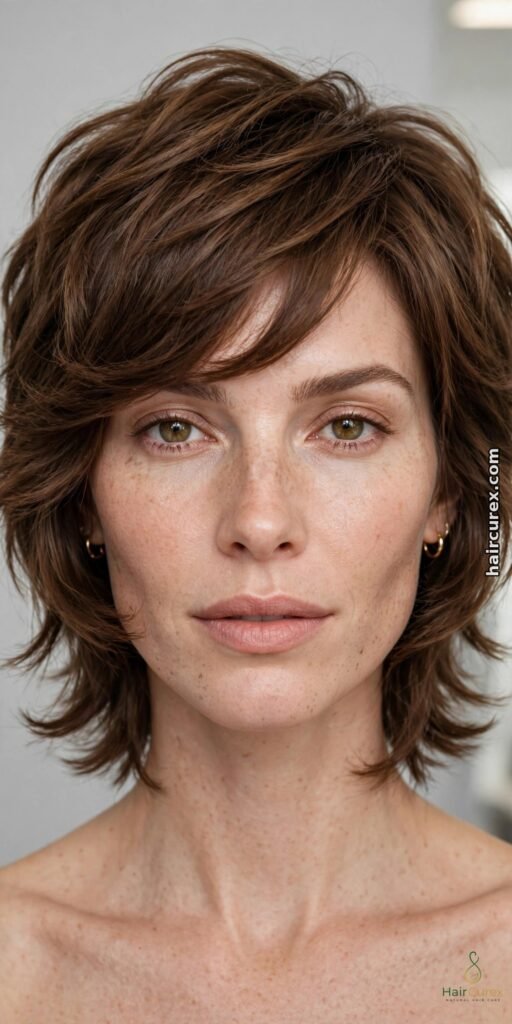
For a bolder, more textured option, a shag or wolf cut can be a great match for a heart-shaped face — provided it is cut with the balancing rule in mind. Both cuts are built on layers, and the layers are what make them work here: choppy, textured layers through the mid-lengths and ends add volume and movement around the jaw and chin, exactly where a heart face needs it. The result is a cut with personality that still flatters the shape, especially on wavy or thick hair that holds texture well.
The version to ask for is a longer shag or a softer wolf cut, with the shortest layers starting no higher than the cheekbones and plenty of length left at the bottom. A very short, top-heavy shag with lots of volume at the crown does the opposite of what you want, so be specific with your stylist: volume at the jaw, not at the crown. Wispy, eyebrow-skimming bangs complete the look by softening the forehead. Styling is refreshingly low-effort — a little texturizing spray, scrunch, and air-dry or a quick diffuser session is usually enough, which is part of why this cut has stayed popular.
Haircuts to Be Careful With on a Heart-Shaped Face
No haircut is truly forbidden, but a few styles work against a heart-shaped face unless they are adapted carefully, and it is better to know why before you book. Slicked-back styles are the biggest one: pulling all the hair back exposes the full width of the forehead with nothing to break it up, and a high, tight bun does the same thing while also removing any balancing volume from the jaw. If you love wearing your hair up, a low ponytail with face-framing pieces left out is a much better choice — the volume sits below the jaw and the loose pieces soften the forehead, which is why it flatters heart faces far more than a high bun does.
Heavy, blunt bangs are the second style to approach with care. A straight-across fringe creates a hard horizontal line across the widest part of the face, which can make the forehead look wider and the chin look smaller by comparison. Wispy, side-swept or curtain bangs achieve the softening effect without the hard line, so they are almost always the better choice. Very short bobs that end above the jaw are a similar story: they expose the narrow jaw without adding any framing volume, which leaves the face looking top-heavy. And high-volume styles at the crown — big blowouts with lots of height on top, or teased-up roots — add width where the face is already widest. Keep the volume at the sides and ends, and the balance takes care of itself.
None of this means you cannot wear these styles. A blunt fringe cut with soft, textured ends and a little piece-y separation can look wonderful on a heart face, and a short bob with waves and a deep side part can be just as flattering as a chin-length one. The point is to know what you are compensating for, so you and your stylist can adapt the cut instead of discovering the problem in the mirror afterwards.
How to Style Haircuts for a Heart-Shaped Face at Home

A good cut does most of the work, but a few styling habits make the difference between a cut that flatters you every day and one that only looks right when you leave the salon. The first habit is the parting: a deep side part is the easiest, most reliable trick for a heart-shaped face, because it creates asymmetry across the forehead and adds volume on one side at the same time. If you usually wear a centre part, try moving it an inch or two to the side for a week — the difference is often bigger than expected. A centre part can work, but only if the hair has enough volume and texture to stop it clinging to the face and framing the forehead in a hard line.
The second habit is where you put the volume. When you blow-dry, use a round brush to lift the hair at the mid-lengths and ends rather than at the roots on top, and flick the ends outward or curl them away from the face at jaw level. A light mousse or texturizing spray through the mid-lengths adds fullness where the face narrows without weighing the hair down. Avoid heavy styling products at the crown, and be gentle with straighteners near the roots — pin-straight hair that lies flat against a narrow chin does nothing for the balance you are trying to create. The American Academy of Dermatology’s healthy-hair advice is worth a read alongside any styling routine: gentle handling, less heat, and protecting the hair you have all matter more than any single product: AAD tips for healthy hair.
Finally, keep the cut in shape. Bobs and pixie cuts lose their balancing length fastest — a chin-length bob becomes a jaw-length bob within a few weeks, and the volume moves up the face with it. Book trims every 6 to 8 weeks for bobs and lobs, and every 4 to 6 weeks for pixie cuts, and your stylist can keep the fullness sitting exactly where it should. Long layers are more forgiving: a trim every 10 to 12 weeks is usually enough, since the layers grow out gracefully and the length itself keeps working for you.
What to Ask Your Stylist
The most useful thing you can do before your appointment is to walk in with a clear, short brief. Show your stylist two or three photos of the cut you want on someone with a similar face shape and hair texture — photos of strangers are fine, and photos of yourself with a filter are not, because they do not show how the cut behaves on real hair. Then say the balancing rule out loud: “I have a heart-shaped face, so I want volume at the jaw and something soft across the forehead.” That one sentence tells a good stylist more than a paragraph of description, because it names the goal instead of just the cut.
Ask three questions before the scissors come out. First, “Where will the shortest layer sit?” — the answer should be at the chin or below for long hair, and at the cheekbone at the very highest. Second, “How will this grow out?” — a cut that grows out well saves you money and bad-hair weeks, and your stylist should be able to tell you what it will look like in six weeks. Third, “What will I need to do to style this at home?” — if the answer involves three products and twenty minutes every morning, and you have five minutes, say so now, not after the cut. A cut that suits your face but not your life is a cut you will regret. Expect to pay a typical U.S. range of roughly $40 to $90 for a cut at a mid-range salon, more in major cities or for a senior stylist, and colour or treatments on top of that — and remember that a consultation is usually free, so there is no cost to asking first and booking second.
Frequently Asked Questions
What is the best haircut for a heart-shaped face?
The most flattering haircuts for a heart-shaped face are chin-length bobs, lobs, long layers that start at the chin, and long pixie cuts — all of them add volume at or below the jawline, which balances a wider forehead and a narrower chin. Side-swept bangs or curtain bangs make almost any of these cuts work even better by softening the forehead.
Do bangs suit a heart-shaped face?
Yes — side-swept bangs, wispy bangs and curtain bangs all suit a heart-shaped face very well, because they break up the width of the forehead with a soft, diagonal line. Heavy blunt bangs are the one type to be careful with: the hard straight line across the forehead can make it look wider and the chin look narrower.
Should heart-shaped faces avoid short hair?
No. Short hair suits heart-shaped faces when the cut keeps some softness around the jaw — a long pixie with a side-swept fringe or a chin-length bob with soft waves both flatter this shape. Very short, slicked-back crops are the versions to be careful with, because they expose the forehead and the pointed chin at the same time.
Is a middle part bad for a heart-shaped face?
Not necessarily. A middle part can work if the hair has enough volume and texture to stop it clinging to the face, and curtain bangs with a middle part are a popular, flattering combination. But a deep side part is usually more flattering, because the asymmetry breaks up the forehead and adds volume on one side.
What hairstyles make a heart-shaped face look thinner?
Styles that add length and keep volume low — long layers with a side part, a lob that ends at the collarbone, or soft waves that fall past the jaw — tend to make a heart-shaped face look longer and slimmer. Avoid lots of volume at the crown, which widens the top of the face, and avoid cuts that end above the jaw without any softness around it.
How do I know if I have a heart-shaped face or an oval face?
Measure your forehead, cheekbones and jawline: on a heart-shaped face the forehead is widest, the cheekbones are close behind, and the jaw is noticeably narrower, ending in a pointed chin. On an oval face the forehead and jaw are closer in width and the chin is rounded rather than pointed. A widow’s peak hairline is also a common, though not universal, sign of a heart-shaped face.