


Curly hair types run from loose 2A waves to tight 4C coils, and knowing where your hair falls on that scale changes almost everything about how you care for it — how often you wash, which products actually help, and why a routine that works for someone else’s curls can leave yours frizzy or flat. The 2A–4C system, created by hairstylist Andre Walker, sorts hair by the shape and tightness of its curl pattern. This guide explains every type from 2A to 4C, shows you how to find your own, and gives you a simple care routine for each family.
Quick answer: The 2A–4C system groups curly hair types by curl shape: Type 2 is wavy, Type 3 is curly, and Type 4 is coily, with A, B and C marking looser to tighter patterns within each family. To find your type, wash your hair, let it air-dry with no products, and look at the shape that forms — loose S-waves mean Type 2, defined spirals mean Type 3, and tight coils or zigzags mean Type 4. The one care rule that matters most for every family is moisture: the tighter the curl, the drier the hair tends to be.
Curly Hair Types at a Glance
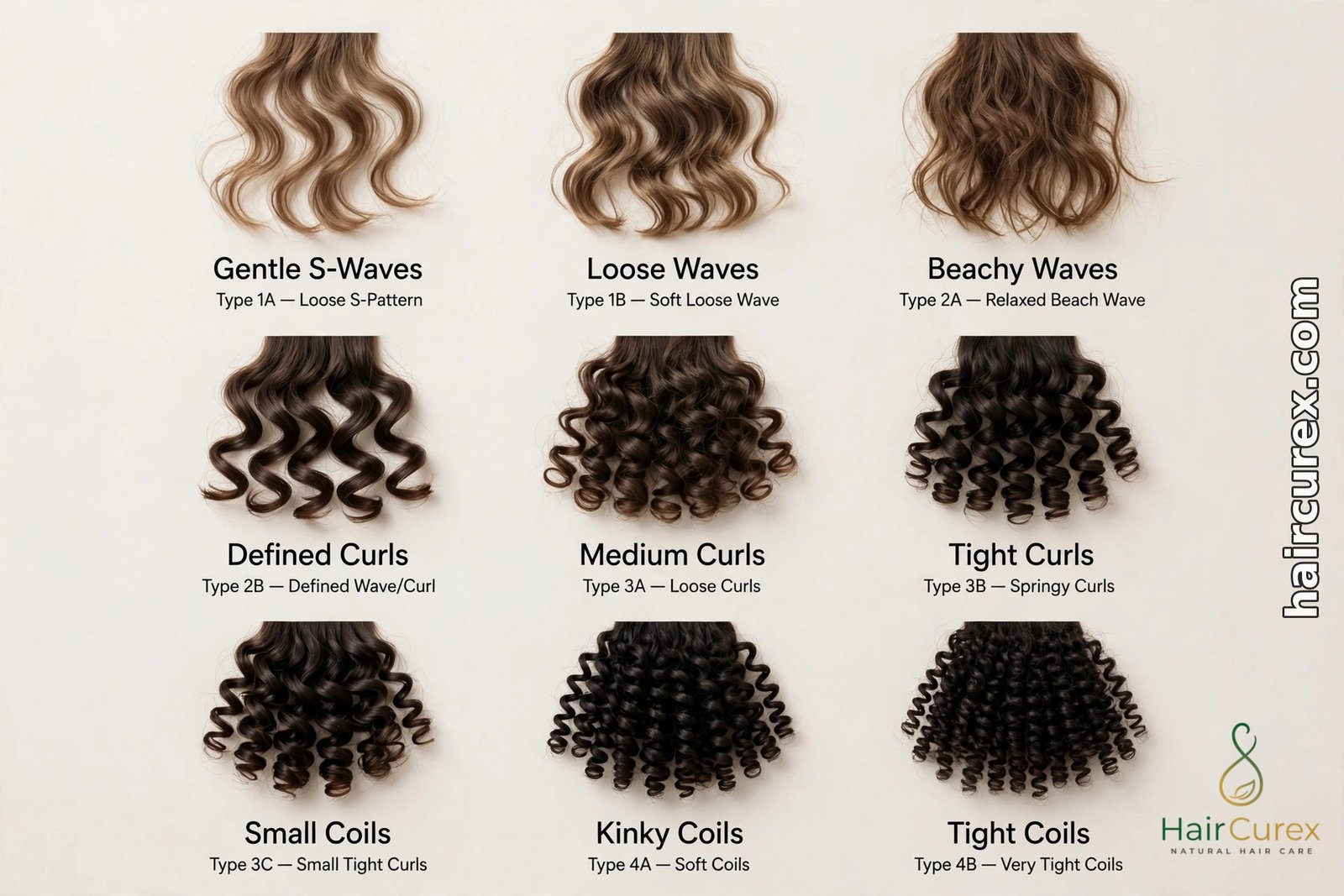
Here is the whole system in one place. Use it to narrow down your type, then read your family’s section for the full care advice.
| Type | Curl pattern | Look and feel | Key care |
|---|---|---|---|
| 2A | Loose, stretched S-wave | Fine, flat roots | Light products; wash often |
| 2B | Defined S-wave from mid-length | Medium texture, some frizz | Light leave-in or mousse |
| 2C | Strong S-wave, some ringlets | Coarser, fuller, borderline curly | Light gel; condition mid-lengths to ends |
| 3A | Large, loose spirals | Shiny, bouncy, easily weighed down | Lightweight curl cream |
| 3B | Medium springy ringlets | Bouncy, full, dries out faster | Curl cream plus gel |
| 3C | Tight pencil-sized corkscrews | Dense, voluminous, lots of shrinkage | Rich leave-in; detangle with conditioner in |
| 4A | Small S-shaped coils | Dense, soft, defined coils | Moisturize after every wash |
| 4B | Tight zigzag bends | Less defined, cottony feel | Heavy creams; protective styles |
| 4C | Very tight zigzag coils | Densest, most fragile, most shrinkage | Maximum moisture; gentle handling |
The number is the shape family and the letter is how tight the pattern is within it — A is loosest, C is tightest. Most people do not have one single type. It is completely normal to have 2C waves at the nape, 3A curls at the crown, or tighter coils underneath and looser curls on top. Your “type” is the pattern that covers most of your head.
How the Curly Hair Typing System Works
The system most people use today was created in the 1990s by celebrity hairstylist Andre Walker. It divides hair into four numbered types based on the shape of the strand: Type 1 is straight, Type 2 is wavy, Type 3 is curly, and Type 4 is coily or kinky. Each number is split into A, B and C based on the width of the wave, curl or coil — A is the widest pattern, B is medium, and C is the smallest and tightest.
It is a useful shorthand for choosing products and routines, not a medical diagnosis. It says nothing about your hair’s health, thickness or porosity. Hair also changes over time: hormones, pregnancy, medication, heat damage and chemical treatments can all loosen or tighten a pattern. If your hair sits between two types, pick the care advice for the type that matches most of your hair, and borrow tips from the neighboring type for the sections that behave differently.
Type 2: Wavy Hair (2A, 2B, 2C)
Type 2 hair sits between straight and curly. It forms S-shaped waves rather than true ringlets.

2A hair
2A hair is fine, with a loose, tousled wave that usually starts toward the ends while the roots stay fairly straight. Heavy creams and oils flatten it completely, so lightweight products are the rule. Our full guide to 2A hair covers the routine in detail — in short, wash as often as your scalp gets oily, condition mainly the mid-lengths and ends, and use a light mousse on soaking-wet hair.
2B hair
2B hair has a more defined S-wave that starts higher up, around the mid-lengths, and holds its shape better than 2A. A light leave-in conditioner or mousse scrunched in while the hair is wet is usually enough. Avoid brushing 2B hair when it is dry — that is the fastest way to turn waves into a frizzy puff.
2C hair
2C is the waviest of the wavy types and the closest to true curls. The waves are strong S-shapes that start at the roots, and you will often find a few actual ringlets mixed in, usually underneath or at the nape. A light gel scrunched in on wet hair gives definition without stiffness, and conditioning the mid-lengths to ends helps keep frizz down.
Type 3: Curly Hair (3A, 3B, 3C)
Type 3 hair forms real ringlets — distinct, springy spirals that hold their shape from root to tip. This is also where dryness starts to become a real issue, because the scalp’s natural oils have a harder time travelling down a spiralled strand.
3A hair
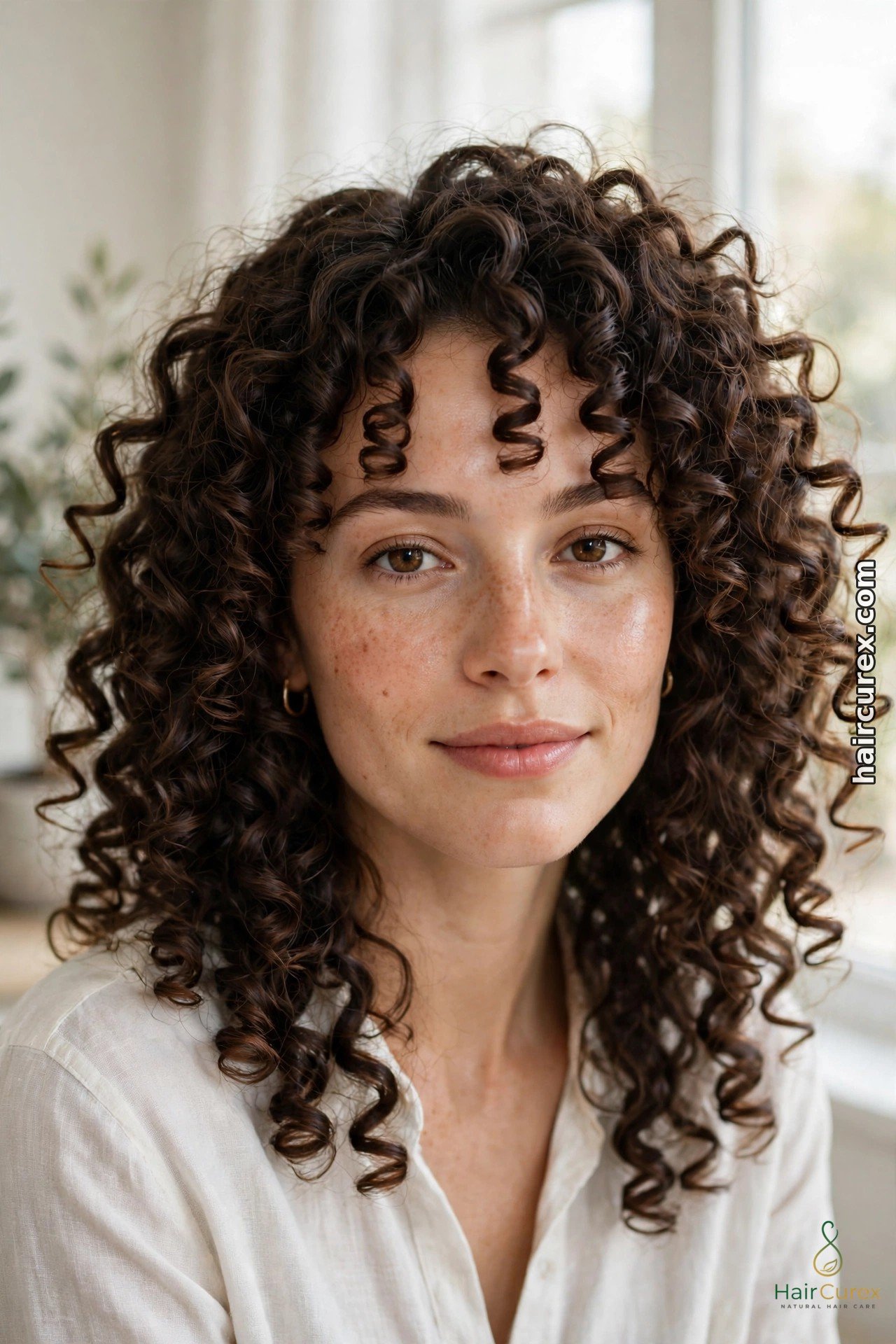
3A hair has large, loose, well-defined curls that look like stretched-out S-shapes or loose spirals. The curls are easily pulled out by the weight of the hair itself or by heavy products. The key is lightweight moisture: a light curl cream or leave-in is usually enough, and heavy butters will drag the curls flat. Our guide to 3A hair goes through the best products and routine for this type in full.
3B hair
3B hair has tighter, springier ringlets about the width of a marker pen, with more volume and bounce than 3A. It dries out faster, frizzes more readily, and needs more moisture to stay defined. A curl cream for softness plus a gel for hold is the usual combination, applied to soaking-wet hair in sections. Our guide to 3B hair covers the full routine, including how to refresh second-day curls without a full wash.
3C hair
3C hair has tight corkscrew curls about the width of a pencil, densely packed together. Because the curls are so tight, moisture does not travel down the strand easily, so this type needs richer leave-in products and regular deep conditioning. Detangle only with conditioner in the hair, working in sections from the ends upward, and never brush 3C curls dry.
Type 4: Coily Hair (4A, 4B, 4C)
Type 4 hair is the tightest and driest of all the curly hair types, and the most fragile. The coils are small and densely packed, and the hair experiences the most shrinkage — it is common for 4A to 4C hair to shrink to half its stretched length or less. Gentle handling and consistent moisture matter more here than for any other family.

4A hair
4A hair has small, distinct S-shaped coils that form tight rings, usually about the width of a crochet needle. Moisture is the priority: apply a leave-in conditioner after every wash, seal it in with a light oil or butter, and wash the hair in sections to reduce tangling. Detangle with plenty of conditioner and your fingers or a wide-tooth comb, never a fine brush on dry hair.
4B hair
4B hair bends in a tight zigzag pattern rather than forming clear rings, so the curl pattern is less defined and the hair has a soft, cottony feel. Heavier creams and butters work well here, and protective styles — twists, braids, buns — help reduce the daily handling that causes breakage. Wash in sections, detangle gently while the hair is saturated with conditioner, and avoid tight styles that pull at the edges, since repeated tension can cause hair loss along the hairline.
4C hair
4C hair has the tightest pattern of all: very tight zigzag coils that can be hard to see as a distinct curl without stretching the strand. It experiences the most shrinkage and is the most fragile of all hair types, so it needs the most moisture and the gentlest handling. Our guide to 4C hair covers the full routine, including the LOC method — liquid, oil, cream — that many people with 4C hair use to layer moisture. Moisturize little and often, detangle only on wet, conditioned hair, and sleep on satin or with a bonnet. Dermatologists note that thick, curly hair does not need washing daily or even weekly, but it should still be washed at least every two to three weeks for scalp health — the American Academy of Dermatology’s curly hair tips explain how to balance washing, moisturizing and detangling for this hair type.
How to Find Your Curly Hair Type
You do not need any special tools to find your type — just a wash day and a mirror.
- Wash with a gentle shampoo and conditioner, and use no styling products afterwards. Product residue changes how your pattern looks, so a clean, product-free head is the only fair test.
- Let your hair air-dry completely without touching it. Do not blow-dry, brush or scrunch while it dries — heat and handling stretch the pattern out and give a false reading.
- Look at the shape once it is fully dry. Loose, stretched S-waves mean Type 2. Clear spirals and ringlets mean Type 3. Tight coils or zigzag bends mean Type 4.
- Check the width of the curl. A wide, loose wave is an A; a curl about the width of a marker is a B; a curl about the width of a pencil or smaller is a C.
- Check more than one section. Look at the crown, the sides, the nape and the underneath layers. If most of your hair is one type and a smaller section is another, your main type is the one that covers most of your head.
- Repeat the test on a different wash day. Humidity, product buildup and how recently you trimmed your hair all affect the result. If you get the same pattern twice, you have your answer.
A Simple Wash-Day Routine by Type Family
One routine does not fit all nine types, but the structure is the same — only the frequency and the richness of the products change. The table below is a starting point; adjust it over a few weeks until your hair tells you it is right. Our full curly hair routine guide walks through each step in more detail.

| Step | Type 2 (wavy) | Type 3 (curly) | Type 4 (coily) |
|---|---|---|---|
| Wash | 2–4 times a week | 1–3 times a week | Every 1–2 weeks |
| Shampoo | Lightweight, sulfate-free; scalp only | Moisturizing; scalp only | Moisturizing; wash in sections |
| Condition | Mid-lengths to ends | Full length; detangle with it in | Full length, generous amount |
| Leave-in | Light leave-in or mousse | Curl cream on soaking-wet hair | Leave-in plus oil or butter |
| Style | Scrunch and air-dry, or diffuse on low | Scrunch in gel; air-dry or diffuse | Twist or braid for definition |
| Refresh | Water spray and a little mousse | Water and leave-in spray | Water-based moisturizer, then oil |
| Deep condition | Once a month | Every 1–2 weeks | Weekly |
On washing frequency, the right schedule depends on your hair’s texture, thickness and how much you sweat. Healthline’s guide to washing curly hair puts the usual range at one to five times per week. The practical test is your own hair: if it feels tight, dry and frizzy, you are probably washing too often; if it looks greasy and limp at the roots, you are probably not washing enough.
Common Mistakes with Curly Hair
Brushing dry curls. A brush pulls the curl pattern apart and creates frizz. Detangle only when the hair is wet and coated in conditioner, with your fingers or a wide-tooth comb, working from the ends upward.
Using products that are too heavy — or too light. Heavy butters flatten 2A and 3A curls; a light mousse does almost nothing for 4C coils. Match the weight of the product to the tightness of the curl.
Washing too often, or not often enough. Daily washing strips the oils curly hair already struggles to distribute, while going too long between washes lets buildup irritate the scalp.
Skipping conditioner, or applying it only to the ends. Curly hair is drier along its whole length, not just at the tips. Condition the full length, and leave a little in if your type needs it.
Rubbing hair dry with a rough towel. Towel friction roughs up the cuticle and creates frizz. Blot gently with a microfiber towel or an old cotton T-shirt instead, and never wring your curls out.
Using heat without protection. Flat irons and curling irons on unprotected curly hair cause damage that loosens or destroys the pattern over time. If you heat-style, use a heat protectant every time and keep the temperature as low as works.
Expecting one product to fix everything. No cream, oil or gel changes your curl type. Products support the pattern you have; they cannot create a different one. If a product promises to turn your waves into ringlets, it is promising something it cannot deliver.
When to See a Stylist or Dermatologist
Most curl problems are routine problems, and they improve with the right washing and conditioning habits. But some signs mean it is time for professional help rather than another product.
See a stylist who understands curly and coily hair when your cut is fighting your pattern — for example, if your curls hang flat on top and puff out at the bottom. A curly cut is done on dry hair, curl by curl, so the stylist can see how each curl falls.
See a dermatologist promptly if you notice sudden or patchy hair loss, bald spots, a scalp that is painful, sore or burning, heavy flaking that does not improve with a dandruff shampoo, or breakage so severe that your hair is snapping off in handfuls. These can be signs of a scalp condition or a form of hair loss that needs medical treatment, and the earlier they are checked, the more options there are.
Frequently Asked Questions
What are the curly hair types 2A to 4C?
The 2A to 4C system sorts curly hair by the shape and tightness of its pattern. Type 2 is wavy, Type 3 is curly with defined ringlets, and Type 4 is coily with tight coils or zigzags. Within each family, A is the loosest pattern, B is medium, and C is the tightest.
How do I find my curly hair type?
Wash your hair, apply no styling products, and let it air-dry completely without touching it. Once dry, look at the pattern: loose S-waves mean Type 2, defined spirals mean Type 3, and tight coils or zigzags mean Type 4. Check several sections of your head, since mixed patterns are normal.
Can you have more than one curly hair type?
Yes, and most people do. It is common to have looser curls on top and tighter coils underneath, or wavier hair at the nape and curlier hair at the crown. Your main type is the pattern that covers most of your head.
Does curly hair type change over time?
Yes. Hormones, pregnancy, medication, heat damage and chemical treatments can all loosen or tighten your pattern. If your pattern changes, re-test it with the wash-and-air-dry method and adjust your routine to match the hair you have now.
How often should I wash curly hair?
It depends on your type. Wavy 2A to 2C hair usually needs washing 2 to 4 times a week, curly 3A to 3C hair about 1 to 3 times a week, and coily 4A to 4C hair every 1 to 2 weeks — but never less often than every 2 to 3 weeks, for scalp health.
What is the best routine for curly hair?
Shampoo the scalp, condition the full length and detangle while the conditioner is in, apply a leave-in or curl cream to soaking-wet hair, and let it air-dry or diffuse on low heat. Match the product weight to your type — light products for loose waves and curls, richer creams and butters for tight coils.