


Dark red hair is the grown-up version of red: deep, glossy and rich, with none of the high-maintenance brightness of fire-engine red. It reads as burgundy in dim light and flashes wine-red in the sun, which is why it suits so many people — it adds warmth and dimension without shouting. It is also one of the most forgiving reds you can choose. Because the base is dark, it works on brown and even black hair without heavy lightening, it fades gracefully into a warm brown-red instead of going patchy, and it looks polished in a professional setting. The catch is the same as with every red: the color fades faster than brown or black, so the shade you pick and the way you care for it decide whether it still looks expensive six weeks later. This guide covers every dark red shade, who each one suits, how to get it at home or in a salon, and exactly how to stop dark red hair fading.
Quick answer: Dark red hair suits most skin tones — burgundy and wine red flatter cool skin, mahogany and auburn-red flatter warm skin, and deep cherry suits anyone who wants a bolder look. It works on dark brown hair without lightening, though vivid shades need a lighter base. To stop it fading, wash 2-3 times a week in cool water with a sulfate-free, color-safe shampoo, wait 48-72 hours before the first wash after dyeing, protect it from sun and heat, and refresh it with a red color-depositing conditioner every 1-2 weeks.
Dark Red Hair Shades at a Glance
Dark red is not one color. The shade you choose changes how natural it looks, how much lightening your hair needs, and how fast it fades. These are the main families:

| Shade | What it looks like | Best for | Fade speed |
|---|---|---|---|
| Burgundy | Deep wine red with a purple edge | Cool skin tones; dark brown hair, no lightening | Slow — the dark base holds pigment well |
| Wine red | Rich red with a clear berry tone | Cool to neutral skin; a statement look that stays elegant | Slow to medium |
| Mahogany | Brown-red, polished and natural | Warm skin tones; professional settings | Slowest — one of the longest-lasting reds |
| Auburn red | Warm red-brown, the most natural dark red | Warm and neutral skin; first-time reds | Medium — fades to a warm brown-red |
| Deep cherry | Dark red with a bright, juicy edge | Anyone wanting a bolder dark red; needs a lighter base for full brightness | Medium to fast |
| Black cherry | Almost black indoors, red in sunlight | Very dark hair; a subtle first step into red | Slow — looks like black hair dye until the light hits it |
| Copper dark red | Dark red with a copper glow | Warm skin; fair to medium hair | Medium — softens toward copper |
If this is your first time going red, mahogany or auburn red is the safest starting point: both look natural, work on brown hair without bleach, and fade gracefully instead of going patchy. Burgundy is the best choice if your skin has cool or pink undertones and you want depth without lightening. Our full guide to red hair dye covers the dye types, application steps and the full shade range in more detail if you want to compare bright reds with these darker shades before deciding.
Who Does Dark Red Hair Suit?

Match the shade to your skin’s undertone, not just your eye color. Look at the veins on your wrist in daylight: greenish veins usually mean warm undertones, bluish veins mean cool undertones. Warm undertones suit mahogany, auburn red and copper dark red. Cool undertones suit burgundy, wine red and black cherry. If you cannot tell, auburn red works on almost everyone — it sits in the middle of warm and cool, which is why colorists reach for it so often.
Fair skin. Dark red hair is one of the best colors for fair skin because the contrast makes both the hair and the complexion look richer. Burgundy and wine red are the classic picks here, and they look striking with blue or green eyes. The one shade to be careful with is deep cherry on very fair skin — it can look harsh if the red is too bright against a pale face, so ask for a darker, wine-leaning version first. If you want a bolder fashion color instead, purple hair and pink hair are the brighter alternatives, while bronde hair is the lighter, sun-kissed option.
Medium skin. Almost every dark red shade works on medium skin. Mahogany is the most natural-looking option and the easiest to wear every day, while burgundy adds drama without needing lightening. If your skin has olive undertones, lean toward wine red or burgundy rather than copper dark red, because copper can pull out yellow tones in olive skin.
Dark skin. Dark red hair looks superb on dark skin — the depth of the color picks up the warmth in the complexion instead of fighting it. Burgundy, wine red and black cherry are the strongest choices, and they show up beautifully on dark brown or black hair without any lightening. Deep cherry also works well if you want more visible red, though it may need a gentle lift first to show its true brightness. Avoid shades that are too close to your natural hair color or the red will disappear indoors; you want enough contrast for the color to read.
Hair type and length. Dark red hair flatters straight, wavy and curly hair alike, but it behaves differently on each. On straight hair the color looks sleek and uniform, so uneven application shows more — take your time with sections. On wavy and curly hair the different tones catch the light in layers, which makes the color look more dimensional and hides fading better. On very fine hair, choose a darker shade like burgundy or black cherry: lighter, brighter reds can make fine hair look thinner at the roots as the color fades.
Dark Red Hair on Dark Hair: Do You Need to Lighten First?
This is the question that decides most dark red hair results, and the honest answer is: usually not. Dark red dye shows up well on dark brown hair because the shade is close to your starting color — the dye deposits red pigment over a dark base, and the result is a deep, rich red that is obvious in sunlight and subtle indoors. That is exactly why dark red is the best first red for people with dark hair.
There are two exceptions. First, if you want a vivid, bright dark red — deep cherry at full brightness, or a red that reads clearly red indoors as well as outdoors — you will need to lift your hair a level or two first. Without lightening, a bright red on black hair usually looks like a subtle reddish tint. Second, if your hair has been dyed black before, especially with black hair dye, the old color can block the red almost completely. In that case a colorist may need to do a gentle color-removal or lightening step before the red will take.
A strand test answers this for your own hair in ten minutes: dye a small hidden section, wait the full processing time, and check the result in daylight. It tells you the true color on your hair and whether your hair can handle the dye. If the strand test looks too subtle, you know you need a lighter base or a brighter shade before committing your whole head.
How to Get Dark Red Hair at Home
Applying dark red hair at home is very doable if you follow the steps in order. Because the shade is dark, small mistakes are far less visible than with bright reds — but even coverage still matters.
What you need: dark red dye and developer (if permanent or demi-permanent), gloves, an applicator brush and bowl, old towels and a dark T-shirt, petroleum jelly or barrier cream, sectioning clips, a wide-tooth comb, and a timer.
- Patch test 48 hours before. Dab a little dye behind your ear or on your inner elbow and leave it for 48 hours. The U.S. Food and Drug Administration’s hair dye guidance stresses this step because allergic reactions can develop even if you have dyed your hair before without a problem — the ingredient PPD is the usual trigger. Skip the dye if you see redness, itching or swelling.
- Do not wash your hair the day you dye it. Slightly oily hair protects your scalp, and dye grips better on hair that is not freshly washed. If your hair is very dirty or full of product, wash it the day before instead.
- Protect your skin and clothes. Rub petroleum jelly along your hairline, ears and the back of your neck. Wear the dark T-shirt and put old towels on the floor — dark red dye stains everything it touches, and it stains skin, so if you do get dye on your skin, wipe it off quickly.
- Section your hair into four parts. Clip it into quadrants. Work one section at a time so you do not miss patches — uneven application is the main cause of patchy color, and it shows most on straight hair.
- Apply roots first for permanent dye, ends first for a refresh. On virgin hair, start at the roots where the heat of your scalp helps the color develop, then pull the dye through to the ends for the last 10–15 minutes. If you are only refreshing faded ends, apply to the mid-lengths and ends first and the roots last.
- Saturate properly. Each section should be fully coated, not just skimmed. Use a brush for even coverage and comb through gently at the end. Dark red looks flat and dull when it is under-applied.
- Time it exactly. Set a timer for the time on the box — usually 30–45 minutes. Leaving dye on longer does not make dark red last longer; it damages the hair and can push the color darker or muddier than you wanted.
- Rinse with cool water until it runs clear. Rinse without shampoo on the first wash if the instructions allow it, then condition well. Hot water opens the hair cuticle and lets red pigment escape, so cool water from the very first rinse matters.
- Dry and check in daylight. Dark red looks almost black under bathroom lights. Check the result in natural light before deciding whether it needs a second pass — and wait at least a week before re-dyeing if it does.
Salon or At Home?
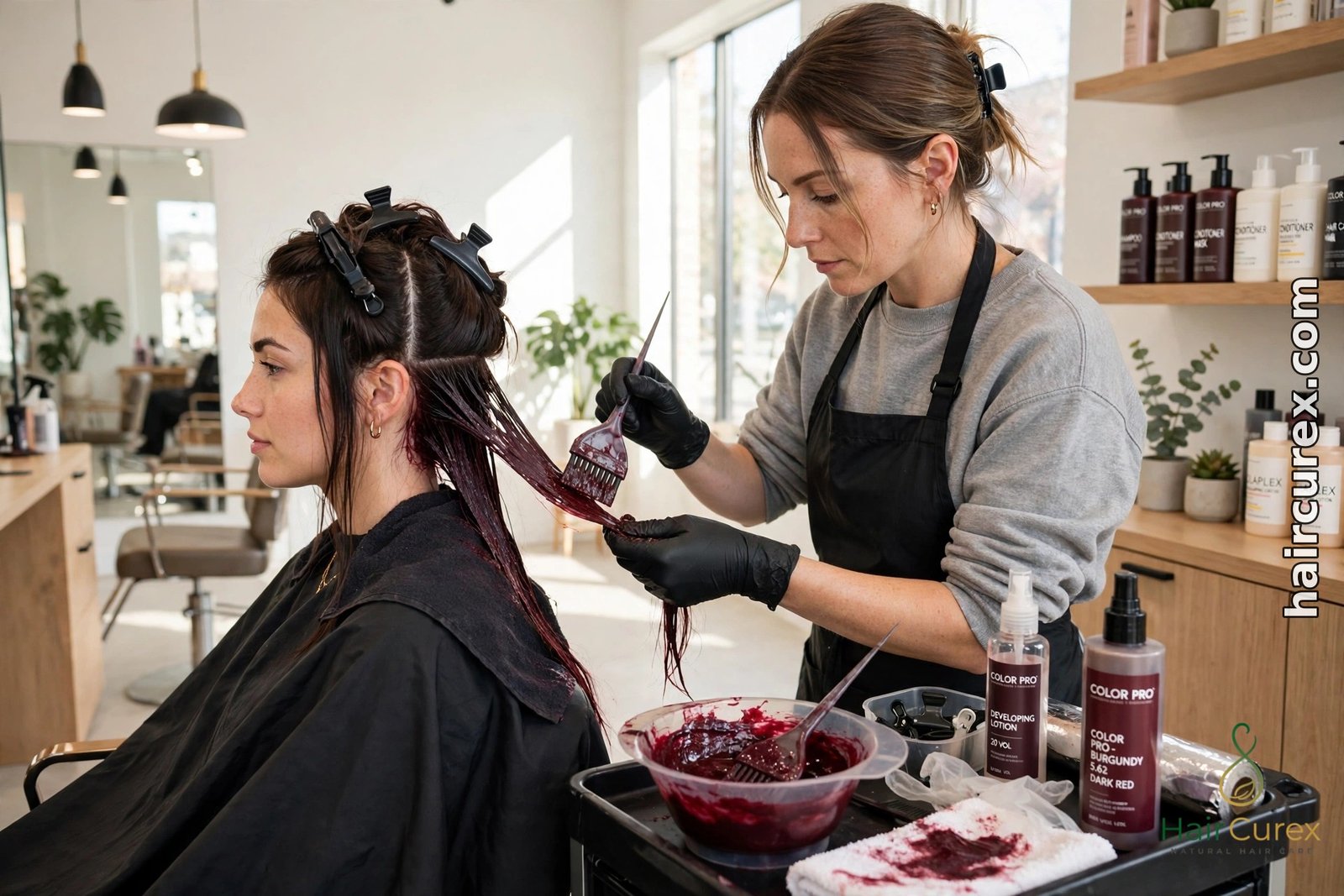
At-home dye works well for a single-process dark red close to your natural color, especially mahogany, burgundy or black cherry on dark brown hair. A salon is worth the money in these cases:
- You want a vivid deep cherry on dark hair. Lightening dark hair to the base a bright red needs is the hardest part of the process, and uneven lightening shows badly under red.
- You want a dimensional color. Salon colorists layer two or three red tones — a darker base with brighter pieces — which looks more natural and fades more evenly than one flat box color. Dimensional dark red is also what makes the color look expensive rather than flat.
- Your hair is already damaged or previously colored. Red over old color, henna or bleach can react unpredictably; a colorist can test and correct it before the full application.
- You want dark red balayage or highlights. Placement matters more than the dye itself, and that is hard to do on your own head. A dark red balayage over a brown base is one of the lowest-maintenance ways to wear the color, because the roots grow out softly.
A salon dark red typically costs $80–$200 depending on your area and whether lightening is involved, but the color usually lasts longer because a colorist can use a stronger, better-sealed application. If you go the salon route, ask which shade they used and what aftercare they recommend; the fading advice below still applies either way.
How to Stop Dark Red Hair Fading

This is the part that decides whether your dark red hair lasts two weeks or six. Red fades because its large pigment molecules escape through the hair cuticle every time you wash, heat-style or go out in the sun. Dark red holds up better than bright red because the base is darker, but every habit below still helps — each one either closes the cuticle or reduces the number of times it opens.
Wash less, and wash cool. The single biggest lever. Washing every day strips dark red fast; stretching to 2–3 washes a week can double how long the color looks fresh. Use the coolest water you can stand — hot water opens the cuticle and releases pigment. Dry shampoo between washes keeps roots fresh without a full wash.
Use a sulfate-free, color-safe shampoo. Sulfates are strong cleansers that strip color along with dirt. A sulfate-free shampoo made for color-treated hair cleans gently and keeps the cuticle flatter. Wash with a small amount and focus on the scalp, not the lengths — the lengths do not need scrubbing, and scrubbing them is what pulls the color out.
Wait before the first wash. Do not wash for at least 48–72 hours after coloring. That window lets the cuticle settle and the pigment lock in. The first few washes will still show red in the water — that is normal — but it should slow down after the first week. If the water is still running dark red after two weeks, you are probably washing too often or too hot.
Add a red color-depositing conditioner or mask. These products put a little red pigment back every time you use them, which cancels out the fading from washing. Use one every 1–2 weeks, or every wash if your shade is on the brighter side. Choose a conditioner made for red or burgundy hair rather than a generic color-depositing product, so the tone it adds matches your shade instead of pulling it copper. A weekly deep-conditioning mask also matters because damaged hair loses color faster than healthy hair — the American Academy of Dermatology’s healthy-hair tips cover the daily habits that keep color-treated hair in good condition.
Refresh the color, don’t re-dye the whole head. When dark red hair starts to look dull — usually after 4–6 weeks — refresh only the lengths with a demi-permanent dye in the same shade, or a color-depositing mask. Re-dyeing the whole head every time over-processes the lengths and makes them fade faster next time. Touch up the roots with permanent dye only where new growth shows.
Sun, Heat and Swimming: The Three Fade Accelerators

Sunlight. Sunlight fades dark red hair faster than any other color, and burgundy is especially vulnerable because its purple tones break down in UV light. Wear a hat in strong sun, or use a UV-protectant hair spray before going out. If you spend a lot of time outdoors, a darker shade like black cherry will hold its color noticeably longer than a brighter wine red.
Heat styling. Heat opens the cuticle, so keep flat irons and curling irons below 180°C (350°F) and always use a heat protectant. Air-drying when you can is the simplest way to slow fading — every heat-styled wash cycle costs a little color. If you do use heat, let your hair cool completely before brushing it out; brushing hot hair roughs up the cuticle.
Swimming. Chlorine and salt water both strip dark red. Wet your hair with clean water before getting in a pool — soaked hair absorbs less chlorinated water — and rinse immediately afterwards with fresh water. A leave-in conditioner applied before swimming adds a barrier, and a swim cap is worth it if you swim regularly. If your hair turns brassy or greenish after swimming, a clarifying wash followed by a red color-depositing conditioner usually restores the tone.
How Long Does Dark Red Hair Last?
Honest expectations matter more than any promise on a box:
- Semi-permanent dark red: 4–12 washes, usually 2–4 weeks depending on how often you wash. Good for testing a shade before committing.
- Demi-permanent dark red: 4–6 weeks, fading gradually rather than washing out in patches. The best balance of longevity and gentleness for most people.
- Permanent dark red: the color is in the hair until it grows out, but the vibrancy fades noticeably after 3–4 weeks without maintenance. Roots will need touching up every 4–6 weeks.
With good aftercare — cool washes, sulfate-free shampoo, heat protection and a red depositing conditioner — a permanent dark red can still look rich at six weeks. Without it, the same color can look dull and brownish within two. The difference is not the dye; it is the routine.
5 Mistakes to Avoid with Dark Red Hair
- Choosing the shade from the box photo alone. Box photos are shot on pre-lightened hair. Your result depends on your starting color, so do a strand test and expect a darker, subtler result on dark hair.
- Skipping the patch test. Dark red dyes contain the same sensitizing ingredients as other permanent dyes. A reaction can develop even if you have dyed your hair before.
- Washing with hot water every day. This is the fastest way to lose the color. Cool water and fewer washes matter more than any expensive shampoo.
- Using a clarifying or anti-dandruff shampoo every wash. Strong cleansers strip red pigment. If you need one, use it once a week at most and follow with a color-depositing conditioner.
- Re-dyeing the whole head every month. It over-processes the lengths and makes them fade faster. Refresh the lengths, touch up only the roots, and let the color build gradually.
FAQ
Does dark red hair suit dark skin?
Yes — dark red hair looks excellent on dark skin. Burgundy, wine red and black cherry are the strongest choices: they pick up the warmth in the complexion and show up well on dark brown or black hair without lightening. Choose a shade with enough contrast against your natural color so the red reads clearly in daylight.
Does dark red hair need bleach?
Usually not. Dark red shades like burgundy, mahogany and black cherry show up well on dark brown hair without lightening. You only need to lighten first if you want a vivid, bright deep cherry that reads clearly red indoors, or if old black dye is blocking the color.
How do I stop dark red hair fading?
Wash 2–3 times a week in cool water with a sulfate-free, color-safe shampoo, wait 48–72 hours before the first wash after dyeing, protect your hair from sun and heat, and use a red color-depositing conditioner every 1–2 weeks. Refresh the lengths with a demi-permanent dye rather than re-dyeing the whole head.
How long does dark red hair last?
A demi-permanent dark red lasts 4–6 weeks, fading gradually. A permanent dark red stays in the hair until it grows out, but its vibrancy fades after 3–4 weeks without maintenance. With good aftercare it can still look rich at six weeks.
Is dark red hair high maintenance?
No — it is one of the lowest-maintenance reds. Because the base is dark it fades gracefully into a warm brown-red instead of going patchy, and roots grow out softly, especially with mahogany or auburn red. You will still need color-safe washing habits and a refresh every few weeks to keep it looking rich.
What skin tone suits burgundy hair?
Burgundy suits cool skin tones best — skin with pink or blue undertones, and blue or green eyes. It also works well on dark skin, where its depth looks rich and elegant. Warm skin tones usually look better in mahogany or auburn red instead.