

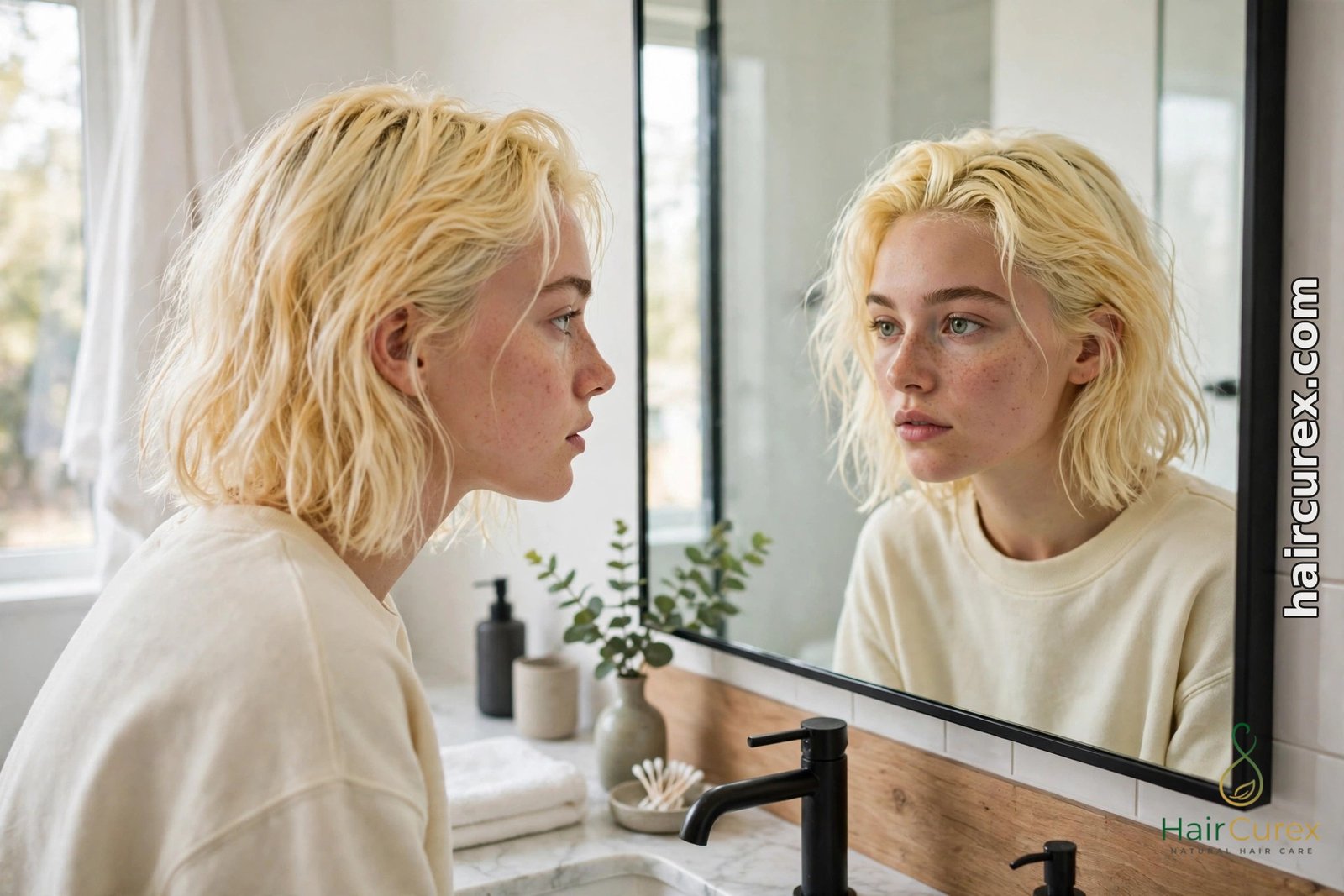
Quick answer: Hair bleach lightens your hair by opening the cuticle and removing your natural pigment, and it can be done safely at home if you follow the rules: do a strand test and a patch test 48 hours before, use 20-volume developer for most at-home bleaching, never leave bleach on longer than 45 minutes, and never bleach hair that is already damaged, previously relaxed, or treated with henna or metallic dyes. Bleaching always causes some damage, so the goal is controlled, limited damage — not zero damage — and knowing when to stop or see a professional is part of doing it safely.
Bleaching is the most powerful thing you can do to your hair at home, and also the easiest to get wrong. Unlike a semi-permanent dye that sits on the surface, hair bleach changes the structure of the hair itself. Done carefully, it lifts dark hair to blonde, creates the base for vivid colors, and opens up styles that are impossible on unbleached hair. Done carelessly, it can break hair off at the roots, burn the scalp, and leave patchy orange bands that take months to fix.
This guide covers the whole process the safe way: what bleach actually does, the two tests you must do first, which developer volume to choose, the supplies you need, the step-by-step application, timing, toning, and aftercare — plus the red flags that mean you should book a professional instead of doing it yourself.
How Hair Bleach Works
Hair bleach is a mixture of a lightening powder (usually persulfate-based) and a developer (hydrogen peroxide). The developer opens the hair cuticle so the bleach can get inside the hair shaft, and the bleach then breaks down melanin — the pigment that gives your hair its color. Dark hair passes through stages as it lifts: black to dark brown, to red-brown, to orange, to yellow, and finally to pale yellow. That is why bleached hair often looks orange halfway through — the orange stage is a normal part of the process, not a sign that something has gone wrong.
Two things decide how far your hair lifts: the strength of the developer and how long the hair bleach stays on. Stronger developer lifts faster but damages more, and longer processing time lifts more but also weakens the hair further. There is a ceiling: bleach can only lift hair so far in one session, usually 4 to 7 levels depending on your starting color, and trying to push past that ceiling in one go is how hair breaks. If your hair needs more lift than one session can safely give, the safe answer is a second session after at least two weeks of deep conditioning — never a second round on the same day.
It is also important to be honest about damage. Hair bleach does not just remove color; it removes some of the protein and moisture that keep hair strong and elastic. Every bleaching session makes hair more porous, drier, and more fragile. Good technique, the right developer, and proper aftercare keep that damage manageable — but no product or method makes bleaching damage-free, and anyone who promises that is not telling you the truth.
Before You Start: The Two Tests You Must Not Skip
Before you use hair bleach on a single strand on your head, do two tests. They take a little time, but they are the difference between a safe result and a chemical burn or a head full of broken hair.
The patch test checks for an allergic reaction. Mix a tiny amount of bleach and developer, apply a small dab to the skin behind your ear or on the inside of your elbow, and leave it for 48 hours. If you get redness, itching, swelling, or a rash, do not bleach your hair — an allergy to hair bleach can become serious, and a reaction on your scalp is far worse than a reaction on your arm.
The U.S. Food and Drug Administration advises patch testing before using hair dyes and seeking medical advice if a reaction appears: FDA, hair dyes and safety. Even if you have bleached before without a problem, test again — allergies can develop over time, and a new brand or formula can trigger a reaction the old one did not.
The strand test checks what hair bleach will do to your hair. Take a small, hidden section of hair — from underneath, near the nape — apply the mixed bleach, and time how long it takes to reach the lightness you want. Then check the strand: does it feel stretchy, gummy, or mushy when wet? Does it snap when you pull it gently? If it does, your hair cannot handle the bleach, and you should not proceed. The strand test also tells you your real processing time, which is far more useful than the number on the box, because your hair’s starting color, thickness, and history all change how fast it lifts.
Do both tests at least 48 hours before the full application. If either test fails, stop. A failed test is not a challenge to push through — it is your hair and skin telling you the answer.
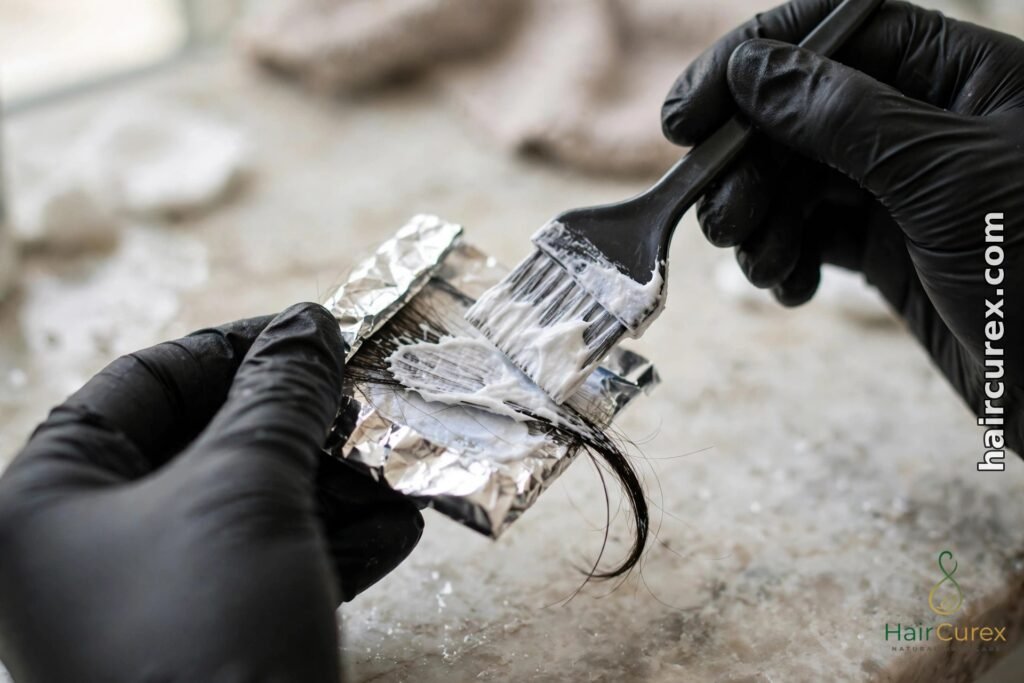
Developer Volumes Explained
Developer strength is measured in volumes, and choosing the wrong one is the most common hair bleach mistake at home. The volume tells you how much peroxide is in the developer and how much lift it gives. Higher volume lifts faster and further, but it also causes more damage and more scalp irritation. For at-home bleaching, 20 volume is the right choice in most cases.
| Developer | Lift | Best for | Risk level |
|---|---|---|---|
| 10 volume (3%) | 1 level | Toning, refreshing already-light hair, very gentle lift | Low — too weak for most bleaching |
| 20 volume (6%) | 2–3 levels | Most at-home bleaching, dark blonde to medium brown hair | Moderate — the safest effective choice |
| 30 volume (9%) | 3–4 levels | Dark brown to black hair that needs more lift | High — more damage, more scalp irritation |
| 40 volume (12%) | 4–5 levels | Professional use on very dark, resistant hair | Very high — avoid at home; high breakage and burn risk |
As a rule, use the lowest volume that will get you to your target shade. If 20 volume gets you there in 40 minutes, there is no reason to use 30 volume. Never use 40-volume developer at home: it works fast, but it also heats up on the scalp, irritates skin, and can snap fragile hair. Professionals who use 40 volume do so with training, constant monitoring, and the ability to rinse immediately — none of which you have in your bathroom. If your hair needs 40 volume to reach your goal, your goal needs a professional, not a stronger chemical.
Mixing ratio matters too. Most hair bleach powders mix at a 1:2 ratio — one part powder to two parts developer — but always follow the instructions on your specific product, because ratios vary by brand. Measure properly with a scale or measuring scoop; guessing the ratio gives you a mixture that is either too thick to spread evenly or too runny to stay where you put it.
What You Need to Bleach Hair at Home
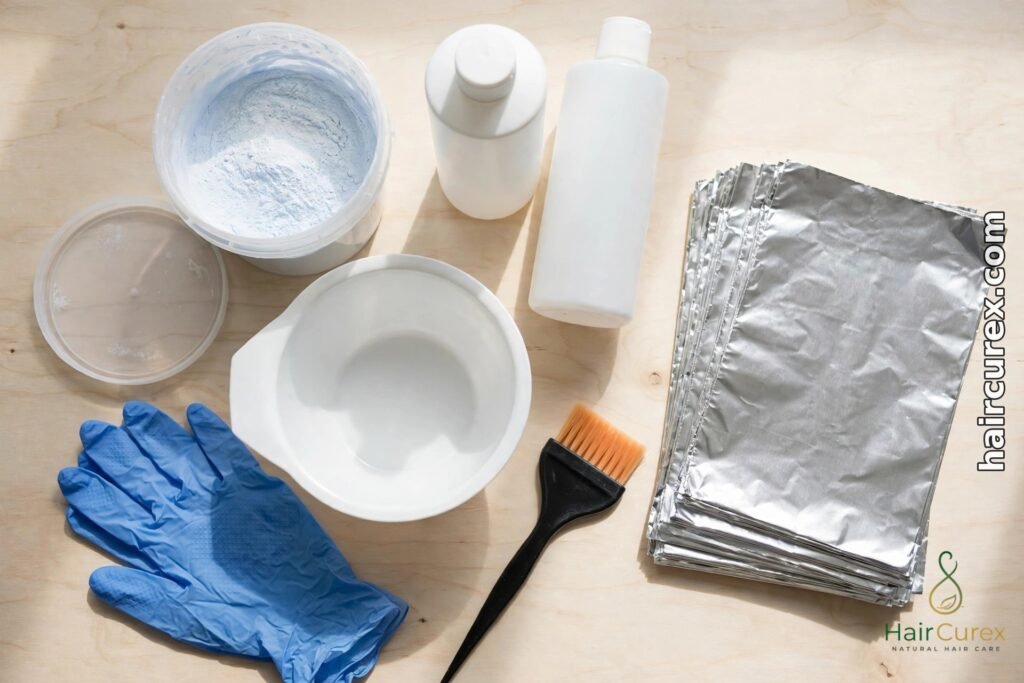
Gather everything before you mix the hair bleach, because once the powder and developer are combined, the clock is running. You will need: bleach powder, 20-volume developer (30 only if your hair is very dark and your strand test says it is safe), a plastic or glass mixing bowl (never metal — metal reacts with bleach), a tint brush, sectioning clips, a wide-tooth comb, gloves, old towels and an old shirt, aluminum foil or plastic wrap, a timer, and a shower cap. For aftercare, have a toner or purple shampoo, a deep-conditioning hair mask, and a sulfate-free shampoo ready.
Work in a ventilated room and keep the hair bleach away from your eyes — wear the gloves the whole time, and if bleach gets in your eyes, rinse with water for at least 15 minutes and seek medical advice. Do not bleach your hair the same day you wash it: hair that was washed one to two days ago has natural oils on the scalp that offer a small amount of protection. Do not scratch your scalp before bleaching, and do not apply bleach to broken, irritated, or sunburned skin.
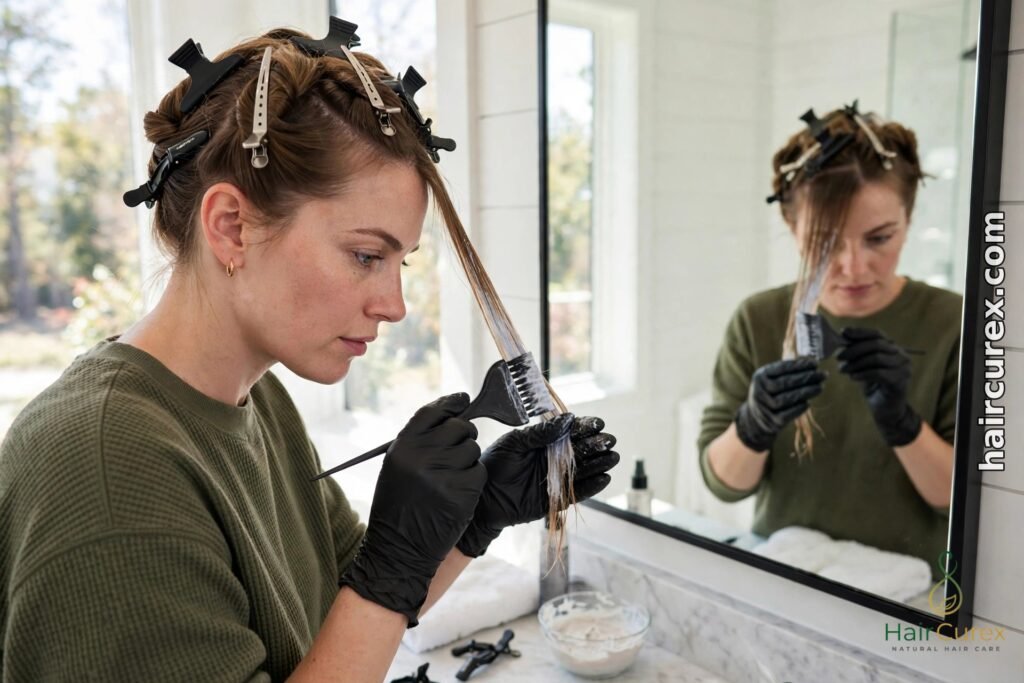
How to Bleach Your Hair at Home, Step by Step
Follow these steps in order, and keep the timer running from the moment the hair bleach touches the first section of hair — not from when you finish applying it. Bleach starts working immediately, so the first section always processes longer than the last.
Step 1: Section your hair. Divide dry, unwashed hair into four sections — two in front, two in back — and clip each one up. Work in thin subsections, about half a centimeter thick, so the bleach saturates every strand evenly. Thick sections are the main cause of patchy results: the outside lifts while the inside stays dark.
Step 2: Mix the bleach. In your plastic bowl, mix one part bleach powder with two parts developer (or the ratio on your product), stirring until the mixture is smooth and creamy, like cake batter. Mix only what you need for one application, and use it immediately — mixed bleach loses strength as it sits.
Step 3: Apply to the lengths first, roots last. Start at the back, working forward, and apply bleach to the mid-lengths and ends first, keeping it about a centimeter away from the scalp. The heat from your scalp makes bleach work faster at the roots, so the roots go on last — about 15 minutes into the process, or when the lengths are already visibly lifting. Saturate each section fully; dry spots do not lift.
Step 4: Check every 5 to 10 minutes. Set a timer and check the color regularly by wiping a small strand clean with a damp cloth. Do not rely on the clock alone — check the hair. Watch for the color stages: orange means it is still lifting, yellow means it is nearly there, and pale yellow is the target for most blonde shades. If the hair feels hot, stretchy, or gummy, rinse immediately, whatever the color looks like.
Step 5: Rinse thoroughly. Never leave bleach on longer than 45 minutes, even if the color is not where you want it. Rinse with lukewarm water until the water runs clear, then wash with a gentle sulfate-free shampoo. If your hair is still too dark or too orange, wait at least two weeks, deep-condition in between, and do a second session — do not re-bleach the same day.
Step 6: Tone. Freshly bleached hair is usually yellow, and toner is what turns that yellow into the blonde you actually want. Apply toner according to its instructions, usually for 5 to 20 minutes, then rinse. If you are going for a vivid color — blue, purple, pink, or red — the bleached base is what makes those shades bright and true. Our guide to purple hair shades and dyeing at home explains how a light base changes the final color, and the same principle applies to every vivid shade.
That is the full process. If any step felt rushed, uneven, or uncomfortable, write down what happened before you forget it — it will help you (or a professional, if you need one) fix the result.
How Long to Leave Hair Bleach On
Timing depends on your starting color and your target shade, and the strand test gives you the most accurate number for your hair. These are general guides, not promises — always check the hair, not just the clock.
| Starting color | Target | Typical time with 20 volume |
|---|---|---|
| Dark blonde | Pale blonde | 20–30 minutes |
| Light brown | Blonde | 30–40 minutes |
| Medium brown | Light blonde | 35–45 minutes |
| Dark brown to black | Blonde (first session) | 40–45 minutes — expect orange or yellow, not blonde yet |
| Already bleached or lightened | Lighter blonde | 15–25 minutes on the regrowth only |
The 45-minute maximum is a hard limit, not a suggestion. After about 45 minutes, bleach stops lifting much further and mostly just damages the hair. If you need more lift, the answer is a second session after at least two weeks — not more time, and never a second application on the same day. Also remember that bleach works faster in a warm room and on fine hair, and slower in a cool room and on coarse, resistant hair. If your hair is very dark, our guide to black hair dye shades and application covers the opposite direction — going darker — which is far more forgiving than going lighter, and worth considering if you are unsure about bleaching.
Toner After Bleach: Why It Matters
Toner is not optional after bleaching — it is the step that turns raw, yellow bleached hair into a wearable blonde. Bleach removes pigment unevenly, leaving warm yellow and orange tones behind, and toner deposits a small amount of cool pigment that neutralizes those warm tones. A violet-based toner cancels yellow; a blue-based toner cancels orange. Choose based on the tone you see in the mirror, not the tone you wish you had.
Apply toner to damp, towel-dried hair and leave it on for the time on the product instructions, usually 5 to 20 minutes, checking every few minutes. Toner works quickly, and leaving it on too long can turn blonde hair grey, lavender, or ashy — especially on very light, porous hair. Rinse with cool water and follow with a deep conditioner. If you are aiming for a softer, blended blonde rather than a bright platinum, a bronde shade can be a good middle ground: our guide to bronde hair, what it is and who it suits explains how brown and blonde tones blend for a lower-maintenance result.
Purple shampoo is the maintenance version of toner. Use it once a week or once every two weeks to keep brassiness away between toning sessions — not every wash, because overuse can dry the hair out and leave a purple cast on very light hair.
After Bleaching: How to Keep Bleached Hair Healthy
Bleached hair needs a different routine from unbleached hair, starting on day one. Wash less often — two to three times a week at most — and use lukewarm water, not hot, because hot water opens the cuticle and lets moisture escape from already porous hair. Use a sulfate-free shampoo, and condition every time you wash. Once a week, swap your regular conditioner for a deep-conditioning hair mask: our guide to how to choose and use a hair mask for your hair type explains which masks suit bleached hair and how to use them without weighing the hair down.
Cut back on heat styling. Bleached hair is more fragile when hot, so if you use a flat iron or curling iron, use the lowest heat setting that works, always use a heat protectant, and never iron the same section twice. Air-drying is the gentlest option. The American Academy of Dermatology’s healthy hair guidance covers the same basics — limit heat, handle wet hair gently, and condition regularly: American Academy of Dermatology, healthy hair tips.
Be gentle with wet bleached hair. It stretches and snaps more easily than unbleached hair, so detangle with a wide-tooth comb or your fingers, starting from the ends, and never brush it roughly when wet. Trim split ends every six to eight weeks — bleached ends split faster, and a small trim now prevents breakage traveling up the hair shaft later. And protect bleached hair from the sun and chlorine: both dry it out and shift the tone, so wear a hat outdoors and rinse with fresh water before and after swimming.
What to Expect After Bleaching
Realistic expectations make the difference between a good bleaching experience and a disappointing one. After one session, dark brown hair usually reaches a warm orange or yellow — not platinum blonde. Reaching a cool, pale blonde from dark hair takes two or sometimes three sessions, spaced at least two weeks apart, with deep conditioning in between. Hair also feels different after bleaching: drier, rougher, and more tangled when wet. That is normal, and it improves with consistent conditioning and masks over the following weeks.
Your hair texture and type affect the result too. Fine hair lifts fast and breaks easily, so it needs shorter processing times and gentler handling. Coarse hair lifts more slowly and can usually handle a longer session. Curly and wavy hair is naturally drier than straight hair, so it needs extra moisture after bleaching — if you are not sure how your texture behaves, our guide to curly hair types, 2A to 4C explained helps you identify your type and what it needs.
Color also fades faster on bleached hair. The cuticle stays slightly open after bleaching, so dye molecules wash out more quickly — vivid colors on a bleached base look brighter, but they also fade faster. That is a trade-off, not a failure, and it is why regular toning and gentle washing matter so much after bleaching.

When to See a Professional Instead
Some situations should never be handled at home, no matter how careful you are. See a professional if any of these apply to you:
Your hair is already damaged. If your hair is breaking, feels gummy or stretchy when wet, or has split ends running far up the shaft, bleach will make it worse. A professional can assess whether your hair can handle any lightening at all, and what treatment it needs first.
Your hair has been relaxed, permed, or treated with henna or metallic dyes. Relaxers and perms change the hair’s structure, and bleach on top of them can cause severe breakage or even melting. Henna and metallic dyes (including some “progressive” color products) can react with bleach, producing heat, smoke, or unpredictable color. Tell a professional exactly what is on your hair — they need the full history to keep you safe.
You want a big change in one session. Going from black to platinum, fixing a bad bleach job, or correcting bands and patches are all professional jobs. Color correction is a skill, and a salon has the products, the lighting, and the experience to fix uneven results without further damage.
Your scalp is sensitive, irritated, or broken. Bleach on broken skin burns, and a scalp condition such as eczema or psoriasis can flare badly. Wait until your scalp is fully healthy, or let a professional decide whether lightening is safe for you.
You had a bad reaction before. If you have ever had swelling, blistering, or breathing difficulty after a hair color or bleach, do not bleach at home again. See a doctor first, and tell any future colorist about the reaction.
Paying for a professional is not a failure — it is the safe choice when the risk is higher than your experience. A salon visit costs more than a box of bleach, but it costs far less than fixing broken hair or treating a chemical burn.
Common Hair Bleach Mistakes
Most at-home bleaching problems come from a short list of avoidable mistakes. Bleaching dirty, product-coated hair is one: buildup blocks the bleach and causes patchy lift, so clarify the day before if you use heavy styling products — but do not wash on the day itself. Overlapping bleach onto already-bleached hair is another: re-bleaching the lengths every time you do your roots causes breakage, so apply bleach to the regrowth only and keep it off the previously lightened hair.
Leaving bleach on too long is the mistake that causes the most damage. The 45-minute limit exists for a reason, and “just ten more minutes” is how healthy hair becomes broken hair. Using 40-volume developer at home, skipping the strand test, and bleaching over henna or metallic dye are the other big ones — all of them are covered in the sections above, and all of them are easy to avoid once you know about them.
Finally, do not bleach your hair the same day as another chemical service. Bleach and relaxers, perms, or keratin treatments do not mix on the same day, and combining them can destroy the hair. Space chemical services at least two weeks apart, and tell your stylist about everything you have done to your hair recently.
Hair Bleach FAQs
How long should I leave hair bleach on?
Never leave hair bleach on for longer than 45 minutes. Most at-home bleaching takes 20 to 45 minutes depending on your starting color, with dark hair needing the full time and lighter hair needing less. Check the color every 5 to 10 minutes and rinse as soon as the hair reaches pale yellow — or immediately if the hair feels hot, stretchy, or gummy.
What volume developer should I use to bleach my hair at home?
Use 20-volume developer for most at-home bleaching — it lifts 2 to 3 levels with moderate damage. Use 30 volume only for very dark hair, and only if your strand test says it is safe. Never use 40-volume developer at home; it causes severe damage and scalp burns and should only be used by professionals.
Can I bleach my hair at home safely?
Yes, if your hair is healthy and you follow the safety steps: do a patch test and a strand test 48 hours before, use 20-volume developer, never exceed 45 minutes, and do not bleach hair that is damaged, relaxed, or treated with henna or metallic dyes. If any of those risk factors apply, see a professional instead.
Why did my hair turn orange after bleaching?
Orange is a normal stage of lightening — dark hair lifts through red-brown and orange before it reaches yellow and pale blonde. It means the bleach needs more time, or a second session after at least two weeks. A blue-based toner neutralizes orange tones, while a violet-based toner neutralizes yellow tones.
How often can I bleach my hair?
Wait at least two weeks between full bleaching sessions, and deep-condition in between. For root touch-ups, bleach only the new growth every 4 to 6 weeks, keeping bleach off the previously lightened lengths. Bleaching the same hair too often is the fastest way to breakage.
Does hair bleach damage your hair permanently?
Bleach causes lasting changes to the hair it touches — it removes pigment and some protein, making hair more porous and fragile — but the damage is limited to the bleached hair, not the hair that grows in afterward. New growth is undamaged, so the long-term fix for damaged bleached hair is consistent care, regular trims, and letting the healthy hair grow in.