

K18 vs Olaplex is the comparison almost every person with damaged hair eventually searches for, and the honest answer is that neither product is universally better — they repair different parts of the hair’s structure. K18’s Leave-In Molecular Repair Hair Mask uses a peptide that reconnects broken keratin chains and works in just 4 minutes without rinsing, while Olaplex No. 3 Hair Perfector uses patented bond-building technology to relink broken disulfide bonds and needs at least 10 minutes before you rinse, shampoo and condition. If speed and a leave-in routine matter most, K18 is the easier habit to keep. If budget matters most, or you want a weekly rinse-out treatment that fits a full wash-day system, Olaplex No. 3 is the more affordable starting point. For severely damaged
hair, some stylists use the two in rotation, because they approach repair from different angles. For K18 vs Olaplex, the right choice depends on how K18 vs Olaplex fits your wash-day routine and budget.
Why Hair Needs Bond Repair in the First Place
Healthy hair gets its strength from bonds inside each strand. Bleach, permanent color, heat styling, chemical straightening and even rough brushing break those bonds over time. When enough of them break, hair feels stretchy when wet, snaps easily when dry, loses its curl pattern, frizzes in humidity and stops holding color well. A conditioner can make damaged hair feel softer for a day, because it coats the outside of the strand, but it does not rebuild the internal structure. That is the gap bond repair treatments are made to fill.

It helps to set expectations before you buy either product. No at-home treatment can turn hair that has been bleached to breaking point back into virgin hair, and no treatment replaces a trim when ends are split all the way up the shaft. What a good bond repair product can do is make damaged hair measurably stronger, less prone to breakage and easier to style, especially when you use it consistently for several weeks. For more on where repair stops and a trim starts, see our guide to split ends.
K18 vs Olaplex: How Each Treatment Works
K18 is built around K18PEPTIDE, a biotech-developed peptide designed to mimic hair’s natural structure. According to K18, the peptide reconnects polypeptide chains and disulfide bonds broken during bleaching, coloring, chemical services and heat. In practical terms, that means K18 targets the keratin chains that give hair its shape and strength, working at a molecular level inside the strand rather than just coating the surface.
Olaplex takes a different route. Its patented ingredient, bis-aminopropyl diglycol dimaleate, is designed to find and relink broken disulfide bonds — the sulfur bonds that bleach breaks apart to lift color. Those bonds are a major source of hair’s elasticity and strength, so rebuilding them is why Olaplex became a salon staple after chemical services. Olaplex No. 3 is not a conditioner and not a protein treatment in the traditional sense; it is a pre-shampoo bond builder, and you still need to shampoo and condition after it.
The difference matters because hair damage is rarely one single thing. Bleach breaks disulfide bonds, heat and chemical services damage keratin chains, and everyday wear weakens both. That is why neither brand can honestly claim to fix everything alone, and why the “which is better” question depends on what kind of damage your hair actually has.
K18 vs Olaplex Comparison Table
| Comparison | K18 | Olaplex |
|---|---|---|
| Key technology | K18PEPTIDE, reconnects keratin polypeptide chains and disulfide bonds | Bis-aminopropyl diglycol dimaleate, relinks disulfide bonds |
| Hero product compared | K18 Leave-In Molecular Repair Hair Mask (50 ml) | Olaplex No. 3 Hair Perfector (100 ml) |
| When you use it | After shampoo, on damp hair | Before shampoo, on damp hair |
| Wait time | 4 minutes | At least 10 minutes |
| Rinse out? | No, leave-in, style as usual | Yes, then shampoo and condition |
| How often | For 4–6 washes after a salon service, then as needed | About once a week, or 2–3 times a week for very damaged hair |
| Approximate US price | Around $75 for 50 ml | Around $30 for 100 ml |
| Best for | Fast routine, bleach and heat damage, people who hate rinse-out steps | Budget-friendly weekly repair, bleach and chemical damage, building a full wash-day system |
| Texture and feel | Lightweight, absorbs quickly | Slightly heavier, cream-like, needs a wash after |
Prices are approximate US retail prices at the time of writing and vary by retailer and size, so check the current price before you buy. Smaller travel sizes exist for both brands and are a sensible way to test a product before committing to a full bottle.
How to Use K18 Correctly
K18’s official instructions are deliberately simple, and skipping a step is the most common reason people say it “did not work.” Shampoo your hair and do not condition first, then towel-dry thoroughly so hair is damp but not dripping — K18 itself describes the ideal state as roughly 65 percent wet, because hair that is too dry cannot absorb the peptide and hair that is too wet dilutes it. Apply 1–3 pumps for the full-size mask, starting at the ends and working up toward the roots, using more only for long or thick hair. Wait the full 4 minutes before combing or styling, and do not rinse it out. After those 4 minutes you can add conditioner, leave-in products or styling products as usual.
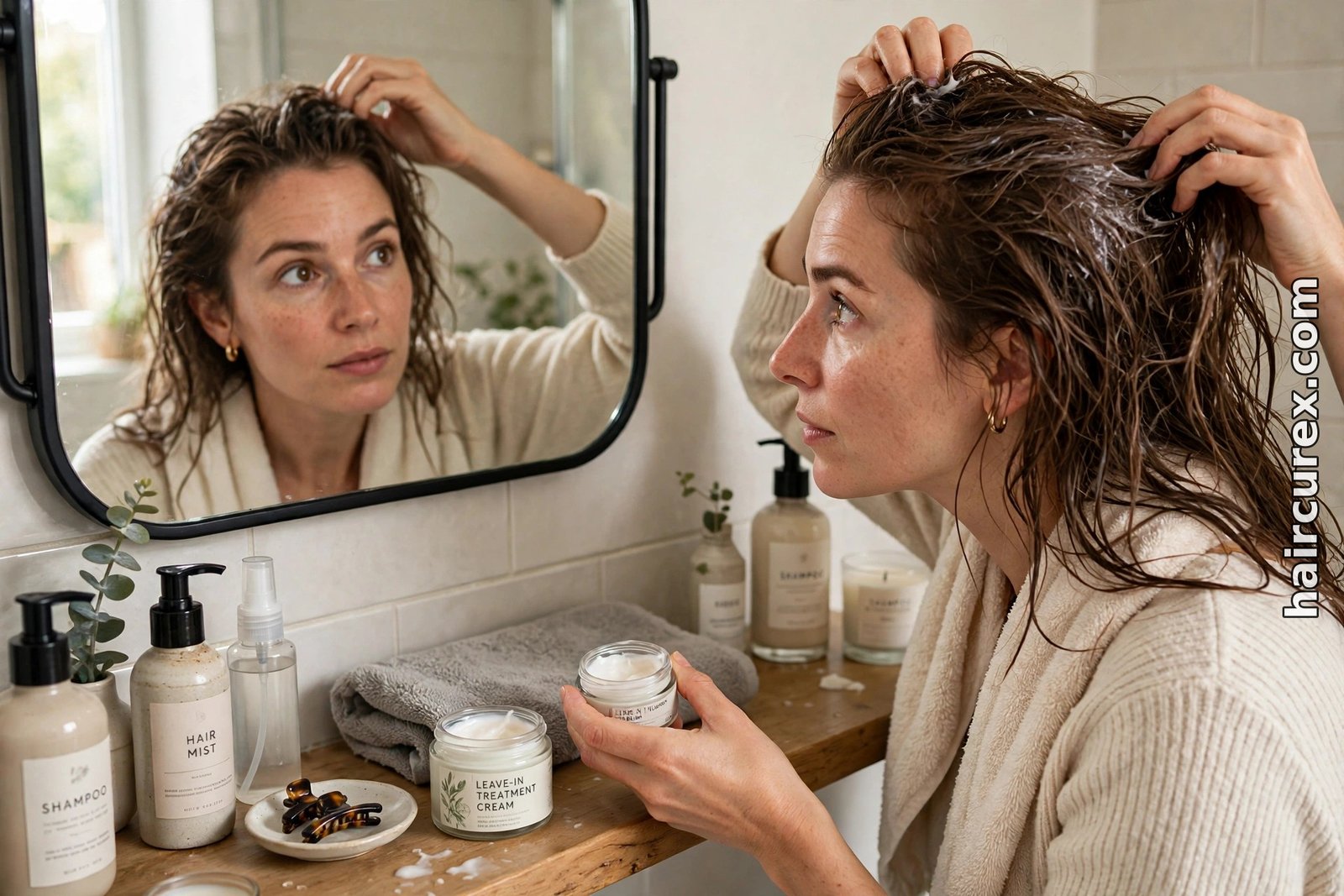
K18 recommends using the mask for 4–6 washes after a salon service, then as needed. It also advises clarifying first if you use a lot of heavy products, so buildup and minerals do not block the peptide from reaching the hair. A patch test on a small section is wise if you have sensitive skin or a history of reactions to hair products. For a full walkthrough of the product on its own, see our K18 hair mask guide.
Source: K18 — How To Use K18
How to Use Olaplex No. 3 Correctly
Olaplex No. 3 is a pre-shampoo treatment, which surprises people who expect a mask they use after conditioning. Dampen your hair and towel-dry it, then apply a generous amount from roots to ends and comb through once so every section is saturated. Leave it on for a minimum of 10 minutes, then rinse, shampoo and condition as usual. For stronger repair, Olaplex also sells No. 0 as a primer: you apply No. 0 to dry hair, wait 10 minutes, then apply No. 3 on top for another 10 minutes before rinsing. That two-step system is the brand’s recommended route for maximum at-home repair, but No. 3 works on its own too.

Frequency is weekly for most people, rising to 2–3 times a week for very damaged hair. Leaving No. 3 on overnight is a popular internet tip, but it is not what the brand instructs, and longer is not automatically better — the treatment is designed to work in its recommended window, and you still need to wash it out and follow with shampoo and conditioner. If your hair feels dry after No. 3, that usually means it needs moisture afterwards, not more bond builder: pair it with a hydrating conditioner or mask rather than using it daily.
Source: LovelySkin — How to Use Olaplex Hair Care Products for Beginners
K18 vs Olaplex for Different Hair Types
Fine hair usually prefers K18, because the leave-in formula is lightweight and absorbs without weighing hair down, and because you do not add a rinse-out cream plus a shampoo and conditioner on top of it. Use the smallest effective amount and focus on mid-lengths and ends, where damage is worst, rather than loading the roots. For K18 vs Olaplex, the right choice depends on how K18 vs Olaplex fits your wash-day routine and budget.
Thick, coarse or very curly hair can suit either product, but the practical difference is time and saturation. Olaplex No. 3 needs a generous, even application and a full wash afterwards, which takes longer on thick hair but also gives you a thorough weekly reset. K18 is faster on wash days, which helps if you wash curly hair less often and want a treatment that does not add another full wash cycle.
High-porosity hair — hair that soaks up water fast and loses it just as fast, often after bleach — tends to absorb both treatments quickly and may need more frequent use at first. If that sounds like your hair, read our high porosity hair guide before choosing, because porous hair also needs moisture and gentle handling alongside bond repair, not bond repair alone.
Color-treated hair benefits from either product, because repaired cuticles hold color better than damaged ones. Neither product strips color when used as directed, but always follow the brand’s instructions rather than mixing treatments or leaving a rinse-out product in overnight in the hope of extra repair.
Cost Per Use: Which Is Really Cheaper?
On the shelf, Olaplex No. 3 looks far cheaper: roughly $30 for 100 ml against roughly $75 for 50 ml of K18. The gap narrows a little when you look at how much you use. K18 is concentrated — 1–3 pumps per use for most hair lengths — so a 50 ml bottle can last many weeks even with regular use. Olaplex No. 3 asks for a generous amount from roots to ends, so a 100 ml bottle goes faster than its size suggests, especially on long or thick hair. For K18 vs Olaplex, the right choice depends on how K18 vs Olaplex fits your wash-day routine and budget.
Even so, Olaplex remains the cheaper entry point, and that matters if you are unsure whether bond repair will help your hair at all. A sensible low-risk test is to start with Olaplex No. 3 for four weekly uses and judge breakage, softness and manageability. If you love the results but hate the rinse-out routine, or you want a faster leave-in step, try K18 next. If budget is tight, there is no shame in sticking with Olaplex: a treatment you actually use every week beats a premium bottle you use twice and abandon.
One more cost trap to avoid: buying both full-size bottles at once. Test one product properly for a month first. If you later rotate the two, you will know what each one does for your hair instead of guessing which one deserves the credit.
Can You Use K18 and Olaplex Together?
Yes, many stylists and experienced users rotate them, but do it with a plan rather than layering everything on the same wash day. A workable rotation is Olaplex No. 3 once a week as your rinse-out repair step, and K18 after a salon color or bleach service for 4–6 washes, or on wash days when you want a quick leave-in boost. Do not apply K18 on top of wet Olaplex No. 3 and hope for double repair — the two products are designed for different steps of a routine, and mixing them undiluted on the same head of hair makes it impossible to tell what is helping or irritating your scalp.
Watch for overload signs either way: hair that feels stiff, coated or straw-like after treatments may be getting too much protein-style repair and not enough moisture. In that case, cut back to one treatment a week, add a moisturizing mask, and give your hair a wash cycle with just shampoo and conditioner. Bond repair and moisture are partners, not rivals, and most damaged hair needs both. For a routine that balances the two, see our beginner hair care routine and our keratin treatment guide, which covers a different kind of smoothing service that is often confused with bond repair.
Mistakes That Make Either Treatment Disappoint
Using K18 on soaking wet hair dilutes the peptide, and rinsing it out defeats its leave-in design. Skipping conditioner before K18 is actually correct — condition after the 4 minutes if you need it, not before. With Olaplex, the mirror-image mistake is treating No. 3 as a conditioner and leaving it in, or skipping shampoo and conditioner afterwards and wondering why hair feels coated.
Other common mistakes apply to both: expecting one use to fix months of bleach damage, using a treatment daily when weekly use is recommended, and ignoring the rest of the routine. Heat protectant, gentle detangling from the ends up, lukewarm water and regular trims do as much for breakage over time as any bottle. If breakage suddenly worsens, hair feels gummy when wet, or your scalp becomes irritated, stop the treatment and talk to a stylist or dermatologist rather than pushing through.
The Verdict: K18 vs Olaplex, Which Is Worth It?
| Quick decision guide | Who it suits |
|---|---|
| Choose K18 if: | you want the fastest routine, you prefer leave-in products, your hair is fine and easily weighed down, you want a post-salon repair step. |
| Choose Olaplex No. 3 if: | budget comes first, you like a weekly wash-day ritual, you want a full shampoo and conditioner system, you are testing bond repair for the first time. |
| Choose both in rotation if: | your hair is severely damaged, you have tried one alone without enough improvement, and you can keep the routine consistent for at least a month. |

So, K18 vs Olaplex: which bond repair treatment is worth it? Choose K18 if you will actually use a 4-minute leave-in treatment consistently and you are willing to pay more for that convenience. Choose Olaplex No. 3 if you want proven weekly bond repair at a much lower price and you do not mind a rinse-out step. Both are credible, well-used products with clear instructions and real science behind them — the best one is the one that fits your hair, your budget and the routine you will honestly keep for at least four weeks. When you weigh K18 vs Olaplex for your own hair, remember that the K18 vs Olaplex decision should follow your routine, not just the price.
Frequently Asked Questions About K18 vs Olaplex
Is K18 or Olaplex better for bleached hair?
Both can help bleached hair, because bleach breaks the bonds both products target. K18 is faster and leave-in, while Olaplex No. 3 is cheaper and rinse-out. For severely bleached hair, some stylists rotate the two, but start with one product for a month so you can judge its effect.
Can I use K18 and Olaplex on the same day?
It is better to rotate them on different wash days rather than layering them together. Use Olaplex No. 3 as a weekly pre-shampoo treatment and K18 as a leave-in step after shampooing on other wash days.
How long does K18 take compared to Olaplex?
K18 takes 4 minutes and is not rinsed out. Olaplex No. 3 needs at least 10 minutes on damp hair, followed by rinsing, shampooing and conditioning, so allow 20 minutes or more in total.
Is Olaplex No. 3 a conditioner?
No. Olaplex No. 3 is a pre-shampoo bond-building treatment, not a conditioner. You must rinse it out and follow with shampoo and conditioner, or hair can feel dry or coated.
Which is cheaper, K18 or Olaplex?
Olaplex No. 3 is cheaper to buy, at roughly $30 for 100 ml compared with roughly $75 for 50 ml of K18. K18 is more concentrated per use, but Olaplex remains the lower-cost entry point for most people.
How long until I see results from K18 or Olaplex?
Most people notice softer, more manageable hair after the first few uses, but meaningful improvement in breakage and strength usually takes 4–6 weeks of consistent use. If nothing improves after a month, check your technique, add moisture, or ask a stylist whether a trim is needed.