


Curtain bangs are a soft, face-framing fringe that is parted in the middle (or slightly off-centre) and gets longer towards the sides, like curtains drawn open on either side of the face. They suit more people than almost any other fringe because the length is tapered rather than blunt: the shortest pieces sit near the nose or cheekbone and blend into face-framing layers, so they flatter straight, wavy and curly hair and most face shapes. Ask your stylist for soft, feathered ends that blend into your layers — never a thick, blunt block — start a little longer than you think, and style them by blow-drying away from the face with a round brush. Best of all, curtain bangs grow out gracefully: as they lengthen they simply become face-framing layers, so there is no dramatic awkward stage if you decide to grow them out.
What Are Curtain Bangs?
Curtain bangs are a fringe cut to frame the face rather than cover the forehead. The centre is the shortest point, usually ending around the eyebrows or the bridge of the nose, and each side sweeps down past the cheekbones towards the jaw or chin, merging into the rest of the haircut. Unlike a straight-across fringe, there is no hard horizontal line: the eye follows two soft diagonals, which is why the style reads as gentle and face-opening rather than heavy.
The look became famous in the 1970s and has returned in waves ever since, because it does several jobs at once. It adds shape to long, one-length hair without losing length. It softens strong features — a square jaw, a high forehead, sharp cheekbones — without hiding them. And it is forgiving: a slightly uneven curtain fringe still looks intentional, while a slightly uneven blunt fringe does not. That forgiveness is also what makes curtain bangs a good first fringe. If you have never had bangs, this is the lowest-risk way to try them, because the grow-out is built into the cut itself.
They are not the same as face-framing layers, though the two overlap. Face-framing layers start further back and longer; curtain bangs are a true fringe section at the front, cut shorter and styled forward and out. A good cut usually has both: the bangs at the front, blending into layers that carry the shape down the sides of the face.
Curtain Bangs by Face Shape
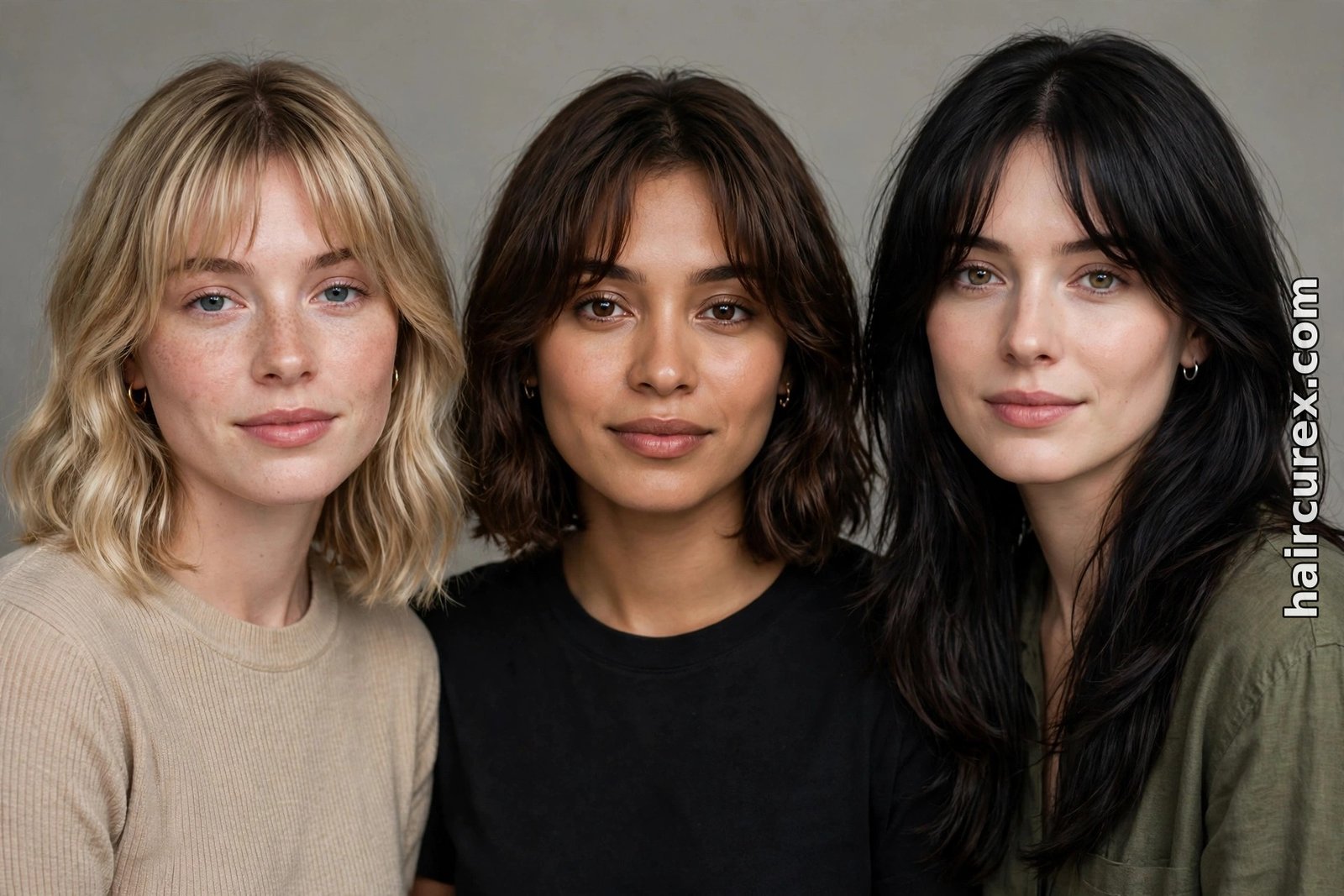
Almost every face shape can wear curtain bangs — the trick is adjusting the length and the part, not choosing a different cut altogether. The general rule, echoed in professional face-shape guides, is that round and diamond faces do best with longer pieces and a slightly deeper part so the bangs do not add width at the cheeks, while oval faces can wear almost any length, and square and heart faces benefit from the softening diagonal of the sweep.
Oval faces have the most freedom: cheekbone-length bangs open up balanced proportions without covering them. Round faces should ask for bangs that start a little longer, ending at or below the cheekbone, with a part that sits slightly off-centre for a stronger diagonal. Square faces get the most from soft, wispy ends that round off a strong jaw and brow — avoid thick, heavy pieces that add another hard line. Heart faces, wide at the forehead and narrow at the chin, suit curtain bangs that add softness around the forehead while the longer side pieces balance the narrower lower face. Long or oblong faces can use slightly shorter, fuller curtain bangs to shorten the visible length of the face, but should keep the crown flat rather than adding height on top.
| Face shape | Best curtain bangs length | Part and tip |
|---|---|---|
| Oval | Any length, cheekbone is classic | Centre part works well |
| Round | Longer, cheekbone or below | Slightly off-centre part for a diagonal |
| Square | Soft, wispy, medium length | Centre part, feathered ends to soften the jaw |
| Heart | Medium, sweeping past the cheekbones | Centre or soft side part, keep sides light |
| Long or oblong | Shorter and fuller | Centre part, avoid extra crown height |
Curtain Bangs by Hair Type
Straight hair shows the cut most precisely, which is a blessing and a warning: a good curtain cut looks sleek and deliberate, but any blunt or uneven edge shows too, so ask for feathered, point-cut ends. Styling is straightforward — a round brush blow-dry gives the classic swept shape, and a flat iron with a gentle outward twist at the ends finishes it.
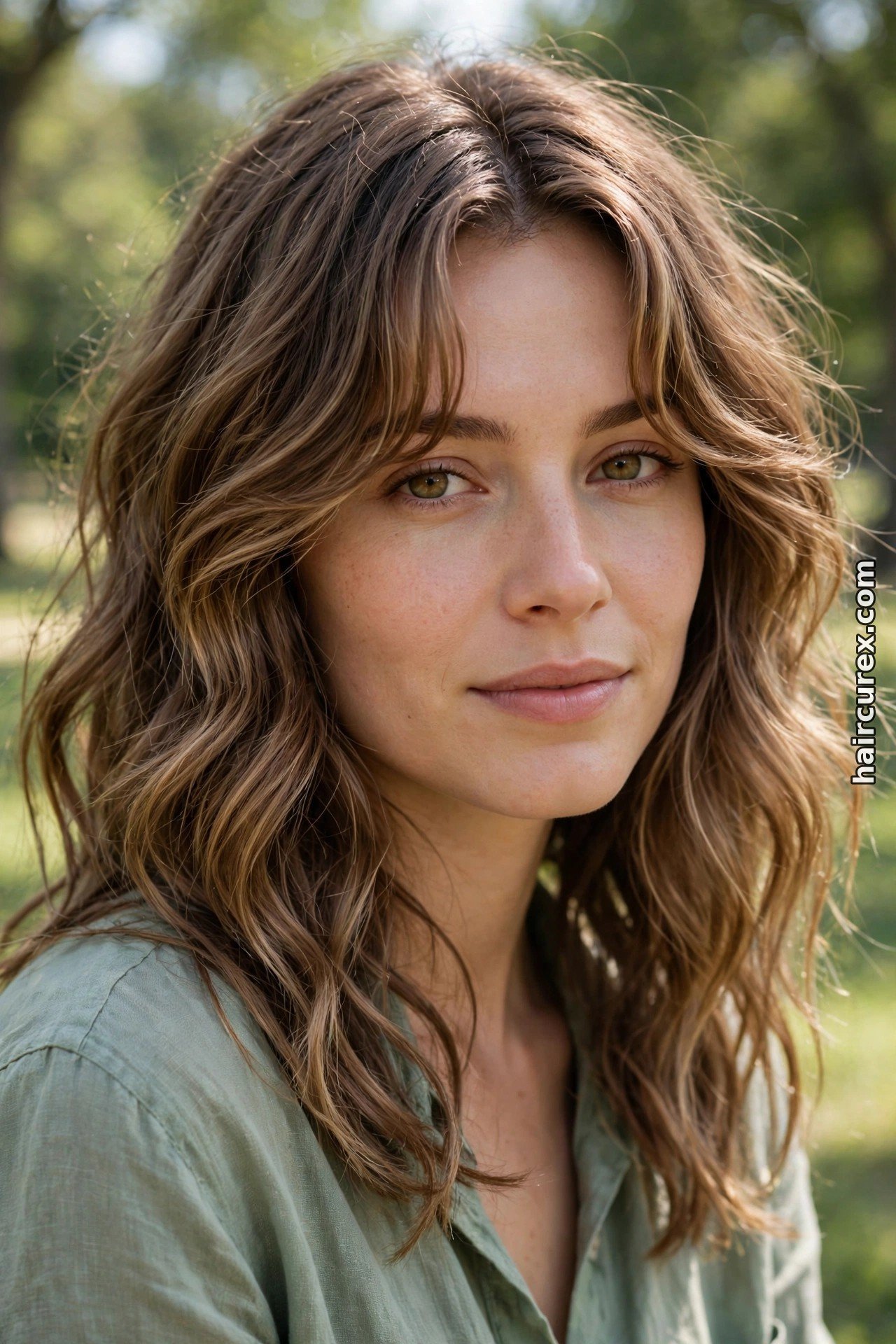
Wavy hair is arguably the easiest match for curtain bangs. Natural wave gives the sweep for free, and the bangs blend into wavy layers without much effort. Let them air-dry with a little mousse or texturising spray, then finger-style the part open. The main caution is shrinkage and wave pattern: waves spring up as they dry, so bangs cut wet can end up shorter than expected — ask your stylist to cut wavy bangs dry or nearly dry, or to leave extra length.
Curly hair can absolutely wear curtain bangs, but the cut must follow the curl pattern, not fight it. Ask for a rounded curtain shape with the centre a little softer and the sides a touch longer, cut curl by curl or dry, so the fringe does not spring into a triangle shape. Diffuse gently rather than stretching the curls straight, and accept a little more volume at the front — that is part of the look. Very tight coils need the most length left in, because shrinkage is greatest; start long and trim in stages.
Fine hair benefits from curtain bangs because they add the illusion of fullness at the front without thinning the rest of the hair, but keep the section light — taking too much hair into the fringe thins the lengths behind it. Thick hair needs the opposite: weight removed from inside the bang section (internal texturising) so the fringe sits soft instead of bulky. Our guide to haircuts for round face shapes explains the same balance of width and length in more detail, and the butterfly haircut pairs beautifully with curtain bangs because both are built on airy, face-framing layers.
How to Ask for Curtain Bangs at the Salon
The single most useful thing you can do is bring two or three reference photos and say what you like in each — the length, the softness, the part — rather than asking for a celebrity’s whole haircut. Your hair texture, density and growth pattern will change how any photo translates, and a good stylist will adapt the details to you. Use this script, adapted from professional salon advice: “I’d like curtain bangs — soft, face-framing pieces parted in the middle, shortest around my nose or cheekbones and getting longer towards my jaw, blending into my layers. Please keep the ends feathered, not blunt, and start a little longer than the photo — we can always take more off.” Then name your specifics: your part (centre or slightly off-centre), your usual styling routine (air-dry, blow-dry, or both), and whether you want to be able to tuck the bangs behind your ears.
Ask three questions before the scissors come out. First, how will the bangs be cut — wet or dry? For wavy and curly hair, dry or nearly-dry cutting is more predictable. Second, how much hair will go into the fringe section? A wider section looks fuller; a narrower one keeps more thickness in the lengths. Third, when should you come back for a trim? Most curtain bangs need a tidy-up every 3–4 weeks to hold their shape, though growing them out deliberately stretches that to 6 weeks or more.

How to Style Curtain Bangs
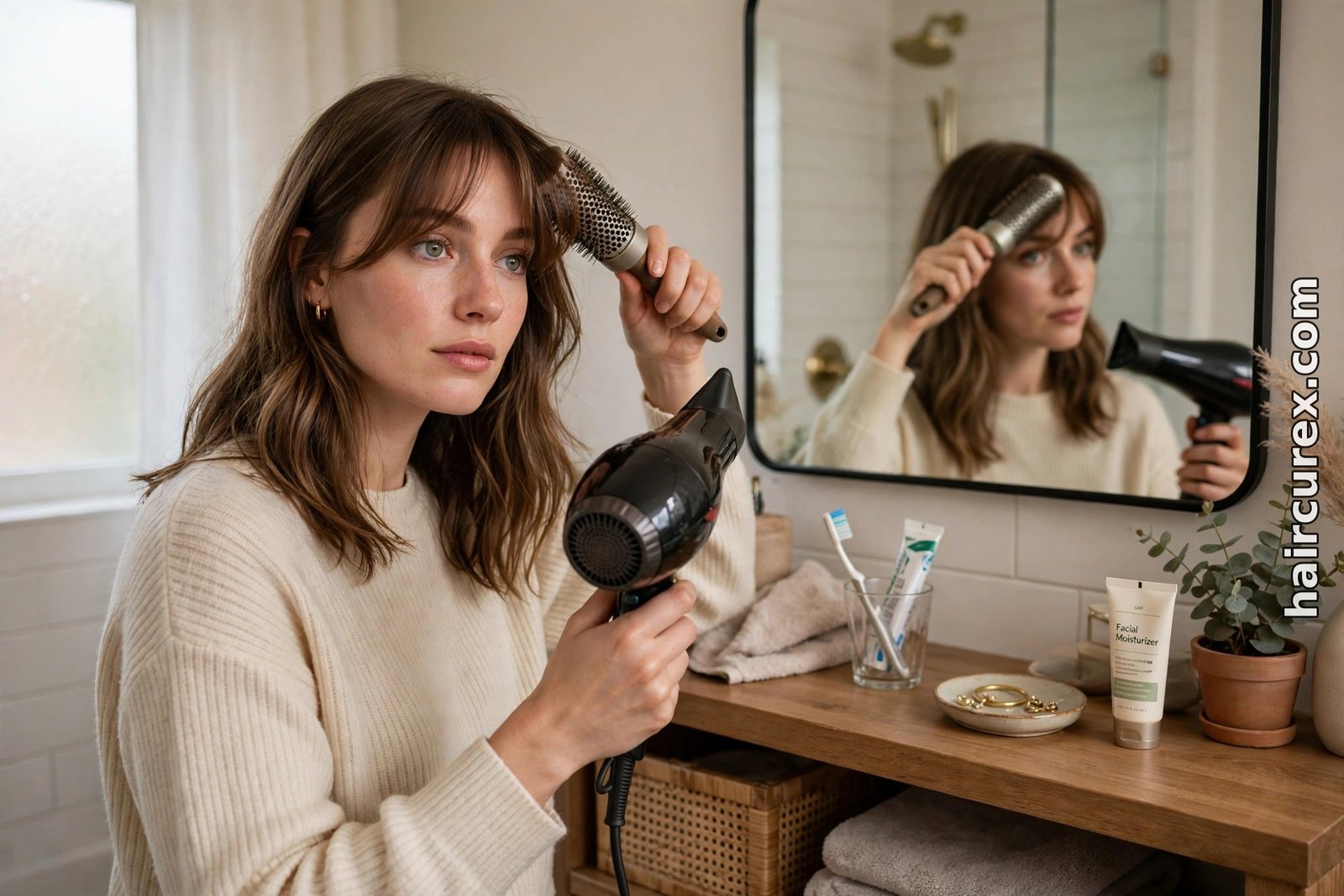
Start with damp hair: curtain bangs style best when they are slightly wet, not soaking and not fully dry. Work a small amount of heat protectant through the fringe, then part it where you want it to fall. For the classic blowout, use a medium round brush and a dryer with a nozzle: roll each side away from the face, directing the airflow down the hair shaft, and let the section cool on the brush for a few seconds before releasing it — cooling is what sets the sweep. Finish with a light mist of flexible-hold hairspray, not a stiff one; the look should move.
For a no-heat version, apply a little mousse or texturising spray to damp bangs, part them, and either let them air-dry or tuck each side loosely behind the ears while wet so they dry blended into the next layer. A flat iron can add soft waves: clamp near the root, twist gently away from the face, and glide to the ends, then brush through with your fingers. Between washes, bangs get oily faster than the rest of your hair because they sit on your forehead — a puff of dry shampoo at the roots, or a quick rinse of just the fringe in the sink, revives them without a full wash. Avoid touching them constantly and keep heavy creams and oils off the fringe, since both flatten the sweep and add grease.
| Method | Best for | Key tip |
|---|---|---|
| Round-brush blow-dry | Classic bouncy sweep, straight and wavy hair | Cool on the brush before releasing |
| Air-dry with mousse | Wavy and curly hair, low effort | Part while damp, do not over-touch while drying |
| Flat-iron twist | Polished waves, straight hair | Twist away from the face, brush through with fingers |
| Tuck behind ears while wet | Growing out, or a soft no-heat day | Tuck while wet so bangs dry blended into layers |
Trimming and Maintaining Curtain Bangs
Curtain bangs are low-maintenance compared with a blunt fringe, but they are not no-maintenance. Plan a trim every 3–4 weeks if you want to hold the shape, and every 6 weeks or longer if you are deliberately growing them out, since the tapered shape forgives extra length. A fringe trim is usually quick and often cheaper than a full cut — ask your salon about a bang-trim service between full appointments.
If you trim at home, go slowly and use proper hair scissors, never household scissors, which crush the hair and cause split ends. Trim dry, in small snips, cutting vertically into the ends (point-cutting) rather than straight across, and always cut less than you think you need — you can take more off, but you cannot put it back. Stop and check the part and both sides in the mirror after every few snips. If the fringe has gone very uneven or too short, a salon tidy-up is worth it rather than chasing the shape shorter at home. Keep the ends healthy between trims: split ends travel up the hair shaft, so the advice in our split ends guide — regular trims, heat protectant, gentle brushing — applies doubly to a fringe, where damage shows first.
How to Grow Out Curtain Bangs
Growing out curtain bangs is one of the easiest grow-outs in hairdressing, because the cut is already tapered. There is no single blunt edge to wait out; instead, the shortest centre pieces gradually catch up with the side pieces, and the whole fringe melts into face-framing layers. Most people reach a comfortable layered look in 3–6 months, depending on starting length and growth rate, and the in-between stages are easy to style.
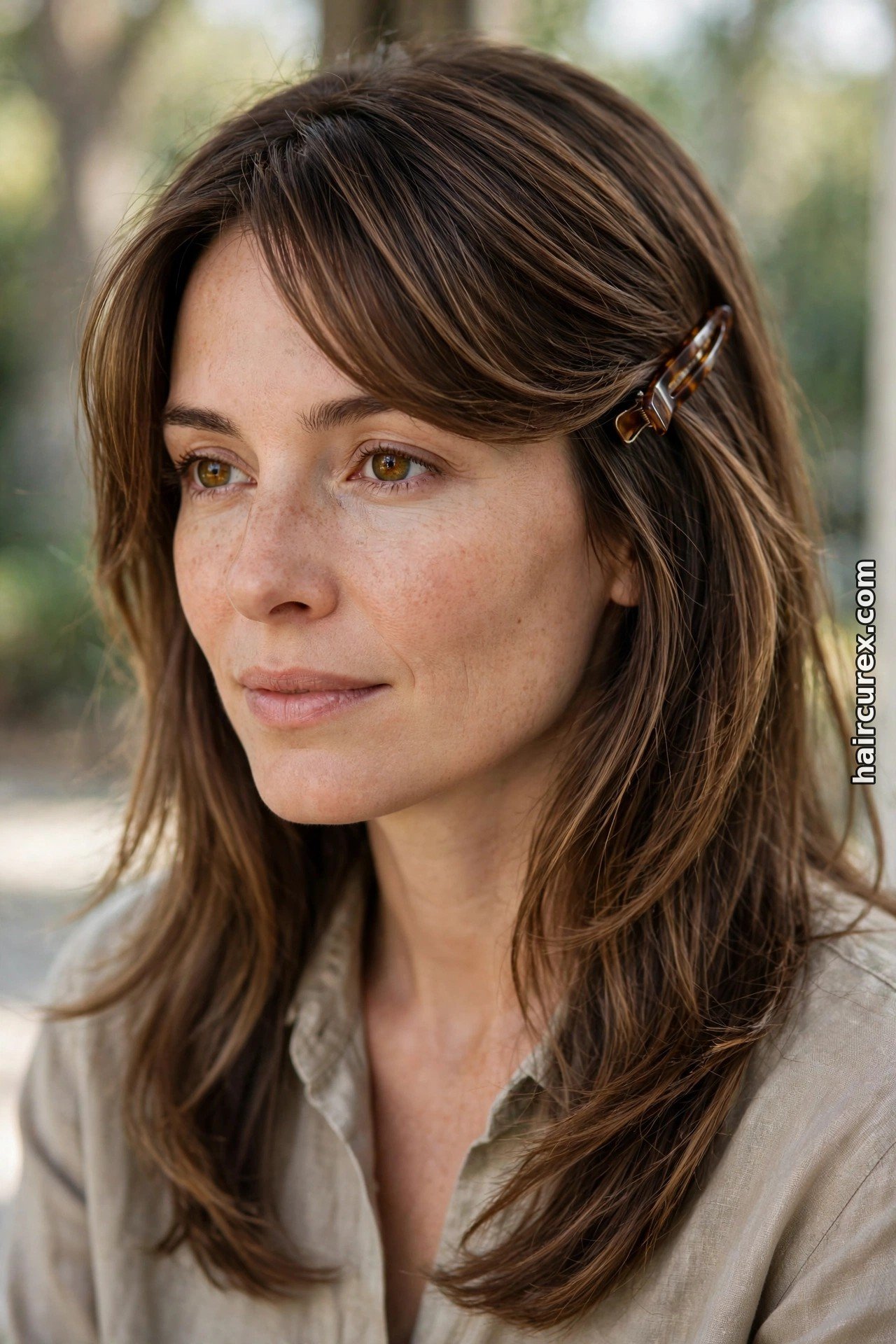
In the first few weeks, when the centre pieces start falling into your eyes, sweep them to the sides and pin them loosely at the temples with small clips, or tuck them behind your ears while wet so they dry out of the way. At the awkward middle stage, a side part helps: sweeping the whole fringe to one side turns it into a side-swept bang, which looks deliberate. A light styling cream smoothed over the sides tames flyaways without weighing the fringe down. By the time the bangs reach chin length, they are simply layers — ask your stylist to blend them into your haircut at your next appointment rather than cutting them back, and the grow-out is complete.
| Grow-out stage | What it looks like | Best styling fix |
|---|---|---|
| Weeks 1–4 | Centre pieces falling into eyes | Sweep to sides, pin at temples, tuck behind ears while wet |
| Months 2–3 | Uneven lengths, middle stage | Switch to a side part, use light styling cream on flyaways |
| Months 4–6 | Chin-length pieces | Blend into face-framing layers at your next cut |
Mistakes to Avoid With Curtain Bangs
The most common mistake is cutting them too short on the first visit. Start long — a stylist can remove length in minutes, but regrowing a too-short fringe takes months. The second is cutting a thick, blunt block and calling it a curtain fringe: the whole point is feathered, tapered ends that blend, so insist on softness if the section starts looking heavy. The third is ignoring your natural part and cowlicks: a strong cowlick at the hairline will fight a centre part every morning, so work with the growth pattern or choose a slightly off-centre part that cooperates with it.
Styling mistakes are just as fixable. Too much product makes bangs greasy and flat fast — start with a pea-sized amount and add only if needed. Skipping heat protectant before the dryer or flat iron dries out the finest, most visible hair on your head. And styling from fully dry hair rarely works: rewet the fringe lightly before restyling in the morning, since bangs set overnight in whatever shape they slept in. If you are unsure whether curtain bangs suit your face at all, our guide to which hairstyle suits you walks through face-shape measuring step by step before you commit.
Frequently Asked Questions About Curtain Bangs
Do curtain bangs suit everyone?
They suit most people, because the tapered, face-framing shape adapts to different face shapes and hair textures. The adjustment is in length and part: longer pieces and a deeper part for round faces, softer wispy ends for square faces, and extra length left in for curly hair to allow for shrinkage.
How often should I trim curtain bangs?
Every 3–4 weeks to hold the shape, or every 6 weeks or longer if you are growing them out, since the tapered shape blends naturally as it lengthens.
Can I style curtain bangs without heat?
Yes. Part them while damp, apply a little mousse or texturising spray, and let them air-dry — or tuck each side behind your ears while wet so they dry swept back and blended into your layers.
Do curtain bangs work on curly hair?
Yes, when they are cut to follow the curl pattern, ideally dry or curl by curl, with the centre kept soft and the sides a little longer so the fringe does not spring into a triangle shape.
How long does it take to grow out curtain bangs?
Most people reach a comfortable face-framing layer stage in 3–6 months. Because the cut is already tapered, the grow-out has no harsh blunt stage — the fringe simply becomes layers.
What should I ask my stylist for?
Ask for soft, face-framing curtain bangs, shortest around the nose or cheekbones and lengthening towards the jaw, with feathered ends that blend into your layers. Bring reference photos, start longer than you think, and mention your natural part and styling routine.