

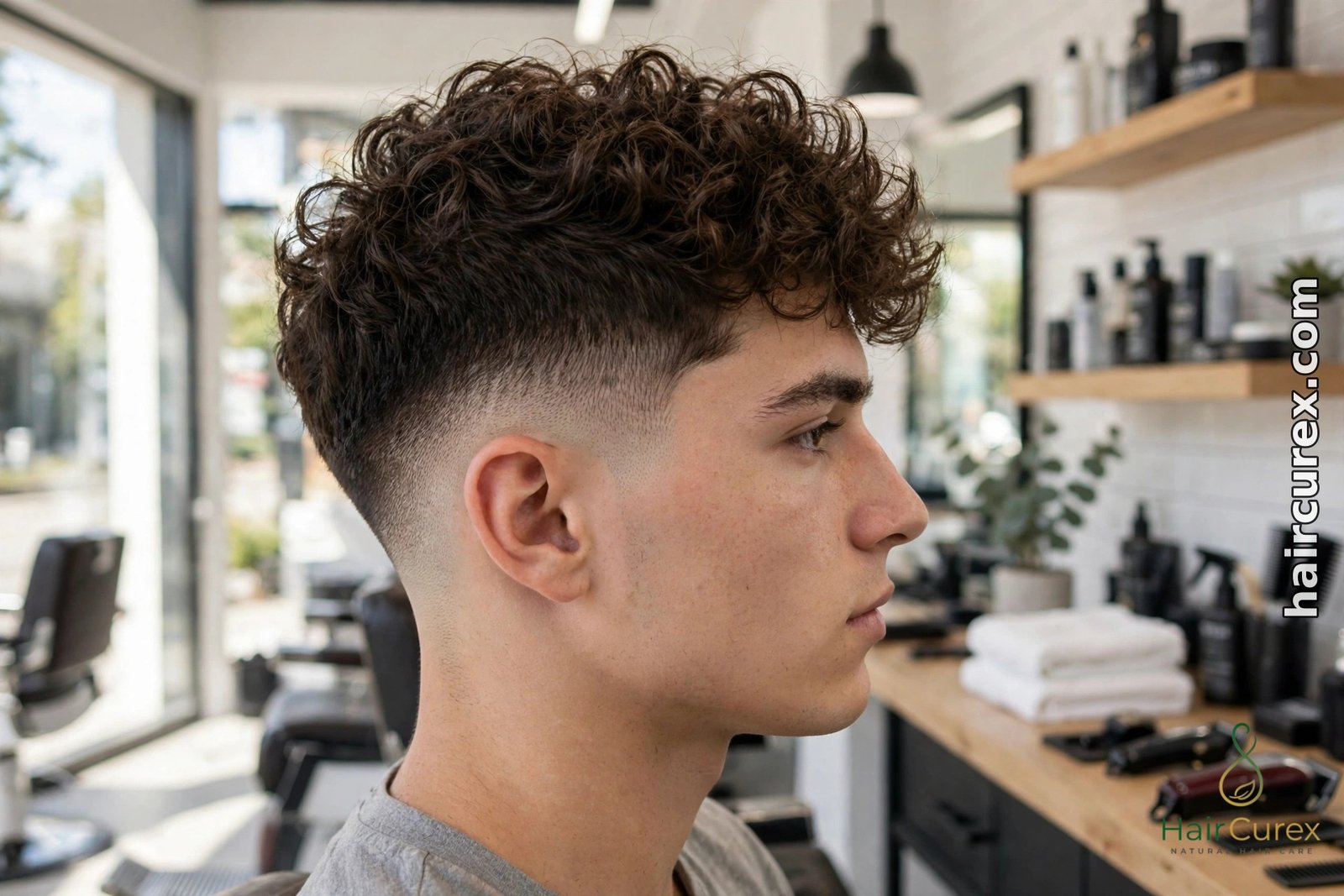
Quick answer: A low taper fade for curly hair keeps your curls on top and gradually shortens the hair low around the sideburns, over the ears and down the nape — nothing higher. Ask your barber for it in five parts: keep the taper low, say how much side length stays above it, name the shortest finish at the bottom (skin, a zero or a #1), choose a tapered or natural neckline, and describe the top separately. Bring side and back photos of someone with your curl type, because a photo removes more guesswork than any guard number. Expect to book a touch-up every 3 to 4 weeks, and the cut to cost roughly $30 to $60 at most U.S. barbershops.
Curly hair and fades are a tricky combination, and that is exactly why the low taper fade has become the go-to cut for curly-haired men. A regular fade climbs high up the side of the head, which on curly hair can leave a puffy, uneven band where the short sides meet the long curls — and once the curls grow out, the shape falls apart fast. A low taper fade for curly hair avoids that problem. It only tightens the edges, right where the hair meets the skin, and leaves everything above it alone. The result looks clean from the side and back, keeps the volume and shape of your curls on top, and grows out far more gracefully than a high fade. This guide to the low taper fade for curly hair explains what the cut actually is, which curl types it suits, the exact words to use in the chair, how to style it at home, and the mistakes that turn a good idea into a bad haircut.
What Is a Low Taper Fade for Curly Hair?

A low taper fade for curly hair is a haircut where the hair on top stays curly and full, while the hair at the edges — the sideburns, the arc around the ear and the nape of the neck — gradually gets shorter as it moves down toward the skin. The word “low” is the key: the shortest part of the blend sits low on the head, just above the ear and at the back of the neck, and the fade zone is short, usually only an inch to an inch and a half of travel. Above that zone, the sides stay at whatever length they already were, so the curls keep their shape and the cut does not eat into the volume on top.
That low placement is what makes a low taper fade for curly hair work so well with curls. Curly hair has volume by nature — it springs outward as it grows, and the sides of a curly head are often the widest part of the silhouette. A high fade removes that width aggressively, which can leave the head looking narrow at the sides and heavy on top, and the line where the fade meets the curls is hard to blend because curly hair does not lie flat.
A low taper fade sidesteps all of that: it only cleans up the perimeter, so the curls above it keep their natural shape, and the short blend zone is small enough that the barber can make it smooth without fighting the curl pattern. The cut works on most curl types, from loose waves to tight coils, because the taper of a low taper fade for curly hair is done on the shortest hair at the edges, where the curl pattern matters least.
It is worth being clear about what the cut does not do. A low taper fade for curly hair does not define your curls, does not make your hair curlier, and does not fix an uneven curl pattern — the curls on top are shaped by the cut up there, not by the fade at the edges. It also does not solve frizz or dryness on its own; those are care and styling issues, and the fade only frames the curls you already have. What a low taper fade for curly hair does do is give curly hair a clean, intentional outline, so the curls look styled rather than overgrown.
A detailed guide to the cut’s four decisions — placement, retained side length, shortest finish and neckline — is available from Taper Fade Trends: Low Taper Fade: The 4 Choices and What to Tell Your Barber.
Low Taper Fade vs Low Fade vs Mid Fade
Barbers use “taper”, “fade”, “low”, “mid” and “high” loosely, and two barbers can hear the same words and cut two different haircuts. Knowing the differences before you sit down is the cheapest insurance against a surprise. A taper only shortens the edges — the sideburns, around the ear and the nape — and leaves the side panel above it at full length. A fade takes the sides down further and blends them through a longer gradient, so more of the side of the head is short. The height — low, mid or high — says where the blend starts. Put together, a low taper fade for curly hair is the most conservative option of the three: the shortest work sits low, the blend zone is short, and most of the side stays full.
| Cut | Where the blend sits | How much of the side is short | Best for curly hair when… |
|---|---|---|---|
| Low taper fade | Just above the ear, sideburns and nape | Only the bottom inch or so | You want to keep volume and curl shape on top |
| Low fade | About an inch above the ear | A short gradient up the lower side | You want a slightly sharper, more visible fade |
| Mid fade | Midway up the side, above the temple | Half the side of the head | Your curls are short on top and you want contrast |
| High fade | Near the top of the head | Most of the side | Usually too aggressive for longer curls — the curl-to-fade line is hard to blend |
If you are unsure which one you want, a low taper fade for curly hair is the safe first step. It is the easiest to grow out, the easiest to fix if you do not like it, and the easiest to turn into a low fade or mid fade at your next visit if you decide you want more contrast. The reverse is not true: a mid fade cannot be undone until the hair grows back. Tell your barber “low taper — keep the short work at the sideburns and the neckline, do not take the sides down” and you have removed most of the ambiguity in one sentence.
Which Curl Types Suit a Low Taper Fade Best?
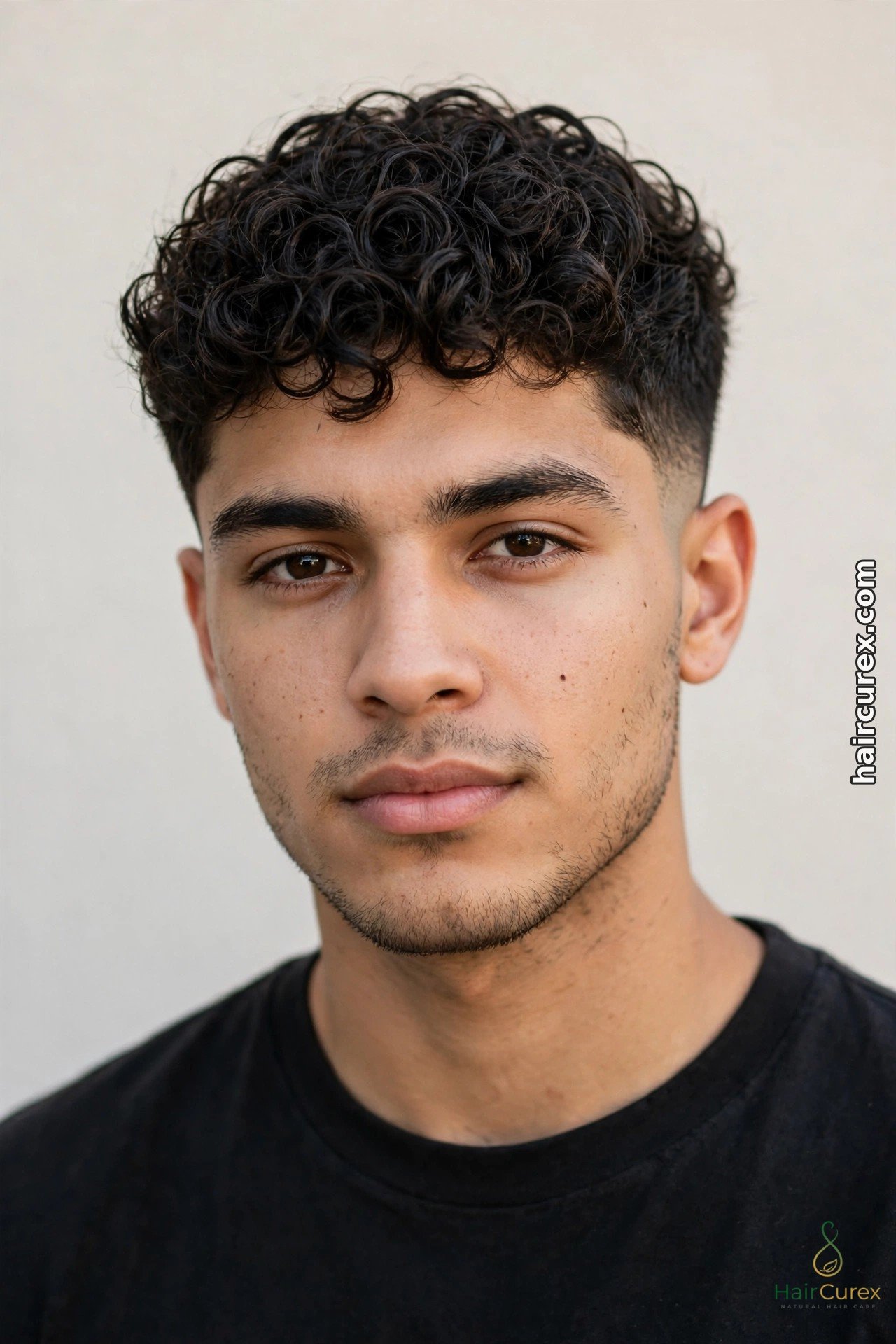
A low taper fade for curly hair works across the curl spectrum, but it flatters each curl type in a slightly different way, and knowing your type helps you describe the top. Loose waves (2A to 2C) get the cleanest result: the taper frames the waves without fighting them, and the top can be worn swept back, pushed forward or parted.
Classic curls (3A to 3C) are the sweet spot for this cut — the curls have enough definition to hold a shape on top, and the low taper keeps the sides from puffing out as the curls grow. Tight curls and coils (4A to 4C) also work well, though the taper of a low taper fade for curly hair needs a barber who is comfortable cutting coily hair: the fade at the edges is done with clippers on very short hair, so the curl pattern matters less there, but the top needs to be shaped with the coil pattern in mind, not cut the same way as straight hair.
Density matters as much as curl type. Very thick, dense curly hair grows outward as well as downward, so the sides can look wide within two weeks of a cut — a low taper fade for curly hair handles this better than a longer style because the edges stay tight, but you may need touch-ups on the shorter end of the range. Fine curly hair is the opposite: the taper of a low taper fade for curly hair can make the sides look thin if the barber takes the bottom too short, so a #1 or #2 finish at the bottom is usually safer than skin for fine hair. If your curls are different lengths or looser at the front than at the back — which is common — say so before the cut starts, because the barber will shape the top differently to even the silhouette out.
Hair length on top is your other decision, and it is separate from the taper. Short curls (1 to 2 inches on top) with a low taper fade for curly hair give a neat, low-maintenance look that dries fast and needs little product. Medium curls (2 to 4 inches) are the most versatile: you can wear them forward as a textured fringe, pushed up, or to the side, and the taper keeps the outline tidy.
Longer curls (4 inches and up) with a low taper fade for curly hair look great, but the contrast between the long top and the short edges is strong, so the top needs regular shaping or the silhouette goes top-heavy. If you are growing your curls out, the low taper fade is the best cut to grow through — it keeps the edges clean while the top gains length, which is the stage where most curly cuts look untidy.
What to Ask Your Barber: The Exact Script

Most bad taper fades are not bad barbering — they are bad briefs, and that is doubly true for a low taper fade for curly hair. “Low taper fade, not too short” can mean five different haircuts, because every word in it is vague. Barbers think from the bottom up and from the outside in, so give them the information in that order: how high the taper sits, how short the bottom goes, what stays on the sides above it, what happens on top, and how the edges finish. Say all five and there is almost nothing left to guess.
1. Fade height — say “low” and point. “I want a low taper fade. Start it around the top of my ear, and a bit lower at the back.” Point with your finger to the line where you want the shortest part to stop. Pointing is faster and clearer than describing, and it works even if you and your barber use the words differently.
2. How short at the bottom — pick one finish. Choose one: “Take it down to skin right at the edge” for the sharpest finish; “Keep the bottom at a zero, no skin” for a soft shadow; or “Keep it at a #1 at the bottom, I want it subtle.” If you have a sensitive scalp, thin hair or a conservative workplace, the zero or #1 is the safer choice. A #1 leaves about 1/8 inch (3 mm) and a #2 leaves 1/4 inch (6 mm) on standard clipper guards.
3. The sides above the taper — protect your curls. “Above the taper, keep the sides full — scissors on the sides, do not take them down with the clippers.” This is the sentence that stops a low taper turning into a low fade. If you do want the sides shorter, name the guard: “Take the sides to a #3 above the taper.” Without that sentence, the barber has to guess, and the guess usually takes more hair off than you wanted.
4. The top — length and shape, separately. The taper says nothing about the top, so describe it on its own: “Leave about three inches on top and keep my curls — just shape them and take off about half an inch.” Or: “Leave the top as it is, just clean up the shape.” Name the finish too: textured, pushed forward, or parted to the side. If you want the curls defined rather than thinned out, say “do not thin the top” — thinning shears on curly hair can create frizz and uneven curl clumps.
5. The edges — neckline and sideburns. “Tapered neckline, please, not blocked.” A blocked neckline is squared off with a straight edge and grows into a visible shelf within about ten days; a tapered neckline fades out and stays clean for weeks. For sideburns, say “keep my sideburns natural” or “cut them to the middle of the ear” — otherwise they may be blended away entirely.
Put together, the sentence most barbers want to hear is: “Low taper fade for curly hair, starting at the top of my ear and lower at the back. Down to a zero at the bottom, with just the edge cleaned with the trimmer. Sides stay full above it — scissors only. Leave about three inches on top, keep the curls, just shape them. Tapered neckline, natural sideburns.”
Bring two or three photos as well: one from the side and one from the back, of someone with a curl type close to yours. Show the photo first, then explain what you like about it. A photo cannot show the guard or blade used, so ask for the look, not a number read off a picture. And when a cut works, ask the barber what they used and save it on your phone — that note is what makes the next visit effortless.
One more thing to ask before the clippers start: whether your barber is comfortable cutting curly hair. Not every barber is. If they cut your curls dry, ask them to wet them first or cut them in their natural curl pattern — cutting curls the way you would cut straight hair is how you get uneven lengths once the hair dries and springs up. Our guide to trimming curls at home covers the same principle from the other side of the chair, and it is worth reading before you book: how to trim curly hair at home.
How to Style a Low Taper Fade for Curly Hair

Styling a low taper fade for curly hair is simple, because the cut does most of the work: the taper keeps the outline tidy, so your job is only to define the curls on top. Start with damp, not dripping, hair — after a shower, squeeze out the excess water with a microfibre towel or an old T-shirt, never a rough bath towel, which roughens the cuticle and creates frizz. Work a curl cream or leave-in conditioner through the top with your fingers, raking it from roots to ends, then scrunch gently upward to encourage the curl pattern.
A pea-sized amount of curl cream is enough for short curls; medium to long curls need a little more, but start small — too much product weighs curls down and makes them look greasy rather than defined. Our roundup of curl creams explains which formulas suit wavy and curly hair and how much to use: best curl cream for wavy hair.
How you dry it decides how it looks. Air-drying gives the softest, most natural curl, and it is the best option if you have time. If you use a hairdryer, use a diffuser on low heat and low speed, and dry the roots first — that is where the volume comes from — then the lengths. Do not touch the curls while they dry: every touch breaks up the curl clumps and adds frizz. Once the hair is fully dry, you can break the cast of any gel or cream by scrunching gently with your hands, and if a few curls need help, twist them around your finger while they are still slightly damp. For a fuller wash-day routine, our step-by-step curly hair routine covers the order — cleanse, condition, leave-in, cream, gel — and why the order matters.
Between washes, the taper is what keeps the cut looking fresh, and the top is what needs the least work. On non-wash days, refresh the curls with a light mist of water and a tiny amount of leave-in conditioner, then scrunch — do not re-wet the whole head, or the curls will go limp.
Sleep on a silk or satin pillowcase, or in a loose pineapple ponytail, so the curls on top do not flatten overnight and the tapered edges do not get roughed up. And keep the product off the faded areas: curl cream and gel on very short hair at the sides can build up and make the taper look dull, so apply product to the top only.
If your hair feels dry overall, a basic hair care routine for beginners — gentle shampoo, conditioner every wash, a weekly mask — will do more for the health of your curls than any styling product. The American Academy of Dermatology’s healthy-hair guidance covers the same basics — gentle washing, minimal heat and careful handling of wet hair: American Academy of Dermatology healthy hair tips.
How Long It Lasts, What It Costs and When to Go Back
A low taper fade for curly hair holds its shape for about 3 to 4 weeks, which is longer than most fades. The reason is the low placement: the blend zone is small and the taper is gradual, so grow-out shows slowly — the neckline is usually the first thing to look untidy, and the sides stay presentable for weeks after a mid or high fade would already look grown out.
Tight curls and dense hair grow out faster and may need a touch-up at 3 weeks; loose waves and fine hair can often stretch to 4 or even 5 weeks. The sign it is time to go back is not the calendar, it is the mirror: when the taper at the nape starts to look fuzzy, or the curls above the taper start to stick out sideways, book the next cut.
Cost varies by city and by shop, but as a typical U.S. range, a low taper fade for curly hair costs about $30 to $60 at most barbershops, with premium shops in big cities charging $60 to $90. A taper-only touch-up between full cuts — just the edges and the neckline, no work on top — is often cheaper, around $15 to $25, and it is the smart way to stretch a cut: get the full cut every 4 weeks and a taper tidy-up at 2 weeks if the neckline bothers you. Ask your barber what they charge for a neckline cleanup when you are in the chair — most shops offer it, but few advertise it.
Between visits, resist the urge to clean up the taper of a low taper fade for curly hair yourself unless you know what you are doing. The nape and the area behind the ears are hard to see and easy to ruin, and one wrong pass with clippers can take the taper too high — a mistake that takes weeks to grow out. If you do touch it up, use a trimmer with a guard, work in small passes, and stop the moment the line looks clean. Otherwise, leave it to the barber: a 10-minute tidy-up is cheap, and it protects a low taper fade for curly hair you paid good money for.
Mistakes That Ruin a Low Taper Fade
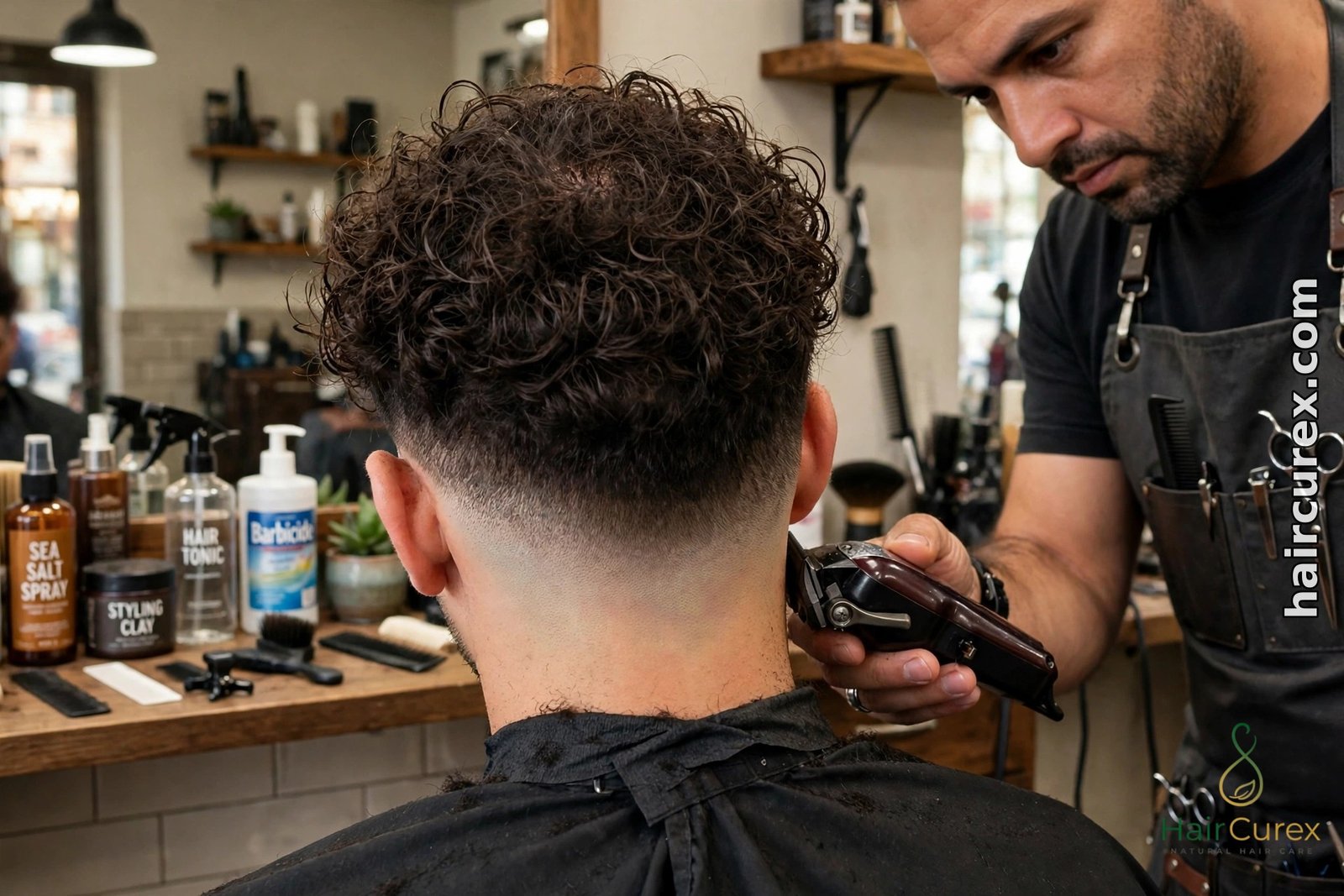
The most common mistake with a low taper fade for curly hair is letting the taper climb too high. The moment the shortest work rises above the top of the ear, you no longer have a low taper fade — you have a mid fade, and on curly hair that usually means a visible line where the short sides meet the curls, plus a puffy band as the curls grow. The fix is the pointing sentence from the script above: show the barber the line with your finger before the clippers start, and check in the mirror after the first side is done, not after both.
The second mistake with a low taper fade for curly hair is taking the bottom too short for your hair. Skin at the bottom looks sharp on thick, dark hair, but on fine or light curly hair it can look patchy, and on a sensitive scalp it can irritate. If you are trying a low taper fade for curly hair for the first time, a zero or a #1 at the bottom is the safer finish — you can always go shorter next time, but you cannot put hair back.
The third mistake with a low taper fade for curly hair is thinning the top. Thinning shears remove bulk, but on curly hair they cut some strands shorter than others inside the same curl clump, which makes the curls spring up unevenly and frizz. If your curls feel heavy, the answer is usually shaping — removing length from the right places — not thinning. Tell the barber “no thinning shears on top” if you have been burned by this before.
The fourth mistake with a low taper fade for curly hair is skipping the photos. Barbers see dozens of heads a day, and your description of “a low taper, like the guy on Instagram” means nothing without a picture. Bring side and back photos of someone with your curl type, and tell the barber what you like about the photo — the height of the taper, the length on top, the neckline — so they know which part of the picture to copy.
The fifth mistake with a low taper fade for curly hair is treating the fade and the curls as one job. They are two separate decisions: the taper controls the edges, the top controls the curls. If you only say “low taper fade” and nothing about the top, the barber has to invent the top — and their invention may not be yours. Describe the top in inches and in shape, every single time. And the sixth mistake is waiting too long between cuts. A low taper fade for curly hair forgives grow-out better than most fades, but after 5 or 6 weeks the shape is gone, and the barber has to rebuild the cut instead of maintaining it — which costs more time, more hair, and more money. Book the next cut before you leave the shop.
A low taper fade for curly hair is one of the easiest good haircuts to get, as long as you ask for it properly. Keep the taper low, name the finish at the bottom, protect the sides above it, describe the top separately, and choose a tapered neckline. Bring photos, point at the line, and save the details when the cut works. Do that and the curls on top will look intentional instead of accidental, the edges will stay clean for weeks, and the next visit will take five minutes of explaining instead of fifteen.
If you are weighing it against a longer, wilder curly style, our wolf cut for men guide shows the other end of the curly spectrum — long, layered and deliberately messy — so you can pick the look that fits the way you actually live.
Low Taper Fade for Curly Hair FAQs
How do I ask my barber for a low taper fade for curly hair?
Ask in five parts: “Low taper fade, starting at the top of my ear and lower at the back. Down to a zero at the bottom. Sides stay full above it — scissors only. Leave about three inches on top, keep the curls, just shape them. Tapered neckline, natural sideburns.” Bring side and back photos of someone with your curl type, and point to the line where the taper should stop.
Is a low taper fade good for curly hair?
Yes — it is one of the best fade options for curly hair. It only tightens the edges at the sideburns, around the ears and at the nape, so the curls on top keep their volume and shape. It also grows out more gracefully than a mid or high fade, because the blend zone is small and the taper is gradual.
What guard should I ask for with a low taper fade?
There is no single right guard — it depends on your hair. A common starting point is a zero at the very bottom, blending up through a #1 and a #2, with the sides above the taper left at scissors length or a #3. For fine hair, ask for a #1 at the bottom instead of skin. Tell the barber the look you want and let them choose the guards; the photo matters more than the number.
How often should I get a low taper fade touched up?
Every 3 to 4 weeks for a full cut. Tight curls and dense hair may need a touch-up at 3 weeks, while loose waves and fine hair can often stretch to 4 or 5 weeks. A cheaper taper-only tidy-up of the edges and neckline at 2 weeks can stretch a full cut further.
Will a low taper fade make my curls look thinner?
No, if it is cut correctly — the taper only affects the short hair at the edges, and the curls on top are untouched. But if the barber thins the top with thinning shears or takes the sides too high, the curls can look thinner and frizzier. Say “no thinning shears on top” and “keep the taper low” to prevent both problems.
What is the difference between a low taper fade and a low fade?
A low taper fade only shortens the edges — the sideburns, around the ear and the nape — and leaves the side panel above it at full length. A low fade blends a short gradient up the lower side of the head, so more of the side is short. The low taper is the more conservative, easier-to-grow-out option; the low fade looks slightly sharper.