


Quick answer: A wavy hair routine that actually works is simple: wash with a sulfate-free shampoo, condition only the lengths, detangle with your fingers or a wide-tooth comb, apply a pea-sized amount of leave-in and a light curl cream, scrunch, then air-dry or diffuse on low heat. The whole wash day takes about 20 minutes, and the waves last two to three days with a refresh on day two. Wavy hair needs less product and less washing than curly hair — heavy creams and daily washing are the two things that flatten waves fastest.
Wavy hair is the most misunderstood hair type. It is not straight enough to behave like straight hair, and not curly enough to follow a curly hair routine — so most wavy-haired people end up doing one of two things wrong: treating it like straight hair and brushing the waves out, or treating it like curly hair and weighing it down with heavy products meant for tight curls. A good wavy hair routine sits in the middle: gentle washing, light moisture, and a little encouragement for the wave pattern instead of a fight against it.
This guide is a complete wash-day routine for wavy hair, from the shower to the second-day refresh. It works for 2A, 2B and 2C waves, and it is built on one principle — do less, but do it right.
First, Know Your Wave Type: 2A, 2B or 2C
Before you pick products, know which kind of waves you have, because the routine changes with the wave. Type 2A hair is fine, almost straight, with a gentle S-shape that starts around mid-length — it is the easiest to weigh down and the hardest to keep wavy, so it needs the lightest products. Type 2B has a more obvious S-wave from the roots, with a little frizz at the crown, and holds a wave well once it is encouraged. Type 2C has strong, defined waves that almost look curly, with more volume and more frizz — it can handle slightly richer products than 2A or 2B. If you are not sure which type you are, our guide to curly hair types, 2A to 4C explained walks through each one with photos and care notes, and the 2A, 2B and 2C guides on this site cover each type in detail.
One thing all three types share: wavy hair is usually finer and flatter at the roots than curly hair, and it loses its wave pattern easily. That is why the routine below is deliberately light — every step is designed to add definition without adding weight.
The Simple Wavy Hair Routine: Wash Day in 5 Steps
Here is the whole routine in one place. The sections below explain each step in detail, but if you want the short version, this is it: wash, condition, detangle, style, dry. Twenty minutes, four products at most, and no step you can skip without the waves noticing.
Step 1: Wash — Less Shampoo Than You Think
Start by wetting your hair fully with lukewarm water — hot water strips natural oils and makes wavy hair frizzier, while cold water does not rinse shampoo out properly. Use a sulfate-free shampoo, about a coin-sized amount, and massage it into your scalp with your fingertips, not your nails. The scalp is the only place that needs shampoo; the lengths get clean enough from the shampoo running down as you rinse.
How often should you wash wavy hair? Most wavy hair does best washed two to three times a week. Washing every day strips the oils that give waves their shape and shine, and the waves go limp. If your scalp gets oily between washes, a dry shampoo at the roots on day two or three is a better fix than another wash. If your scalp feels itchy or flaky, wash more often — scalp health comes first, and you can always refresh the waves after. Rinse the shampoo out completely: leftover shampoo residue is one of the most common reasons waves look dull and feel coated.

Step 2: Condition — Lengths Only, and Rinse It Out
Apply a lightweight conditioner from mid-length to the ends — never on the roots, where it flattens waves and makes hair look greasy by lunchtime. Leave it in for two to three minutes while you finish the rest of your shower, then rinse it out thoroughly with lukewarm water. Wavy hair that is over-conditioned goes stringy and straight; wavy hair that is under-conditioned goes frizzy. The sweet spot is a conditioner that leaves the hair feeling smooth but not slippery when wet.
Once a week, or once every two weeks if your hair is fine, swap the regular conditioner for a hair mask — but use half the amount you think you need, and rinse it out fully. Our guide to how to choose and use a hair mask for your hair type explains which masks suit wavy hair and which ones are too heavy. A deep treatment is not a daily step, and for 2A hair it may only be needed once a month.
Step 3: Detangle Gently While the Hair Is Wet
Detangle wavy hair while it is still wet and full of conditioner, never when it is dry. Dry detangling pulls the wave pattern apart and turns it into frizz. Use your fingers first to work through any knots, then a wide-tooth comb if you need it, starting from the ends and working up to the roots. Never use a fine-tooth comb or a brush on wet wavy hair — both break the wave clumps and create the puffy, undefined look most wavy-haired people are trying to avoid.
After rinsing, do not rub your hair with a towel. Rubbing roughs up the cuticle and creates frizz before you have even started styling. Instead, squeeze the water out gently with your hands, then wrap your hair in a microfiber towel or an old cotton T-shirt for five to ten minutes. A regular bath towel is too rough for wavy hair; the microfiber or T-shirt absorbs water without disturbing the wave pattern.
What Products Does Wavy Hair Actually Need?
Wavy hair needs fewer products than the internet suggests. The essentials are four: a sulfate-free shampoo, a lightweight conditioner, a leave-in conditioner or light curl cream, and optionally a gel or mousse for hold. That is the whole shelf. Anything more is a styling choice, not a necessity.
The rule for choosing products is simple: if it feels heavy, greasy or coated on your hand, it will feel heavy, greasy or coated on your hair. Wavy hair is easily weighed down, so creams should be light, gels should be used in small amounts, and oils should be used only on the very ends — a drop or two, never a palmful. If you are choosing between a curl cream and a gel, the difference matters: cream gives softness and definition with light hold, gel gives stronger hold and more definition but can feel crunchy if you use too much. Our comparison of curl cream vs gel for wavy hair explains which one suits each wave type and how much to use.
| Product | How much to use | Where it goes | Skip it if… |
|---|---|---|---|
| Sulfate-free shampoo | Coin-sized amount | Scalp only | Your scalp is very oily — then wash more often instead |
| Lightweight conditioner | Coin-sized amount | Mid-lengths to ends | Your hair is very fine — use half as much |
| Leave-in conditioner | Pea-sized amount | Lengths, not roots | Your hair is 2A and already soft — cream alone may be enough |
| Curl cream or mousse | Pea to grape-sized | Lengths, scrunched in | You want a very natural, loose wave with no hold |
| Light-hold gel (optional) | Pea-sized amount | Lengths, scrunched in | Your hair is fine — gel can weigh 2A waves down |
| Hair mask | Half a palmful | Lengths, once a week | Your hair is fine and gets limp easily — once a month is enough |

Step 4: Scrunch — The Move That Makes the Waves
Scrunching is the single most important styling step in a wavy hair routine, and it is also the simplest. With your hair still damp, take a section in your open palm, push it up toward your scalp, and squeeze gently for a few seconds. Repeat all over your head, section by section. Scrunching pushes the hair into its natural S-shape and encourages the wave pattern to form instead of drying straight and flat.
Apply your styling products before you scrunch, not after. The order is: leave-in conditioner first, raked through the lengths with your fingers; then curl cream or mousse, scrunched in; then gel, if you use it, scrunched in last. Work in small amounts — you can always add more, but you cannot take product out without re-washing. Once you have scrunched, stop touching your hair. Every touch while it dries breaks up the wave clumps and adds frizz. This is the hardest part of the routine for most people, and it makes the biggest difference.

Step 5: Dry Without Frizz
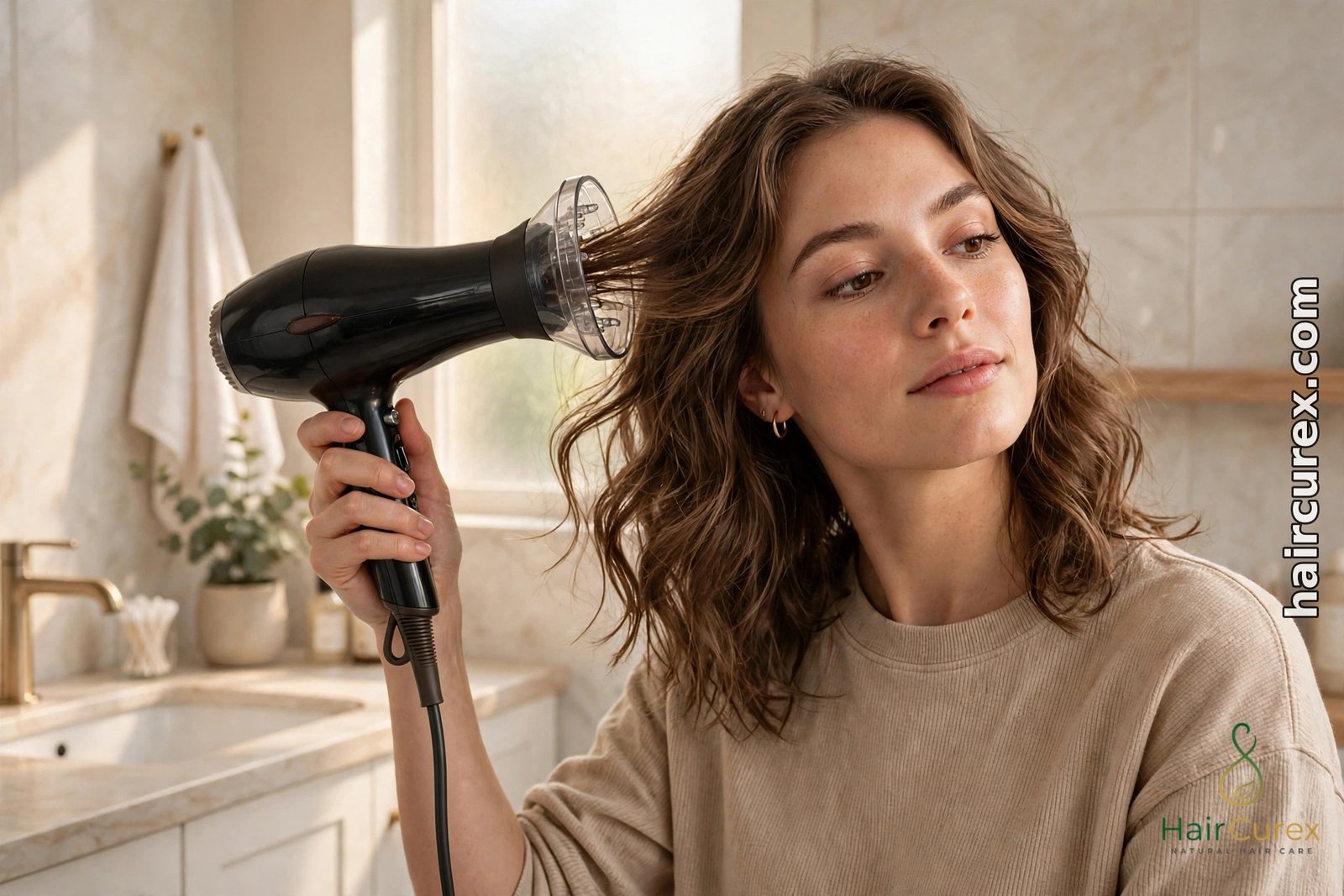
You have two good options for drying wavy hair: air-dry, or diffuse on low heat. Air-drying is the gentlest and the cheapest — just let the waves dry naturally, hands off, for about an hour. Diffusing is faster and gives more volume, but only if you do it right: use the lowest heat setting, keep the dryer moving, and cup the hair in the diffuser bowl rather than blasting it. High heat and a fast airflow are the two things that turn defined waves into frizz.
Never dry wavy hair with a regular hair dryer and no diffuser, and never brush it while it dries. If you use a diffuser, our guide to how to dry curly and wavy hair without frizz covers the technique in detail, including how long to hold each section and when to stop. Once the hair is completely dry — not 90 percent dry, completely dry — you can gently scrunch out any crunch from gel. If you break the gel cast while the hair is still damp, the waves go frizzy and will not recover until the next wash.
How to Make the Waves Last Until the Next Wash Day
Wash-day waves should last two to three days. The night routine decides whether they do. Before bed, gather your hair into a loose pineapple — a high, loose ponytail on top of your head with a silk or satin scrunchie — or braid it loosely. Sleep on a satin or silk pillowcase if you can; cotton pillowcases absorb moisture and create friction that flattens waves overnight. Our guide to how to sleep with curly and wavy hair covers night routines that protect your waves while you sleep.
On day two, refresh instead of re-washing. Lightly mist the hair with water from a spray bottle, scrunch in a pea-sized amount of leave-in conditioner or curl cream, and let it air-dry for ten minutes. That is usually enough to bring the waves back. If the roots look flat, flip your head upside down and shake the roots gently with your fingers. Dry shampoo at the roots on day three can extend the style one more day — spray it at the roots, wait two minutes, then massage it in with your fingertips.

Common Wavy Hair Routine Mistakes
Most wavy hair problems come from a short list of avoidable mistakes. Brushing dry wavy hair is the biggest one — a brush pulls the S-shape straight and turns waves into a frizzy triangle. If you need to detangle between washes, use your fingers on damp hair only. Using too much product is the second most common mistake: heavy creams, butters and oils are made for tight curls, not waves, and they flatten 2A and 2B hair within hours. If your waves look good right after styling and fall flat by midday, you are almost certainly using too much product.
Washing every day is the third mistake — it strips the oils that give waves shape, and the waves get limper the more you wash. Skipping conditioner is the fourth: wavy hair without conditioner is dry, frizzy hair, and no amount of styling product fixes that. And drying with a rough towel or a hot dryer without a diffuser is the fifth — both rough up the cuticle and create the frizz people blame on their hair type, when it is actually the drying method. Fix these five things and most wavy hair routines start working within two or three wash days.
What the Experts Say About Washing and Caring for Wavy Hair
The American Academy of Dermatology recommends washing curly and wavy hair less often than straight hair, using a gentle shampoo, conditioning the lengths, and handling wet hair carefully — because wavy hair is more fragile when wet and more prone to frizz when handled roughly. Their curly hair care guidance covers washing frequency, conditioning and styling in plain terms: American Academy of Dermatology, curly hair care. The same advice applies to the basics of healthy hair in general — limit heat styling, use the lowest heat setting that works, and be gentle with wet hair: American Academy of Dermatology, healthy hair tips.
One honest note: no routine, product or technique can change your wave type. A 2A wave will not become a 2C curl, and no cream will make straight hair wavy. What a good wavy hair routine does is bring out the wave pattern you already have — defined, frizz-free and consistent from wash day to wash day. That is the realistic goal, and it is achievable in about two weeks of following the routine consistently.
Wavy Hair Routine FAQs
How often should I wash wavy hair?
Most wavy hair does best washed two to three times a week. Washing every day strips the natural oils that give waves their shape, and the waves go limp. If your scalp gets oily between washes, use dry shampoo at the roots instead of washing again, and wash more often only if your scalp feels itchy or flaky.
What is the best routine for wavy hair?
The best wavy hair routine is simple: wash with a sulfate-free shampoo, condition only the lengths, detangle with your fingers or a wide-tooth comb while the hair is wet, apply a pea-sized amount of leave-in and a light curl cream, scrunch to encourage the waves, then air-dry or diffuse on low heat. The whole wash day takes about 20 minutes.
Should I brush wavy hair?
Do not brush wavy hair when it is dry — brushing pulls the wave pattern apart and creates frizz. Detangle only while the hair is wet and full of conditioner, using your fingers or a wide-tooth comb, starting from the ends and working up. Between washes, use your fingers on damp hair if you need to detangle.
Why does my wavy hair go flat?
Wavy hair usually goes flat for one of three reasons: too much product, washing too often, or brushing it dry. Heavy creams, butters and oils weigh waves down, daily washing strips the oils that give waves shape, and brushing pulls the S-shape straight. Use light products in small amounts, wash two to three times a week, and never brush dry wavy hair.
How do I make my wavy hair wavier?
Scrunching is the most effective way to make wavy hair wavier: with damp hair, push sections up toward your scalp and squeeze gently to encourage the S-shape, then do not touch the hair while it dries. A light curl cream or mousse scrunched in before drying helps, and diffusing on low heat adds more definition and volume than air-drying. Plopping — wrapping damp hair in a T-shirt for 10 to 20 minutes — can also boost the wave pattern.
Can I use curly hair products on wavy hair?
You can use curly hair products on wavy hair, but use less of them and choose the lightest formulas. Products made for tight curls are often too heavy for waves, especially 2A and 2B hair, and they flatten the wave pattern. Lightweight curl creams, mousses and leave-in conditioners work well; heavy butters, thick creams and oils usually do not.