

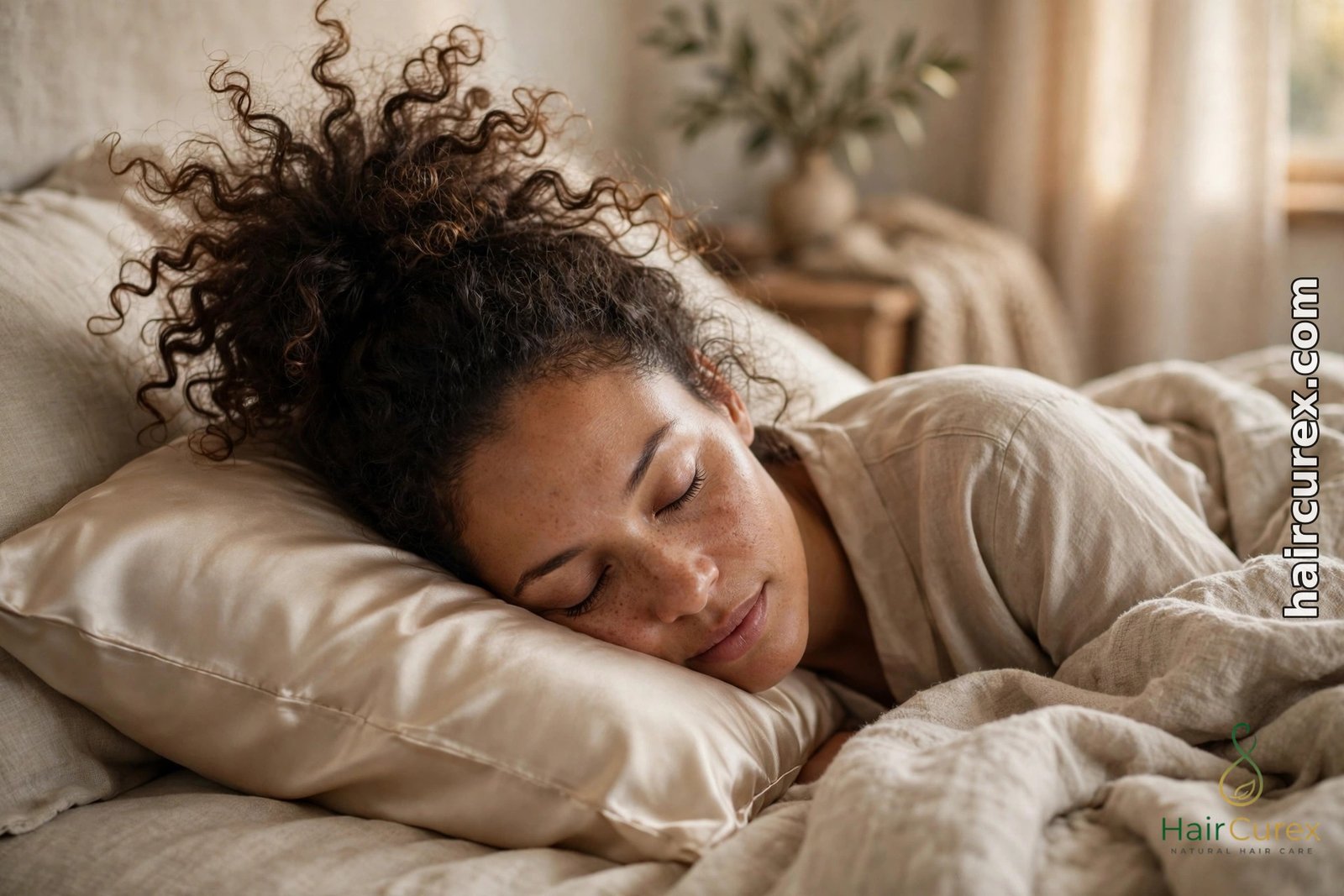
Quick answer: Learning how to sleep with curly hair comes down to two things: cutting friction and keeping your curls lifted off the pillow. A loose pineapple, a satin or silk pillowcase, or a satin bonnet will protect most curl patterns overnight. Add a little leave-in conditioner before bed, keep the style loose so it never pulls, and refresh with water and a light product in the morning. No single method works for everyone, so try two or three and keep the one that gives you the best second-day hair.
You wash, style, and diffuse your curls into perfect definition — then you go to sleep, and by morning half of them are flat, frizzy, or tangled into a knot at the nape of your neck. It is one of the most frustrating parts of having curly or wavy hair, and it is also one of the easiest to fix. Your hair does not lose its shape overnight because your curls are “difficult.” It loses shape because eight hours of tossing, turning, and pressing your head into a cotton pillowcase creates friction, absorbs moisture, and crushes the curl pattern flat.
The good news is that a small change to your night routine can save you most of your morning styling time. This guide walks through seven proven night routines for curly and wavy hair, how to choose the right one for your curl type and length, the mistakes that cause the most damage, and a five-minute morning refresh that brings second-day curls back to life.
Why Curls Lose Their Shape Overnight
Curly and wavy hair is naturally drier and more fragile than straight hair. The bends in each strand make it harder for your scalp’s natural oils to travel down the hair shaft, so curls are already working with less moisture. That dryness makes the cuticle — the outer layer of each strand — more likely to lift and catch on things.
Overnight, three things work against your curls. First, friction: a cotton pillowcase has a rough surface that rubs against the cuticle all night, lifting it and creating frizz. Second, compression: your body weight presses curls flat against the pillow, stretching the pattern out of shape. Third, moisture loss: cotton absorbs water from your hair, leaving it drier by morning.
How to Sleep With Curly Hair: 7 Night Routines That Work
These seven methods are ordered from simplest to most protective. You do not need all of them — pick one as your base, then layer on a second if your hair still needs help.
1. The Pineapple Method
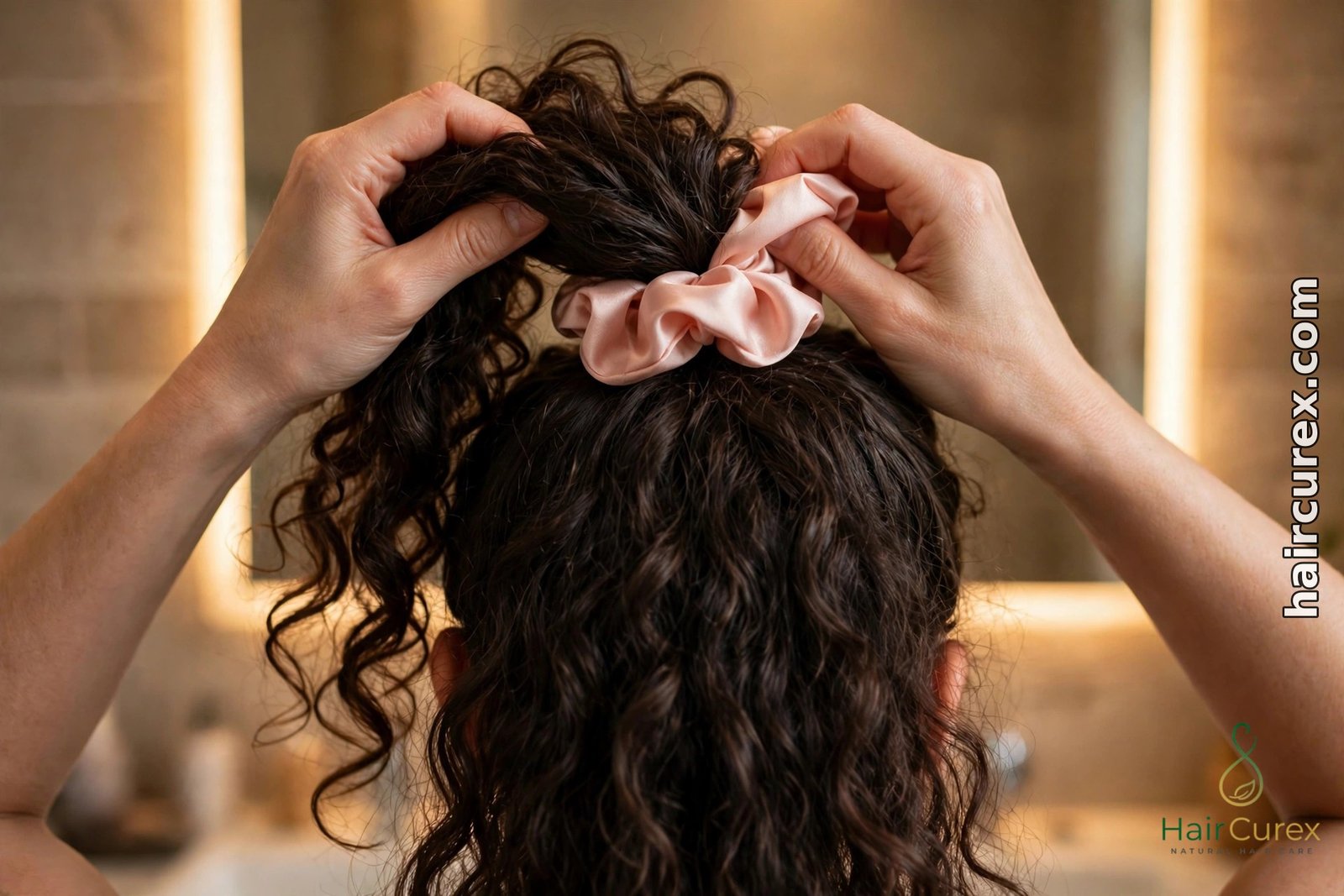
The pineapple is the classic curly-hair night routine, and it is the best place to start. Gather your dry curls into a very loose, high ponytail on the crown of your head, so the curls sit on top like the leaves of a pineapple. The position keeps your body weight off the curls, so they are not crushed under your head all night.
Use a silk or satin scrunchie, or a spiral hair tie, and loop it only once. The hold should be loose enough that you can slide a finger under it. If you feel any pulling at your hairline, it is too tight. Never pineapple wet hair: wet curls stretch under their own weight and dry into dents and creases. If your hair is still damp, wait until it is mostly dry, or use a diffuser on low heat first. Our full Curly Girl Method guide covers the wash-and-style steps that set your curls up for a good night in the first place.
The pineapple works best for medium to long hair, roughly shoulder length and beyond. If your hair is short, the curls may not reach the top of your head — in that case, skip to the bonnet or pillowcase methods below.
2. Switch to a Satin or Silk Pillowcase
If you change only one thing, make it this. A satin or silk pillowcase has a smooth surface that lets curls glide instead of catching and snagging. That single change cuts friction, reduces frizz, and helps curls hold their shape — and it protects your hair even on nights when you fall asleep without doing anything else to it.
Silk is the premium option: it is a natural fiber, breathable, and gentle on both hair and skin. Satin is usually polyester or a silk blend, and it gives you most of the same slip at a much lower price. Either one is a big step up from cotton. Wash your satin or silk pillowcase in a mesh laundry bag on a gentle cycle, and replace it when the surface starts to feel rough or pilled.
A satin pillowcase also pairs well with every other method on this list. Even with a pineapple or bonnet, the ends of your hair can escape and rub against the pillow — a smooth pillowcase is your safety net.
3. Wear a Satin Bonnet or Scarf
A satin bonnet wraps your curls in a smooth, low-friction cocoon and keeps them contained while you move in your sleep. It is the most protective option for tight curls and coily hair (types 3C and 4), and for anyone whose hair tangles easily at the nape.
Choose a bonnet with a wide, soft elastic band that sits flat without digging in, and one large enough to hold all of your hair without compressing it. Put it on after your pineapple or loose twists, tucking the curls in gently rather than stuffing them. If a bonnet feels too warm or slides off during the night, a satin scarf tied loosely at the nape is a good alternative — just make sure the knot is not pulling on your hairline.
The American Academy of Dermatology’s dermatologist guidance on curly hair recommends exactly this kind of protection: a loose pineapple or braid before bed, plus satin or silk bonnets or pillowcases to reduce friction and preserve your style. You can read their 6 curly hair tips from dermatologists for the full list.

4. Loose Braids or Twists for Wavy Hair
Wavy hair (types 2A–2C) often does not hold a pineapple well — the waves are too soft and slip out, or the high ponytail leaves a dent. Loose braids or twists are usually the better choice. Divide your hair into two or four sections, braid each one loosely, and secure the ends with a small silk scrunchie or spiral tie.
Keep the braids loose, especially at the scalp. Tight braids can cause breakage and, over time, tension at the hairline. In the morning, undo the braids and shake the waves out gently — you will often find soft, defined waves with almost no frizz. This method also doubles as a heat-free way to add wave to straighter sections. If you are still learning your wave pattern, our 2C hair guide explains how wavy hair behaves and which routines suit it best.

5. The Medusa Clipping or Multi-Pineapple Method
If one pineapple leaves the curls at the sides and back flat, try two or three small, loose pineapples — sometimes called the Medusa method. Gather the top section into a high pineapple, then gather the hair at each side into smaller, loose ones. This distributes the curls more evenly and protects the sections a single pineapple misses.
This method suits long, thick, or very curly hair best. It takes a little longer to set up, but it is worth it if you wake up with great curls on top and a flattened, tangled mess underneath. Use the same rules as the single pineapple: silk scrunchies, one loose loop, no pulling, and never on wet hair.
6. Moisturize Lightly Before Bed
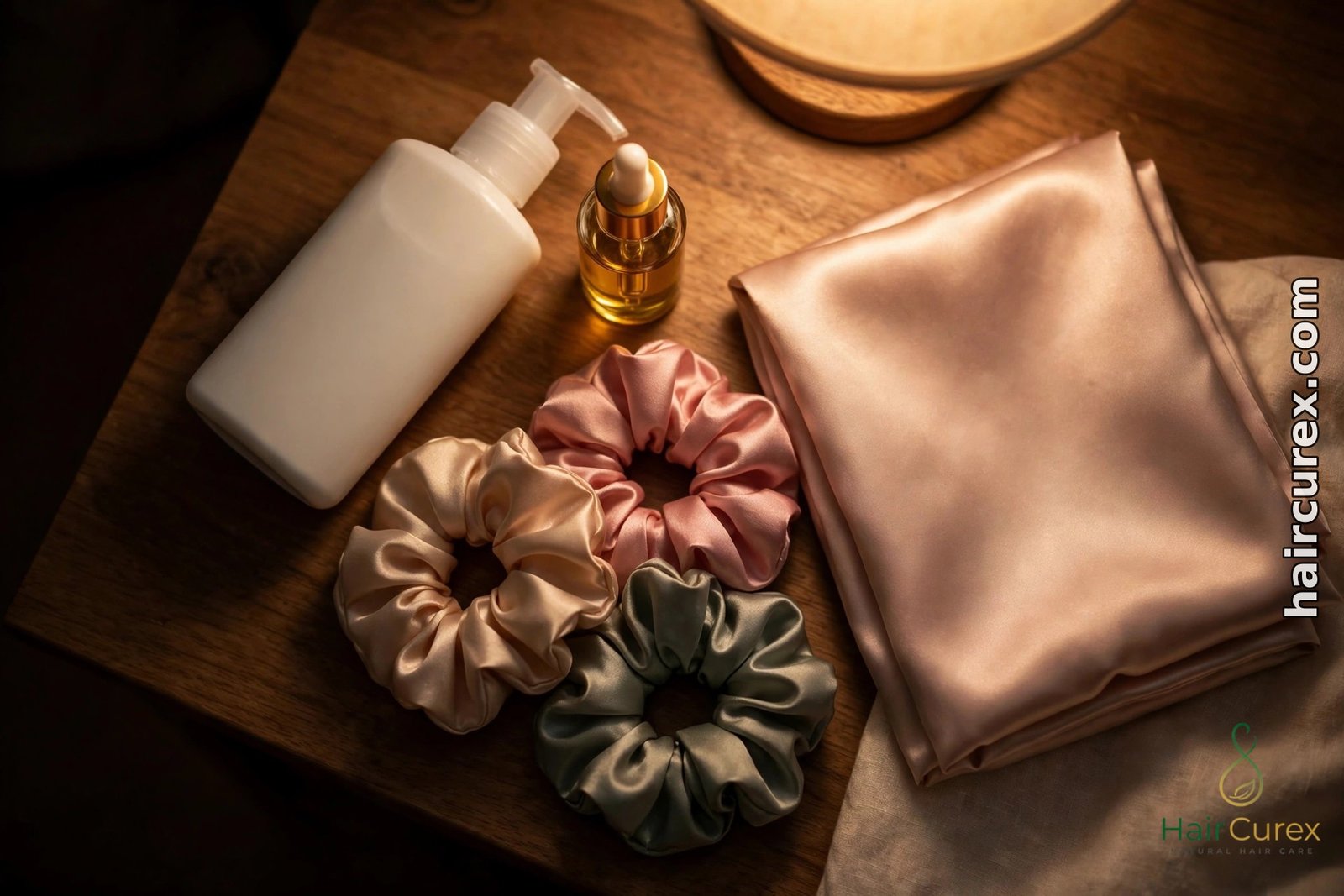
A small amount of leave-in conditioner or a few drops of hair oil before bed can help curls stay hydrated overnight, especially if your hair runs dry. Apply it to the lengths and ends only, not the roots, and use less than you think you need — too much product weighs curls down and leaves residue on your pillowcase.
This step matters most in winter or in dry climates, when indoor heating pulls moisture out of hair. In humid weather, you may not need it at all. A light mist of water mixed with a little leave-in conditioner in a spray bottle works well too, and it is the same mixture you will use for your morning refresh. For more on choosing products that will not dry your curls out, see our guide to getting rid of frizzy hair, which covers the ingredients that help and the ones to avoid.
7. Sleep on a Silk Pillowcase With Hair Draped Above the Pillow
This is the simplest method of all, and it works well for short to medium curls. Before lying down, gently gather your curls and drape them above the top edge of your pillow, so your head rests on the pillow but your hair does not sit under it. The curls stay free of your body weight, and the silk surface keeps friction low.
It only works if you mostly sleep on your back or stay fairly still. If you toss and turn, your hair will slide back under your head, and you will need a bonnet or pineapple instead. Think of this as the low-effort option for quiet sleepers and short hair.
Which Night Routine Fits Your Hair? (Comparison Table)
Use this table to pick a starting point, then adjust after a few nights. The right method is the one you will actually do every night.
| Method | Best for | Protection level | Effort |
|---|---|---|---|
| Loose pineapple | Medium–long curls, types 3A–3C | Good | 1 minute |
| Satin/silk pillowcase | Every curl type, every length | Moderate | None (one-time switch) |
| Satin bonnet or scarf | Tight curls, coily hair, tangle-prone hair | Highest | 1 minute |
| Loose braids or twists | Wavy hair, types 2A–2C | Good | 3–5 minutes |
| Multi-pineapple (Medusa) | Long, thick, very curly hair | Very good | 3 minutes |
| Light moisturize before bed | Dry curls, winter, dry climates | Supports other methods | 1 minute |
| Hair draped above pillow | Short curls, back sleepers | Moderate | Seconds |
Two combinations work especially well: a pineapple plus a satin pillowcase, and a bonnet plus a satin pillowcase. Layering a smooth surface under a protective style covers both friction and compression at once.
Step-by-Step: A 5-Minute Night Routine for Curly Hair
- Check dryness. Your hair should be at least 80% dry before bed. If it is still wet from your evening wash, diffuse on low heat or let it air-dry longer. Sleeping on wet curls stretches the pattern and can leave your scalp damp all night.
- Detangle gently if needed. If you have knots, work through them with your fingers or a wide-toothed comb on damp hair with a little leave-in conditioner. Never brush dry curls — it breaks up the curl pattern and creates frizz.
- Add a little moisture. Smooth a pea-sized amount of leave-in conditioner or a few drops of oil over the lengths and ends. Skip the roots.
- Choose your protective style. Pineapple for longer curls, loose braids for waves, bonnet for tight curls or tangle-prone hair.
- Check the tension. Shake your head gently. Nothing should pull, hurt, or leave a dent. If it does, redo it looser.
- Sleep on satin or silk. Even with a protective style, a smooth pillowcase catches the ends that escape.
That is the whole routine. Five minutes at night can save you fifteen to twenty minutes of restyling in the morning.
Morning Refresh: Bring Second-Day Curls Back in 5 Minutes
Even with the best night routine, your curls will need a small refresh in the morning. Here is a quick routine that works for most curl types:
- Take your pineapple, braids, or bonnet down gently and shake your hair out at the roots.
- Mist the lengths lightly with water, or with a water and leave-in conditioner mix in a spray bottle. Do not soak your hair — damp is enough.
- Smooth a small amount of curl cream or gel over the frizziest sections, scrunching upward to reactivate the curl pattern.
- Let your hair air-dry for a few minutes, or diffuse on low heat for a minute or two if you are short on time.
- Once fully dry, scrunch out any crunch from gel with clean hands and fluff the roots gently.
If your curls still look flat at the crown, flip your head upside down and shake the roots out, then flip back and arrange the top layer with your fingers. Avoid brushing — a brush will turn defined curls into a puff of frizz.
Common Mistakes That Ruin Curls Overnight
- Sleeping on wet hair. Wet hair is weaker and more elastic than dry hair, so it stretches, creases, and breaks more easily. It also keeps your scalp damp for hours. Always let curls dry at least 80% before bed.
- Tying hair too tightly. A tight ponytail or braid pulls on the roots all night and can cause breakage and, over time, thinning around the hairline. The American Academy of Dermatology warns that repeated tension from tight hairstyles can contribute to hair loss. If a style hurts, loosen it.
- Using regular elastic bands. Thin rubber elastics snag and snap strands. Switch to silk scrunchies, spiral ties, or fabric-covered bands.
- Brushing dry curls before bed. Brushing breaks the curl clumps apart and creates frizz that no night routine can fix. Finger-detangle or use a wide-toothed comb on damp hair only.
- Skipping protection on “lazy” nights. One unprotected night can undo two good ones. A satin pillowcase is the safety net for nights when you do nothing else — that is exactly why it is worth the one-time switch.
- Overloading products at night. Heavy oils and thick butters before bed weigh curls down and transfer to your pillowcase. Keep night products light and save heavy treatments for wash day.
Most of these mistakes come from the same root cause: treating curly hair like straight hair. Curls need less tension, less friction, and more moisture — and the night routine is where those three needs are easiest to meet.
How to Plop Before Bed (When It Helps, and When It Does Not)
Plopping — wrapping wet curls in a cotton T-shirt or microfiber towel to dry in their natural shape — is a daytime styling step, not a night routine. It works well right after washing, but do not sleep in a plop: the wrap comes loose, the fabric stays damp against your scalp, and the curls dry unevenly. If you wash your hair in the evening, plop for 15–20 minutes, then remove the wrap and let your hair finish drying before you choose your night style. Our detailed guide to how to plop curly hair walks through the technique step by step.
When to See a Dermatologist
Night routines can protect the curls you have, but they cannot fix hair loss or scalp problems. See a board-certified dermatologist if you notice hair coming out in clumps, a widening part or bald patches, persistent itching, flaking, or scalp pain, or breakage that continues even after you have switched to gentle, low-tension routines. For more on telling normal shedding apart from a real problem, read our guide to hair breakage and how to stop it.
Frequently Asked Questions
Can I sleep with wet curly hair?
It is best not to. Wet hair is weaker and stretches more easily, so sleeping on wet curls can cause breakage, creases, and a stretched-out curl pattern. A damp scalp overnight can also irritate the skin. Let your hair dry at least 80% before bed, or diffuse on low heat if you are short on time.
Is the pineapple method bad for your hair?
No — as long as it is loose. A loose pineapple held with a silk scrunchie and looped only once protects curls without pulling. It becomes a problem only when it is tied tightly, wrapped twice, or done on wet hair. If you feel pulling at your hairline, redo it looser.
Do silk pillowcases really help curly hair?
Yes. Silk and satin have a smooth surface that reduces friction against the hair cuticle, which means less frizz, fewer tangles, and better curl definition in the morning. They also absorb less moisture than cotton, so your hair stays more hydrated. Satin gives you most of the same benefit at a lower price.
Should I wear a bonnet every night?
If your hair tangles easily, or you have tight curls or coily hair, wearing a satin bonnet every night is one of the most effective things you can do. For looser curls and waves, a bonnet is helpful but not essential — a satin pillowcase and a loose pineapple or braid may be enough. Try it for a week and compare your second-day hair.
How do I keep my curls from going flat at the back of my head?
Flatness at the back comes from your body weight pressing the curls against the pillow. A high pineapple or multi-pineapple lifts the curls off the pillow, and a bonnet keeps them contained. Draping your hair above the top edge of the pillow also helps if you sleep on your back.
Can wavy hair use the pineapple method?
Wavy hair can, but loose braids or twists usually work better. Waves are softer than curls and tend to slip out of a pineapple or develop a dent from the scrunchie. Two or four loose braids protect the wave pattern and give you soft, defined waves in the morning. The Keranique guide to the pineapple method explains the step-by-step technique and when it works best.