


Frizz usually starts in the few minutes after washing, when wet curls are at their most fragile and every rub, blast of hot air, or rough towel lifts the cuticle — the hair’s outer layer — and lets moisture escape. Once that layer is roughened, curl clumps break apart and the smooth pattern from the shower turns into flyaways. The good news: drying is one of the easiest parts of a curl routine to fix, because it depends more on technique than on expensive products.
Learning how to dry curly and wavy hair without frizz is mostly about patience and gentle handling.
Quick answer: Learning how to dry curly and wavy hair without frizz comes down to handling wet hair gently, removing water without rubbing, and letting curls set before you touch them again. Squeeze out water with a microfiber towel or cotton T-shirt, apply leave-in and styling products to soaking-wet hair, then either plop, diffuse on low heat and low speed, or air-dry without touching your hair until it is fully dry. Finish with a cool shot and scrunch out any crunch only when the hair is completely dry.
How to Dry Curly and Wavy Hair Without Frizz
There is no single drying method that works for everyone, and that is the first thing to accept. Fine waves dry fast and lose volume easily, while thick curls can take hours and stay damp at the roots long after the ends feel dry. Your goal is the same either way: keep curl clumps together, avoid friction and excess heat, and give the hair a chance to form its pattern before it sets.
Start with the wash itself. Hair that is properly conditioned and detangled before drying will always dry with less frizz than hair that was roughly handled in the shower. Detangle with your fingers or a wide-tooth comb while conditioner is still in your hair, then rinse gently. If you are unsure of your pattern, our curl type chart can help you identify it.
Step 1: Remove Water Without Rubbing
The biggest frizz mistake happens before any dryer is switched on. Rubbing wet hair with a regular bath towel creates friction, breaks up curl clumps, and roughs up the cuticle. Instead, cup sections of hair in your hands and squeeze gently, working from the ends upward. You are pressing water out, not wringing it out. Think of it as blotting, not drying.
Do this step after you have applied your styling products, not before. Products applied to soaking-wet hair distribute more evenly and help lock clumps together as the water leaves. If your hair starts to dry before you have applied anything, mist it lightly with water so the products can spread. For a full routine around this step, see our curly hair routine, which covers wash-day order from cleansing to styling.
That gentle first step sets the tone for how to dry curly and wavy hair without frizz.
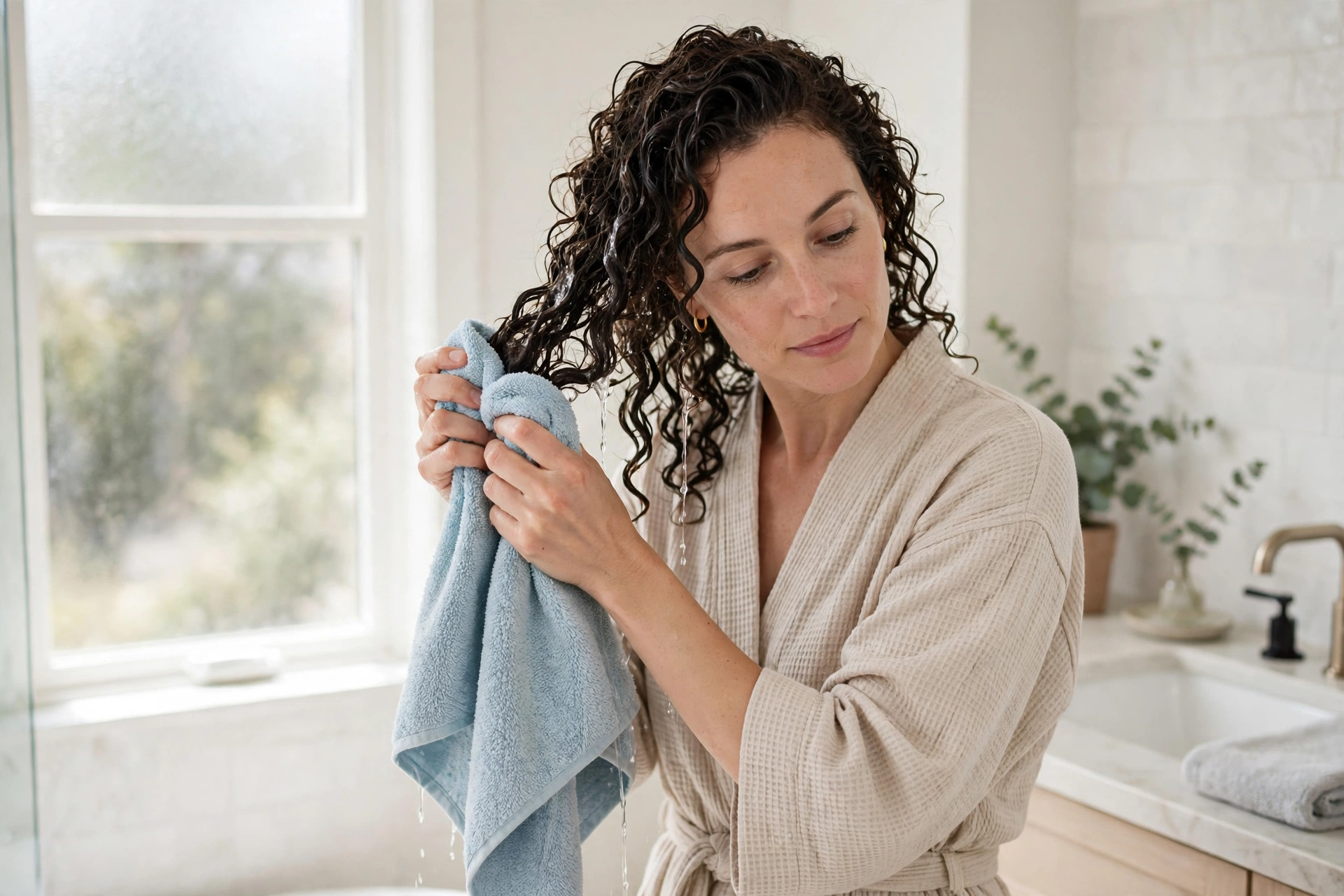
Microfiber Towel vs. Cotton T-Shirt: Which Is Better?
Both beat a standard terry-cloth towel, but they suit different hair types. A microfiber towel absorbs a lot of water quickly and is very smooth, which makes it a good choice for thick or long hair that holds a lot of water. A plain cotton T-shirt is thinner and lighter, so it absorbs more slowly and is often better for fine or wavy hair that can be weighed down or over-dried at the ends.
Technique matters more than fabric: wrap hair loosely, never twisted tight, for 10 to 20 minutes. Longer can flatten roots and dent the curl pattern. A hair porosity test can also tell you how fast your hair absorbs and releases water, which affects drying time.
What Is Plopping, and Does It Work?
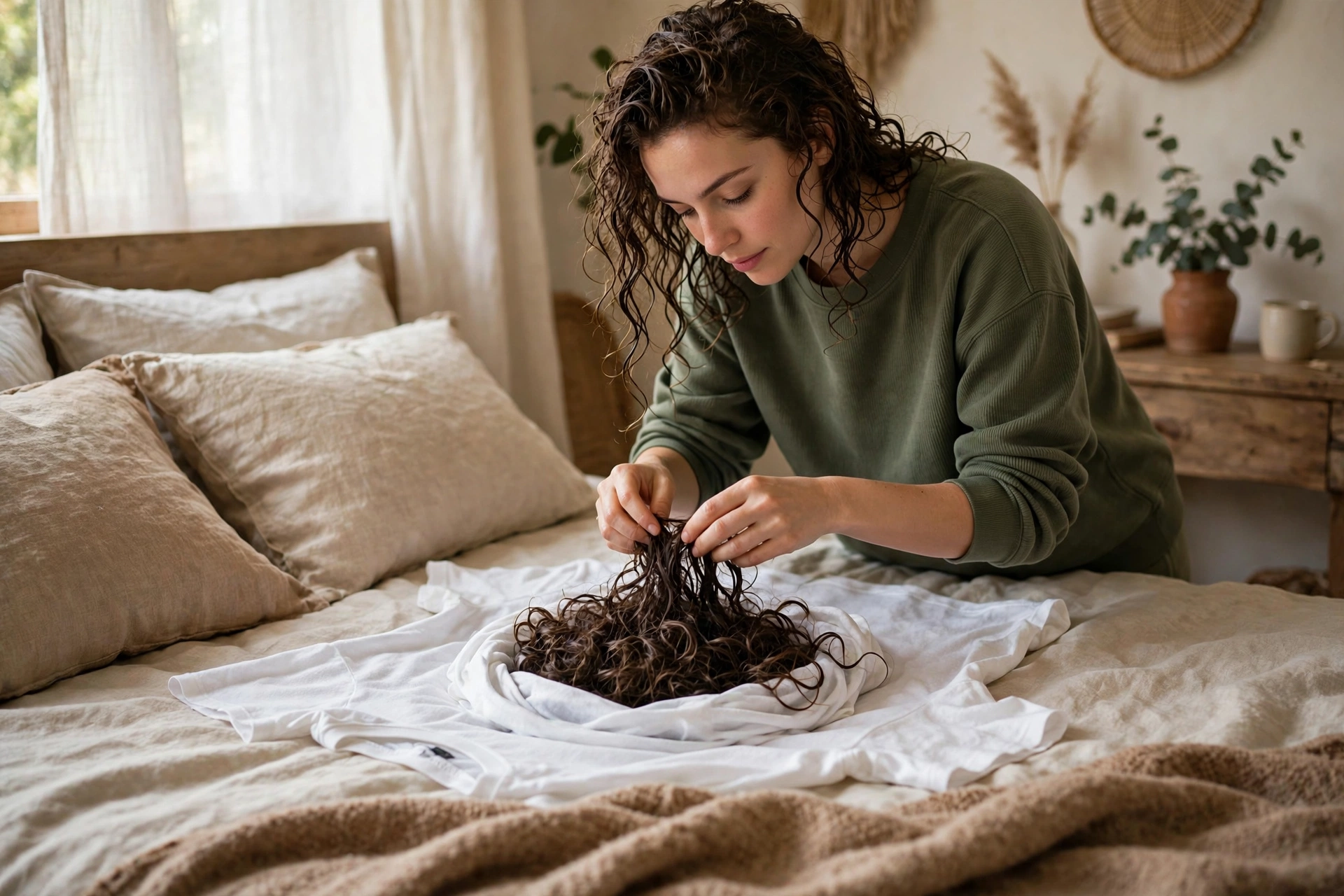
Plopping means laying wet, product-coated curls onto a flat T-shirt or microfiber towel, then wrapping the fabric around your head so the curls pile on top of themselves instead of hanging down. Gravity pulls water out while the curls keep their shape, which is why plopping often gives better definition than air-drying loose hair. It is especially helpful for wavy and loose curly hair, which can be stretched out and flattened by the weight of water as it dries.
To plop, lay the shirt flat, flip your head forward so curls fall into the center, fold the shirt over the back of your head, and tie the sides at your neck. Keep it on for 15 to 30 minutes, then let hair finish drying. Do not plop overnight — too long wrapped up flattens roots and frizzes the top layer.
Plopping is one of the simplest ways to learn how to dry curly and wavy hair without frizz.
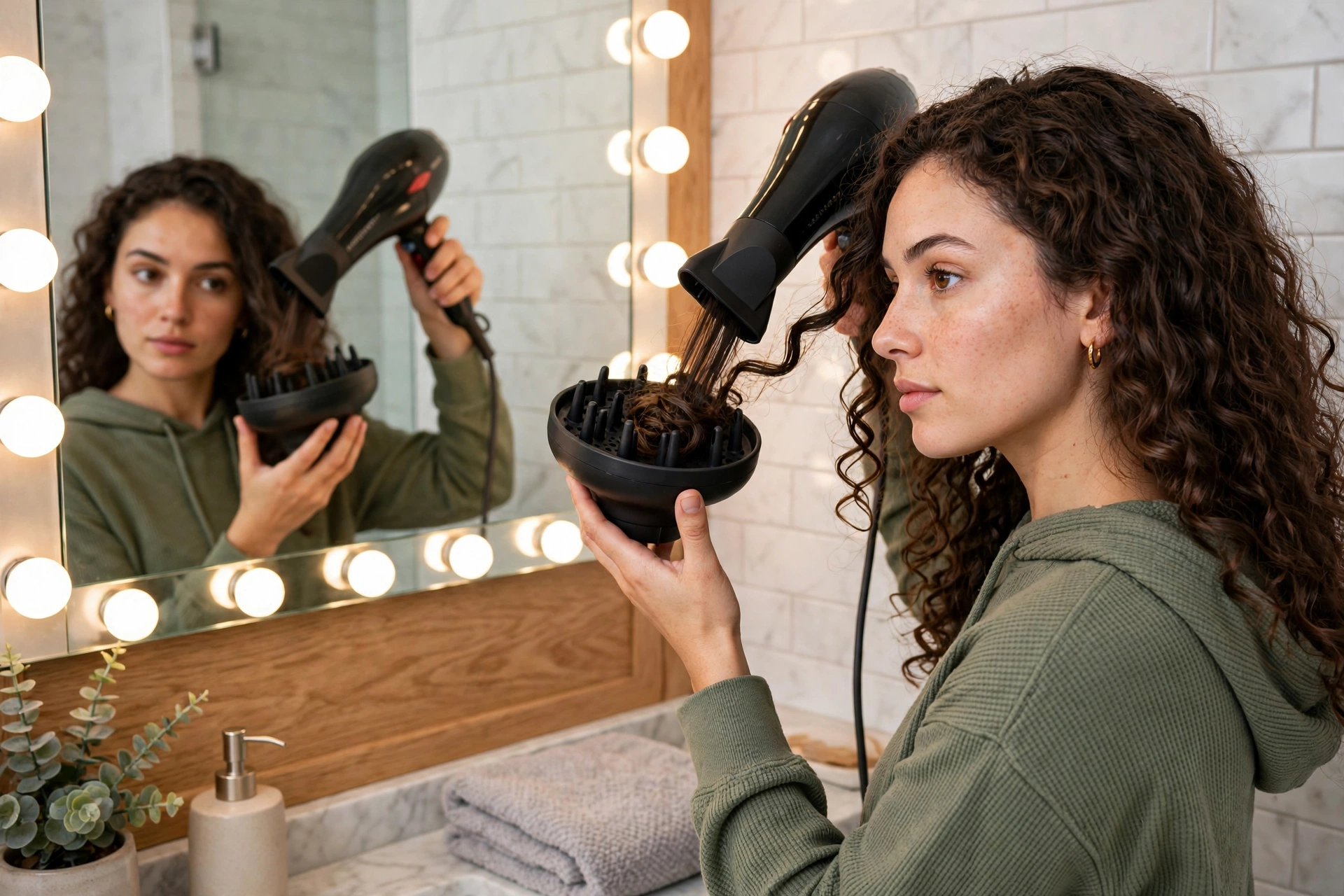
How to Diffuse Curly Hair Without Frizz
Diffusing uses a bowl-shaped attachment that spreads the dryer’s airflow over a wider area, so curls are not blown apart the way they are by a bare nozzle. Used correctly, it gives more volume and faster drying than air-drying, with less frizz than regular blow-drying. Used badly — high heat, high speed, and constant movement — it can create more frizz than any other method.
Low heat and a still diffuser are central to how to dry curly and wavy hair without frizz.
Diffuser Settings That Actually Help
Set the dryer to low or medium heat and low speed. High speed is the main culprit when diffusing goes wrong, because it pushes curl clumps apart before they have set. A heat protectant is worth using even on low heat, since repeated warm air still dries the hair over time. Dermatologists at the American Academy of Dermatology advise limiting blow-drying, using low or medium heat settings, and using a product to protect hair from heat — advice that fits diffusing perfectly.
A Step-by-Step Diffusing Technique
First, plop or air-dry for 10 to 20 minutes so hair is damp, not dripping. Then work in sections: place curls in the diffuser bowl, bring it to your scalp, and hold still for 30 to 60 seconds. Move on without shaking the hair. Stop at about 80 percent dry and finish with a cool shot — the rest will dry naturally, without the over-dried, fluffy finish of diffusing to bone dry.
Hover Diffusing vs. Pixie Diffusing: What’s the Difference?
Hover diffusing means holding the diffuser a few inches away from your hair and moving it slowly around your head without touching the curls. It is gentle, adds soft volume, and works well for fine waves and loose curls that lose definition when handled. Pixie diffusing means cupping sections of hair into the diffuser bowl and pressing it against the scalp, holding each section still before moving on. It gives more lift at the roots and tighter definition, which suits thicker curls that need help holding their shape.
Choosing between hover and pixie diffusing depends on your hair, but both fit how to dry curly and wavy hair without frizz.
How to Air-Dry Curly Hair Without Frizz
Air-drying is the gentlest option and the one dermatologists most often recommend, but it only works if you leave your hair alone. After applying products to wet hair, gently scrunch upward to encourage clumps, then do not touch, brush, or re-scrunch your hair until it is completely dry. Every time you run your fingers through half-dry curls, you break the cast — the slightly stiff layer that styling products form — and invite frizz.
Patience is the key when air-drying, and it is a core part of how to dry curly and wavy hair without frizz.

Wavy Hair vs. Curly Hair: Drying Differences That Matter
Wavy hair (roughly types 2A to 2C) is easily weighed down, so it usually dries best with lighter products, less plopping time, and a shorter diffuse. Too much cream or gel, or too long wrapped in a towel, can pull waves straight and leave them stringy. Curly hair (roughly types 3A to 3C) holds more water and needs more moisture, so it usually benefits from a longer plop, a richer leave-in, and pixie diffusing for root lift.
Waves usually do well with a light mousse or a little curl cream, while tighter curls need cream plus gel to hold through drying. Our guide to the best curl cream for wavy hair explains how to pick a formula that defines without weighing waves down.
Lighter products help waves keep their shape, which matters for how to dry curly and wavy hair without frizz.
Drying Method Comparison
Pick the method that fits your schedule, hair type, and frizz tolerance — the best one is the one you can do consistently without rushing.
| Method | Typical drying time | Frizz risk | Best for |
|---|---|---|---|
| Plopping + air-dry | 2–4 hours | Low | Wavy and loose curly hair; defined clumps |
| Hover diffusing | 20–40 minutes | Low to medium | Fine waves; soft volume |
| Pixie diffusing | 20–45 minutes | Medium if rushed | Thick curls; root lift and definition |
| Air-drying only | 2–4+ hours | Low, if untouched | Thick or fragile hair; lowest heat damage |
| Regular blow-drying (no diffuser) | 15–30 minutes | High | Not recommended for curls; straightening only |
Drying Mistakes That Cause Frizz
Most frizz is caused by a handful of habits that are easy to correct. Brushing or combing dry or half-dry curls is the worst offender — it separates clumps into individual strands. Towel-rubbing, as mentioned above, is a close second. Diffusing on high heat and high speed, touching your hair while it dries, and applying products to hair that has already started to dry all make the problem worse, because products cannot distribute evenly on partially dry hair.
Avoiding those habits is the fastest way to improve how to dry curly and wavy hair without frizz.
How to Handle Humidity and Frizz
Humidity is the other half of the frizz equation. When the air is humid, dry hair absorbs water from the atmosphere, the hair shaft swells, and the cuticle lifts — which is why a style that looked perfect indoors can turn frizzy within minutes outside. You cannot control the weather, but you can reduce how much moisture your hair takes in.
A gel with a reasonably strong hold forms a light barrier around each clump and slows moisture exchange, and products applied to very wet hair help because moisturized hair absorbs less water from the air. On very humid days, a little oil smoothed over fully dry hair can seal the surface — use a light hand on wavy hair. A moisturizing wash routine, such as co-washing, also helps, since dry hair reacts more to humidity.
A strong-hold gel helps in humidity, and it supports how to dry curly and wavy hair without frizz.
How to Refresh and Re-Dry Curls Without Frizz
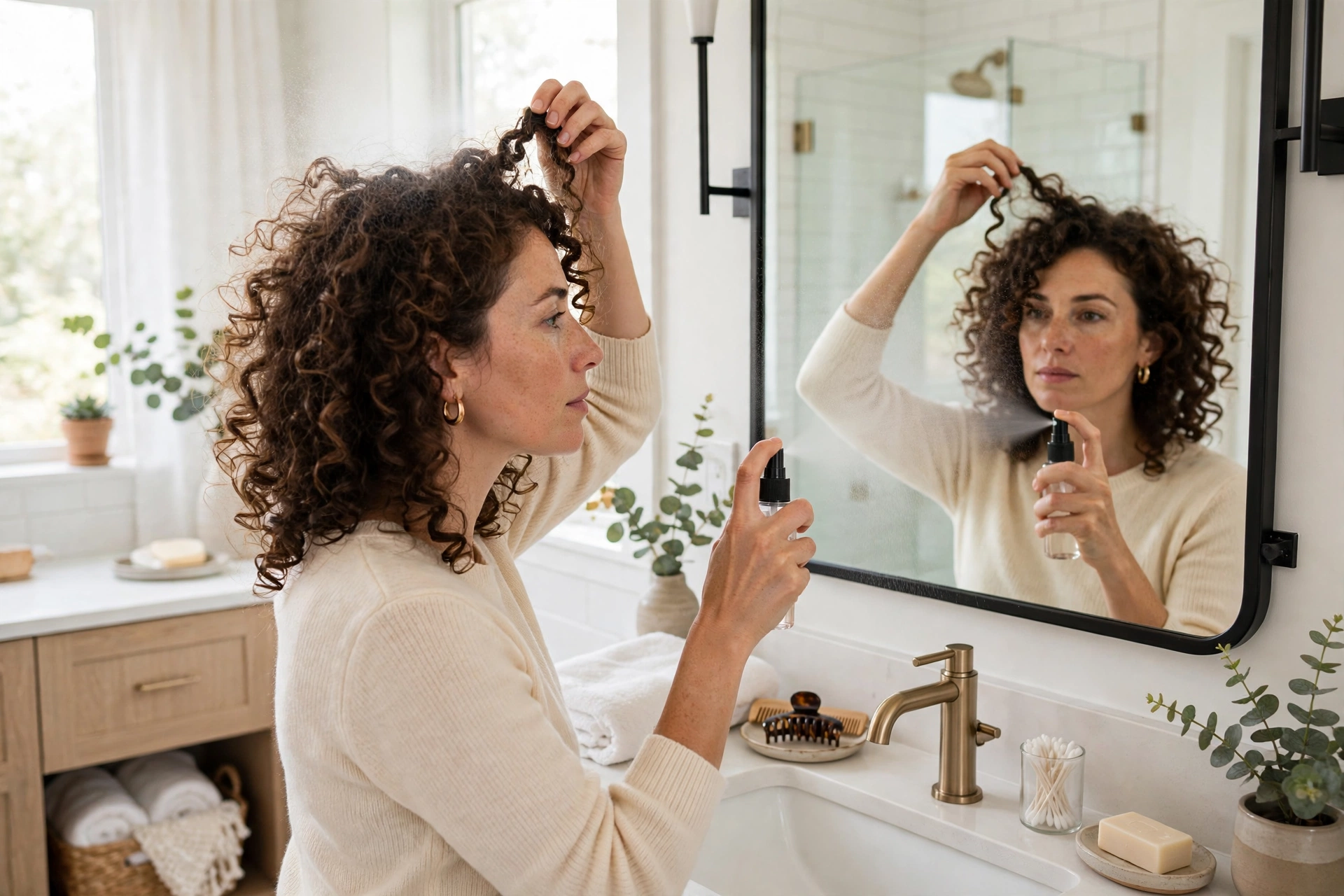
Second- and third-day hair does not need a full wash to look good again. Mist your hair lightly with water — damp, not dripping — then smooth a small amount of leave-in conditioner or curl refresher over the surface with praying hands, scrunching gently upward. For flat sections, hover diffuse on low heat for two to three minutes, or clip the roots for lift while the hair dries.
Do not fully re-wet hair on refresh days unless you plan to restyle it — that takes as long as wash day and leaves roots limp. A light mist, a little product, and a short diffuse is usually enough; a tiny amount of oil on the ends only will smooth any remaining frizz. The American Academy of Dermatology’s curly hair tips likewise recommend keeping curly hair moisturized and never brushing it dry.
A light mist refreshes curls without a full wash, which is useful for how to dry curly and wavy hair without frizz.
Frequently Asked Questions
Should I dry curly hair with a regular towel?
No — a regular terry-cloth towel creates friction that breaks up curl clumps and lifts the cuticle, which causes frizz. Use a microfiber towel or a plain cotton T-shirt instead, and squeeze or blot the water out rather than rubbing.
Is diffusing bad for curly hair?
Not when done correctly. Diffusing on low heat and low speed, holding each section still, and stopping at about 80 percent dry gives volume and definition with far less frizz than blow-drying without a diffuser. High heat and high speed are what cause damage and frizz.
How long should I plop my hair?
Most people do best with 15 to 30 minutes. Less than 10 minutes may not remove enough water, while much longer can flatten the roots and dent the curl pattern, especially for fine or wavy hair.
Why does my hair get frizzy as it dries?
Usually because the curl clumps were disturbed while the hair was still damp — by touching, brushing, towel-rubbing, or high-speed airflow. Once hair starts to set, any disturbance breaks the pattern and creates flyaways that cannot be smoothed until the next wash.
Should I air-dry or diffuse wavy hair?
Either can work. Air-drying gives the softest result but can leave waves flat if the hair is heavy with water. A short hover diffuse adds lift and speeds drying without disturbing the wave pattern, so many wavy-haired people combine the two.
Can I dry my hair completely with a diffuser?
You can, but stopping at about 80 percent dry and letting the rest air-dry usually gives a softer finish. Diffusing until the hair is completely dry often over-dries the ends and creates a fluffy, frizzy texture.
How do I stop frizz in humid weather?
Use a gel with enough hold to slow moisture exchange, apply products to soaking-wet hair, and keep hair moisturized between washes. A light oil or serum smoothed over fully dry hair can help seal the surface on very humid days, but use it sparingly on fine or wavy hair.
Final Thoughts
Frizz-free drying is less about buying new tools and more about changing a few habits: stop rubbing, stop touching hair while it dries, and stop defaulting to high heat. Pick the method that fits your hair type and your morning — plopping and air-drying when you have time, low-speed diffusing when you do not — and give it a few wash days before judging it. Curls respond to consistency, and once your drying routine stops fighting your pattern, the rest of your routine gets easier too.