


1C hair is the thickest, fullest type of straight hair. It hangs mostly straight, like all type 1 hair, but it has a slight bend at the ends and a little natural body at the roots — just enough movement to keep it from looking completely flat. It is also the straight-hair type most likely to go limp and oily by the end of the day, because the scalp’s natural oils travel easily down a straight strand and there is no curl pattern to hide them. If your hair looks sleek and shiny in the morning and flat and greasy by evening, and no amount of curl holds for long, there is a good chance you have 1C hair. This guide explains how to tell for sure, how 1C hair differs from 1A, 1B and 2A hair, and the simple routine that keeps it light, shiny and full of movement.
Quick answer: 1C hair is straight hair with a slight bend at the ends, a bit of body at the roots, and a coarse or thick texture. It is the fullest of the three straight hair types (1A, 1B, 1C). To care for it, wash with a lightweight, volumizing shampoo, condition only the ends, avoid heavy oils and butters, use dry shampoo between washes, and blow-dry with a round brush for lift at the roots. It holds a curl poorly and goes oily fast, so light products and regular washing matter more than deep conditioning.
What Is 1C Hair?
Hair typing divides hair into four main types — 1 is straight, 2 is wavy, 3 is curly and 4 is coily — and each type is split into A, B and C subtypes. Type 1 hair has no curl pattern at all. Within that group, 1A is fine, thin and completely straight, 1B is medium-textured and straight with a little more body, and 1C is the thickest and coarsest of the three, straight with a slight bend at the ends and the most natural volume at the roots.
That extra thickness is what sets 1C hair apart. The strands themselves are usually medium to coarse, so the hair feels substantial when you hold a section of it, and there is more of it — people with 1C hair often have high hair density too. The result is hair that looks full and healthy when it is freshly washed, with a natural shine that wavy and curly hair has to work for. The shine comes from the same reason 1C hair goes oily: on a straight strand, sebum (the scalp’s natural oil) slides down the hair shaft without anything to slow it. On curly hair the same oil gets stuck at the bends, which is why curls are dry and straight hair is shiny — and, by the second day, greasy.
1C hair also has a little natural texture that 1A hair does not. The ends may flick out or curve slightly, and the hair can hold a soft bend for a few hours after styling. But it is still straight hair: it will not form a wave on its own, and a curl made with an iron usually drops out within hours unless you set it carefully. If you are not sure where you fall in the whole system, our guide to curly hair types explains the system, from 2A hair and 2B hair to 4C, and how each type is cared for — 1C sits right at the straight end of that same hair type chart.
How to Tell If You Have 1C Hair

The only reliable way to type your hair is to look at it in its natural, untouched state. Wash it with a gentle shampoo, skip all styling products, let it air-dry completely without brushing it while it dries, and then look at what it does on its own. Brushing while wet or blow-drying straight will hide the pattern you are trying to see.
It dries almost completely straight. After air-drying, your hair falls straight from root to tip, with at most a gentle bend or flick at the very ends. If you see a clear S-shaped wave forming anywhere along the lengths, you are probably looking at 2A hair rather than 1C.
It has body at the roots. Unlike 1A hair, which can lie completely flat against the head, 1C hair lifts slightly at the crown and has a bit of natural volume. Your hair does not cling to your scalp — it has some presence and movement of its own.
The strands feel medium to coarse. Take a single strand between your fingers and roll it. If you can barely feel it, it is fine (more like 1A). If it feels wiry or clearly textured, it is coarse — a classic 1C trait. A second test: hold a single strand up to the light. A coarse strand is easy to see and feels sturdy; a fine strand is almost invisible.
It goes oily fast. If your roots look greasy by the end of day one or on the morning of day two, that is normal for 1C hair. The oil travels straight down the shaft, and because the hair is thick, there is more surface for the oil to show on. Fine straight hair can look oily too, but 1C hair goes flat and heavy as well as shiny.
Curls do not hold. If you curl your hair with an iron and it is mostly straight again within a couple of hours — or if braids and buns leave only a faint wave that disappears quickly — your hair is resisting a curl pattern, which points to type 1 rather than type 2.
It is hard to damage but easy to weigh down. 1C hair is usually strong and resilient: it handles heat styling and coloring better than fine hair. But the same thickness means heavy products sit on it and flatten it. If a rich conditioner or hair oil leaves your hair looking limp and stringy, that is another sign you are dealing with 1C hair, not a sign that your hair is damaged.
If most of these boxes are ticked, you have 1C hair. If only some fit, you may be between types — 1B and 1C often blend, and the care routine below works for both.
1C Hair vs 1A and 1B Hair
The three straight-hair subtypes look similar at a glance, but they behave differently, and the differences matter when you choose products and styles. The table below sums them up.
| Trait | 1A hair | 1B hair | 1C hair |
|---|---|---|---|
| Pattern | Completely straight, no bend | Straight with a slight bend | Straight with a slight bend at the ends |
| Strand texture | Fine and thin | Medium | Medium to coarse |
| Body at the roots | Almost none, lies flat | A little lift | Noticeable body and volume |
| Shine | Very shiny | Shiny | Shiny, can look heavy when oily |
| How fast it goes oily | Fast | Fast | Fast, and looks flat as well as greasy |
| Holds a curl | Barely at all | Poorly | Poorly, drops within hours |
| Main problem | Limp, flat, flyaways | Flat roots, oily scalp | Heavy, oily, hard to keep volume |
The practical difference is product weight. 1A hair needs the lightest products of all and often cannot handle conditioner at all on the roots. 1B hair can take a little more moisture. 1C hair can handle a normal conditioner on the lengths — it is thick enough to need it — but it still goes flat if you use anything heavy, and it still needs a volumizing shampoo rather than a moisturizing one.
1C Hair vs 2A Hair: The Easy Mistake
The most common mix-up is between 1C and 2A hair, because both have a slight bend and both can look almost straight. The difference is what the hair does on its own. 2A hair forms a loose, soft S-shaped wave along the lengths when it air-dries — you can see the wave pattern if you look at a section of hair from the side. 1C hair dries straight and only the ends bend. If your hair air-dries into waves that you can scrunch and encourage, you have 2A hair, and our 2A hair guide covers how to bring those waves out. If it dries straight and only the tips flick, it is 1C. The care is similar — both types need light products — but 2A hair benefits from wave-enhancing products and scrunching, while 1C hair benefits from root-lifting and volumizing instead.
How to Care for 1C Hair
1C hair is low-maintenance compared with curly hair, but it has its own needs: volume at the roots, oil control at the scalp, and protection from heat, since most people with 1C hair blow-dry or straighten regularly. The routine below is built around those three things.
How to Wash 1C Hair

Wash frequency is the first decision. Most people with 1C hair need to wash every day or every other day, because the oil shows quickly and there is no curl pattern to hide it. That is normal — do not try to “train” your hair to go a week between washes. Over-washing is rarely the problem for 1C hair; under-washing is, because buildup at the roots is what kills volume.
Use a lightweight, volumizing or clarifying shampoo, and focus it on the scalp. Massage it in with your fingertips, not your nails, and let the lather run down the lengths as you rinse — the lengths do not need scrubbing. If your scalp gets very oily, our guide to the best shampoo for oily hair explains how to handle an oily scalp without drying out the ends. Rinse with lukewarm water, not hot: hot water strips the scalp and can make it produce more oil to compensate, and it roughs up the cuticle so the hair looks dull instead of shiny.
Dry shampoo is the best friend of 1C hair. On the second day, spray it at the roots, wait a minute, then brush it through. It soaks up oil and adds grip and volume at the same time. Use it before your hair looks greasy, not after — it works far better as prevention than as rescue.
The Best Products for 1C Hair

The rule for 1C hair is simple: light products, applied in the right places. Heavy butters, thick oils and rich masks are made for dry, curly hair, and on 1C hair they just sit on the surface and flatten it. Choose products built for fine or straight hair, even though your strands are coarse — “for fine hair” on a label usually means lightweight, which is what matters.
| Product | What to choose | How to use it |
|---|---|---|
| Shampoo | Volumizing or clarifying, sulfate-free if your hair is color-treated | Scalp only, every 1–2 days |
| Conditioner | Lightweight, for fine or straight hair | Mid-lengths to ends only, never on the roots |
| Leave-in | Light spray or milky leave-in, not a cream | A small amount on damp ends |
| Heat protectant | Lightweight spray | Every time before heat styling |
| Dry shampoo | Any trusted brand | At the roots on day 2, before oil shows |
| Hair oil | A drop of light oil (argan or jojoba) | Ends only, to smooth flyaways |
| Hair mask | Lightweight, for straight or fine hair | Once every 1–2 weeks, lengths only |
Conditioner placement is the single most common mistake with 1C hair. Conditioner on the roots coats the hair at the scalp and kills volume for the whole day. Apply it from the ears down, leave it for two or three minutes, and rinse thoroughly. If your ends are dry from heat styling or coloring, a hair mask once every week or two on the lengths only will help without flattening your roots — heavy weekly masking is not needed for 1C hair the way it is for curly hair.
Styling 1C Hair for Volume
Volume is the main styling challenge, because straight hair has no curl to hold it up. The good news is that 1C hair already has more natural body than 1A or 1B, so a few small techniques go a long way.
Blow-dry upside down or with a round brush. Drying your hair upside down for the first minute lifts the roots away from the scalp. Then finish with a round brush, lifting each section up and away from the head as you dry. A nozzle on the dryer points the airflow down the hair shaft, which smooths the cuticle and adds shine.
Use a volumizing mousse at the roots. A golf-ball-sized amount of lightweight mousse, worked into damp roots before blow-drying, gives 1C hair grip and lift that lasts. Avoid heavy styling creams and pomades — they flatten straight hair fast.
Keep heat moderate. 1C hair is strong, but daily high-heat styling still causes damage over time. Use a flat iron or curling iron at a medium setting, always with a heat protectant spray, and let each section cool before you touch it. If you curl 1C hair, pin each curl up while it cools — it is the only way the curl has a chance of lasting past lunchtime. The American Academy of Dermatology’s healthy hair tips are a useful second opinion on gentle handling and heat if your hair is starting to feel dry or brittle.
Sleep on it right. A loose braid or a low, loose bun at night stops 1C hair from tangling and keeps some bend in the ends for the morning. A silk or satin pillowcase reduces friction and flyaways, and it keeps the hair smoother than cotton.
Hairstyles That Work for 1C Hair

1C hair suits styles that use its natural sleekness and body rather than fighting them. Long layers are the classic choice: they remove weight from the ends so the hair moves, and they stop the bottom from looking triangular or heavy. A blunt cut also works well — 1C hair is thick enough to hold a sharp, clean edge, which is something fine 1A hair struggles with. Face-framing layers soften the look and add movement around the face without needing any curl.
Shorter styles work too. A lob (long bob) is one of the best cuts for 1C hair, because the length is short enough to hold volume at the roots and long enough to look sleek. A bob with a slight bend at the ends uses the natural flick of 1C hair instead of fighting it. Bangs also sit well on 1C hair: curtain bangs and side-swept bangs fall naturally, while blunt bangs look sharp and clean because the hair is straight enough to hold the line.
Styles to be careful with: very long, one-length hair with no layers can look heavy and drag the roots flat, and tight curls or ringlets will drop out quickly, so they are a lot of effort for a short result. If you want texture, a soft wave made with a large-barrel iron and set with a light-hold spray is a better bet than tight curls.
7 Mistakes That Make 1C Hair Look Flat
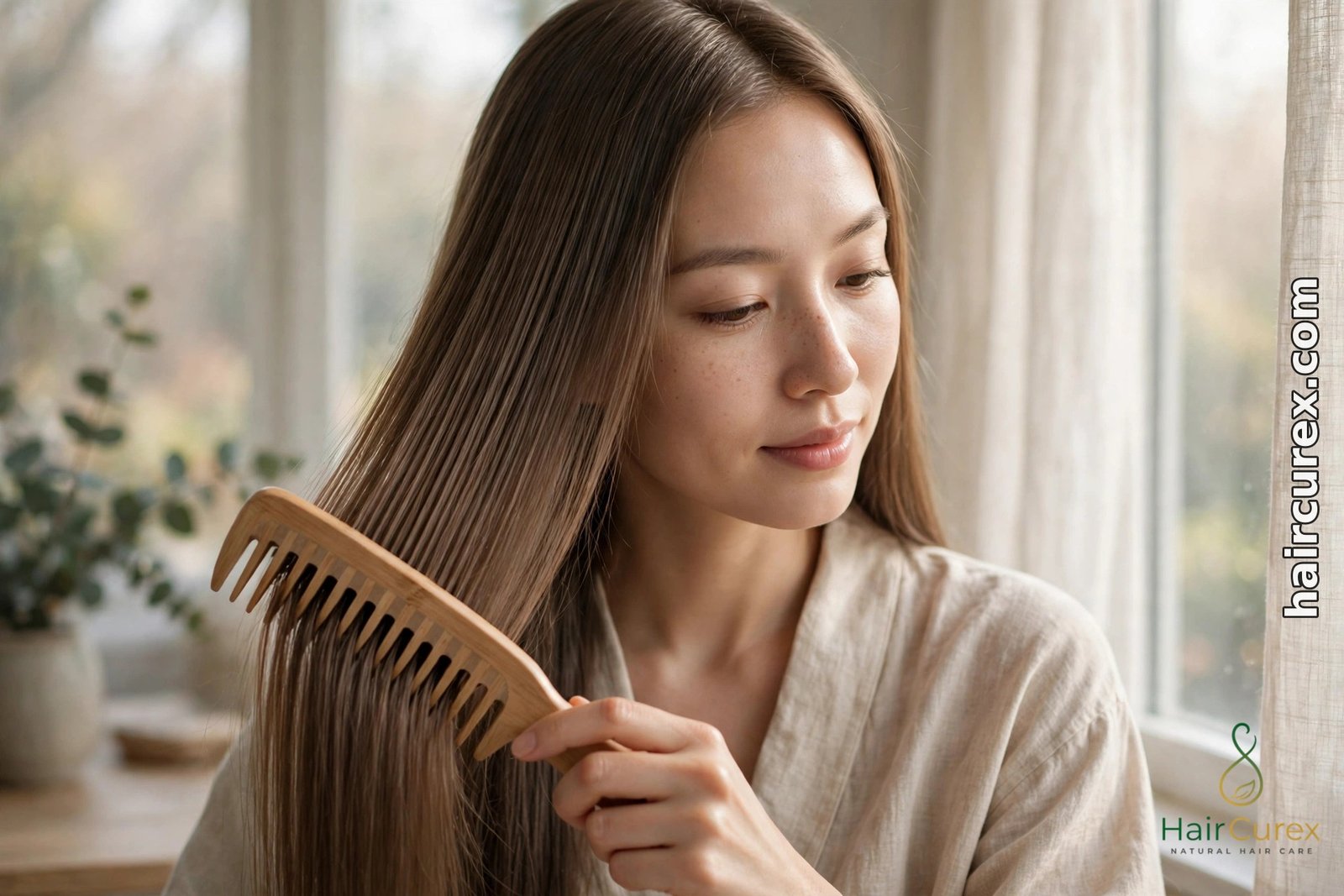
1. Conditioning your roots. Conditioner on the scalp coats the hair and kills volume. Keep it on the lengths only.
2. Using products made for curly or dry hair. Rich butters, heavy oils and thick masks are built for hair that needs moisture locked in. On 1C hair they just weigh it down. Choose lightweight formulas made for straight or fine hair.
3. Skipping shampoo to “train” your hair. 1C hair goes oily because oil travels easily down a straight strand, not because you wash too often. Washing every 1–2 days is normal, and dry shampoo covers the gap.
4. Applying too much product. A pea-sized amount of serum or a single drop of oil is enough for the ends. More product does not mean more shine — it means flat, stringy hair.
5. Blow-drying without lifting the roots. Drying your hair flat against your head sets it flat. Lift each section up and away from the scalp as you dry, even if you only do it for the crown.
6. Using a heavy brush on wet hair. Wet hair is at its most fragile. Detangle with a wide-tooth comb or a brush made for wet hair, starting at the ends and working up, instead of dragging a brush through from the roots.
7. Sleeping with your hair loose on cotton. Loose hair tangles overnight and flattens at the roots. A loose braid and a silk or satin pillowcase keep it smoother and save you styling time in the morning.
When to See a Professional
Most 1C hair concerns are solved by lighter products and better washing habits, but some signs need a professional. See a dermatologist if you notice sudden or patchy hair loss, a scalp that stays itchy, flaky, sore or red despite gentle washing, or hair that breaks off in large amounts — those can be signs of a scalp condition or a medical issue that no shampoo will fix. See a stylist if your hair will not hold any volume no matter what you try, or if the ends look thin and straggly while the roots are thick — the cut may be the problem, not the products, and a good stylist can reshape it so the weight sits where it should.
The Bottom Line
1C hair is straight, thick and full, with a slight bend at the ends and a little natural body at the roots — the fullest of the straight hair types. It shines easily, goes oily fast, holds a curl poorly and is weighed down by heavy products. The routine that works is simple: wash every 1–2 days with a lightweight volumizing shampoo, condition the ends only, use dry shampoo between washes, keep oils and masks light and on the lengths, and blow-dry with lift at the roots. Do that consistently, and 1C hair does what it does best: look sleek, shiny and full without much effort at all.
Frequently Asked Questions
How do I know if I have 1C hair?
Wash your hair, skip all styling products and let it air-dry completely. If it dries almost straight with only a slight bend at the ends, has some body at the roots, feels medium to coarse between your fingers, goes oily within a day or two and will not hold a curl, you very likely have 1C hair.
What is the difference between 1A, 1B and 1C hair?
All three are straight hair types. 1A is fine, thin and completely straight with no body. 1B is medium-textured and straight with a little more body. 1C is the thickest and coarsest, straight with a slight bend at the ends and the most natural volume at the roots.
Is 1C hair wavy or straight?
1C hair is straight. It may have a slight bend or flick at the ends, but it does not form a wave pattern along the lengths. If your hair air-dries into a visible S-shaped wave, it is 2A hair rather than 1C.
How often should I wash 1C hair?
Most people with 1C hair wash every day or every other day, because oil travels quickly down a straight strand and shows at the roots. Dry shampoo on the second day helps stretch the wash without losing volume.
What products are best for 1C hair?
Lightweight, volumizing products: a volumizing shampoo, a light conditioner used on the ends only, a heat protectant spray, a lightweight mousse for root lift and dry shampoo between washes. Avoid heavy butters, thick oils and rich masks, which flatten 1C hair.
Why does my 1C hair look flat and oily?
The most common reasons are conditioner applied to the roots, products that are too heavy, washing too rarely, or blow-drying without lifting the roots. Switch to lightweight products, keep conditioner off the scalp, wash every 1–2 days and dry with lift at the crown.