


At what temperature does hair burn? Hair starts to scorch and char at around 450°F (232°C) — the top setting on most flat irons — but real damage begins much lower. Lab research shows keratin, the protein hair is made of, starts to break down irreversibly above about 392°F (200°C), and even 300°F can weaken hair if you hold the iron still or go over the same section again and again. The safe setting depends on your hair type: fine or damaged hair needs just 250–300°F (120–150°C), normal hair does well at 300–350°F (150–180°C), and thick or coarse hair rarely needs more than 350–400°F (180–200°C). Never style at the maximum setting, never iron damp hair, and always use a heat protectant first — those three habits matter more than the brand of tool you own.
At What Temperature Does Hair Burn?
Hair is mostly keratin, a protein held together by strong disulfide bonds and by weaker hydrogen bonds that water and heat can reset. That resetting is why a flat iron can straighten hair for a day: heat breaks the hydrogen bonds, the hair takes a new shape, and the next wash brings the texture back. The trouble starts when heat goes past resetting those bonds and starts breaking the protein itself.
There is no single number where every head of hair burns, because damage depends on temperature, contact time and how often you style — but lab research gives clear thresholds. The independent hair-science lab TRI Princeton reviewed the evidence and put about 180°C (356°F) as a practical upper styling range for dry hair, with damage speeding up sharply above roughly 200°C (392°F). True burning — thermal decomposition, where the fibre chars — begins at around 230°C (446°F). That is why so many flat irons top out at 450°F (232°C): the maximum setting on the box is effectively the temperature at which hair burns.
| Temperature (dry hair) | What happens |
|---|---|
| 50–120°C (122–248°F) | Hair loses water; temporary reshaping as hydrogen bonds reset. |
| 120–200°C (248–392°F) | Proteins oxidize and cross-link; light hair can turn yellow. |
| About 180°C (356°F) | Often cited as a practical upper styling range; damage rises above it. |
| 200°C+ (392°F+) | Keratin breaks down (denatures); damage becomes irreversible. |
| 230°C+ (446°F+) | Thermal decomposition; the fibre chars and burns. |
| Wet hair, about 160°C (320°F) | Water inside the strand flashes to steam and cracks the cuticle. |
Keep in mind that these are lab thresholds measured on hair samples, not on people. Your real results depend on how long the plates touch the hair, how many passes you make, and what the hair has already been through — bleach, relaxers and colour all lower the margin. A 1998 study in the Journal of Cosmetic Science heated hair with curling irons at just 132°C and 152°C for 4 to 12 minutes and still measured loss of tryptophan, an amino acid in keratin, and changes in how hard the hair was to comb. Short passes are gentler than long holds — but “lower heat” still is not “no damage.”
Safe Heat Settings by Hair Type
The rule is simple: use the lowest heat that still gives you the style you want. Start low, test one hidden section, and only turn the dial up if the style will not hold. If you have to go above the range for your hair type to get a result, the problem is usually technique — sections too large, hair not fully dry, or no heat protectant — not the temperature.
| Hair type | Safe starting temperature | Passes | Notes |
|---|---|---|---|
| Fine or thin | 250–300°F (120–150°C) | 1 slow pass, about 5 seconds | Most damage-prone; never go above medium. |
| Damaged, bleached or color-treated | 250–300°F (120–150°C) | 1 slow pass, about 5 seconds | Heat-style rarely; deep-condition between sessions. |
| Normal or medium | 300–350°F (150–180°C) | 1 slow pass, 5–8 seconds | The most forgiving range; start at the low end. |
| Thick or coarse | 350–400°F (180–200°C) | 1 slow pass, 7–8 seconds | Needs more heat to hold; never hold one spot longer than 10 seconds. |
| Curly or coily | 300–350°F (150–180°C) | 1 slow pass, 5–7 seconds | Straighten only on fully dry, stretched hair; repeated high heat can loosen the curl pattern for good. |

One setting the table deliberately leaves out is the maximum. No hair type needs 450°F for everyday styling, and the extra heat buys you very little hold for a large jump in damage. If a section does not take at your type’s range, let it cool, check that the hair was fully dry and the section was small enough, and try once more at the same temperature — do not jump straight to the top of the dial.
How Hot Do Your Tools Actually Get?
Flat irons are the hottest tools most people own. Many consumer irons reach 450°F (232°C), and a widely cited protectant study used 232°C on purpose as a harsh test condition. Some brands build in lower caps: ghd says its current flat irons run at 365°F (185°C) and calls this the “optimal temperature” — that is a brand claim, but it lines up well with the lab thresholds above, sitting just below the zone where damage speeds up.
Curling wands and curling irons run in the same range as flat irons, and the same temperature rules apply — the direction you wrap matters as much as the heat, and our guide to which direction to curl hair covers the wrapping that flatters your face shape. A hair crimper presses hot plates directly onto the strand for seconds at a time, so it needs the same care as a flat iron: low to medium heat, short presses, and protectant every time.
Blow dryers work differently: they heat the air, not the hair directly, so distance matters more than the dial. In a 2011 study in the Annals of Dermatology, researchers found that drying from about 15 cm (6 inches) away with the dryer moving caused less total damage than air-drying, because the hair spent less time wet — while a dryer held 5 cm away, where the air reaches about 95°C, caused visible cracks and holes in the cuticle. Keep the dryer moving, use a nozzle to aim the airflow, and hold it at least six inches from your hair.
Cheaper tools without a digital display are the wild card: they can overshoot the setting or heat unevenly, so one section gets 300°F and the next gets far more. If your tool has no temperature control, smells of burning, sparks, or heats unevenly, replace it — an unreliable thermostat is how hair gets burnt at a setting that should have been safe.
How to Tell If Your Hair Is Burning
Burnt hair rarely announces itself with flames. The warning signs are smaller, and catching them early is what saves the rest of your hair:
- A burnt smell while you style. If your hair smells like burning, it is burning — turn the heat down immediately.
- Smoke or steam from dry hair. A little steam from damp hair is water escaping. Smoke, or steam from hair that was already dry, means the strand itself is overheating.
- A sizzling sound. Sizzling means water is boiling inside the strand. Stop — the hair was not dry enough.
- White dots along the strand. Tiny white nodules are weak points where the fibre has been damaged; hair snaps at these dots.
- Crunchy, straw-like ends. Healthy ends feel smooth. Ends that feel dry, rough and brittle after styling have been overheated.
- Curls that will not bounce back. Repeated high heat can permanently change the curl pattern, so straightened curls stop springing back after washing. Flat-iron modelling research has found exactly this effect.
- More split ends and snapping. If breakage climbs in the weeks after you raise your temperature, the heat is the likely cause.
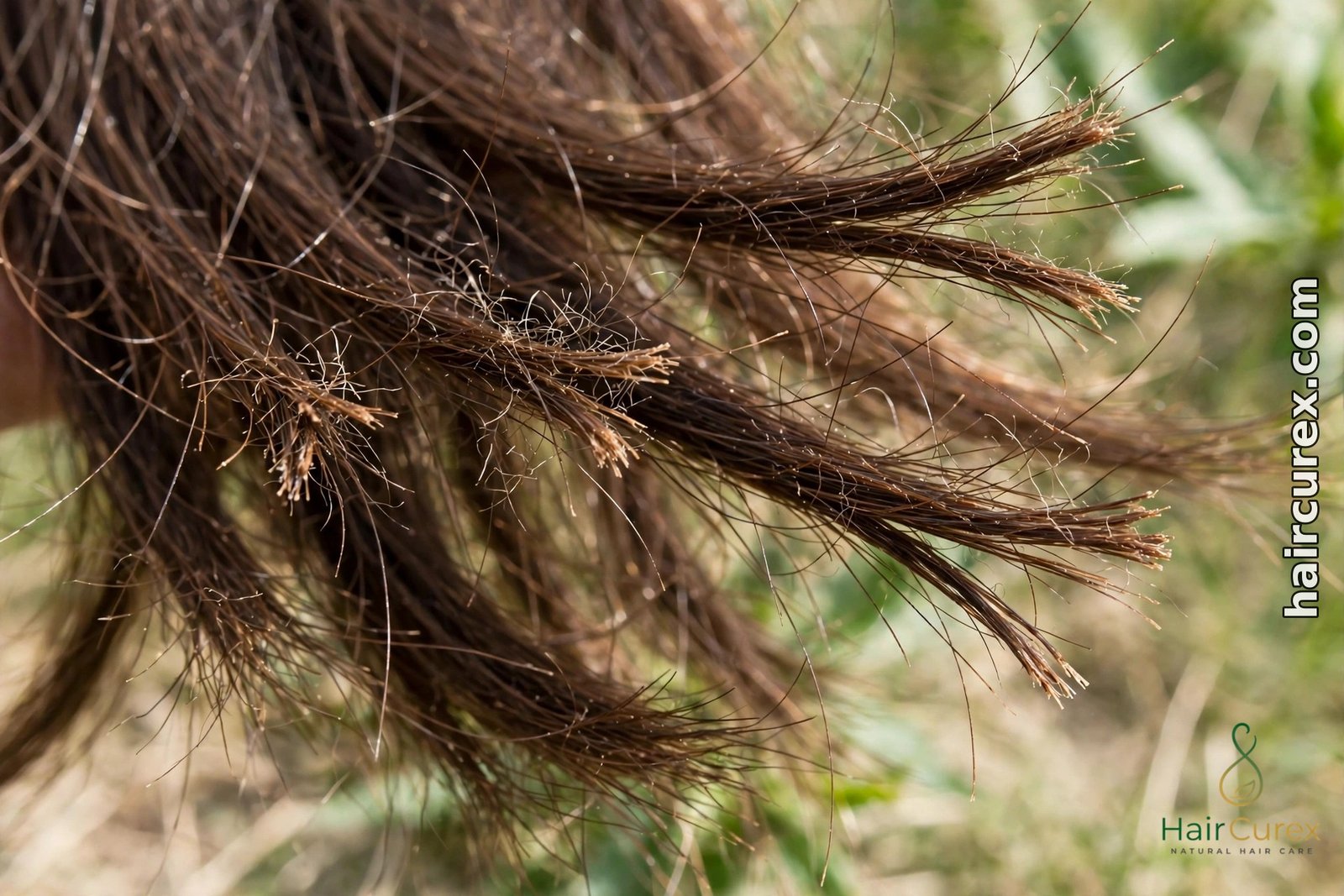
If you notice several of these at once, stop heat styling for a while and read the repair section below. The damage already done cannot be undone, but you can stop it getting worse.
How to Use Heat Without Burning Your Hair
Safe heat styling is a routine, not a single trick. Follow these steps in order and the temperature matters far less, because every step reduces the heat your hair actually absorbs.
Step 1 — Start with completely dry hair. Never press a hot iron onto damp hair: the trapped water turns to steam inside the strand and damages it from within. Air-dry or blow-dry until the hair is 100% dry — if the roots still feel cool or damp, dry longer.
Step 2 — Apply heat protectant evenly. Spray or smooth the best heat protectant sprays and creams for your hair type through the hair, section by section, and comb it through so no part is unprotected. Lab studies show protectants reduce measurable damage, but no product makes extreme heat safe — a protectant plus a lower temperature beats a great protectant used at maximum heat.
Step 3 — Start low and test one section. Set the iron to the low end of your hair type’s range from the table above. Style one hidden section and check the result once it cools. Raise the temperature only if the style will not hold.
Step 4 — Use small sections and one slow pass. One slow, even pass beats five fast ones. A section about one inch wide heats evenly; a wide section leaves the inside straight while the outside burns, which tempts you to go over it again.
Step 5 — Keep the iron moving and never hold still. Do not clamp the iron in one spot, especially at the ends. If a section did not take, let it cool completely before deciding whether to try again — a second pass at full heat doubles the damage for very little extra hold.
Step 6 — Let every section cool before touching it. Curls and straightened sections set as they cool. Touching, brushing or separating warm hair pulls the style straight and adds friction damage.
Step 7 — Limit how often you style. The American Academy of Dermatology suggests using the lowest heat setting, limiting contact time, and using heat tools “once a week or even less often” when possible. Rest days matter: heatless styles between sessions give your hair time to recover moisture.
Step 8 — Check your tool. Dryers that overheat, smell of burning or spark should be unplugged and replaced. A tool with a broken thermostat can burn hair at a setting that looks safe on the dial.

Why Wet Hair Burns at Lower Temperatures
Wet hair is the exception to every temperature in the tables above — it is damaged at lower heat than dry hair, starting at around 160°C (320°F). The reason is simple physics: water trapped inside the strand boils when a hot iron clamps down on it, and the steam has nowhere to go. It can crack the cuticle and burst out of the strand, leaving tiny bubbles inside the hair shaft. Dermatologists call this “bubble hair,” and it was first described in a 1994 case report in the Journal of the American Academy of Dermatology, where researchers found that hair from every volunteer they tested developed bubbles when heated enough while wet.
Bubbled sections break easily and cannot be repaired — they have to grow out or be cut. That is why the “never iron wet hair” rule is the single most important rule in this whole article. If you hear sizzling, see steam, or feel the iron catch on a damp section, stop, dry that section fully with a blow dryer, and only then go back to the iron. Blow-drying first is not an extra step; it is what makes the iron safe to use at all.

Can Burnt Hair Be Repaired?
Honestly, no — not in the way most products promise. Hair is non-living tissue: once keratin proteins denature and fractures form, the structural damage cannot be biologically repaired, only cosmetically managed or cut away. Conditioners and bond-building products can improve how burnt hair feels and reduce further breakage, but heat-denatured keratin and bubble hair do not heal. They grow out or get trimmed.
What actually helps, in order of impact:
- Trim the worst of it. Split, white-dotted and crunchy ends will keep splitting upward if you leave them. A small trim stops the damage travelling.
- Deep-condition weekly. A rich mask or deep conditioner restores moisture and slip, so damaged hair tangles and snaps less while it grows out.
- Use bond-building or protein treatments sparingly. They can temporarily patch the feeling of damaged hair, but overusing protein on already-brittle hair makes it stiffer and more likely to snap — alternate protein with moisture.
- Coat the lengths with a nourishing oil. A heavy conditioning oil smooths the cuticle and adds slip; our guide to batana oil for hair explains what a rich oil can realistically do for damaged lengths and what it cannot.
- Protect your curl pattern. If high heat has loosened your curls, stop straightening while they recover and follow the care routine for your pattern — our curly hair types guide explains the 2A to 4C system and the moisture-first routine each family needs.
- Take a heat break. Give your hair two to four weeks with no hot tools at all. Heatless styles, braids and buns let the new growth come through without fresh damage on top of old damage.
If your hair is snapping off in handfuls, your scalp is painful, sore or burning, or you have sudden patchy hair loss, see a dermatologist promptly rather than trying another product — those can be signs of a scalp condition or a form of hair loss that needs medical treatment.
Common Mistakes That Burn Hair
Most burnt hair comes from the same few errors, and all of them are avoidable.
- Using the maximum setting by default. The top of the dial is the temperature at which hair burns, not a styling setting. Start low and stay there.
- Ironing damp hair. The single most damaging mistake — trapped water boils inside the strand and causes bubble hair.
- Going over the same section again and again. Each pass adds damage. One slow pass at the right temperature beats three fast ones at maximum heat.
- Holding the iron still. More than 10 seconds in one spot does not make a better style — it makes a burnt one.
- Skipping heat protectant. Protectant is not optional with direct-contact tools. It spreads heat more evenly and slows moisture loss.
- Putting oil on before ironing. Oil plus a hot iron can fry the hair — plain oils are not heat protectants and some smoke on hot tools. Oil goes on after styling, on cool hair, as a finishing step.
- Heat styling every day. Even moderate heat adds up. Daily styling at any temperature shows up as dryness, split ends and breakage within weeks.
- Trusting a broken tool. An iron with no temperature control, uneven plates or a burning smell will damage hair at any setting.

Frequently Asked Questions
At what temperature does hair burn?
Hair starts to char at around 450°F (232°C), but keratin damage becomes irreversible above about 392°F (200°C). Research reviewed by TRI Princeton puts about 356°F (180°C) as a practical upper styling range for dry hair, and wet hair is damaged from around 320°F (160°C).
Is 450°F too hot for a flat iron?
For most hair, yes — 450°F is the temperature at which hair burns, not a safe styling setting. Very coarse hair may need more heat than fine hair, but staying under 400°F with fewer, slower passes is the lower-risk approach for every hair type.
What temperature should I use on fine hair?
Use 250–300°F (120–150°C) for fine or thin hair, with one slow pass of about 5 seconds per section. Fine hair is the most damage-prone, so never go above a medium setting, and always use heat protectant first.
Can heat-damaged hair be repaired?
No — heat-denatured keratin cannot be un-denatured, and bubble hair cannot be fixed. Conditioners and bond builders can improve how damaged hair feels and reduce further breakage, but the damage itself only leaves by trimming or growing out.
Is it safe to flat iron wet hair?
No. Water trapped inside a wet strand boils when a hot iron clamps down, forming steam bubbles inside the shaft — “bubble hair” — which break easily and cannot be repaired. Always dry your hair completely before using a flat iron or curling iron.
Does heat protectant make high heat safe?
No. Lab studies show protectants reduce measurable damage — in one 2011 study, pretreated hair broke less when combed after flat-ironing at 232°C — but the protection is partial. No product makes 450°F safe; a protectant plus a lower temperature is the combination that actually protects your hair.