


Quick answer: Batana oil for hair is a rich conditioning oil made from the kernels of the American oil palm — and the honest answer is that it conditions and protects the hair you already have, but there is no clinical evidence that it regrows hair or reverses hair loss. No published trial has tested batana oil for hair growth, and dermatologists say the same: it may make hair softer, shinier and less likely to break, which helps you keep the length you grow, but it cannot create new hair or wake up dormant follicles. Used as a pre-wash treatment once or twice a week, most people notice softer, shinier hair within a few uses — and that, not regrowth, is the realistic result to expect from batana oil for hair.
Batana oil for hair is everywhere right now. Scroll through TikTok or Instagram and you will find video after video of glossy, waist-length hair credited to a small jar of dark brown oil, with claims that it regrows bald spots, reverses thinning, blocks DHT and even brings back your natural colour. The videos are convincing, the before-and-after photos look dramatic, and the oil itself has a genuine history — it has been used for generations in Honduras. But the gap between what social media promises and what the evidence supports is wide, and it matters, because the wrong expectation costs money and, worse, costs time for people whose hair loss actually needs a proven treatment. This guide separates the tradition from the hype: what batana oil for hair really is, what it can and cannot do, how to use it properly, how it compares with rosemary oil and minoxidil, and what results you can realistically expect.
What Is Batana Oil?
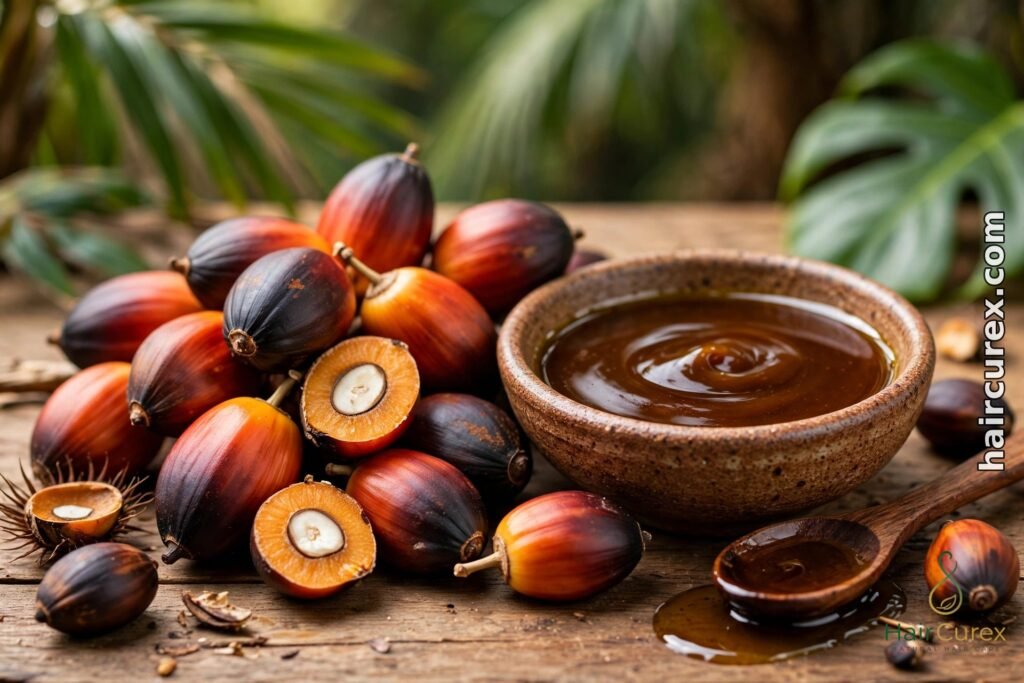
Batana oil is a thick, dark brown oil pressed from the kernels of the American oil palm, Elaeis oleifera, a palm species native to Central and South America. It comes from La Mosquitia, a remote region of north-eastern Honduras, where Miskito families have made it by hand for generations: the palm nuts are harvested, boiled, and the oil is slowly extracted over a fire, which gives genuine batana oil its deep brown colour and its strong, earthy, almost coffee-like smell. On cosmetic labels it appears as Elaeis Oleifera Kernel Oil. Pure batana oil has one ingredient — the oil itself — and that simplicity is part of its appeal.
What is actually in the oil? Laboratory analysis of the American oil palm’s kernel lipids found them dominated by lauric, myristic and oleic acids, with linoleic and palmitic acids also present, along with antioxidant compounds including vitamin E. That is a respectable nutritional profile for a plant oil, and it is the reason batana oil feels so rich and nourishing on the hair. But there is an important distinction that sellers often blur: identifying fatty acids or vitamin E in an oil does not prove that the finished product stimulates new hair growth. A compound existing in a bottle and a compound changing what a hair follicle does are two very different things, and no study has bridged that gap for batana oil for hair.
The oil’s texture tells you a lot about how it behaves. Real batana oil is a deep brown, semi-solid balm at room temperature that melts into a liquid in your hands. It is heavy — heavier than argan oil or jojoba oil — which means it coats the hair shaft thoroughly and stays put, but also means it can weigh fine hair down and needs proper washing out. That heaviness is exactly why it works well as a pre-wash treatment and poorly as a leave-in product for most people. If you are new to hair oils in general, our guide to hair oil explains how different oils behave on different hair types, and why a heavy oil like batana suits dry, thick or curly hair far better than fine, straight hair.
Batana Oil for Hair: What the Evidence Actually Says
This is the section that matters most, so here it is plainly: there is no clinical evidence that batana oil for hair regrows hair, reverses balding, or treats any medical form of hair loss. None. No randomised trials, no peer-reviewed human studies. A search of PubMed finds no clinical trials of batana oil for hair growth or hair loss, and a review by the natural cosmetic formulation school Formula Botanica likewise found no solid evidence linking it to hair growth. Healthline states it directly: “There’s no evidence that batana oil can help with hair loss” — while noting that, as an antioxidant-rich oil, it may reduce scalp dryness and help hair feel more nourished. WebMD agrees, noting that researchers have not studied batana oil for hair in clinical trials. Dermatologist Dr. Ronda Farah was equally clear: “there’s no evidence that batana oil can reverse balding.” Healthline’s full review of the evidence is worth reading before you buy: Healthline on batana oil for hair loss.
That does not mean the traditional reputation is invented — it means it is untested. The Miskito people of Honduras have used batana oil on their hair for generations, and the tradition says it thickens hair and adds shine. Traditional use is a real starting point for research, but it is not the same as proof, and it is not the same as the specific claims now circulating online. A tradition of using an oil for shine and conditioning is one thing; a claim that the same batana oil for hair regrows hair on a balding scalp, blocks DHT, or reactivates dormant follicles is a much bigger claim, and it is the bigger claim that has no evidence behind it. The social media testimonials that drive batana oil for hair sales are personal experience, not clinical proof — and personal experience cannot separate the effect of the oil from the effect of the scalp massage used to apply it, from another treatment used at the same time, or from a shedding trigger resolving on its own.
Two specific claims deserve a closer look, because they sound scientific. The first is the DHT claim: laboratory research has shown that certain unsaturated fatty acids can inhibit 5-alpha-reductase — the enzyme that converts testosterone into DHT — under experimental conditions. That is a real laboratory finding, but it does not prove that batana oil applied to the scalp lowers DHT enough to treat pattern hair loss. Lab conditions and a human scalp are very different environments, and no clinical study has established batana oil as a topical DHT blocker. The second is the “growth” claim built on the oil’s fatty acids and vitamin E: researchers have identified oleic, palmitic and linoleic acids in the oil along with antioxidant compounds, but, as trichologists point out, identifying these compounds does not prove the finished product stimulates new growth, extends the growth phase of the hair cycle, or treats hair loss in a clinically meaningful way.
The fairest summary of the evidence is this: batana oil for hair is a traditional, genuinely nourishing conditioning oil that the internet turned into a regrowth miracle it was never shown to be. That is not a reason to dismiss it — conditioning, shine and breakage reduction are real benefits, and for many people they are exactly what their hair needs. It is a reason to buy it for the right job, at the right price, with the right expectations, and to use a proven treatment instead if you have genuine pattern hair loss.
| Claim about batana oil for hair | What the evidence says | Verdict |
|---|---|---|
| Regrows hair / reverses balding | No clinical trials; Healthline, WebMD and dermatologists all say there is no evidence | Not supported |
| Blocks DHT and treats pattern hair loss | Some fatty acids inhibit 5-alpha-reductase in lab conditions only; no human scalp study exists | Not proven |
| Reverses grey hair | No evidence at all; no study or expert source supports this | Not supported |
| Makes hair grow faster | Hair growth rate is set by genetics, age, health and hormones; no oil changes it | Not supported |
| Conditions, softens and adds shine | Rich, heavy oil that coats the shaft — consistent with how all heavy plant oils behave | Realistic |
| Reduces breakage and helps keep length | Coated, more flexible hair snaps less during detangling and styling | Realistic |
| Soothes a dry scalp | Antioxidant-rich oil can reduce scalp dryness; may aggravate dandruff if left on too long | Plausible, with care |
What Batana Oil Can Realistically Do for Your Hair
Strip away the viral claims and batana oil for hair still has genuine uses — they are just cosmetic ones, and cosmetic is not a small thing when your hair is dry, brittle and breaking. As a heavy conditioning oil, batana oil for hair coats the hair shaft, and that coating does several useful things at once. It smooths the cuticle, which is what makes hair look shinier and feel softer. It adds slip, so a comb or brush glides through instead of catching and snapping strands. It seals in moisture on hair that dries out quickly, which is why it suits curly, coily and heavily processed hair particularly well. And by reducing friction and breakage, it helps you keep the length you already grow — the difference between hair that seems stuck at shoulder length because the ends keep snapping off, and hair that slowly gains length because the ends survive.
That last point — length retention — is where most of the honest “growth” stories come from. If your hair grows the usual half an inch a month but the ends break off at the same rate, your hair never looks longer. Reduce the breakage, and the same growth rate suddenly shows up as visible length. People who say batana oil for hair “made my hair grow” are very often describing exactly this: not faster growth from the follicle, but less breakage at the ends, so the growth they were already getting finally became visible. Over a few months of consistent use, hair can genuinely look longer, fuller and healthier — that is improved length retention, not new growth, and knowing the difference keeps your expectations honest.
The scalp benefits are real but modest. Massaging any oil into the scalp feels good, improves the feeling of dryness, and the massage itself increases blood flow to the area. One small human study of standardized scalp massage found an increase in hair thickness after 24 weeks, though it was a very small study and does not establish massage as a reliable treatment for hair loss. Our guide to scalp massage for hair growth covers the technique and the limits of that evidence in detail. The practical takeaway: the massage that comes with applying batana oil for hair may be doing as much for your scalp as the oil itself, so do not skip that step — and do not credit the oil alone for what the massage contributed.
How long before you see anything? Softer, shinier hair is usually noticeable after the first one or two uses, because conditioning is immediate. Visible length retention takes longer — expect 2 to 3 months of consistent once-or-twice-weekly use before you can fairly judge whether your ends are surviving better. If you want to understand what normal growth looks like in that timeframe, our guide to how long it takes to grow hair sets out the real numbers, month by month, so you can tell the difference between genuine progress and wishful thinking. And if after 3 months your hair looks and feels no different, the oil is probably not the right product for your hair type — that is useful information, not a failure, and it is better to learn it in 3 months than to keep buying jars for a year on the strength of a viral video.
How to Use Batana Oil for Hair Step by Step
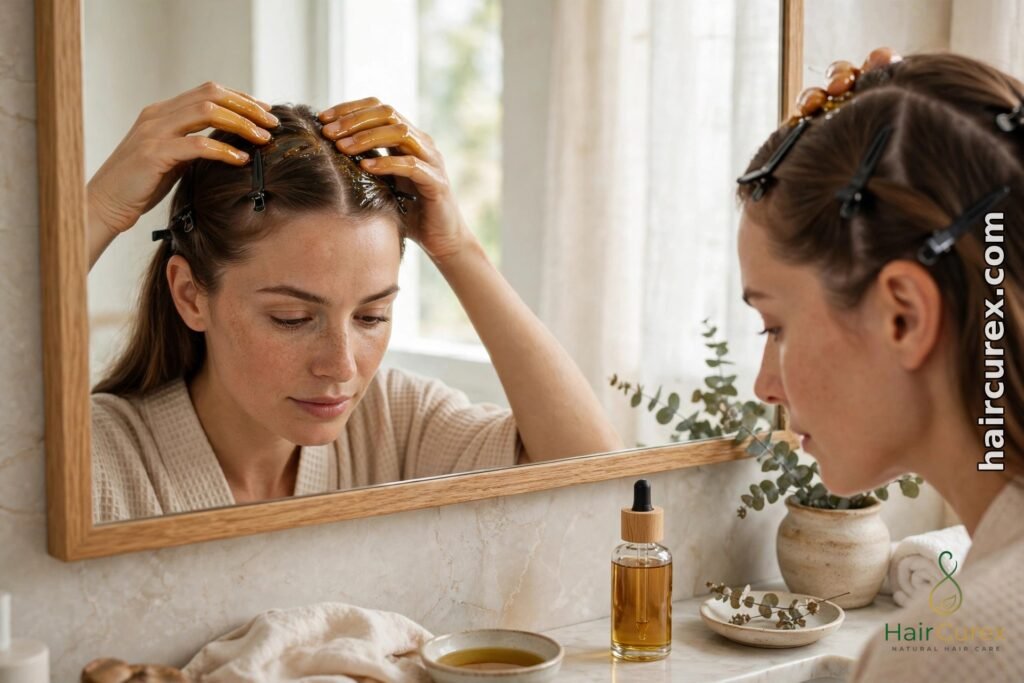
Batana oil for hair works best as a pre-wash treatment, not as a leave-in product. Used this way, it has time to coat and soften the hair, and then it washes out cleanly instead of sitting on your scalp and weighing your hair down. Follow these steps once or twice a week.
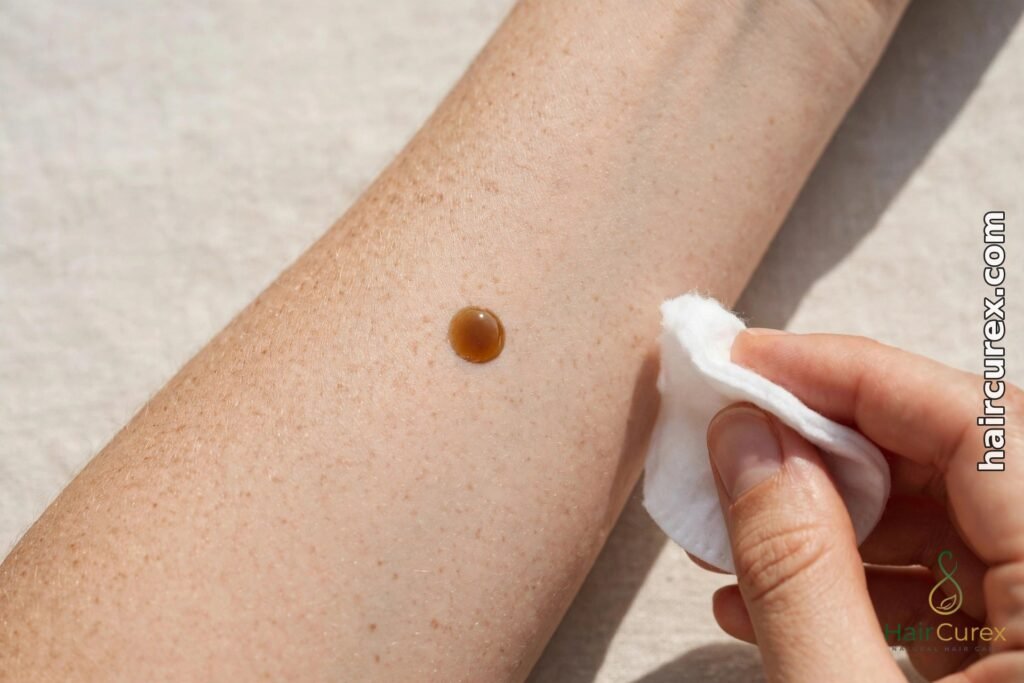
Step 1: Patch test first. Before you put batana oil for hair anywhere near your scalp, test it on your inner arm. Put a small amount on the skin, leave it for 24 hours, and check for redness, itching or irritation. Batana oil is a plant oil, and any plant oil can irritate skin or trigger an allergy — especially if you have a palm or nut sensitivity. If your skin reacts, do not use it. If you have dandruff or seborrhoeic dermatitis, be extra careful: heavy oils left on the scalp can aggravate those conditions, so keep the oil mainly on the lengths and ends, or check with a dermatologist first.
Step 2: Warm a small amount in your hands. Scoop out a pea-sized amount for short hair or up to a teaspoon for long, thick hair. Rub it between your palms until it melts into a liquid — real batana oil for hair is semi-solid at room temperature and turns liquid with body heat. Start with less than you think you need; you can always add more, but too much oil is hard to wash out and leaves hair limp and greasy.
Step 3: Apply to the lengths and ends first, then the scalp. Work the oil through the mid-lengths and ends, where hair is oldest, driest and most likely to break. If you want the scalp benefits, massage a small amount into the scalp with your fingertips for 3 to 5 minutes, working in sections so the coverage is even. That massage matters — it spreads the oil, and the massage itself is the part with the (limited) evidence for scalp health. Avoid piling oil onto the roots if your hair is fine or gets greasy quickly; for fine hair, ends-only application is usually the right call.
Step 4: Leave it on for 30 minutes to 2 hours. Cover your hair with a shower cap or an old towel to keep the oil warm and off your clothes. Thirty minutes is enough for a conditioning boost; 1 to 2 hours gives the oil more time to coat the shaft. An overnight treatment is popular on social media, but it is not necessary — and for people with dandruff, acne-prone skin along the hairline, or an oily scalp, an overnight application increases the risk of irritation and breakouts without adding proven benefit. If you do leave it overnight, protect your pillow with a towel and wash it out thoroughly in the morning.
Step 5: Wash it out properly. Batana oil for hair is heavy, so one gentle shampoo may not remove it fully. Wet your hair, shampoo, rinse, and shampoo a second time if the hair still feels coated or heavy — a double wash is normal with this oil and is not a sign you did anything wrong. Follow with conditioner on the mid-lengths and ends. If your hair still feels greasy after two washes, you used too much oil; use half as much next time. Judge the result once the hair is dry: wet hair always looks darker and flatter than it really is, and the true softness and shine only show on dry hair.
Step 6: Repeat once or twice a week. Consistency is what produces the length-retention benefit, not a single heavy application. Once a week is enough for most people; twice a week suits very dry, curly or coily hair. Daily use is too much for almost everyone — it builds up on the scalp, weighs hair down, and for people prone to dandruff or scalp acne, it can make things worse. Think of batana oil for hair as a weekly treatment in a routine, not a daily product.
Batana Oil vs Rosemary Oil vs Minoxidil
Batana oil for hair is usually compared with the other products people reach for when they want thicker, fuller hair, so it is worth putting them side by side honestly. Rosemary oil is the closest comparison: it is also a plant oil, also applied to the scalp, and also popular on social media — but unlike batana, it has at least one human trial behind it. A randomized trial of 100 people with androgenetic alopecia compared rosemary oil with 2% topical minoxidil over six months, and hair counts increased significantly in both groups by the six-month assessment, with no significant difference between them in that study. That is a small, single trial — not proof that rosemary oil is as good as minoxidil in general — but it is far more evidence than batana oil has. Our full guide to rosemary oil for hair growth covers that study and how to use rosemary oil properly. Coconut oil is the other common comparison: it is lighter than batana, better studied for reducing protein loss from the hair shaft, and usually easier to wash out, though it does not have the same deep-conditioning richness. Our coconut oil for hair guide explains where it wins and where it does not.
Minoxidil is in a different category entirely. It is a medicine, not a cosmetic oil: it is FDA-approved for pattern hair loss, it has decades of clinical trial data, and it works by a mechanism — prolonging the growth phase of the hair cycle and enlarging miniaturized follicles — that no plant oil has been shown to match. It also has side effects (scalp irritation, unwanted facial hair growth, an initial shedding phase) and it only works while you keep using it. The honest comparison is not “batana versus minoxidil, which is better” — it is “which job are you trying to do?” If your hair is dry, brittle and breaking, batana oil for hair is a reasonable conditioning treatment. If your hair is actually thinning from pattern hair loss, an oil is not the right tool, and minoxidil — discussed with a doctor or dermatologist — is the evidence-based option. The American Academy of Dermatology’s healthy-hair guidance is a good starting point for the basics that support any hair routine, whatever products you choose: American Academy of Dermatology healthy hair tips.
| Product | What it is | Evidence for hair growth | Best for |
|---|---|---|---|
| Batana oil | Heavy plant oil from the American oil palm | No clinical trials; tradition and anecdote only | Conditioning dry, brittle hair; reducing breakage |
| Rosemary oil | Essential oil, usually diluted in a carrier oil | One small RCT vs 2% minoxidil; both groups improved over 6 months | Scalp care with the best oil-based evidence available |
| Coconut oil | Light plant oil from coconuts | Some evidence it reduces protein loss from the hair shaft | Pre-wash protection; easier to wash out than batana |
| Minoxidil 2% / 5% | FDA-approved medicine for pattern hair loss | Extensive clinical trials; the strongest topical evidence | Pattern hair loss, used as directed, long term |
Who Should (and Shouldn’t) Use Batana Oil
Batana oil for hair suits some people well and others not at all, and the difference is mostly hair type and scalp condition. It suits dry, thick, curly, coily or heavily processed hair best — hair that is porous, loses moisture fast, and breaks easily will feel the conditioning benefit most. It suits people whose main problem is breakage rather than shedding: if your hair grows but the ends keep snapping, a heavy conditioning oil is a sensible part of the fix. It also suits people who enjoy a weekly oiling ritual and will actually do it consistently, because the benefit only builds with regular use.
It suits other people poorly. Fine, straight or easily weighed-down hair will look limp and greasy with batana oil, even in small amounts — a lighter oil, or ends-only application, is a better choice. People with dandruff, seborrhoeic dermatitis or a very oily scalp should be cautious: heavy oil left on the scalp can feed the yeast that drives dandruff and can make flaking worse. People with a palm or nut allergy should patch test carefully or skip it entirely. And people with active, progressive pattern hair loss should not use batana oil as their only treatment — the oil will condition the hair they have, but it will not slow the thinning, and the months spent hoping it will are months in which a proven treatment could have been working.
There is also the question of buying real batana oil. The market is full of diluted or fake products trading on the viral hype, so check the label before you buy: genuine batana oil lists a single ingredient, Elaeis Oleifera Kernel Oil, and is deep brown, semi-solid at room temperature, and strongly scented — earthy, smoky, almost like coffee. If the product is pale yellow, runny, or scentless, it is probably not pure batana oil, whatever the label says. If the ingredient list is long, you are buying a blend with a little batana in it, not batana oil. Typical U.S. prices for a small jar of pure batana oil for hair run roughly $15 to $40, depending on size and brand; a price far below that range is a warning sign, and a price far above it is paying for marketing, not for a better oil.
Mistakes to Avoid When Using Batana Oil
Most bad experiences with batana oil for hair come from the same few mistakes. The first is using far too much. A heavy oil needs very little product — a teaspoon is plenty for long hair — and the most common complaint about batana oil, that it leaves hair greasy and limp, is almost always a sign of over-application rather than a problem with the oil itself. Start small and add more only if your hair still feels dry after washing it out.
The second mistake is expecting regrowth. If you buy batana oil for hair hoping it will fill in a thinning crown or a receding hairline, you will be disappointed, and the disappointment is not the oil’s fault — it is the expectation’s fault. Buy it for conditioning and breakage, judge it on conditioning and breakage, and if you have real hair loss, see a dermatologist about treatments with evidence behind them. Sudden shedding, patchy loss, a painful or inflamed scalp, or hair loss that keeps getting worse over months are all reasons to get professional advice rather than trying another oil.
The third mistake is skipping the patch test, especially if you have sensitive skin or any palm or nut allergy. The fourth is leaving the oil on the scalp overnight every night, or using it daily — heavy oil plus a warm scalp plus time is a recipe for clogged follicles, breakouts along the hairline, and worse dandruff. The fifth is buying a fake or diluted product and then judging batana oil for hair by it: check the ingredient list, the colour, the texture and the smell before you decide the oil does not work for you. And the sixth is treating it as a substitute for the basics — gentle washing, minimal heat, and careful handling of wet hair do more for the health of your hair than any single oil, and no product can compensate for a routine that damages hair faster than it can recover.
Batana oil for hair is a good product with a bad reputation problem — not because the oil is bad, but because the claims attached to it are bigger than the evidence. Used honestly, as a rich weekly conditioning treatment for dry, breakage-prone hair, it earns its place on the shelf: softer hair, more shine, fewer snapped ends, and length that finally gets to show. Used as a miracle regrowth cure, it will disappoint you, and it will cost you the time you could have spent on a treatment that actually works for hair loss. Buy the real oil, patch test it, use a little once or twice a week, wash it out properly, and judge it after 2 to 3 months on what it actually does — condition your hair. That is a real benefit, and it is enough.
Batana Oil for Hair FAQs
Does batana oil regrow hair?
No. There is no clinical evidence that batana oil for hair regrows hair or reverses balding. No published trials have tested it for hair growth, and dermatologists state plainly that there is no evidence it can reverse hair loss. It conditions hair and reduces breakage, which can make hair look fuller and longer over time, but that is length retention — not new growth from the follicle.
How long does it take for batana oil to work?
Softer, shinier hair is usually noticeable after the first one or two uses, because conditioning is immediate. Visible length retention — hair looking longer because the ends stop breaking — takes 2 to 3 months of consistent once-or-twice-weekly use. If you see no difference after 3 months, the oil is probably not right for your hair type.
How do you use batana oil on hair?
Use it as a pre-wash treatment: warm a small amount (a pea-sized amount for short hair, up to a teaspoon for long hair) in your hands, work it through the mid-lengths and ends, massage a little into the scalp if you want, leave it on for 30 minutes to 2 hours, then wash it out with shampoo — usually a double wash — and follow with conditioner. Repeat once or twice a week.
Can batana oil block DHT?
Not in any clinically proven way. Some unsaturated fatty acids can inhibit the enzyme that makes DHT in laboratory conditions, but no study has shown that batana oil applied to a human scalp lowers DHT enough to treat pattern hair loss. Do not use it as a DHT blocker; if you have pattern hair loss, discuss evidence-based options like minoxidil with a doctor.
Is batana oil good for curly hair?
Yes — curly, coily and heavily processed hair is where batana oil for hair works best. Curly hair tends to be drier and more breakage-prone, and a heavy oil that coats the shaft, adds slip and seals in moisture suits it well. Fine, straight hair is more likely to be weighed down, so people with fine hair should use a smaller amount and keep it to the ends only.
Does batana oil have side effects?
It is generally well tolerated, but as a plant oil it can irritate skin or trigger an allergy, so patch test on your inner arm for 24 hours before first use. Heavy oil left on the scalp can aggravate dandruff or seborrhoeic dermatitis and can cause breakouts along the hairline. Using too much, or using it daily, can leave hair greasy and limp and clog scalp follicles. People with a palm or nut allergy should be especially careful.