


Quick answer: Coily hair is the tightest curl pattern, types 4A, 4B and 4C, with dense, springy coils that form tight curls, zigzags or no clear curl pattern at all. You can tell you have coily hair if your hair forms tight coils or zigzags when wet, springs up a lot when it dries, and shrinks to half its stretched length or less. Coily hair needs regular moisture, gentle detangling and protective styles, because its shape makes it the driest and most fragile hair type.
Coily hair is often misunderstood, even by the people who have it. It can look short when it is actually long, feel rough when it is actually just dry, and seem unmanageable when it simply needs a different routine from straight or wavy hair. This guide explains what coily hair is, how to tell if you have it, how it differs from curly and wavy hair, and how to care for it, from wash day to protective styles, so your coils stay moisturised, defined and healthy.
What Is Coily Hair?
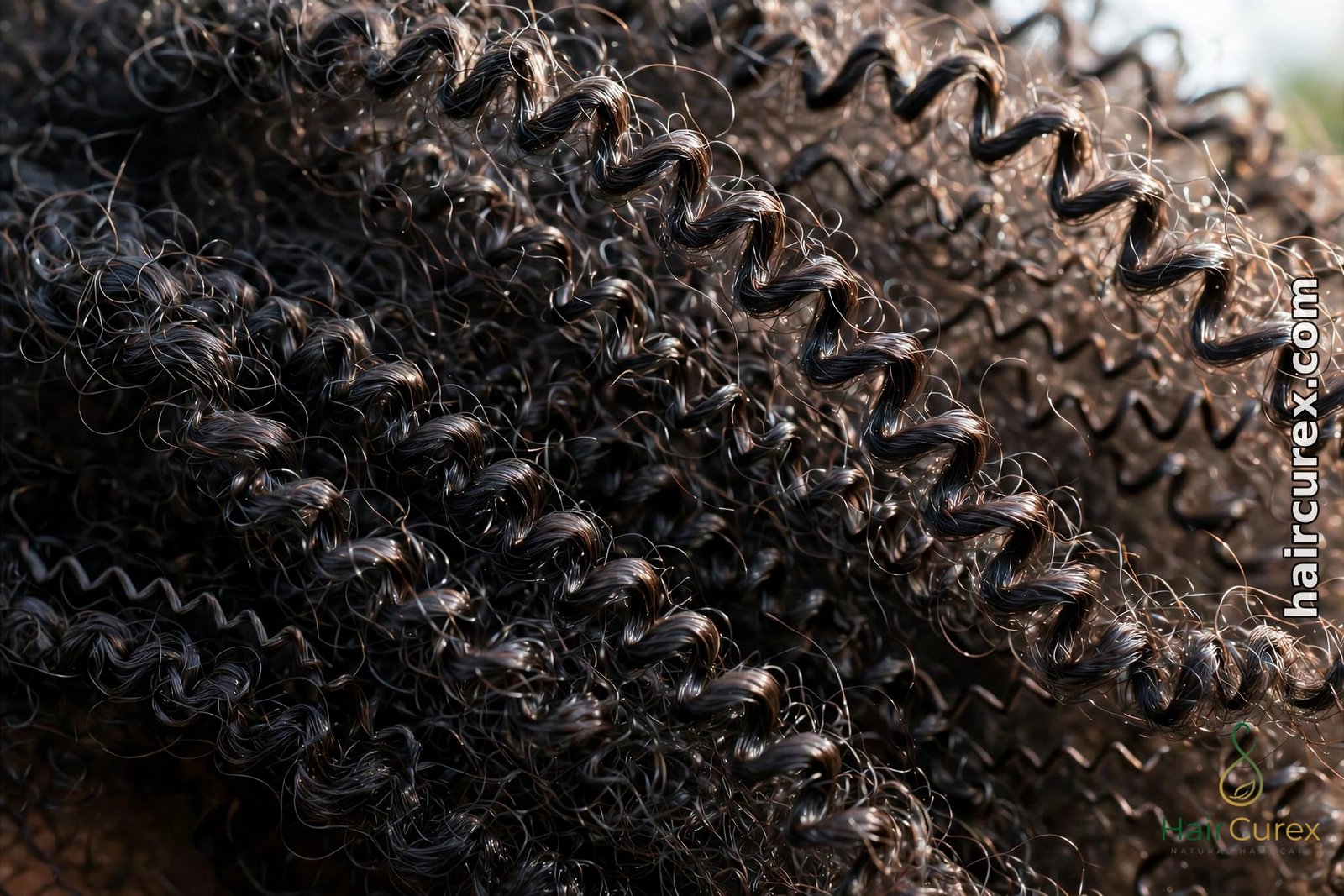
Coily hair is hair that grows in very tight curls or coils, classified as type 4 in the hair typing system that runs from type 1, straight, to type 4, coily. Within type 4 there are three subtypes. Type 4A has tight, springy, S-shaped coils about the width of a crochet needle. Type 4B has tighter, less defined coils with a Z-shaped pattern that bends sharply instead of curling in a loop. Type 4C has the tightest pattern of all, with dense coils that may have no clear curl pattern and can look almost straight when the hair is dry and unstretched, even though it is tightly coiled when wet. Most people have more than one pattern on their head, so you may be mostly 4B with some 4A at the front, or mostly 4C with some 4B at the back.
What makes coily hair different is not just the curl shape. The hair shaft is flatter and more elliptical than straight hair, which makes it bend and twist as it grows. Each bend is a weak point where the hair can break, and the oils from the scalp have a long, winding path to travel down the strand, so the ends stay dry even when the scalp is healthy. That is why coily hair is naturally drier and more fragile than other hair types, and why moisture and gentle handling matter so much. Our guide to curly hair types explains the full 2A to 4C system and how each type behaves.
How to Tell If You Have Coily Hair
The easiest test is the wet-hair test. Wash your hair, let it air-dry without any product, and look at the pattern it forms on its own. Coily hair forms tight coils, zigzags or dense, springy clumps when wet, and the coils are smaller than a pencil in width. If your hair dries into loose S-shaped waves or large, open curls, it is wavy or curly, not coily. If it dries into tight coils that spring up and shrink a lot, it is coily.
- Look at the curl size. Coily hair has coils tighter than a pencil. 4A coils are about the width of a crochet needle, 4B coils are smaller and more zigzag, and 4C coils are the tightest, with little visible curl definition.
- Check the shrinkage. Wet your hair, stretch a strand to its full length, and let it go. If it springs back to half its length or less, that is shrinkage, and it is one of the clearest signs of coily hair.
- Feel the texture. Coily hair often feels dense and springy, and a single strand may feel fine, wiry or coarse. Rub a strand between your fingers: if it feels smooth, it is fine; if it feels bumpy, it is coarse.
- Watch how it dries. Coily hair dries with volume and a halo of frizz if it is not moisturised, and it tangles easily at the ends because the coils wrap around each other.
- Notice how it behaves with water. Coily hair absorbs water quickly and dries slowly, because the dense coils trap water. If your hair takes a long time to dry and shrinks a lot, it is very likely coily.
If you are still unsure, compare your hair with the guides for the closest types. Our 4B hair guide and our 4C hair guide describe the two tightest coily patterns in detail, with the same tell-tale signs and care routines, so you can see which one matches your hair best.
Coily Hair vs Curly and Wavy Hair
Coily, curly and wavy hair are all textured hair, but they behave very differently. Wavy hair, types 2A to 2C, forms loose S-shaped waves and is usually the easiest to manage. Curly hair, types 3A to 3C, forms open, springy curls that are easy to see and define. Coily hair, types 4A to 4C, forms the tightest pattern, with the most shrinkage, the most dryness and the most fragility. The table below compares them at a glance.
| Hair type | Curl pattern | Shrinkage | Moisture needs | Main challenge |
|---|---|---|---|---|
| Wavy (2A-2C) | Loose S-shaped waves | Very little | Light | Frizz and flat roots |
| Curly (3A-3C) | Open, springy curls | Some, up to a third | Moderate | Frizz and definition |
| Coily 4A | Tight S-shaped coils | About half | High | Dryness and tangles |
| Coily 4B | Z-shaped, less defined coils | More than half | High | Dryness and breakage |
| Coily 4C | Densest coils, little definition | Up to 75 percent | Very high | Dryness, tangles and breakage |
What Causes Coily Hair?
Coily hair is caused by the shape of the hair follicle you are born with. Round follicles produce straight hair, oval follicles produce wavy or curly hair, and flat, ribbon-like follicles produce coily hair, because the hair twists as it grows out of an asymmetrical opening. The curl pattern is set by genetics, and it cannot be changed permanently by products, although heat styling, chemical treatments and damage can loosen or alter the pattern temporarily. Your curl pattern can also change over time with age, hormones and hair health, which is why some people find their coils loosen or tighten as they get older.
Coily hair is most common in people of African descent, but it appears in people of many backgrounds, because the genes that shape the follicle vary widely. Two people with coily hair can have very different hair: one may have fine, dense 4C coils that tangle easily, while another has coarse, springy 4A coils that hold a style for days. That is why the care routine matters more than the label. The pattern tells you what your hair tends to do; the routine is what you build around it.
How to Care for Coily Hair
Caring for coily hair comes down to three things: moisture, gentle handling and protection. The routine below is a simple wash-day routine that works for most coily hair. It takes longer than a wash-and-go for straight hair, but it prevents the dryness and breakage that make coily hair hard to manage. If your hair is looser and needs a lighter routine, our wavy hair routine shows how wash day changes for looser textures.
- Pre-poo before you wash. Apply a light oil or conditioner to dry hair 15 to 30 minutes before washing, to protect the hair from losing too much moisture in the shampoo.
- Wash in sections. Divide your hair into four to six sections, and wash one section at a time with a sulphate-free shampoo, focusing on the scalp. Use lukewarm water, not hot water.
- Condition every time. Apply a generous amount of conditioner, detangle with your fingers or a wide-tooth comb while the conditioner is in, and rinse with cool water.
- Deep condition weekly or every two weeks. A deep-conditioning mask restores moisture and elasticity, and it is the single most useful step for dry coily hair.
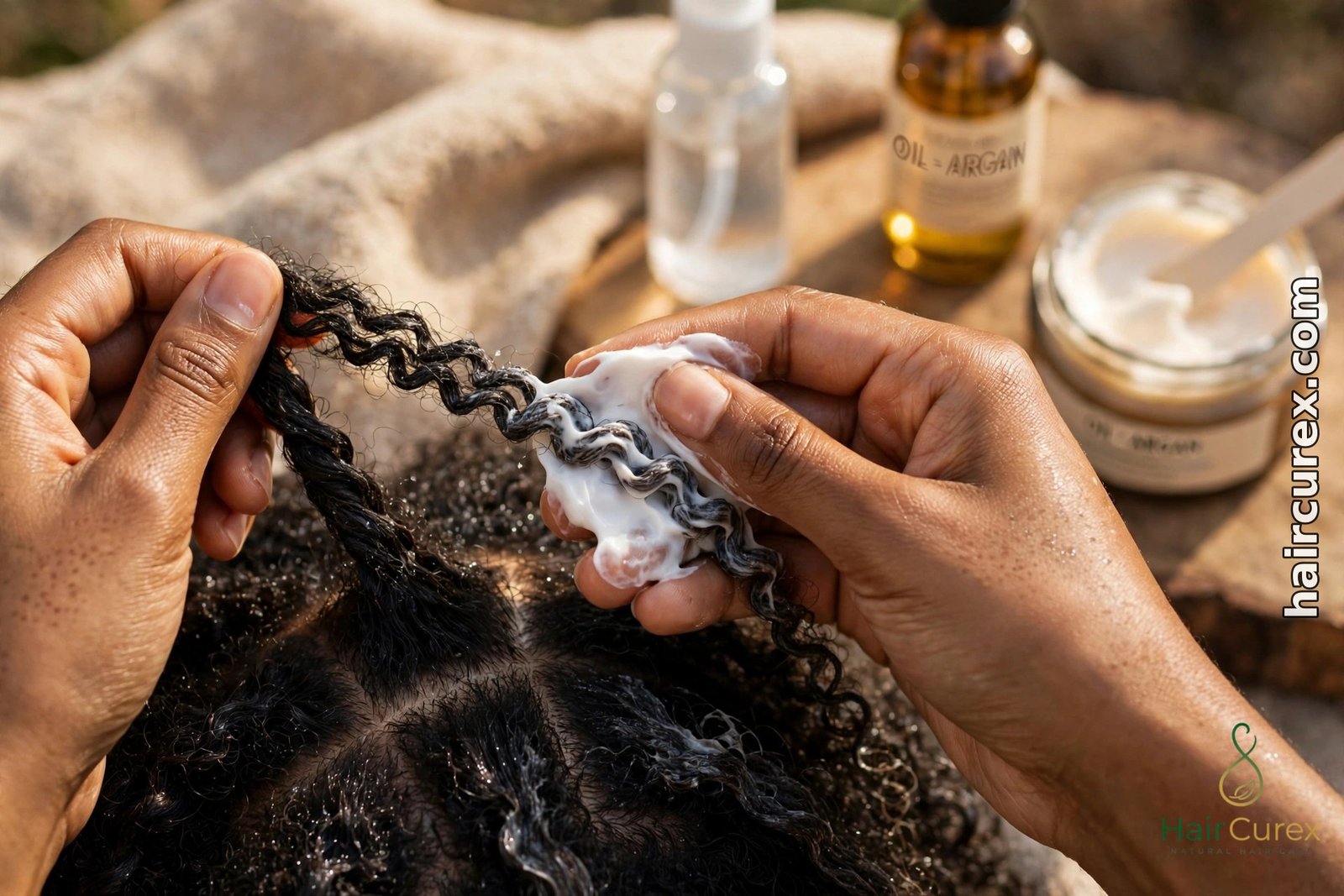
- Moisturise while the hair is damp. Apply a leave-in conditioner, then a cream, then a light oil to seal the moisture in. This is the LOC method, explained in the next section.
- Style gently. Use your fingers or a wide-tooth comb, never a fine-tooth comb on dry hair, and avoid pulling or brushing dry coils, which causes frizz and breakage.
- Protect it at night. Sleep on a satin or silk pillowcase, or wrap your hair in a satin bonnet or scarf, so the hair does not rub against cotton and lose moisture while you sleep.

How to Moisturise Coily Hair
Moisture is the biggest need for coily hair, and the order you apply products in matters as much as the products themselves. The LOC method stands for liquid, oil, cream: first a water-based leave-in conditioner, then a light oil to seal, then a cream to hold the moisture in and define the coils. The LCO method reverses the last two steps, liquid, cream, oil, and it works better for hair that is fine or low porosity, because the cream goes on before the oil seals it. Try both for two weeks each and keep the one that leaves your hair softer for longer.
How often you moisturise depends on your hair. Most coily hair needs moisture every day or every other day, and a full wash every one to two weeks. If your hair feels dry, rough or brittle, it needs more moisture. If it feels limp, mushy or overly soft, it may need protein instead, because hair that is over-moisturised loses its strength. Dermatologists who care for curly and coily hair recommend washing only when the hair needs it, keeping the hair moisturised, taking care of the scalp, and detangling gently, and their curly hair care tips are a good, source-checked starting point for any coily routine.
What Is Hair Shrinkage and How Do You Manage It?
Hair shrinkage is the difference between the length of your hair when it is stretched and its length when it is dry and coiled. Coily hair can shrink by 50 to 75 percent, which is why hair that reaches your shoulders when stretched may look like it barely reaches your ears when dry. Shrinkage is not damage, and it is not a problem to fix. It is a sign that your hair is healthy and elastic, because only springy, moisturised coils shrink this much. Our guide to hair shrinkage explains why it happens and how to measure it.
If you want to show more length, stretch your hair while it dries. Twist-outs, braid-outs, banding and African threading all stretch the coils gently and give you length without heat. Blow-drying on a low heat with a diffuser, or using a hair dryer with a comb attachment, also stretches the hair, but use heat sparingly and always use a heat protectant, because heat damage can loosen the curl pattern permanently. If you want definition instead of length, let the hair shrink: apply your styling product to wet hair, let it air-dry without touching it, and enjoy the volume.

Protective Styles for Coily Hair
Protective styles tuck the ends of your hair away so they do not rub against clothes, tangle or dry out. They are one of the best ways to keep coily hair healthy and to retain length. Two-strand twists, flat twists, braids, cornrows, Bantu knots and wigs are all protective styles, as long as they are not installed too tightly. Styles that pull at the hairline can cause traction alopecia, a type of hair loss from tension, so a style should never hurt. If it hurts, it is too tight, and it should be loosened or taken out.
Keep a protective style in for two to six weeks, and keep moisturising the hair and scalp while it is in. Wash your scalp gently, spray it with a water-based leave-in, and oil the scalp lightly. When you take the style out, detangle gently and deep condition before you restyle. Protective styles are not a reason to skip wash day, and they work best as part of a routine that also includes regular washing, conditioning and moisture. The American Academy of Dermatology’s healthy-hair tips cover the same gentle habits, such as using conditioner, limiting heat and protecting the hair while you sleep, that keep coily hair healthy in any style.

5 Mistakes to Avoid with Coily Hair
- Brushing dry hair. Brushing dry coily hair breaks the curl pattern, causes frizz and snaps the hair. Detangle only when the hair is wet and coated in conditioner.
- Skipping conditioner. Coily hair needs conditioner every wash and a deep conditioner regularly. Shampoo alone leaves it dry and tangled.
- Using too much heat. Frequent flat-ironing and blow-drying on high heat can loosen the curl pattern permanently. Use heat rarely, on low settings, with a heat protectant.
- Installing styles too tightly. Tight braids, twists and ponytails pull on the hairline and can cause traction alopecia. A style should never hurt.
- Ignoring the scalp. A dry, flaky or sore scalp affects the hair that grows from it. Wash the scalp, moisturise it lightly, and see a dermatologist if it stays sore, very flaky or itchy.
Frequently Asked Questions
What is coily hair?
Coily hair is the tightest curl pattern, types 4A, 4B and 4C, with dense, springy coils that form tight curls, zigzags or no clear curl pattern at all. It is caused by flat, ribbon-like hair follicles, it shrinks a lot when it dries, and it needs more moisture and gentler handling than other hair types.
How do I know if I have coily hair?
Wash your hair and let it air-dry without product. If it forms tight coils or zigzags smaller than a pencil, springs up a lot, and shrinks to half its stretched length or less, you have coily hair. If it dries into loose waves or large open curls, it is wavy or curly instead.
Is coily hair the same as curly hair?
No. Curly hair, types 3A to 3C, has open, springy curls that are easy to see and define. Coily hair, types 4A to 4C, has much tighter coils or zigzags, more shrinkage, more dryness and more fragility. Both are textured hair, but coily hair needs more moisture and gentler care.
How often should I wash coily hair?
Most people with coily hair wash every one to two weeks, with a deep conditioner each time. Wash more often if your scalp gets oily or itchy, and less often if your hair feels dry. Between washes, refresh the hair with water and a leave-in conditioner, and co-wash with conditioner if the hair needs moisture but not a full shampoo.
Why does coily hair shrink so much?
Coily hair shrinks because the tight coils spring up as they dry, pulling the ends closer to the scalp. Shrinkage of 50 to 75 percent is normal for coily hair and is a sign of healthy, elastic coils, not damage. Twist-outs, braid-outs and banding stretch the hair gently if you want to show more length.
Can coily hair grow long?
Yes. Coily hair grows at about the same rate as other hair, roughly half an inch a month, but it looks shorter because of shrinkage, and it breaks more easily because it is dry and fragile. Keeping it moisturised, handling it gently, and wearing protective styles helps you keep the length you grow.
Coily hair is not difficult hair. It is hair with a tight pattern, a high need for moisture and a low tolerance for rough handling. Once you know your pattern, moisturise on a regular schedule, detangle gently, protect your hair at night and in styles, and let shrinkage be a sign of healthy coils, coily hair becomes much easier to live with, and much easier to love.