

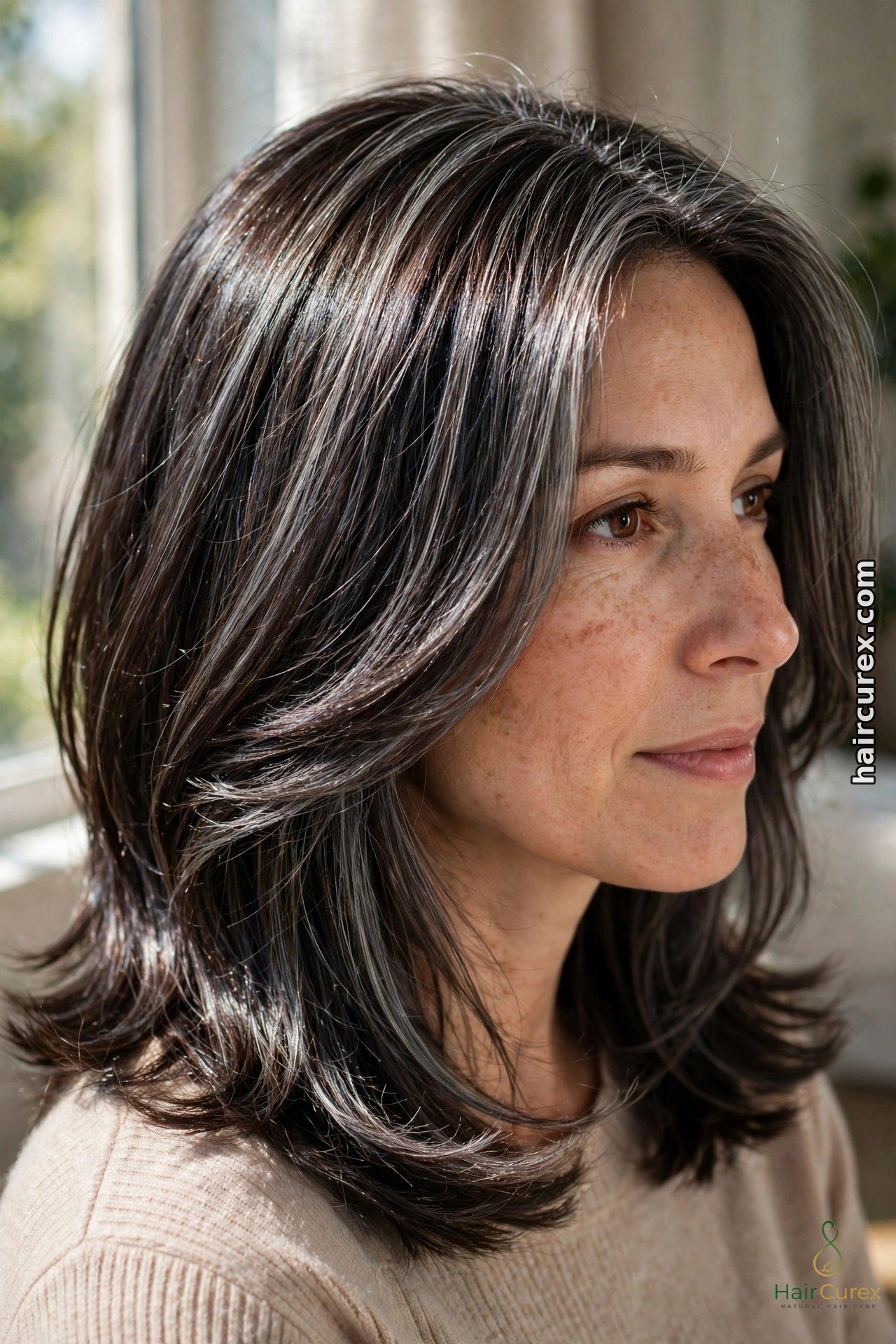
Gray blending for dark hair is a coloring technique that weaves your natural silver strands into the rest of your hair instead of covering them up. Rather than dyeing everything one flat dark shade, a colorist adds fine highlights, lowlights and a sheer gloss so the gray reads as dimension — like intentional silver streaks — instead of regrowth. On dark hair the effect is especially striking, because the contrast between dark strands and silver is at its widest, and a good blend turns that contrast from a problem into the look itself. This guide explains how gray blending for dark hair works, what it honestly costs, how long it lasts, and when full coverage is the better choice.
Quick answer: Gray blending for dark hair uses fine highlights, lowlights and a demi-permanent gloss to weave silver strands into dark hair so there is no harsh regrowth line. It typically costs $120–$250 for a first salon session and $90–$180 for maintenance, lasts 8–12 weeks before a refresh, and works best when you are less than about 50% gray. On dark hair it usually needs some lightening of the surrounding hair, because gray cannot be darkened to match — the dark hair has to come up to meet the silver.
What Is Gray Blending for Dark Hair?
Gray blending for dark hair is not one single service. It is a custom mix of techniques — highlights, lowlights, babylights, balayage and a demi-permanent gloss — chosen for how much gray you have, where it sits, and how dark your base color is. The goal is always the same: make the gray look deliberate. Instead of a solid wall of dark dye with a silver stripe appearing at the part within weeks, the colorist breaks up the boundary between pigmented hair and gray hair so new growth blends in instead of announcing itself.
That is the core difference from traditional gray coverage. Coverage paints over the gray with permanent color until it disappears, which looks perfect on day one and then grows out with a visible line. Blending keeps the gray and disguises it as dimension. The silver is still there — it just reads as highlights. That is why blending grows out so gracefully and why people who switch to it usually visit the salon far less often.
On dark hair, blending takes more planning than on light hair. On blonde or light brown hair, the gray is already close in tone to the surrounding hair, so a gloss alone can soften it. On dark brown or black hair, the gap between the darkest strands and the white ones is large, so the colorist has to build mid-tones that sit between the two. Gray cannot be made darker to match your hair — the surrounding dark hair has to be lightened up to meet the silver. That usually means fine highlights or balayage through the areas where gray shows most, plus a toner that ties everything together. Expect it to take longer and cost more than a blend on lighter hair, and if you have old box color in the lengths, expect the colorist to talk about doing it across two appointments.
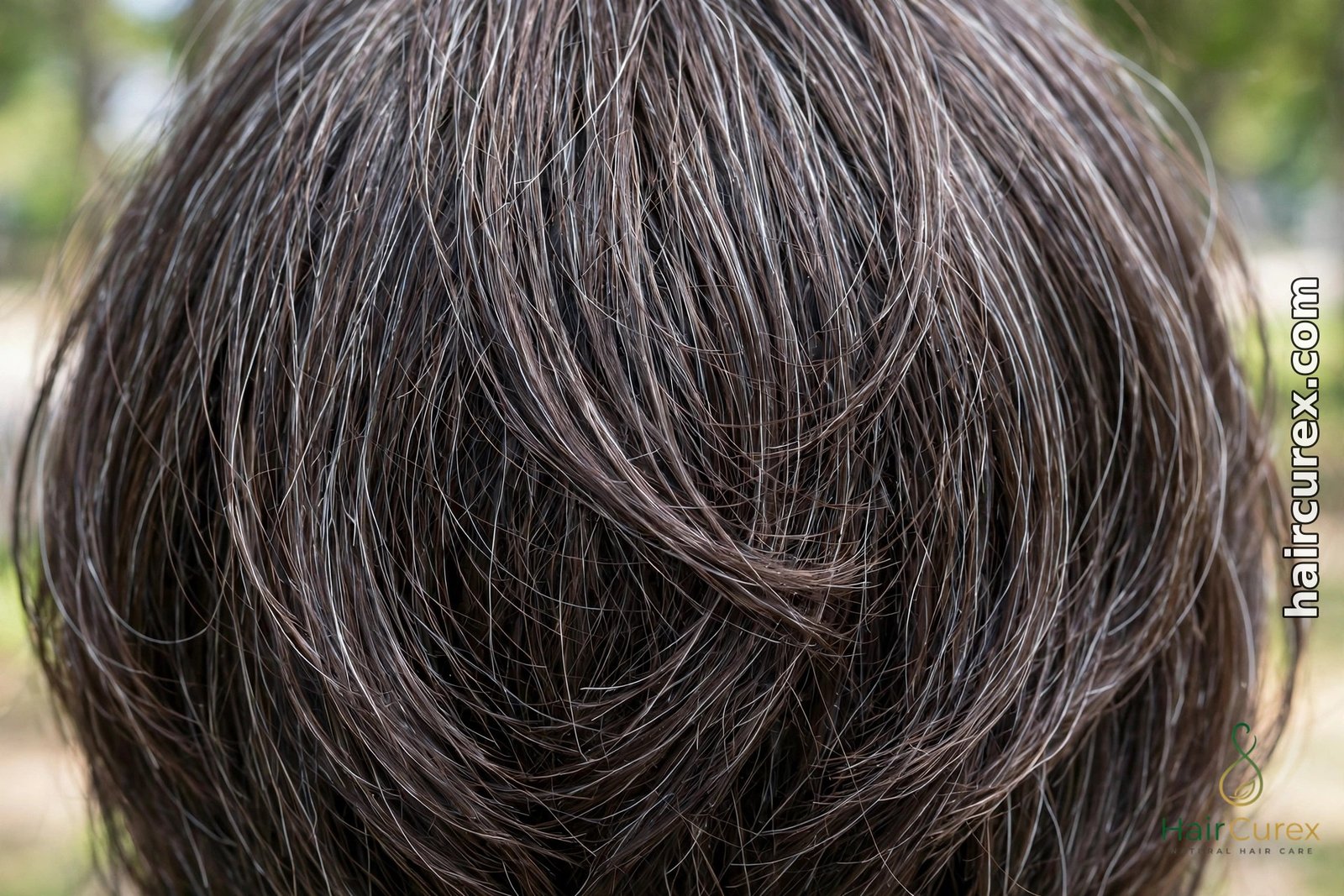
How Gray Blending for Dark Hair Works in the Salon
A gray blending appointment is a consultation first and a color service second. A good colorist will look at your gray percentage, your natural depth, your hair’s history — especially any box dye or henna — and how you wear your part. The plan that follows is usually built from several of these techniques.
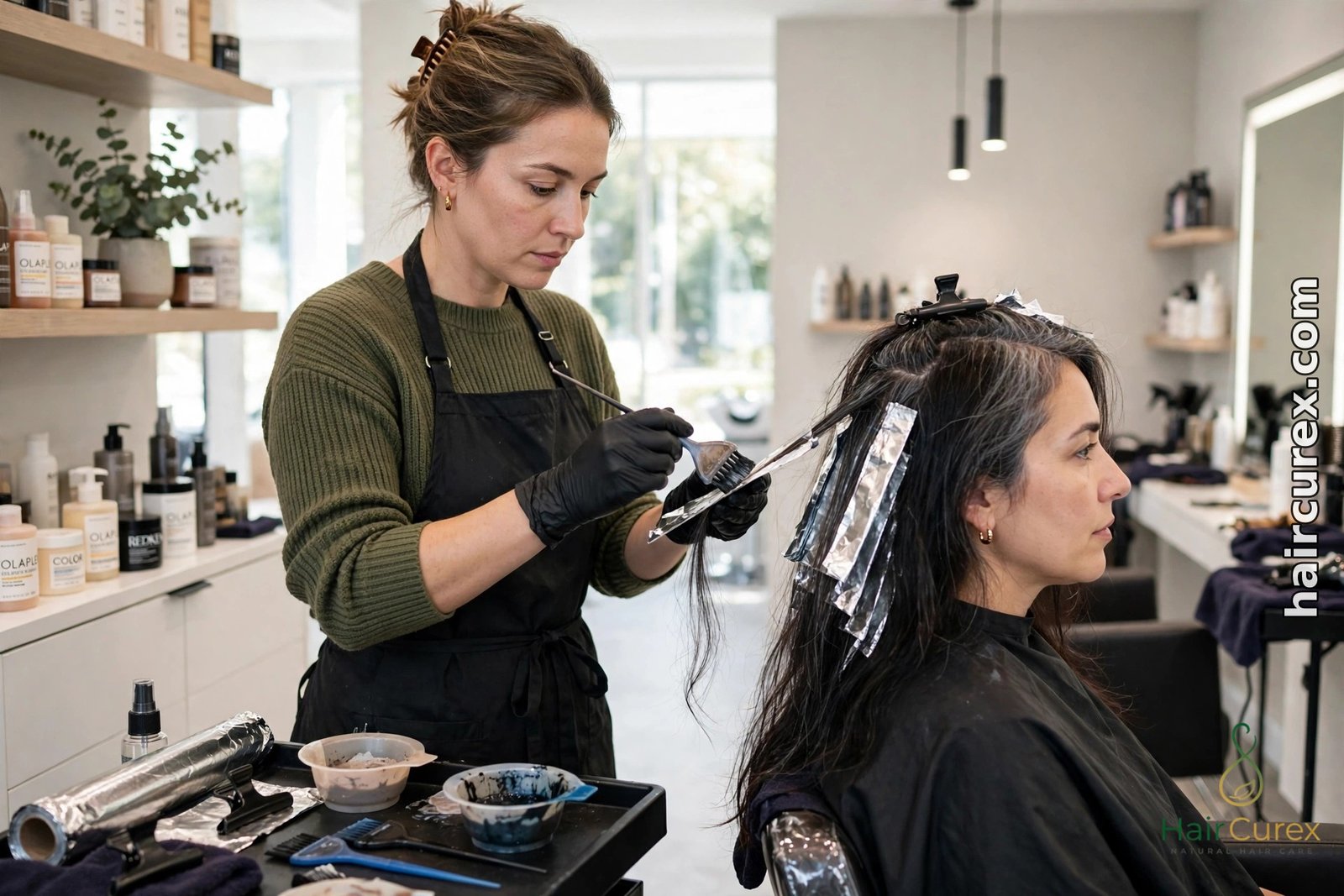
Highlights and babylights
Fine highlights, or very fine babylights, are the workhorse of gray blending on dark hair. The colorist lightens thin strands around the face, at the part and through the crown — exactly where gray appears first — so the silver strands sit among lighter pieces instead of standing out against dark ones. The lighter pieces should be only one or two levels above your base, not platinum, or the result looks striped rather than blended.
Lowlights
Lowlights do the opposite job: darker pieces woven back into the gray-heavy areas to break up a solid block of silver. They are especially useful if your gray is concentrated at the temples or the crown, where it can otherwise read as a solid patch. The lowlights should match your natural depth, not go darker than it.
Balayage
Balayage — hand-painted lightening through the mid-lengths and ends — gives the softest grow-out of all the techniques, because there is no foil line at the root. On dark hair it is often combined with a smoky root, a darker toner applied at the roots that keeps regrowth soft so the line never arrives all at once. A balayage-based blend is the lowest-maintenance version of the look.
Demi-permanent gloss or toner
The gloss is the finishing step that ties the blend together. A demi-permanent color is mixed to your exact tone and applied at the shampoo bowl — at one Fresno salon it takes about ten minutes and is booked as a 30-minute add-on. It tones the gray down so it reads as softness instead of contrast, adds shine, and then fades gradually on its own over about four weeks, without leaving a hard line. Because it is demi-permanent, it deposits color without lifting, which means it cannot lighten dark hair — it can only refine what is already there.
| Technique | What it does | Best for | Upkeep |
|---|---|---|---|
| Fine highlights / babylights | Lightens thin strands so gray reads as dimension | Gray at the part, temples and crown | 8–12 weeks |
| Lowlights | Adds darker pieces to break up solid gray patches | Heavy gray at temples or crown | 8–12 weeks |
| Balayage + smoky root | Soft, hand-painted lightening with a darker root | Lowest-maintenance grow-out | 10–12+ weeks |
| Demi-permanent gloss | Sheer tint that softens gray and adds shine | First-time blenders; between full sessions | About 4 weeks |
| Face-framing pieces | Lightens the strands around the face only | Early gray, mostly at the temples | 8–12 weeks |
A first blending session on dark hair usually takes two to three hours in the salon, and a full blend with a gloss can run three to four hours. The appointment is longer than a root touch-up because the colorist is building dimension strand by strand rather than painting one color over everything.
Gray Blending vs. Full Gray Coverage
Blending and coverage solve the same problem in opposite ways, and the right choice depends on how much gray you have and how often you want to sit in the salon chair. This comparison makes the trade-off plain.
| Factor | Gray blending | Full gray coverage |
|---|---|---|
| What happens to the gray | Stays, disguised as dimension | Covered completely |
| Regrowth line | Soft, no hard line | Visible line at the roots |
| Salon visits | Every 8–12 weeks | Every 4–6 weeks |
| First session cost | Typically $120–$250 | Typically $70–$150 |
| Maintenance cost | Typically $90–$180 | Typically $70–$150 |
| Grow-out | Nearly invisible | Obvious stripe at the part |
| Best for | Under ~50% gray, or people who like the silver | Over ~50% gray, or people who want gray gone |
Coverage is the honest answer if you are more than about 50% gray and want the silver gone entirely — blending cannot hide that much gray, and trying to will look unfinished. Blending is the better choice if you have started to like the silver at your temples, if you want fewer appointments, or if you are growing out old color and want the transition to look intentional rather than neglected. If you are unsure which camp you fall into, preview the shade on your own photo with an AI grey hair preview or one of the AI hair color changer apps before you book, and take the result to your consultation.
How Much Does Gray Blending for Dark Hair Cost?
There is no single price for gray blending for dark hair, because it is not one fixed service — it is a custom mix of highlights, lowlights and gloss, priced on your hair length, how much gray you have, and your city. The ranges below come from salons that publish their prices, so treat them as ballparks, not quotes. A consultation is the only way to get an exact number for your hair.
A San Francisco color studio that specializes in gray blending reports that a first session typically costs $120–$250, with maintenance visits at $90–$180. In premium markets like San Francisco itself, expect the higher end: $150–$350 for a first session and $100–$200 for maintenance. Big-chain salons advertise gray blending as low as $30–$60, while master-colorist studios can run several hundred dollars or more. The same studio notes that a first gray blending session at their salon typically runs about $250 and more, depending on how long the work takes — dark hair, which needs more lightening, sits at the higher end of any range.
There is also a cheaper entry point. Some salons offer gray blending as a gloss add-on to another service: one Fresno salon lists its grey blending add-on from $65, booked with a haircut, and notes that the demi-permanent color itself takes about ten minutes at the shampoo bowl. A Canadian salon that publishes its prices lists a partial highlight blend from $165, a full highlight blend from $215, and a toner and gloss refresh from $75. The pattern is consistent everywhere: the more lightening your dark hair needs, the more the first session costs, and the gloss refresh between full sessions is the cheapest visit of all.
What decides your price, in practice, is the combination of five factors: how much gray you have, how long and thick your hair is, how dark your base is and whether it needs lifting, whether there is old box color to work around, and where the salon is located. A money-piece or face-frame blend around the temples is the cheapest way in; a full-head blend on long, dark, previously colored hair is the most expensive. Always ask whether the quote includes the gloss and the blow-dry, because some salons price those separately.
The honest long-term math favors blending. Full gray coverage needs a root touch-up every 4–6 weeks to hide the harsh line where new growth meets dyed hair, which works out to roughly $1,100–$1,400 a year at typical prices. Gray blending for dark hair stretches comfortably to 8–12 weeks because there is no hard line to chase, so you book roughly half as many appointments — roughly $700–$900 a year. That saving disappears if you have very little gray, because then straightforward all-over coverage is the simpler, quicker and genuinely cheaper service.
How Long Does Gray Blending for Dark Hair Last?
It depends on which part of the blend you mean. The highlight and lowlight work lasts 8–12 weeks before you will want a refresh, and many people stretch it further — the dimensional color grows out without a visible line, so there is no deadline the way there is with coverage. Most clients return every 10–12 weeks, sometimes longer, and a gloss refresh around the eight-week mark can carry the look further still.
The demi-permanent gloss is the short-lived part: it fades gradually over about four weeks, softening a little with every wash, so the gray comes back into view slowly instead of showing up as a stripe at the part. That is a feature, not a flaw — the fade is what makes blending low-commitment. If you want the gloss to last, wash less often, use cool water and color-safe shampoo, and add a gloss refresh between full sessions.
Hair grows about half an inch a month, so after three months you have roughly an inch and a half of new growth at the roots. With coverage, that inch and a half is a visible stripe. With blending, it is just more hair joining the dimensional pattern — which is why the refresh interval can be twice as long.
Gray Blending for Dark Hair at Home
You can do a version of gray blending for dark hair at home, but the honest limit is important: demi-permanent color and glosses cannot lighten hair. On dark hair, an at-home gloss will soften and shine the gray you already have, and it will make the blend look richer — but it cannot create the lighter pieces that make a blend work on dark hair. That part needs lightening, and lightening dark hair evenly is salon work. If you try to bleach fine sections at home, you risk patchy, brassy results and damage that costs more to fix than the salon visit would have.

What works well at home is the maintenance layer. A demi-permanent gloss in a shade close to your natural color, applied every four to six weeks, keeps the silver soft and the tone even. A color-depositing conditioner in a silver or ash tone can extend the blended look for another few weeks. Root touch-up sprays and powders cover the part line between appointments, and they wash out with the next shampoo, so there is no commitment. These are all genuinely useful — just do not expect them to replace the first salon session on dark hair.
Safety first, whichever route you take. Do a patch test 48 hours before using any dye, as the U.S. Food and Drug Administration advises, and a strand test before applying color to your full head. Wear gloves, follow the timing on the box exactly, and never mix different dye formulas. If your hair has been colored with henna or metallic dyes, tell your colorist — those products react unpredictably with lightener. And if you have a sensitive scalp or a history of reactions to hair dye, a salon consultation is worth more than any at-home product.
Who Is Gray Blending for Dark Hair Best For?
Gray blending for dark hair suits most people with dark hair, but it suits some situations better than others. It is an excellent fit if your gray is scattered rather than solid — 10% to 50% gray, concentrated at the temples, the part and the crown. It is also the best choice if you are growing out old color and want the transition to look deliberate, or if you have started to like the silver and want to keep it while losing the “regrowth” look.
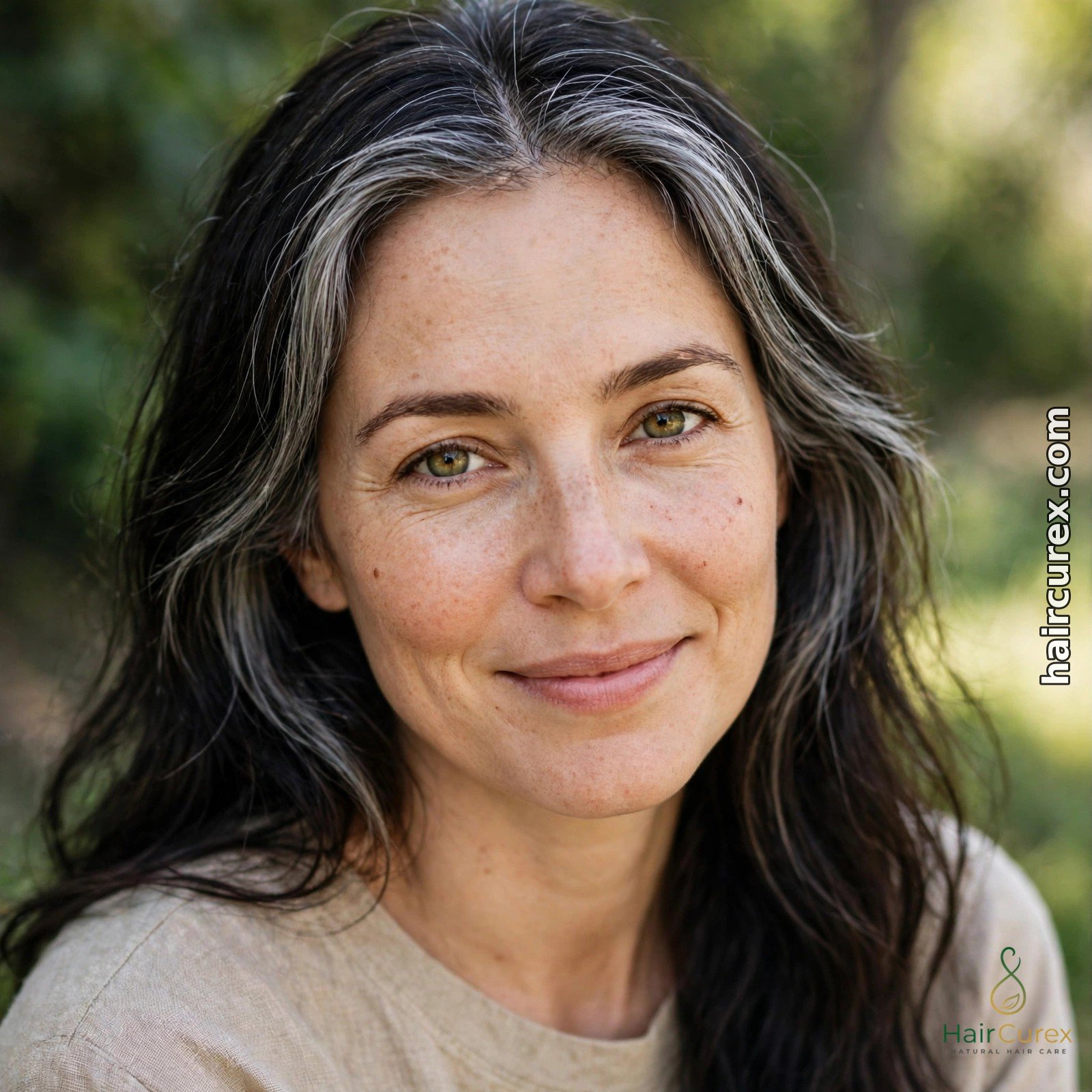
It is a weaker fit if you are more than about 50% gray and want the silver gone, if you want one uniform color with no dimension, or if you are not willing to pay more for the first session than a root touch-up costs. Very dark, previously box-colored hair is also a slower project: the colorist may need two appointments to lift the old color safely, and the result will still be a blend, not a single flat shade. None of that makes blending wrong — it just means the consultation matters more than the booking.
Skin tone plays a part too. The silver pieces in a blend are cool-toned, so they flatter cool and neutral undertones most naturally. If your skin is warm-toned, ask your colorist to keep the highlights in a neutral ash rather than a stark silver, and to leave warmth around the face. Our guide to the best brunette shades can help you see which depths work with your undertones before you commit.
How to Make Gray Blending for Dark Hair Last Longer
The blend itself is low-maintenance, but a few habits decide whether it still looks good at week ten or has gone brassy by week four. Gray and blended hair goes warm faster than pigmented hair, because there is no natural pigment left to anchor the tone — so the anti-brass routine matters more here than with ordinary color.
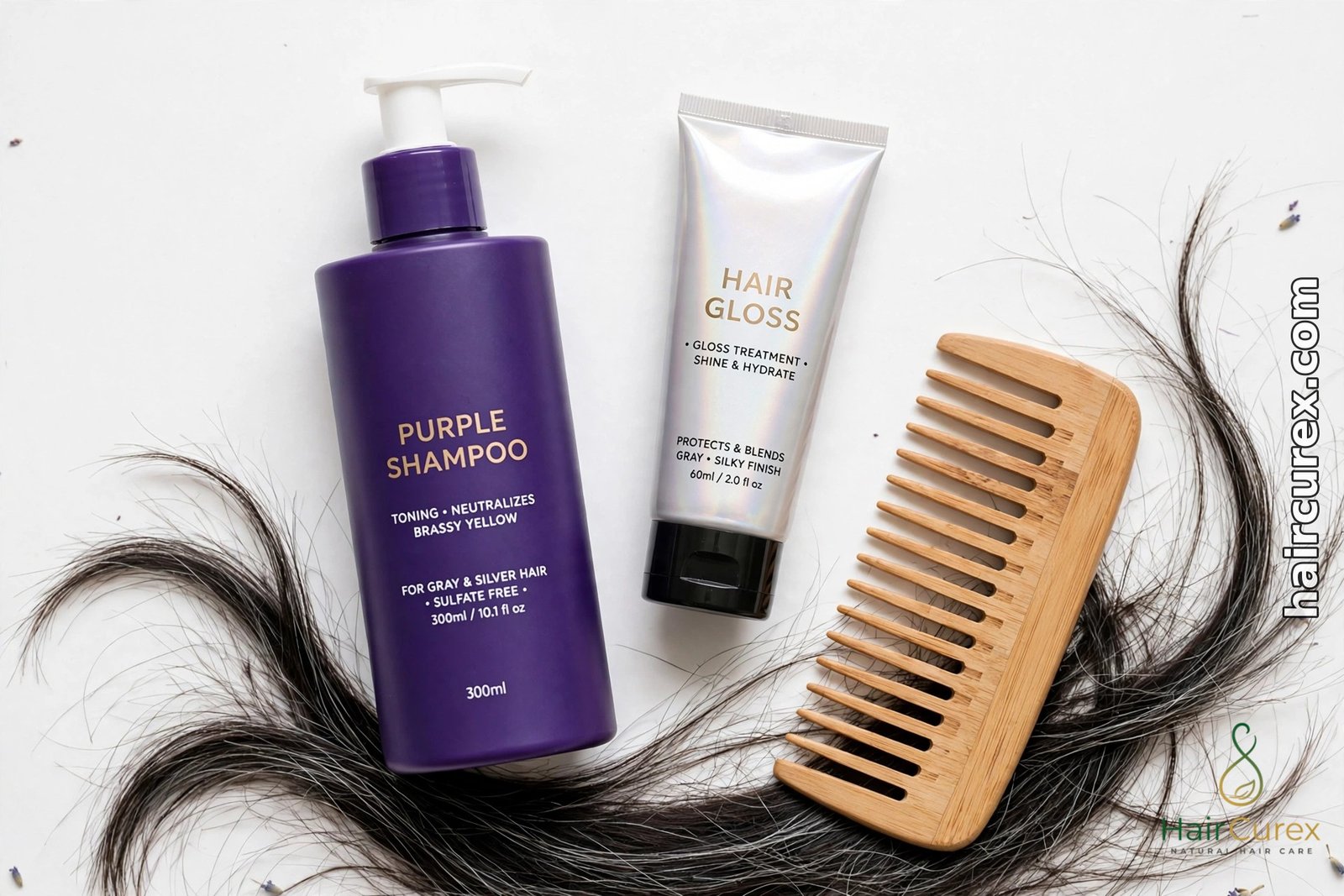
Use purple shampoo once a week. Purple shampoo is the core of the routine: the purple pigment cancels the yellow and orange tones that creep in as the toner fades. Use it once a week, leave it on for 3–5 minutes, then condition. Our purple shampoo guide explains which formulas suit dark hair and how long to leave them on.
Wash less, and wash cool. Shampoo two or three times a week instead of daily, and rinse with lukewarm or cool water. Hot water opens the cuticle and lets toner escape faster. Dry shampoo between washes keeps the roots fresh without another wash cycle.
Use color-safe, sulfate-free products. Sulfates strip toner and gloss, so choose a shampoo labelled color-safe or sulfate-free, and follow with a conditioner for color-treated hair. A weekly deep-conditioning mask matters too, because lightened hair is more porous and loses tone faster when it is dry.
Protect from sun and heat. UV light fades cool tones and brings out warmth, so wear a hat in strong sun or use a UV-protectant spray. Keep heat styling below 180°C (350°F) and always use a heat protectant.
Book a gloss refresh at eight weeks. A toner and gloss refresh between full blending sessions is the cheapest salon visit in the cycle, and it restores the cool tone and shine in under an hour. It is the step that separates a blend that still looks intentional at week ten from one that has gone warm and dull.
5 Mistakes to Avoid with Gray Blending for Dark Hair
- Expecting one session to finish dark hair. Dark hair usually needs lightening to meet the gray, and previously colored hair may need two appointments. A colorist who promises a full blend in one quick session is cutting corners.
- Going too light with the highlights. Platinum pieces against dark hair look striped, not blended. The highlights should sit one or two levels above your base so the silver reads as dimension.
- Skipping the gloss. The gloss is what ties the highlights, lowlights and gray together into one tone. Without it, the pieces look separate and the gray looks accidental.
- Bleaching fine sections at home. Lightening dark hair evenly is the hardest part of the service. At-home bleach on dark hair usually goes patchy and brassy, and the correction costs more than the salon visit would have.
- Skipping the patch test. Blending uses the same dye chemistry as any color service. A patch test 48 hours before is a safety step, not a formality — especially if you are trying a new formula or salon.
Gray blending for dark hair earns its popularity because it solves the real problem — the harsh line between dark dye and silver regrowth — instead of painting over it every month. It costs more the first time than a root touch-up, but it lasts 8–12 weeks, grows out without a stripe, and lets you keep the silver you have started to like. Start with a consultation, ask for fine highlights one or two levels above your base with a demi-permanent gloss to tie it together, and treat the gloss refresh and purple shampoo as part of the color rather than optional extras. If you are still deciding between blending and coverage, browse more hair color ideas first — and remember that the best version of this look is the one built for your gray percentage, your base color and your skin tone, not a photo on a box.
Frequently Asked Questions
How long does gray blending last on dark hair?
Gray blending on dark hair lasts 8–12 weeks before a refresh, and many people stretch it to 10–12 weeks or longer because the dimensional color grows out without a visible line. The demi-permanent gloss fades faster, over about four weeks, and a gloss refresh around week eight keeps the tone cool between full sessions.
How much does gray blending for dark hair cost?
A first gray blending session typically costs $120–$250, with maintenance visits at $90–$180, according to salons that publish their prices. In premium cities the first session can run $150–$350. A gloss add-on can cost from $65 with another service. Dark hair usually sits at the higher end because it needs more lightening, and the exact price depends on your hair length, gray percentage and city.
Does gray blending work on dark hair?
Yes, and it is especially effective on dark hair, where scattered silver strands stand out most. It needs more planning than on light hair, because the surrounding dark hair usually has to be lightened to meet the silver — gray cannot be darkened to match. Fine highlights, lowlights and a demi-permanent gloss build the mid-tones that sit between the two.
Does gray blending damage hair?
It can, but only as much as any highlighting service. The lightening step is what stresses the hair, so the risk depends on how far your dark hair has to be lifted and what is already on it. A good colorist lifts gradually, sometimes across two appointments, and a deep-conditioning routine afterwards keeps lightened hair healthy. The demi-permanent gloss itself is gentle and deposits color without lifting.
Can I do gray blending at home on dark hair?
Partly. A demi-permanent gloss, color-depositing conditioner and root touch-up products work well at home for maintaining a blend. But the lightening step that makes blending work on dark hair — fine highlights lifted one or two levels — is salon work. At-home bleach on dark hair usually goes patchy and brassy, so book the first session with a colorist and maintain it at home afterwards.
Is gray blending better than covering gray?
It depends on what you want. Gray blending is better if you are under about 50% gray, like the silver, and want fewer salon visits with no harsh regrowth line. Full coverage is better if you are over about 50% gray and want the silver gone entirely, or if you want one uniform color. Blending usually costs less over a year because visits stretch to 8–12 weeks instead of every 4–6 weeks.