


Quick answer: The best hair straighteners for you depend on your hair type, not the price tag. Fine or damaged hair needs ceramic plates at 250–300°F (120–150°C). Thick, coarse or curly hair needs titanium or tourmaline plates at 350–400°F (180–200°C). A 1-inch plate suits most hair lengths, wider plates suit long thick hair, and a digital temperature display is the one feature worth paying for. Always use a heat protectant, work in small sections, and never pass over the same section more than twice.
Hair straighteners look simple — two hot plates and a handle — but the wrong one can leave your hair dry, frizzy or broken, while the right one gives you smooth, shiny hair in minutes. The difference comes down to three choices: the plate material, the plate width, and the temperature you use. Get those three right for your hair type and almost any decent flat iron will do a good job. Get them wrong and even an expensive straightener will damage your hair. This guide to hair straighteners compares every option honestly, so you can buy once and buy right.
Hair Straighteners: Plate Materials Compared

The plate material is the most important choice, because it decides how heat reaches your hair. Ceramic plates heat evenly and gently, which is why they suit fine, thin or damaged hair. The heat spreads across the whole plate instead of concentrating in hot spots, so the hair is straightened with less scorching. Ceramic irons usually heat up a little more slowly and the plates can chip or wear down after a couple of years of heavy use, but for everyday straightening of normal to fine hair, ceramic hair straighteners are the safest starting point.
Titanium plates are the opposite: they heat up fast, hold a very high temperature, and transfer heat to the hair quickly. That makes titanium hair straighteners the best choice for thick, coarse or very curly hair that resists straightening — one slow pass with titanium can do what takes ceramic three passes. The trade-off is that titanium can be too hot for fine or damaged hair, and a cheap titanium iron without precise temperature control can easily overheat a section. If your hair is fine, titanium is usually the wrong material.
Tourmaline is a ceramic plate infused with the mineral tourmaline, which releases negative ions as it heats. In practice that means less static and less frizz, and a smoother, shinier finish — which is why tourmaline hair straighteners are a popular pick for frizzy or wavy hair. Most tourmaline irons are really ceramic-tourmaline blends, so they behave like ceramic irons with a frizz-fighting bonus. They cost a little more than plain ceramic, and for frizzy hair the extra cost is usually worth it. There is no single best material — the right one is the one that matches your hair.
| Plate material | Best for | Strengths | Watch out for |
|---|---|---|---|
| Ceramic | Fine, thin, damaged or normal hair | Even, gentle heat; few hot spots; affordable | Heats slower; plates can chip or wear over time |
| Titanium | Thick, coarse or very curly hair | Heats fast and very hot; straightens in fewer passes | Can be too hot for fine hair; needs precise temperature control |
| Tourmaline | Frizzy, wavy or dull hair | Reduces frizz and static; shiny finish | Usually a ceramic blend; costs a bit more |
| Ceramic + tourmaline | Most hair types, especially frizz-prone | Gentle heat plus frizz control; good all-rounder | Quality varies a lot between brands |
Two details matter as much as the material. First, look for floating plates — plates that move slightly on a spring — because they grip the hair evenly and you do not have to squeeze hard to get contact. Second, avoid the cheapest hair straighteners with a single fixed temperature. A flat iron that only has “on” and “off” gives you no control, and uncontrolled heat is how hair gets damaged. If you straighten your hair often, a salon keratin treatment is another way to cut down on daily heat — our guide to keratin treatment cost, results and how long it lasts explains when it is worth it.
What Plate Width Do You Need?

On hair straighteners, plate width decides how much hair each pass covers, and the right width depends on your hair length and thickness. A narrow plate, around half an inch wide, is best for short hair, bangs and getting close to the roots, and for curling the ends under or flicking them out. It is slow on long hair, because each pass covers so little, but it is the only width that works well on pixie cuts and short bobs.
A 1-inch plate is the standard width and the best choice for most people. It handles shoulder-length to long hair well, works on fine and medium hair, and is narrow enough to reach the roots and style bangs. If you are buying your first pair of hair straighteners and you are not sure which width to get, buy a 1-inch plate — it is the most versatile size there is.
Wide plates, 1.5 to 2 inches, are made for long, thick hair. Each pass covers more hair, so you finish faster and with fewer passes overall, which means less total heat exposure.
The trade-off is that wide plates are clumsy near the roots and useless for short hair or bangs, and they make it harder to curl the ends. If your hair is long and thick, a wide plate will save you real time every morning. If your hair is short or fine, it will only get in the way. As a rule: short hair needs a narrow plate, medium hair needs a 1-inch plate, and long thick hair earns a wide plate.
The Right Temperature for Your Hair Type

Temperature is where most hair damage happens, because most people use far more heat than their hair needs. Hair is made of keratin, and keratin starts to break down at high heat — hair begins to burn at around 450°F (232°C), which is why no one should ever straighten at or above that temperature. The right temperature for your hair straighteners is the lowest one that straightens your hair in one or two slow passes. Start low and go up in small steps until the hair stays straight; if one slow pass does the job, that temperature is enough.
Fine, thin or damaged hair needs the least heat, usually 250–300°F (120–150°C). Normal, medium hair usually straightens well at 300–350°F (150–180°C). Thick, coarse or tightly curly hair needs more, usually 350–400°F (180–200°C), and even then it should never go above 400°F for regular use. Hair that has been bleached, coloured or chemically treated is more fragile than virgin hair, so drop the temperature by about 25°F and do a strand test first: straighten one hidden section at your chosen temperature and check that it stays smooth without looking dry or feeling rough.
| Hair type | Recommended temperature | Best plate material |
|---|---|---|
| Fine or thin hair | 250–300°F (120–150°C) | Ceramic |
| Damaged, bleached or coloured hair | 250–300°F (120–150°C) | Ceramic or tourmaline |
| Normal, medium hair | 300–350°F (150–180°C) | Ceramic or tourmaline |
| Wavy or frizzy hair | 300–375°F (150–190°C) | Tourmaline |
| Thick or coarse hair | 350–400°F (180–200°C) | Titanium or tourmaline |
| Tight curls or coily hair | 350–400°F (180–200°C) | Titanium |
A digital temperature display on hair straighteners is worth paying for, because dial settings without numbers are guesswork — “medium” on one iron can be 300°F and on another 380°F. Adjustable heat in small steps, a fast heat-up time and an automatic shut-off are the features that actually protect your hair. Our full guide to at what temperature hair burns and safe heat settings for every hair type goes deeper into the science if you want the details.
How to Use a Flat Iron Without Damaging Your Hair

Good technique matters as much as good hair straighteners. Always start with completely dry hair — never straighten damp hair, because the water inside the hair shaft turns to steam and literally boils the hair from the inside, leaving it brittle and frizzy. If you have just washed your hair, blow-dry it fully first, or let it air-dry completely before you pick up the iron.
Work in small sections, about 1 to 2 inches wide. Clamp the iron near the roots, glide it down in one slow, steady motion, and do not stop halfway — pausing leaves a crease and a hot spot.
One slow pass beats three fast passes: fast passes do not straighten properly, so you end up going over the same section again and again, and repeated passes are what cause most heat damage. Two passes is the maximum for any section; if a section still is not straight after two passes, your temperature is too low or your sections are too thick.
Let each section cool for a few seconds before you touch it or brush it, because hair sets its shape as it cools. When you finish, a drop of lightweight hair oil or serum on the ends adds shine and tames flyaways — but do not apply oil before straightening, because oil on the plates can smoke and make the iron drag. And if you want a salon-smooth finish without daily heat, a blowout is a gentler alternative for special occasions: our guide to how to get a salon blowout at home shows how to get the same smooth look with a dryer and a round brush.
Features Worth Paying For (and Ones That Are Not)
Not every feature on the box is worth the money. A digital temperature display with adjustable heat is the single most useful feature on hair straighteners — it is the difference between controlled styling and guessing. Floating plates are worth it too, because they keep even pressure on the hair without squeezing. An automatic shut-off after 30 to 60 minutes is a genuine safety feature, especially if you ever leave the house wondering whether you switched the iron off. A long swivel cord makes the iron much easier to use, and dual voltage matters if you travel outside the U.S.
Rounded plate edges are useful if you also want to curl or wave your hair with the same tool, and a fast heat-up time of under a minute is a small daily convenience that adds up. On the other hand, steam vents, infrared claims and “ionic” marketing are mostly sales talk — an ionic or tourmaline plate does help with frizz, but a steam function does not make straightening safer, and no iron can repair damaged hair.
Do not pay extra for a famous brand name alone: a mid-priced iron with a digital display and floating plates usually outperforms an expensive iron with a fixed temperature. As a rough guide, most good flat irons typically cost between about $40 and $150 in the U.S. — below that you usually give up temperature control, and above that you are mostly paying for brand and design.
How to Protect Your Hair Before You Straighten It
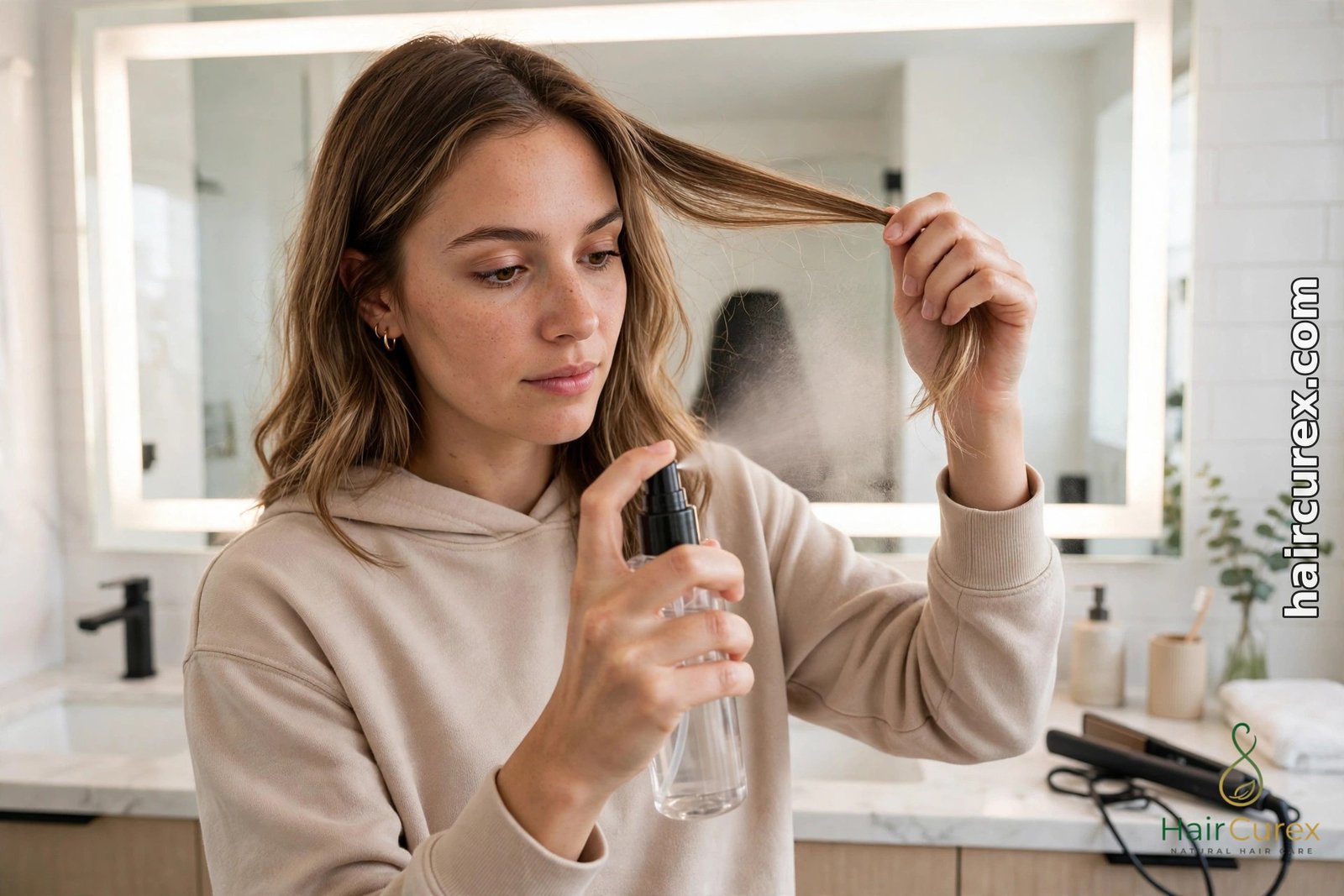
Heat protectant is not optional when you use hair straighteners — it is the cheapest insurance your hair has. A good heat protectant coats the hair shaft and slows how fast heat reaches it, which reduces moisture loss and cuticle damage. Spray or cream both work; sprays suit fine hair because they are lighter, creams suit thick hair because they coat more evenly. Apply it to damp hair before blow-drying, and add a light second layer to dry hair just before straightening if your hair is thick or damaged. Our guide to the best heat protectant sprays and creams compares the types and how to use each one.
Deep condition once a week if you straighten your hair regularly, because heat styling slowly dries hair out and a weekly mask replaces the moisture that heat removes. Do not straighten every day if you can avoid it — even with protectant, daily high heat adds up, and a day or two of rest between sessions lets your hair recover.
The American Academy of Dermatology’s healthy-hair guidance covers the same gentle-care basics that matter most when you use hot tools: American Academy of Dermatology healthy hair tips. And if your hair already shows heat damage — rough texture, white dots along the shaft, ends that will not hold a style — cut back on heat first, then look at repair: Healthline explains the signs and what actually helps: Healthline on heat-damaged hair.
Flat Iron Mistakes That Cause Damage
The most damaging mistake with hair straighteners is straightening wet or damp hair, which boils the water inside the hair shaft and leaves it brittle. The second is using the highest temperature “to get it done faster” — maximum heat does not straighten better, it just damages faster, and the ends pay for it first. Split ends are the earliest visible sign of heat damage, and once a split end forms, no product can glue it back together: our guide to split ends, what causes them and how to prevent them explains what actually works.
Other mistakes are quieter but just as costly. Passing over the same section five or six times because the temperature is too low or the sections are too thick. Clamping the iron hard and dragging it, which crushes the cuticle. Straightening dirty hair, because product build-up and oil fry onto the plates and transfer back onto the hair.
Never cleaning the plates, so burnt residue builds up and snags the hair. And storing the iron while it is still hot, which can melt the cord or damage the plates. A clean iron with a quick wipe of a damp cloth once it has cooled, a sensible temperature, small sections and two passes maximum — that is the whole secret, and it is free.
How to Choose: A Quick Decision Guide
If you want the short version, match your hair to the box below and buy the iron that fits. Fine or damaged hair: ceramic, 1-inch plates, 250–300°F. Normal hair: ceramic or tourmaline, 1-inch plates, 300–350°F. Frizzy or wavy hair: tourmaline, 1-inch plates, 300–375°F. Thick, coarse or curly hair: titanium or tourmaline, 1 to 1.5-inch plates, 350–400°F.
Short hair or bangs: narrow half-inch plates, ceramic, low heat. Long thick hair: wide 1.5 to 2-inch plates, titanium, 350–400°F. Whatever hair straighteners you buy, make sure they have a digital temperature display and floating plates, use a heat protectant every time, and keep the temperature as low as your hair allows. The right flat iron is the one that straightens your hair in one or two slow passes at a temperature your hair can handle — everything else is marketing.
Hair Straighteners FAQs
What is the best hair straightener for fine hair?
Ceramic hair straighteners are the best choice for fine hair, because they heat evenly and gently with fewer hot spots. Use the lowest temperature that works, usually 250–300°F (120–150°C), a 1-inch plate, and a heat protectant every time. Avoid titanium irons, which can be too hot for fine hair.
What temperature should I straighten my hair at?
Fine or damaged hair: 250–300°F (120–150°C). Normal hair: 300–350°F (150–180°C). Thick, coarse or curly hair: 350–400°F (180–200°C). Never go above 450°F (232°C), the temperature at which hair starts to burn. Start low and increase only until one or two slow passes straighten the hair.
Are ceramic or titanium flat irons better?
Neither is better for everyone. Ceramic is better for fine, thin or damaged hair because it heats gently and evenly. Titanium is better for thick, coarse or very curly hair because it heats faster and hotter and straightens in fewer passes. Tourmaline, usually a ceramic blend, is best for frizzy hair because it reduces static and adds shine.
Can I straighten my hair every day?
You can, but daily high heat adds up even with a heat protectant, so it is better to straighten every other day when possible and to keep the temperature as low as your hair allows. Use a heat protectant every time, deep condition weekly, and take a break from heat if your hair starts feeling rough or the ends split.
Should I straighten wet or damp hair?
Never use hair straighteners on wet or damp hair. The water inside the hair shaft turns to steam and damages the hair from the inside, leaving it brittle and frizzy. Always dry your hair completely first — blow-dry it or let it air-dry — then straighten.
What size flat iron should I buy?
A 1-inch plate suits most people and most hair lengths, and it is the best choice if you are buying your first flat iron. Choose a narrow half-inch plate for short hair and bangs, and a wide 1.5 to 2-inch plate for long, thick hair, because each pass covers more hair and you finish faster with fewer passes.