


Haircuts for round face shapes work best when they add length, height and soft angles — and avoid adding width right at the cheeks. The most flattering choices are long layers that start below the chin, an angled lob that is longer at the front, curtain bangs that open diagonally across the forehead, and, for short hair, a pixie with volume on top and softer sides.
What to skip: blunt chin-length bobs with no layers and heavy straight-across bangs, both of which tend to echo the roundness instead of balancing it. No haircut can actually change your face shape, and none needs to — the goal is simply a cut that frames your features well and is easy to live with.
How to Tell If You Have a Round Face
A round face is roughly as wide as it is long, with a softly curved hairline and jawline and no sharp angles. Cheekbones are usually the widest point, but the difference between forehead, cheekbone and jaw widths is small. That soft outline is the key difference from a square face, which shares similar measurements but has a stronger, more angular jaw.
To check, pull your hair back, stand in front of a mirror in good light, and measure four things with a soft tape: face length (centre of hairline to chin tip), forehead width, cheekbone width (fullest point, just below the outer corner of each eye) and jaw width.
If face length and cheekbone width come out close to equal and your jaw curves rather than angles, you are in round-face territory. Many people sit between two shapes — round leaning oval is common — and that is fine: the same principles below still apply, just more softly. A detailed measuring method is explained in the FramesDirect face-shape guide.

The 3 Rules Behind Haircuts for Round Face Shapes
Almost every flattering cut for a round face follows the same three rules, so you can judge any new style against them before you book.
First, add vertical lines. Length that falls past the chin, layers that start below the chin, and a part that runs diagonally all draw the eye up and down rather than side to side. Second, add height at the crown. A little lift on top lengthens the silhouette; flat hair on top with volume at the sides does the opposite.
Third, avoid width at the cheeks. Volume, blunt ends or a hard horizontal line sitting exactly at cheek or chin level will emphasise the widest part of the face. Keep those three rules in mind and most of the styles below will make sense at a glance. The GK Hair face-shape hairstyle guide also recommends long layers, a deep side part and a volumised pixie for round faces, while warning against blunt straight-across bangs.
These three rules explain why the best haircuts for round face shapes work so consistently.
| Rule | What it does | How to get it |
|---|---|---|
| Add vertical lines | Draws the eye downward, lengthening the look | Long layers, angled lob, diagonal side part |
| Add crown height | Lengthens the silhouette | Textured pixie, layered top, root lift when blow-drying |
| Avoid cheek width | Keeps the widest point from standing out | No blunt chin-length ends, no heavy straight bangs, no rounded volume at the cheeks |
Long Haircuts for Round Face: Layers That Slim Without Losing Length
Long hair is the easiest win for a round face, because length itself does the lengthening work. The trick is in the layers. Ask for long layers that start at or below the chin — never at the cheekbone, where short layers add width — and face-framing pieces that fall alongside the face rather than curling into it.
Soft waves that begin below the cheekbones add movement without bulk at the widest point, and a centre or slightly off-centre part works well once the layers are in place, because the layers, not the part, are doing the framing.
Keep the ends healthy and the shape will hold: long hair that is dry or split at the ends looks heavy and shapeless, which pulls attention back to width. Regular trims every 8–10 weeks keep long layers light. If you are deciding between keeping length and going shorter, our guide to which hairstyle suits your face shape walks through the same trade-offs across all face shapes.
In short, long layers are among the most forgiving haircuts for round face shapes.
The Angled Lob: The Medium Cut That Flatters Most Round Faces
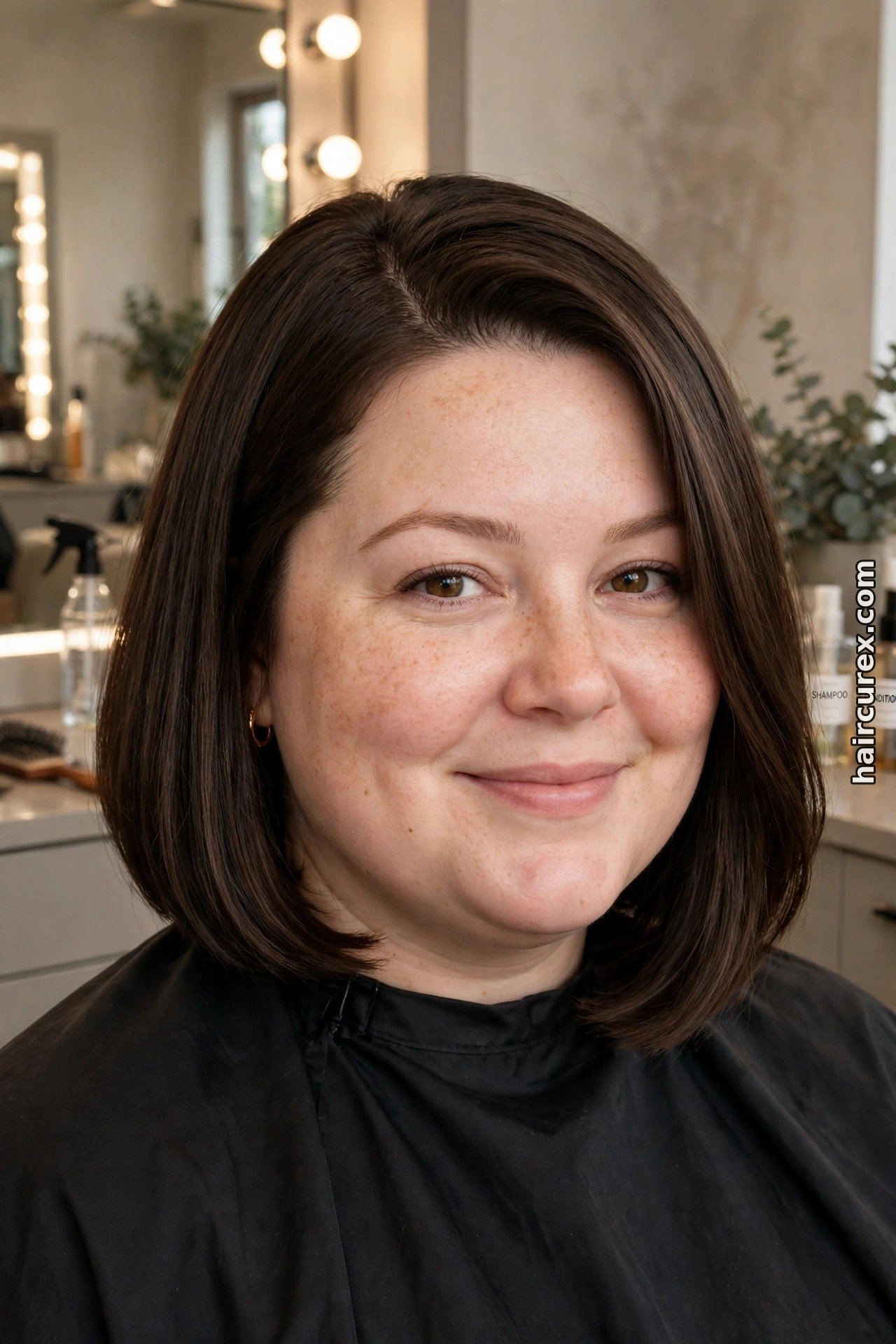
The angled lob — a long bob that is slightly shorter at the back and longer at the front, usually grazing the collarbone — is the most reliable medium-length haircut for a round face. The longer front pieces create a downward diagonal that lengthens the face, and because the cut ends below the chin, it never lands on the widest point.
Wear it with a deep side part for the strongest slimming effect: the diagonal part breaks up the symmetry of a round face in a way a centre part cannot.
Ask your stylist for soft, blended layers through the ends rather than a blunt one-length finish, and keep the shortest layers below the jawline. The lob also grows out gracefully, which matters if you only get a cut every few months — it turns into long layers rather than into a shapeless bob. Style it straight for a sleek finish or with loose waves for movement; both work, as long as the volume stays off the sides at cheek level.
That diagonal effect is why the angled lob ranks so highly among haircuts for round face choices.
Curtain Bangs and Side-Swept Bangs for a Round Face
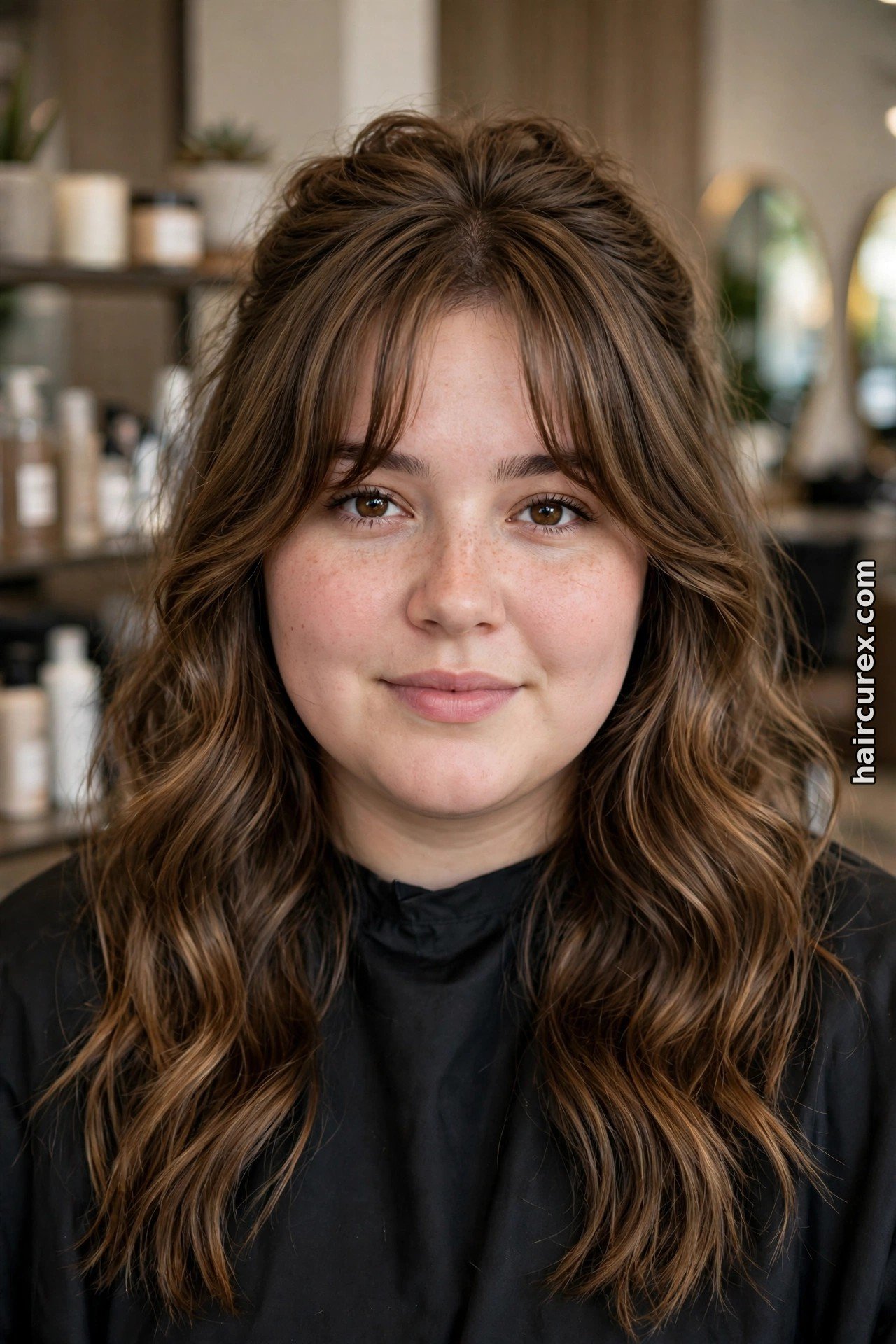
Bangs are not off-limits for a round face — the wrong bang is. Heavy, straight-across bangs cut a hard horizontal line across the forehead and can make the face look wider. The flattering alternatives both work diagonally. Curtain bangs, parted in the middle and swept to each side, open up the face and create two soft diagonal lines; keep them a touch longer than you think, ending around the cheekbone or below, so they frame rather than widen.
Side-swept bangs do the same job with a single diagonal sweep, and they are the lowest-commitment change on this list because they work on almost any length.
Whichever you choose, ask for soft, feathered ends rather than a thick, blunt fringe, and be ready to trim bangs every 3–4 weeks to keep the shape.
If bangs are new to you, start long — a stylist can always take more off, but growing out a too-short fringe takes months. Curtain bangs also pair beautifully with the butterfly haircut, whose layered, airy shape is built on the same face-framing idea.
Curtain bangs are a low-commitment entry point into haircuts for round face styling.
Short Haircuts for Round Face: Pixies and Bobs That Work
Short hair suits round faces too, as long as the cut keeps height on top and avoids a rounded, helmet-like silhouette. The best short option is a textured pixie with longer layers on top, volume at the crown and sides that are tapered rather than puffy — the height on top lengthens the face, and the texture stops the cut looking like a solid round shape.
A side-swept fringe completes it by adding the diagonal line that round faces benefit from.
If a pixie feels like too big a jump, a longer pixie-bob (sometimes called a bixie) with pieces that fall below the jawline is a gentler halfway step. What to avoid in short cuts: a classic rounded bob that ends right at the chin with no layers, and a very short, flat crop with no crown volume, both of which underline roundness. Short cuts need more frequent trims — every 4–6 weeks — to keep the crown height and tapered sides in shape, so factor that maintenance into your choice.
A textured pixie is one of the boldest haircuts for round face shapes, and also one of the most flattering when crown height is kept.

Haircuts for Round Face Men: Quiffs, Texture and Fades
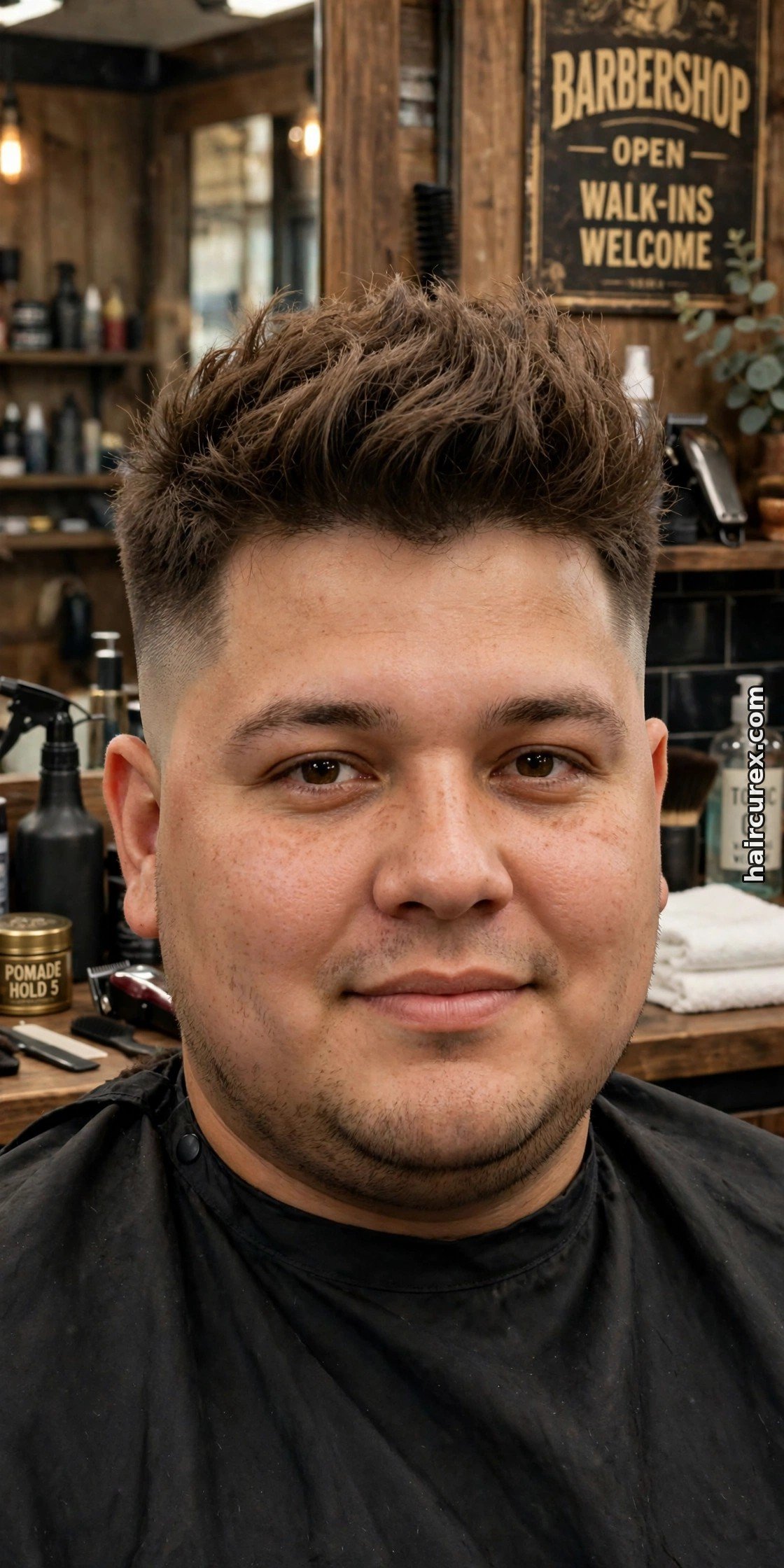
The same three rules apply to men’s cuts. A textured quiff or pompadour with height on top and faded or tapered sides is the classic flattering combination: the height lengthens the face and the short sides keep width off the cheeks. A side part with a textured top works similarly and is easier to style daily.
For curly hair, keep length on top so the curls have height, and keep the sides shorter — a rounded afro shape with equal volume all around will emphasise roundness, while a shaped top with tapered sides will not.
Avoid very short buzz cuts with no top length if slimming is your goal, and avoid long, flat hair with a centre part and no layers, which frames the face in a wide rectangle. Bring two or three reference photos to the barber and point out exactly what you like — the height, the fade, the texture — rather than asking for a celebrity’s whole cut, since your hair texture and growth pattern will change how it falls.
Our AI haircut generator guide can help you preview a style before you commit.
For men, the quiff remains a classic among haircuts for round face shapes.
What to Avoid With a Round Face (and What to Do Instead)
It helps to name the misses plainly, because they are common salon requests. A blunt chin-length bob with no layers ends exactly at the widest point and squares the face off. Heavy straight-across bangs add a hard horizontal line.
Very rounded, one-length cuts with volume at the sides add width where you least want it. And long, straight, centre-parted hair with no layers at all can hang like a curtain that frames the roundness instead of breaking it up.
None of these is a disaster — hair grows, and styling can rescue most of them. A blunt bob gains a new life with a deep side part and soft waves; straight hair gains movement with long layers starting below the chin. If you already have one of these cuts, ask your stylist for the smallest change that fixes it — usually layers below the chin, a side part, or soft texture — before committing to a big chop.
| Avoid | Why it emphasises roundness | Try instead |
|---|---|---|
| Blunt chin-length bob, no layers | Ends at the widest point | Angled lob ending below the chin |
| Heavy straight-across bangs | Hard horizontal line across the forehead | Curtain or side-swept bangs |
| Rounded one-length cut with side volume | Adds width at the cheeks | Textured layers with crown height |
| Long straight centre-parted hair, no layers | Curtain effect framing roundness | Long layers starting below the chin |
How to Style Haircuts for Round Face Shapes Day to Day
A good cut still needs the right styling. For crown height, blow-dry roots upward with a round brush or apply a lightweight volumising mousse to damp roots before drying — heavy products flatten the crown and push volume to the sides. For waves, use a large-barrel iron and start curling below the cheekbones, not at them. For a side part, find your natural part by combing hair back and seeing where it falls, then deepen it by about an inch for a stronger diagonal.
Between cuts, protect the shape: use heat protectant before hot tools, trim split ends before they travel up the shaft (see our split ends guide), and sleep on a silk or satin pillowcase if frizz is roughing up your layers overnight.
A wavy or curly texture can be an advantage here — natural movement breaks up roundness better than pin-straight hair — so work with your texture rather than fighting it flat every morning. If your hair is naturally wavy, a wolf cut for wavy hair can add the same kind of movement with layered texture.
Day-to-day styling is what keeps haircuts for round face shapes looking intentional rather than accidental.
What to Tell Your Stylist: A Script You Can Use
Walk in with this, and you will get far closer to the cut you want: “I have a round face, so I want length and height rather than width at the cheeks. I’d like the layers to start below my chin, some height at the crown, and a part that works diagonally — a deep side part or curtain bangs. Please keep the ends soft and textured, not blunt at chin level.”
Then show two or three photos and say what you like in each: the length, the fringe, the part. A good stylist will adapt those details to your hair texture, density and growth pattern, which matter as much as face shape — fine hair needs lighter layers, thick hair needs weight removed from the inside, and curly hair needs layers cut to its curl pattern, not against it.
Frequently Asked Questions About Haircuts for Round Face Shapes
What is the best haircut for a round face?
The most reliable choices are long layers starting below the chin, an angled lob with a deep side part, and a textured pixie with volume at the crown. All three add length or height and avoid width at the cheeks.
Do bangs suit a round face?
Yes, if they are diagonal rather than horizontal. Curtain bangs and side-swept bangs flatter round faces; heavy straight-across bangs tend to make the face look wider.
Is short hair good for a round face?
Short hair works when it keeps height on top, like a textured pixie with tapered sides. Avoid rounded chin-length bobs with no layers and flat crops with no crown volume.
What haircut makes a round face look slimmer?
No cut changes your actual face shape, but cuts that add vertical lines and crown height — long layers, an angled lob, a deep side part — create a longer, slimmer impression.
Should I get a centre part or a side part with a round face?
A deep side part is usually more flattering because its diagonal line breaks up the face’s symmetry. A centre part can work with long layers, but it is less slimming on its own.
What haircuts should round faces avoid?
Blunt chin-length bobs with no layers, heavy straight-across bangs, and rounded one-length cuts with volume at the sides, because all three emphasise width at the cheeks.