

Postpartum hair loss is the heavier-than-usual shedding many new mothers notice in the months after giving birth, and in most cases it is normal and temporary — not permanent hair loss. During pregnancy, high estrogen levels keep more hairs than usual in the growth phase, so hair often looks thicker and sheds less. After delivery, estrogen falls, and a large number of those hairs shift into the resting phase together; about three months later they shed together, which is why the shower drain, the brush and the pillow can suddenly look alarming. Cleveland Clinic notes that postpartum hair loss usually lasts less than six months and that hair should regain its fullness by the time a child turns one. This guide explains what normal postpartum hair loss looks like, the typical timeline month by month, what genuinely helps while you wait, and — just as important — the warning signs that mean the shedding is not the usual pattern and should be checked by a doctor.
Postpartum Hair Loss: What Is Actually Happening to Your Hair
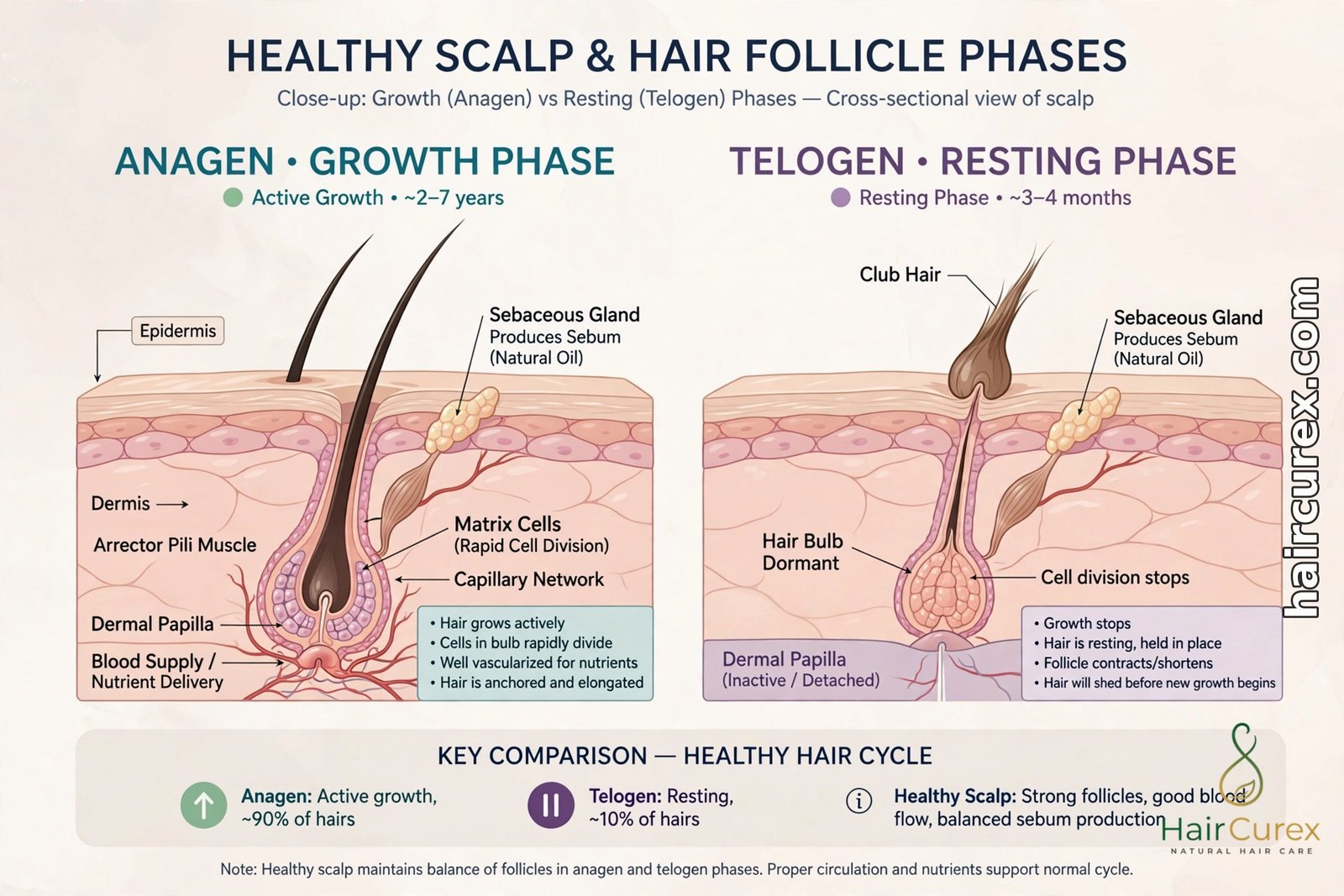
To understand postpartum hair loss, it helps to know how hair normally grows. Each hair follicle cycles through three main phases: anagen, the growth phase, which lasts years; catagen, a short transition phase; and telogen, the resting phase, which lasts about three months before the hair falls out and a new hair begins to grow in its place. At any normal time only a small share of your scalp hairs are in telogen, so you shed roughly 50 to 100 hairs a day without noticing much change in density.
Pregnancy changes that balance. Rising estrogen in pregnancy, especially in the last trimester, holds hairs in anagen longer than usual. Fewer hairs enter telogen, so less hair sheds, and many women notice their hair looks fuller and thicker during pregnancy. This is not new hair growing faster; it is old hair staying put longer than it normally would.
After birth, estrogen drops sharply. The hairs that were held in growth now move into telogen together, rest for about three months, and then shed together. Dermatologists call this pattern telogen effluvium: a temporary, diffuse shedding triggered when a major event — in this case childbirth — pushes many follicles into the resting phase at once. Harvard Health explains the same delay in general telogen effluvium: hairs that enter telogen rest in place for two to four months before falling out, so shedding appears months after the trigger. That delay is why postpartum hair loss feels so sudden and disconnected from the birth itself. You are not losing hair because something went wrong in the last week; you are shedding, on a delay, the hairs that pregnancy kept in place.
The reassuring part of this mechanism is that the follicles themselves are not damaged. In ordinary postpartum hair loss there is no scarring, no destruction of the follicle, and new hairs are already growing underneath as the old ones fall. That is the key difference between shedding and permanent loss: in shedding, regrowth is already under way, even if it is too short to see yet.
What Normal Postpartum Shedding Looks Like
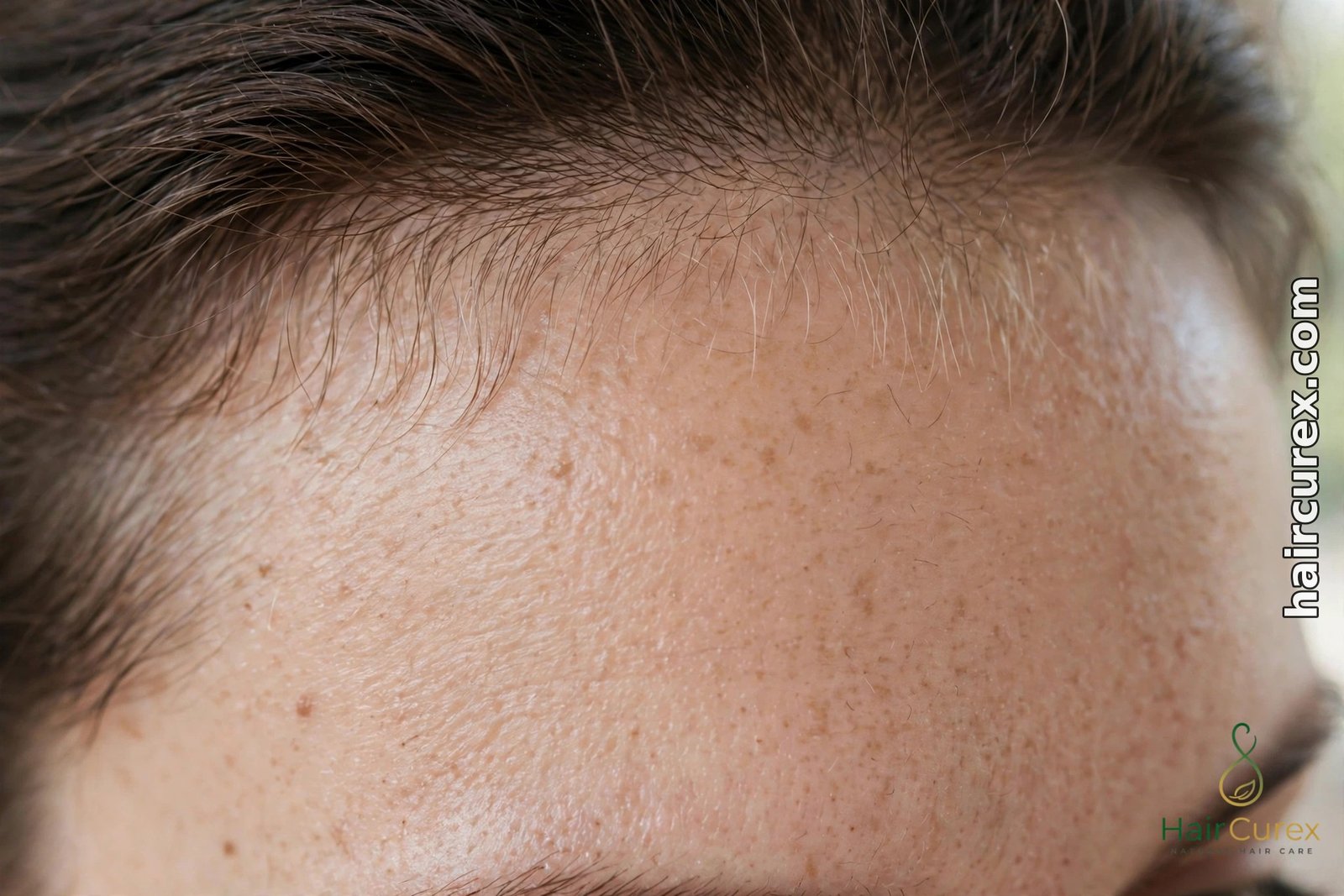
Normal postpartum hair loss is diffuse, meaning it happens all over the scalp rather than in one patch. You may notice more hair on your pillow, in the shower drain, on your brush, on your clothes and in your hands when you run your fingers through your hair. The hairline and temples often look thinner first, because those hairs are finer and shorter regrowth there is more visible, and many women notice wispy new hairs sticking up around the face as regrowth begins. That “baby hair” fringe is a good sign, not a problem: it is the next cycle already growing.
The amount can still be shocking. While normal daily shedding is up to about 100 hairs, postpartum shedding can be noticeably more than that for a period, and long or thick hair makes every shed hair look bigger. A clump in the shower does not automatically mean a clump of follicles has been lost. Hair that was going to shed over many weeks in a normal cycle is now shedding in a compressed window, so the total looks dramatic even though the follicles remain alive.
Texture can change too. New regrowth may feel finer, softer or slightly different in texture at first, and some women notice more frizz or flyaways while short regrowth catches up with the rest of the hair. That usually settles as the new hairs gain length. What normal postpartum hair loss does not do is create smooth, completely bald patches, cause scalp pain, redness, scaling or scarring, or take your eyebrows and eyelashes with it. Those features point to something else and are covered in the “when to see a doctor” section below.
It is also worth saying plainly: postpartum hair loss is common, and noticing it does not mean you did something wrong. Sleep deprivation, the physical recovery from birth, and the demands of caring for a newborn do not cause the hormonal shedding itself, although stress, illness, major weight changes and nutritional deficiencies can add a second trigger on top of it. If you are already worried, the shedding itself can become a source of stress, and that stress can make the experience feel worse even while the biology is following its normal course. Our guide to hair shedding vs hair loss explains in more detail how diffuse shedding differs from progressive thinning, which is a useful comparison if you are trying to tell the two apart.
Postpartum Hair Loss Timeline: Month by Month
No two women follow exactly the same schedule, but the pattern is consistent enough that a timeline helps you judge whether what you are seeing fits the normal course. Cleveland Clinic describes postpartum hair loss as beginning a few months after birth, lasting less than six months, with fullness returning by the child’s first birthday. A questionnaire study of postpartum shedding published in the International Journal of Women’s Dermatology in 2023 found an average start at about 2.9 months, a peak at about 5.1 months, and an end at about 8.1 months — a useful reminder that “normal” spans several months, not a single week.
| Time after birth | What usually happens | What it means |
|---|---|---|
| During pregnancy | Less shedding, hair may look thicker | High estrogen holds hairs in the growth phase. |
| 0 to 2 months after birth | Shedding usually still normal | Hairs that entered the resting phase at birth have not shed yet; the three-month delay is still running. |
| 2 to 4 months | Shedding becomes noticeable and increases | Resting hairs begin to fall; this is the most common start window. |
| Around 4 to 5 months | Shedding often peaks | The largest number of resting hairs sheds in this window; drains and brushes look worst here. |
| 6 to 9 months | Shedding eases, short regrowth becomes visible | New hairs that started growing months earlier gain length; the hairline fringe is a sign of recovery. |
| 9 to 12 months | Density usually close to pre-pregnancy fullness | Most women have regained their usual fullness by the child’s first birthday. |
| Beyond 12 months | Shedding should have settled | Ongoing heavy shedding past a year deserves a medical check, not more waiting. |
Two things about this timeline matter in practice. First, regrowth and shedding overlap: new hairs start growing while old hairs are still falling, so the scalp is recovering even on the days the shower drain looks worst. Second, hair grows slowly — roughly half an inch a month — so even after shedding stops, it takes months for regrowth to reach a length that restores visible fullness. Judging recovery at the peak of shedding will always look discouraging; judging it at nine to twelve months gives a fairer picture. For a realistic sense of how long regrowth takes in general, see our guide on how long it takes to grow hair.
Why Some Women Shed More Than Others
The hormonal shift after birth happens to everyone, but the amount of shedding varies. Women who noticed a big increase in thickness during pregnancy often notice a bigger shed afterwards, simply because more hairs were held in growth and are now released together. Hair length matters for visibility: long hair sheds in longer strands that look more dramatic, even when the number of hairs is the same. Women who had a difficult birth, a serious illness or high fever, major surgery, or very rapid weight loss after delivery may have a second telogen trigger layered on top of the postpartum one, which can prolong or intensify shedding.
Nutritional and thyroid factors can also contribute, which is why doctors sometimes check them when shedding is heavy or prolonged. Iron deficiency and thyroid disorders are both known contributors to diffuse shedding, and both are worth ruling out rather than guessing about. This is not a reason to start supplements on your own: iron, vitamin D and other supplements only help when a deficiency is actually present, they can cause harm in excess, and some products are not appropriate while breastfeeding. If you are concerned about your diet, your iron levels or your thyroid, raise it with your doctor, who can test rather than guess. Our vitamin D deficiency hair loss guide explains how one such deficiency is assessed, and our hair growth vitamins guide explains why testing before supplementing matters.
Breastfeeding itself does not cause postpartum hair loss, and stopping breastfeeding will not stop the shedding. The trigger is the hormonal change after birth, not feeding method, and shedding happens whether a mother breastfeeds or not. Equally, no shampoo, oil or vitamin has been shown to prevent the hormonal shed or to speed the follicle cycle. Products can improve how hair looks and feels while you wait, and gentle care can reduce breakage on top of shedding, but they do not change the timeline of telogen effluvium. Any claim that a product “stops postpartum hair loss” should be treated with scepticism.
What Genuinely Helps While You Wait
There is no shortcut through postpartum hair loss, but there are practical steps that protect the hair you have, reduce extra breakage, and make the regrowth period easier to live with.
Be gentle with wet hair. Wet hair stretches and breaks more easily than dry hair, so detangle with a wide-tooth comb, start from the ends and work upward, and avoid aggressive towel-drying or tight brushing when hair is soaking wet. If you use heat styling, use the lowest effective heat and a heat protectant, and give hair rest days from straighteners and curling tools while it is shedding. Tight hairstyles — very tight ponytails, braids pulled hard at the hairline, heavy extensions — add traction on top of shedding, so looser styles are kinder during this period. Our guide on how to stop hair fall covers the same gentle-handling principles in more depth.
Wash normally, and do not avoid washing to “save” hair. Hairs that are in telogen are going to shed whether you wash or not; skipping washes only lets shed hairs accumulate and then come out in a larger, more frightening clump on wash day, while oil and product build up on the scalp. A gentle shampoo worked into the scalp with your fingertips, rinsed thoroughly, and conditioner on the mid-lengths and ends is enough. If you need help choosing a mild cleanser, our best shampoo for hair fall guide explains what to look for in a gentle formula.
A haircut can help appearance, even though it does not change shedding. Layers or a slightly shorter cut can make thinning less visible and give regrowth a more even look, and many women find that a fresh cut at the peak-shedding stage improves confidence more than any product. Colour and chemical treatments are a personal choice: if your scalp is irritated or you are concerned, discuss timing with your stylist and your doctor, and avoid overlapping a chemical service with an already stressed scalp.
Eat and sleep as well as a new baby allows, without turning food into a hair treatment. A varied diet with adequate protein, iron-rich foods and overall calories supports normal hair growth, but crash dieting or severe calorie restriction after birth can itself trigger more shedding, so rapid “bounce back” diets are counterproductive for hair as well as for recovery. Sleep deprivation is a normal part of early parenthood and is not something to blame yourself for; the point is not perfection, but avoiding additional shocks to the system, such as extreme diets, while the follicles are resetting.
Finally, protect your confidence while regrowth catches up. Volumising styling at the roots, a side part that covers a thinner temple area, soft layers, and headbands or scarves on difficult days are all legitimate tools. Regrowth hairs that stick up around the hairline can be smoothed lightly with a small amount of styling product or a soft brush, rather than pulled flat with heat. These are appearance aids, not treatments, and that distinction is worth keeping clear.
When to See a Doctor About Postpartum Hair Loss
Most postpartum hair loss needs reassurance and time, not treatment. But some patterns are not the usual postpartum shed, and they should be checked promptly rather than waited out.
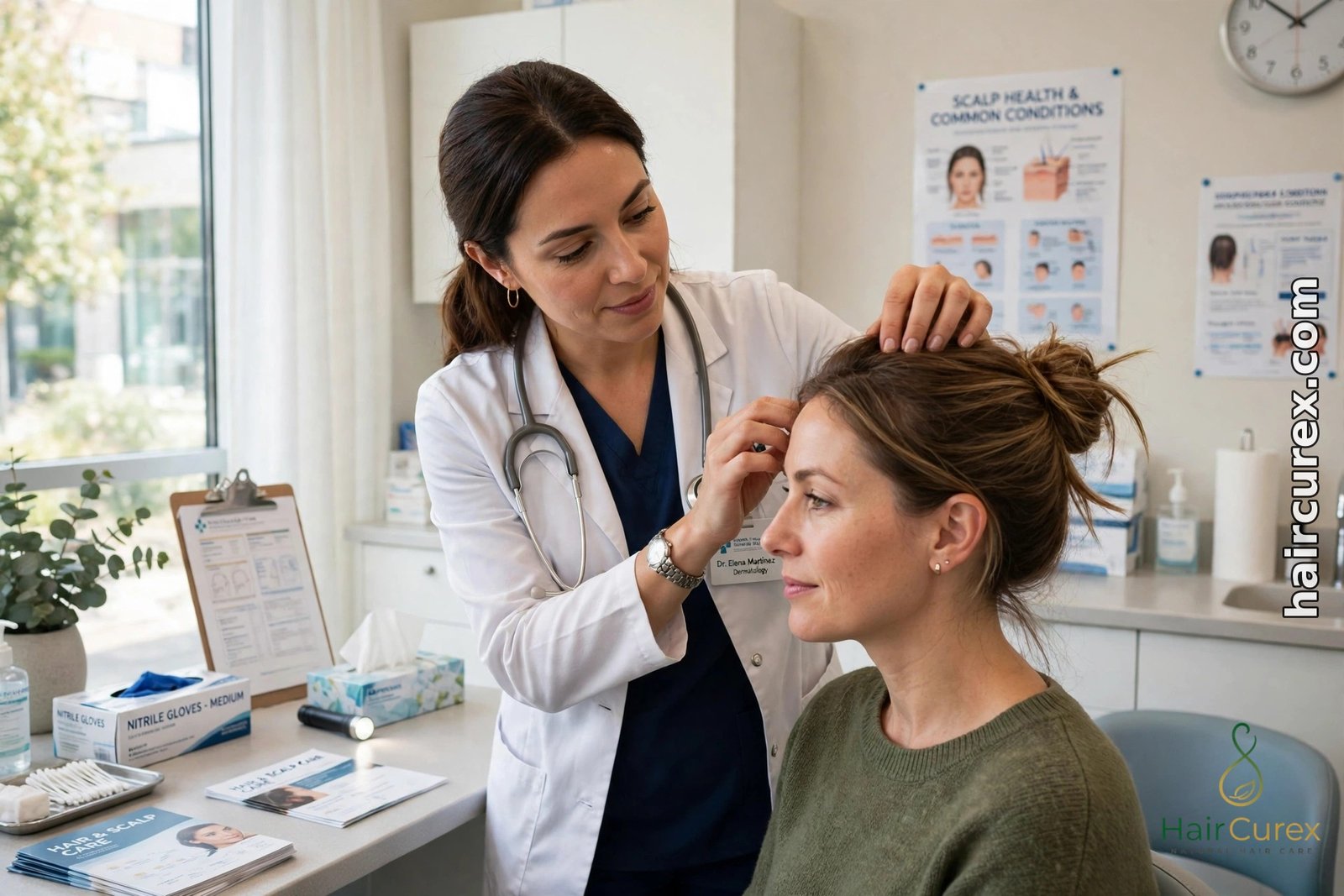
See your doctor or a dermatologist promptly if you notice any of the following: shedding that is sudden and severe, patchy, or rapidly worsening; smooth bald patches, or areas where the scalp looks scarred or the follicles look destroyed; scalp pain, burning, redness, swelling or pus; eyebrows or eyelashes falling out as well; shedding that has lasted more than six months without improving, or is still heavy after your child’s first birthday; or hair loss that follows a new medicine, a major illness or significant weight loss. Also seek care if shedding is causing marked distress — that alone is a valid reason to ask for an assessment and reassurance from a clinician who can examine your scalp.
At an appointment, a doctor will usually take a timeline (when shedding started, any illness or stress two to three months earlier, whether the pattern is diffuse or patchy), examine the scalp, review medicines and supplements, and order targeted blood tests when indicated — commonly iron and thyroid checks. That history often narrows the diagnosis faster than any single test, because the timing and pattern distinguish postpartum telogen effluvium from pattern hair loss, alopecia areata, and scarring conditions, which need different management. Bring your timeline, photos showing the pattern over time, and a list of medicines and supplements, including anything started or stopped around the birth.
Two cautions apply to anything you read about treatment. First, do not start or stop any medicine, including hormonal medicines, on the basis of a hair article, and do not start supplements or hair-loss treatments while breastfeeding without medical advice — safety in breastfeeding is a specific question for your doctor, not a general internet answer. Second, if you have symptoms beyond hair — such as persistent fatigue, feeling very cold or very hot, a racing heart, unexplained weight change, heavy or prolonged bleeding after birth, low mood, or thoughts of harming yourself — seek medical care promptly and tell the clinician about all of your symptoms, not only the hair. Postpartum health is broader than hair, and hair shedding can occasionally be one sign among others that deserves a full check.
Postpartum Hair Loss vs Other Types of Hair Loss
It helps to place postpartum shedding alongside the other patterns a doctor considers, so you can see why pattern and timing matter so much.
| Pattern | How it looks | Typical timing | What usually happens next |
|---|---|---|---|
| Postpartum telogen effluvium | Diffuse shedding all over the scalp, no bald patches | Starts 2 to 4 months after birth, peaks around 4 to 5 months | Settles within 6 to 12 months; fullness returns by the first birthday. |
| Female pattern hair loss | Gradual thinning, widening part, thinner crown, hairline usually preserved | Develops slowly over years, can be unmasked after pregnancy | Progressive without assessment; needs a clinician’s diagnosis. |
| Alopecia areata | Smooth, round bald patches, sometimes eyebrows or eyelashes | Can start suddenly at any time | An immune-related condition needing dermatology assessment. |
| Scarring hair loss | Bald areas with loss of follicle openings, redness or scaling | Variable, may be painful | Follicles can be permanently lost, so early assessment matters. |
If your shedding is diffuse, started a few months after birth, and is gradually easing by six to nine months, it fits the postpartum pattern. If it is patchy, scarring, progressive in a pattern, or still heavy a year on, it does not fit that pattern, and that mismatch is exactly what a doctor needs to hear.
The Bottom Line on Postpartum Hair Loss
Postpartum hair loss is, for most new mothers, a normal and temporary reset of the hair cycle: pregnancy held hairs in growth, birth released them together, and about three months later they shed together. Expect noticeable shedding from around two to four months, a peak around four to five months, easing by six to nine months, and usual fullness returning by your child’s first birthday. Gentle handling, normal washing, looser styles and a varied diet protect the hair you have while regrowth catches up, but no product can prevent or shortcut the hormonal shed. And when the pattern does not fit — patchy loss, scalp pain or scarring, loss of eyebrows or eyelashes, or shedding that is still heavy after a year — see a doctor promptly instead of waiting it out. Knowing what is normal takes much of the fear out of the shower drain, and knowing the warning signs makes sure the minority of cases that need care get it early.
This article is for general information only and is not medical advice. If you are worried about your hair, your recovery after birth, or any other symptom, talk to your doctor or another qualified health professional.
Frequently Asked Questions About Postpartum Hair Loss
Is postpartum hair loss normal?
Yes. Postpartum hair loss is a common, temporary increase in shedding after birth, caused by the drop in estrogen after pregnancy. It is classified as telogen effluvium and usually resolves without treatment within a year.
When does postpartum hair loss start and peak?
Shedding usually becomes noticeable 2 to 4 months after birth and often peaks around 4 to 5 months. A 2023 questionnaire study found an average start at about 2.9 months, a peak at about 5.1 months, and an end at about 8.1 months.
How long does postpartum hair loss last?
Cleveland Clinic notes that postpartum hair loss usually lasts less than six months, with hair regaining its fullness by the time a child turns one. Shedding that is still heavy after a year should be checked by a doctor.
Will my hair grow back after postpartum hair loss?
In ordinary postpartum shedding, yes. The follicles are not damaged, new hairs are already growing as old ones shed, and most women regain their usual fullness within 6 to 12 months, although it takes time for regrowth to gain length.
Does breastfeeding cause postpartum hair loss?
No. The trigger is the hormonal change after birth, not feeding method, and shedding happens whether a mother breastfeeds or not. Stopping breastfeeding will not stop postpartum hair loss.
When should I see a doctor for postpartum hair loss?
See a doctor promptly for patchy or scarring loss, scalp pain, redness or swelling, loss of eyebrows or eyelashes, shedding that lasts more than six months without improving, or shedding still heavy after a year. Also seek care if shedding follows a new medicine or major illness, or is causing marked distress.