

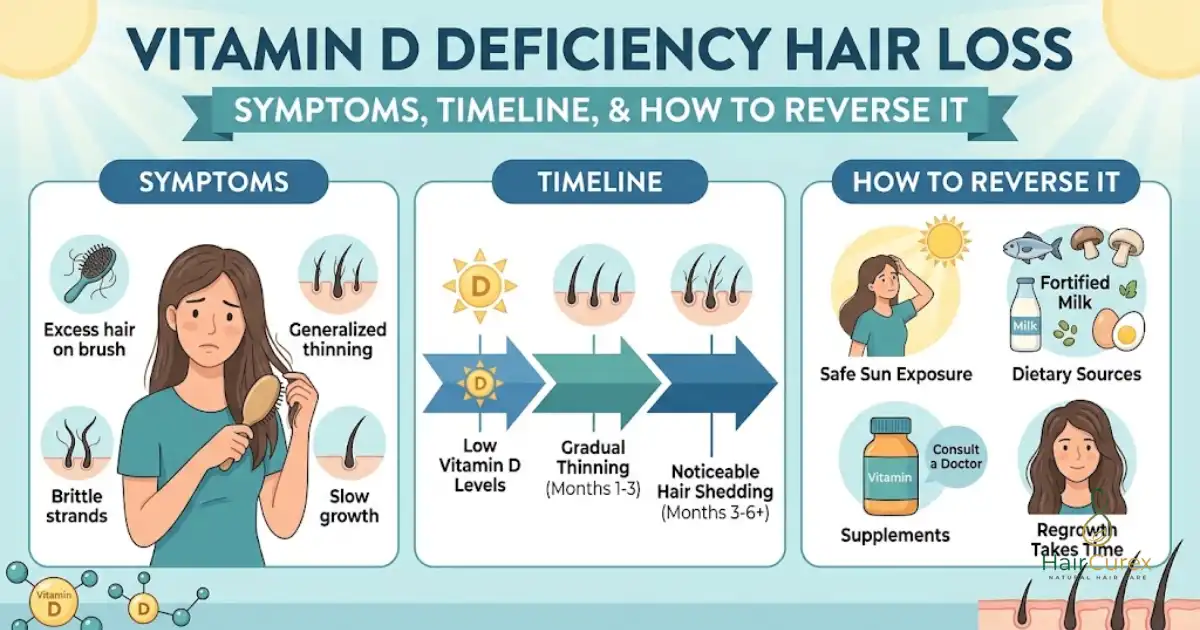
You reach for your hairbrush, run it through once, and there it is again: a clump of strands tangled in the bristles. Maybe you’ve noticed more hair collecting around the shower drain, or your part looks a little wider than it used to. Before you panic and blame genetics, it’s worth asking a question most people never think to ask: could this be vitamin D deficiency hair loss?
It sounds like an odd connection at first. Vitamin D gets talked about mostly in the context of bones and immune health, not hair. But your scalp is packed with vitamin D receptors, and your follicles rely on this nutrient far more than most people realize. When levels drop, hair growth can quietly stall long before you notice anything in the mirror. This article walks through exactly how that happens, what symptoms to watch for, how long the process takes, and what you can actually do to reverse it.
In short, yes, low vitamin D can cause hair loss, and in the vast majority of cases it is reversible once the deficiency is corrected. Levels below 20 ng/mL are generally classified as deficient and are commonly associated with hair thinning. Visible progress usually takes time: the first four to six weeks after correcting levels often show little change, and real improvement often arrives around the 3 month mark.
The Crucial Link Between Vitamin D and Hair Follicle Health
Your hair follicles aren’t just passive tubes that push out strands. They’re small, highly active organs that go through repeated growth cycles, and vitamin D plays a surprisingly central role in keeping that cycle running smoothly. Inside each follicle sit vitamin D receptors, often shortened to VDR, which act like docking stations that let vitamin D communicate with the cells responsible for hair production. Without enough vitamin D circulating in your body, these receptors have nothing to bind to, and the signal that tells follicles to keep cycling normally gets weaker.
This matters because of a specific group of cells called keratinocytes. These are the building blocks of your hair shaft, skin, and nails, and they multiply rapidly inside actively growing follicles. Vitamin D helps regulate how keratinocytes divide and mature. Research published in dermatology journals has linked reduced VDR activity to disrupted keratinocyte behavior, which in turn slows down the hair follicle cycle and can push follicles into a resting, non-growing state earlier than they should enter it.
Here’s the part that surprises most people: vitamin D deficiency doesn’t just affect how fast hair grows. It can influence whether new follicles form at all. Some researchers believe VDR signaling helps regulate the tiny stem cell population at the base of each follicle, the cells responsible for regenerating hair over your lifetime. When that signaling breaks down, follicles don’t just slow down, they can become dormant. That’s the real root cause of hair thinning tied to low vitamin D, and it’s why fixing the deficiency, not just treating the hair, tends to matter so much for recovery.
Can Vitamin D Deficiency Actually Cause Hair Loss?
Let’s answer this directly: yes, low vitamin D levels can cause hair loss, and there’s a growing body of clinical evidence to back that up. Multiple studies have found significantly lower vitamin D levels in patients experiencing diffuse thinning on the scalp compared to people with a full head of healthy hair. One frequently cited study in the British Journal of Dermatology found that women with alopecia areata and telogen effluvium had notably lower serum vitamin D than control groups.
That said, correlation and causation aren’t identical twins, and it’s important to be honest about the nuance here. Vitamin deficiency and hair thinning often show up together because they share overlapping risk factors. Chronic stress, thyroid dysfunction, iron deficiency, and poor diet can all lower vitamin D levels while simultaneously triggering hair loss through separate mechanisms. So when someone asks, “can lack of vitamin D cause hair loss,” the honest answer is that it’s very likely a contributing factor, and in many cases a primary one, but it rarely acts entirely alone.
Certain groups face a higher risk of developing this specific type of medical reason for hair fall. People who spend most of their time indoors, individuals with darker skin tones (since melanin reduces the skin’s ability to synthesize vitamin D from sunlight), older adults, people who are overweight, and those following strict vegan diets without supplementation all tend to run lower vitamin D levels than the general population. If you fall into one of these categories and you’re also seeing unexplained shedding, the connection deserves a closer look rather than a dismissal.
Key Symptoms of Vitamin D Deficiency Hair Loss to Watch For

Recognizing the signs of low vitamin D early can save you months of confusion and unnecessary hair products. The hair-related symptoms typically show up as diffuse thinning on the scalp rather than distinct bald patches. Unlike male pattern baldness, which usually follows a receding hairline or a thinning crown, vitamin D related shedding tends to be spread out evenly across the whole scalp, making your overall hair density feel lighter rather than creating a specific bald spot.
But hair loss almost never travels alone when vitamin D is the culprit. Fatigue and hair shedding frequently appear together, since vitamin D also plays a major role in energy metabolism and immune function. Many people report feeling persistently tired even after a full night’s sleep, right around the same time they start noticing extra strands on their pillow. Bone pain is another classic companion symptom, often described as a deep, aching discomfort in the lower back, hips, or legs, since vitamin D deficiency interferes with calcium absorption and bone remodeling.
| Symptom Category | Common Signs |
|---|---|
| Hair-related | Diffuse thinning, widening part line, increased strands in brush or drain |
| Energy-related | Persistent fatigue, low stamina, brain fog |
| Musculoskeletal | Bone pain, muscle weakness, joint aches |
| Mood-related | Low mood, irritability, seasonal mood dips |
| Immune-related | Frequent colds, slow wound healing |
If you’re experiencing two or three of these symptoms alongside noticeable shedding, that combination is a much stronger signal than hair loss on its own. Isolated shedding could point to dozens of causes, but shedding paired with fatigue and bone discomfort narrows things down considerably.
How to Test and Diagnose Low Vitamin D Levels Accurately
Guessing isn’t a strategy here, and neither is assuming your symptoms automatically mean deficiency. The only reliable way to confirm what’s going on is through a 25-hydroxyvitamin D blood test, often written on lab reports as 25(OH)D. This test measures the primary circulating form of vitamin D in your bloodstream and gives your doctor a precise number to work with rather than a guess based on symptoms alone.
Understanding normal Vitamin D Deficiency levels ng/ml helps you make sense of your results once they come back. Most US labs use the following general reference ranges, though your doctor’s office may vary slightly.
| Vitamin D Level (ng/mL) | Classification |
|---|---|
| Below 20 | Deficient |
| 20–29 | Insufficient |
| 30–50 | Sufficient (normal) |
| Above 50 | Potentially excessive |
For hair growth specifically, some dermatologists and trichologists suggest aiming for the higher end of the sufficient range, generally between 40 and 60 ng/mL, since follicle activity seems to benefit from levels above the bare minimum needed to prevent bone problems. This is sometimes referred to informally as the optimal vitamin D range for hair growth, though it’s worth noting this isn’t yet a universally standardized medical threshold, so it should be discussed with a healthcare provider rather than treated as a fixed rule.
Getting tested in the United States is fairly straightforward. Your primary care doctor can order the test during a routine visit, and it’s typically covered by insurance if you’re showing relevant symptoms. Walk-in lab services like Quest Diagnostics and LabCorp also offer direct-to-consumer testing without a doctor’s referral in many states, and at-home finger-prick test kits have become widely available as well. Whichever route you choose, getting an actual number is far more useful than trying to self-diagnose from symptoms alone.
Vitamin D Deficiency Hair Loss Timeline: What to Expect
One of the most confusing parts of this whole condition is the delay between cause and effect. People often ask how long before hair falls out after vitamin D levels drop, expecting a quick answer, but the truth involves a bit of a lag.
How Long After Deficiency Does Hair Loss Start?
Hair doesn’t fall out the moment your vitamin D dips. Instead, the follicle has to complete its current phase before the effects become visible, and that delay typically runs anywhere from two to four months. This happens because of how the hair growth phases work. Roughly 85 to 90 percent of your scalp hair sits in the anagen, or active growth, phase at any given time, while the rest cycles through catagen, a short transitional phase, and telogen, the resting phase, before eventually shedding.
When chronic vitamin D deficiency disrupts follicle signaling, it tends to push hairs out of the anagen phase prematurely and into telogen. Since telogen hairs shed naturally after resting for around two to three months, that’s exactly why the connection between falling vitamin D and visible shedding feels delayed and confusing. You’re essentially seeing the consequences of a nutritional gap that started building weeks or months earlier.
| Stage | Approximate Timing | What’s Happening |
|---|---|---|
| Deficiency develops | Weeks to months | Vitamin D levels drop below sufficient range |
| Follicle disruption | 4–8 weeks after onset | Anagen phase shortens, hairs shift to telogen early |
| Shedding phase begins | 2–4 months after onset | Telogen hairs release, visible thinning starts |
| Peak shedding | Months 3–5 | Shedding often feels most noticeable here |
| Stabilization (if corrected) | Months 4–6 | Shedding slows once levels normalize |
The good news buried in this timeline is that it works in reverse too. Once you correct the deficiency, the same delayed pattern applies to recovery, which we’ll cover in more detail shortly.
Telogen Effluvium vs. Vitamin D Deficiency: Understanding the Difference
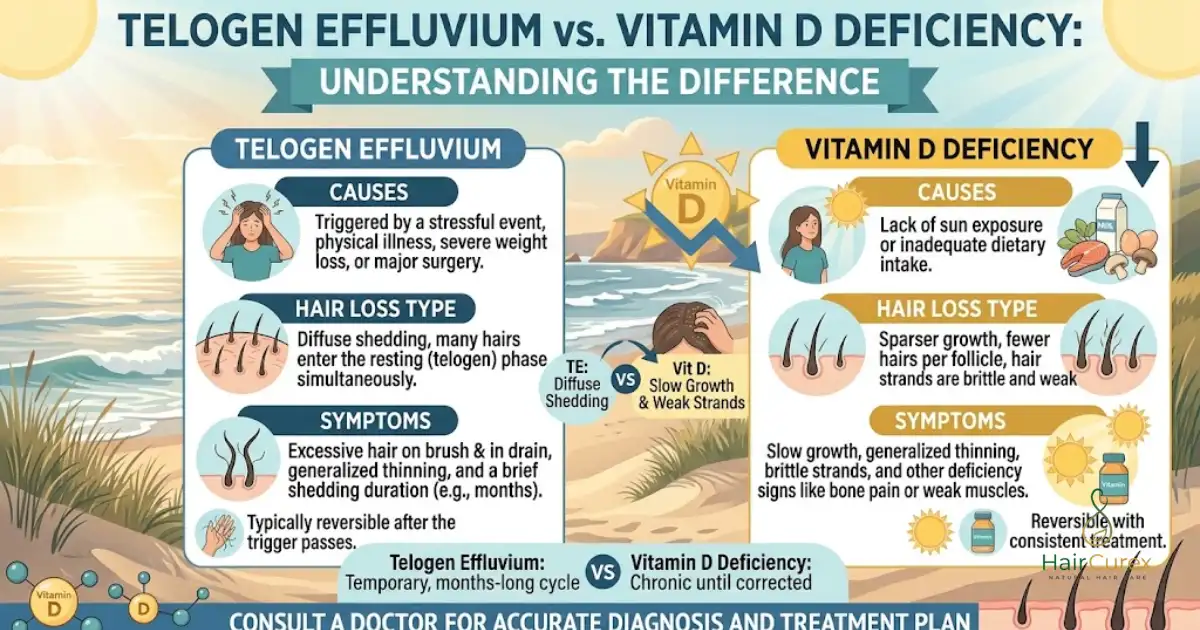
These two terms get mixed up constantly, and understanding the difference clears up a lot of confusion. Telogen effluvium is not a cause of hair loss in itself. It’s a description of the pattern, referring to a sudden, diffuse shedding event where an unusually large number of follicles shift into the resting phase at once. Think of it as the “what” rather than the “why.”
Vitamin D deficiency, on the other hand, is one of several possible triggers that can cause telogen effluvium to happen in the first place. Other common triggers include major stress-induced hair loss following surgery, illness, childbirth, or emotional trauma, along with crash dieting, thyroid disorders, and certain medications. So technically, when vitamin D deficiency causes visible shedding, what you’re experiencing is a case of telogen effluvium with a nutritional root cause.
The distinction matters for recovery expectations. Stress induced hair loss from a single triggering event, like surgery or a bad flu, is usually temporary hair shedding that resolves on its own within three to six months once the body recovers from the acute stressor. Chronic vitamin D deficiency, by contrast, can keep triggering shedding indefinitely if it’s never corrected, because the underlying cause never goes away on its own. This is why testing matters so much. Treating the shedding without treating the deficiency behind it is a bit like mopping up a leak without ever fixing the pipe.

Is Hair Loss From Low Vitamin D Reversible?
Here’s some genuinely encouraging news: in the vast majority of cases, hair loss tied to vitamin D deficiency is reversible. Because this type of shedding stems from disrupted signaling rather than permanent follicle destruction, restoring adequate vitamin D levels generally allows dormant follicles to wake back up and resume normal cycling.
That said, “reversible” doesn’t mean “instant,” and a few factors influence how smoothly the process goes. How long the deficiency lasted before it was corrected plays a major role. Someone who catches low levels within a few months typically bounces back faster than someone who walked around chronically deficient for two or three years. The severity of the deficiency matters too. Someone testing at 8 ng/mL has a longer road back to healthy follicle function than someone sitting at 18 ng/mL. Age, overall nutrition, and whether other conditions like thyroid disease or alopecia areata are also present will all shape the recovery curve as well.
As one dermatologist put it in a patient education piece for the American Academy of Dermatology, “hair loss from nutritional deficiencies tends to respond well to correction, but patients need realistic expectations about timing, because follicles don’t restart overnight.” That patience piece really is the hardest part for most people, since watching your hair thin feels urgent, but stimulating dormant hair follicles back into an active growth phase is a biological process that simply can’t be rushed.
How Long Does It Take for Hair to Grow Back After Fixing Vitamin D?
Once your vitamin D levels move back into the sufficient range, don’t expect to see results overnight. The hair regrowth timeline generally unfolds in a few recognizable stages, and understanding them helps you avoid giving up too early.
For the first four to six weeks after correcting your levels, you likely won’t notice much visible change, and that’s completely normal. Your follicles need time to shift back into the anagen growth phase, and hair grows at an average rate of only about half an inch per month, so early progress happens beneath the surface before it shows. Around the two to three month mark, many people report a noticeable slowdown in shedding, which is usually the first sign that things are turning around.
The real visible progress tends to arrive during what’s often called the 3 month recovery phase, though full regrowth realistically stretches from four months out to a full year depending on how much thinning occurred. New hair growth signs to watch for include short, fine “baby hairs” along the hairline and part, a fuller feel when you run your fingers through your hair, and a reduction in strands left behind after washing or brushing. Full density restoration for more significant thinning can take anywhere from six months to twelve months, so tracking progress with monthly photos tends to be far more reassuring than relying on memory alone.
Best Vitamin D Rich Foods to Naturally Boost Your Levels

Food alone often isn’t enough to correct a significant deficiency, but building a solid diet for hair growth gives your body a steady baseline to work from, and it’s a smart habit regardless of your current levels. Fatty fish for hair health deserves the top spot on this list, since salmon, mackerel, sardines, and trout are among the richest natural sources of vitamin D available, alongside beneficial omega-3 fatty acids that also support scalp health.
Egg yolks provide vitamin D in a form that’s easy to fit into an everyday American breakfast, though the yolk is where the nutrient lives, so skipping it for egg whites alone defeats the purpose. Fortified foods have become one of the most practical vitamin D sources in the US market precisely because natural food sources are fairly limited. Many milk brands, plant-based milk alternatives, orange juices, and breakfast cereals sold in American grocery stores are fortified with vitamin D, making them an easy addition to a daily routine.
| Food | Approximate Vitamin D per Serving |
|---|---|
| Salmon (3.5 oz, cooked) | 400–685 IU |
| Fortified milk (1 cup) | 100–120 IU |
| Egg yolk (1 large) | 40–45 IU |
| Fortified orange juice (1 cup) | 100 IU |
| Canned tuna (3 oz) | 150 IU |
| Fortified breakfast cereal (1 cup) | 40–100 IU |
| Mushrooms exposed to UV light (1 cup) | 400+ IU |
Sunlight exposure remains the most efficient natural source, since your skin produces vitamin D when exposed to UVB rays, but factors like sunscreen use, latitude, season, and skin tone all limit how reliable this route is throughout the year. For most people dealing with a confirmed deficiency, food and sunlight work best as supportive habits alongside supplementation rather than a standalone fix.
Choosing the Right Vitamin D3 Supplements for Hair Growth
When it comes to vitamin d3 vs d2, the science leans fairly clearly in one direction. Vitamin D3, known as cholecalciferol, is the form your skin naturally produces from sunlight, and research consistently shows it raises and maintains blood levels more effectively than D2, or ergocalciferol, which is typically plant-derived and used in some prescription formulations. For most people looking to correct a deficiency and support hair growth, D3 is the more reliable choice sitting on pharmacy shelves.
Regarding the daily recommended dosage for hair loss, general guidelines from the National Institutes of Health suggest 600 to 800 IU per day for most healthy adults simply to maintain sufficiency, but correcting an existing deficiency often requires considerably higher doses, sometimes 1,000 to 5,000 IU daily, prescribed and monitored by a physician based on blood test results. This is an important point worth repeating: self-prescribing high doses without testing can lead to toxicity, since vitamin D is fat-soluble and builds up in your system rather than flushing out like water-soluble vitamins.
Among the best supplements for thinning hair, look for products that pair D3 with cofactors that support absorption and hair health, such as vitamin K2, which helps direct calcium appropriately, or biotin and zinc, which are commonly included in hair-support formulations. Third-party testing certifications like USP Verified or NSF Certified are worth checking for on the label, since supplement quality varies widely across brands in the largely unregulated US market. As always, run your supplement plan past your doctor first, particularly if you’re already taking calcium supplements or have a history of kidney issues.
When Should You See a Dermatologist for Persistent Hair Thinning?
Correcting vitamin D levels solves the problem for a large share of people, but it isn’t a universal fix, and knowing when to escalate matters just as much as knowing the basics.
Red Flags That Mean It’s Time for Professional Help
If your Vitamin D Deficiency levels have returned to a healthy range for three months or longer and you’re still not seeing any improvement in shedding or density, that’s a clear signal to book a trichologist consultation or see a board-certified dermatologist. The same goes for hair loss that appears in distinct patches rather than diffuse thinning, scalp irritation, redness, or scaling, since these can point toward alopecia areata, an autoimmune condition, or a scalp infection rather than a nutritional issue.
A dermatology visit for persistent thinning typically starts with a detailed history and a scalp examination, sometimes using a dermatoscope to examine follicles up close. Bloodwork often expands beyond vitamin D to check thyroid function, iron and ferritin levels, and hormone panels, since male pattern baldness and female pattern hair loss involve hormonal and genetic mechanisms entirely separate from nutritional deficiency and require different treatment approaches altogether, such as minoxidil or finasteride. A skilled dermatologist can also perform a pull test or a scalp biopsy in more complex cases to pin down exactly what’s driving the thinning, which takes the guesswork out of a frustrating and often emotional process.

Conclusion
Vitamin D deficiency hair loss is real, well-documented, and, most importantly, treatable. The connection runs through vitamin D receptors, keratinocyte activity, and the hair follicle cycle, disrupting the normal rhythm of growth and rest that keeps your scalp full. Recognizing the signs of low Vitamin D Deficiency early, especially when paired with fatigue and bone pain, gives you a real head start toward figuring out what’s going on rather than guessing.
Testing through a 25-hydroxyvitamin D blood test takes the mystery out of the equation, and correcting a confirmed deficiency through diet, sunlight, and properly dosed D3 supplementation puts dormant follicles back on track. Recovery takes patience, typically several months before visible improvement shows up, but for most people, hair loss from low vitamin D genuinely is reversible. If levels normalize and thinning persists anyway, a dermatologist can help rule out other medical reasons for hair fall and get you back on solid footing.
FAQs
Can low vitamin D cause hair loss in women specifically?
Yes, and it’s actually more commonly diagnosed in women, partly because women are more likely to be screened for nutritional deficiencies when experiencing diffuse thinning, and partly due to higher rates of vitamin D deficiency among women overall in the US population.
What vitamin D level is too low for hair growth?
Levels below 20 ng/mL are generally classified as deficient and are commonly associated with hair thinning, though some people notice shedding even in the insufficient range of 20 to 29 ng/mL.
Can too much vitamin D cause hair loss?
Extremely high vitamin D levels, typically from excessive supplementation rather than diet or sun, can cause toxicity that leads to elevated calcium levels, which in rare cases has also been linked to hair shedding, so more isn’t automatically better.
Does vitamin D deficiency hair loss look different from male or female pattern baldness?
Yes. Vitamin D related shedding usually causes even, diffuse thinning across the whole scalp, while pattern baldness follows a more predictable pattern, such as a receding hairline or thinning crown in men, or widening part lines in women.
How much vitamin D per day is needed to stop hair loss?
This varies by individual and current blood levels, but general maintenance guidelines suggest 600 to 800 IU daily for most adults, while correcting a diagnosed deficiency often requires a higher, doctor-supervised dose based on your specific test results.