

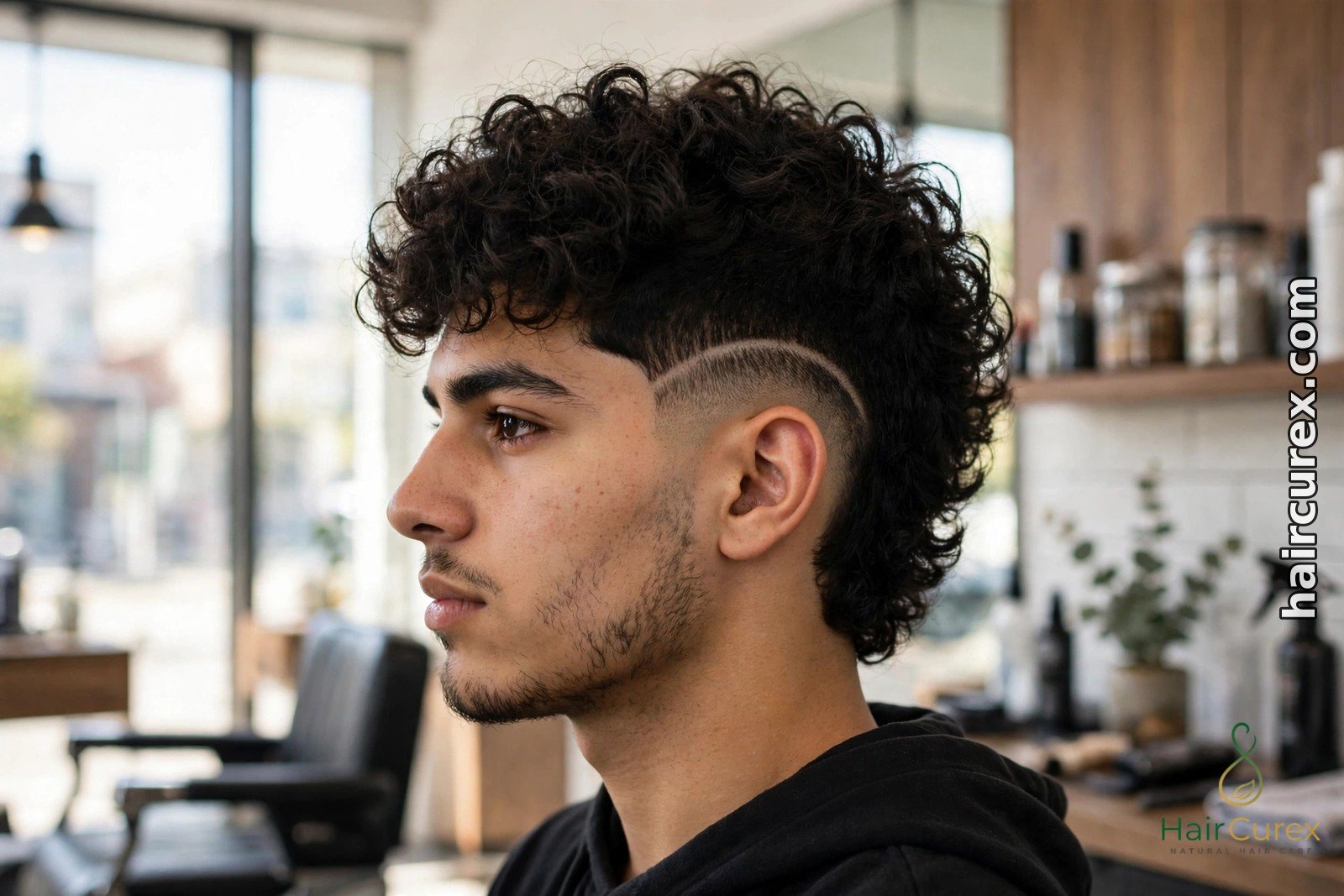
A burst fade for curly hair is a fade that curves in a rounded arc around the ear, blending from skin or a very short guard at the bottom of the curve up into the longer curls on top, while leaving more length at the back and nape than a standard taper. It is the cut to ask for when you want clean, defined sides, visible curl on top, and a shape that still looks intentional as it grows out.
Quick answer: Ask for a burst fade for curly hair with a skin or zero fade at the lowest point of the arc around the ear, blended up to a 2 guard, with the length on top left long enough for your curls to form, a natural neckline at the back, and a light lineup only if you want sharp edges. Show a photo from the side and the back, point to where the curve should sit, and confirm the back will stay longer before the clippers start.
What Is a Burst Fade for Curly Hair?
A burst fade is named for the way the fade “bursts” outward from behind the ear. Instead of running in a straight line from the temple to the nape, the faded area forms a semicircle around the ear. The shortest hair sits just above and behind the ear, and the fade blends upward into the curls on top and the hair at the back.
That curved blend is what makes it different from a taper, which is usually straighter and more gradual, and from a high fade, which takes the short hair much higher up the head.
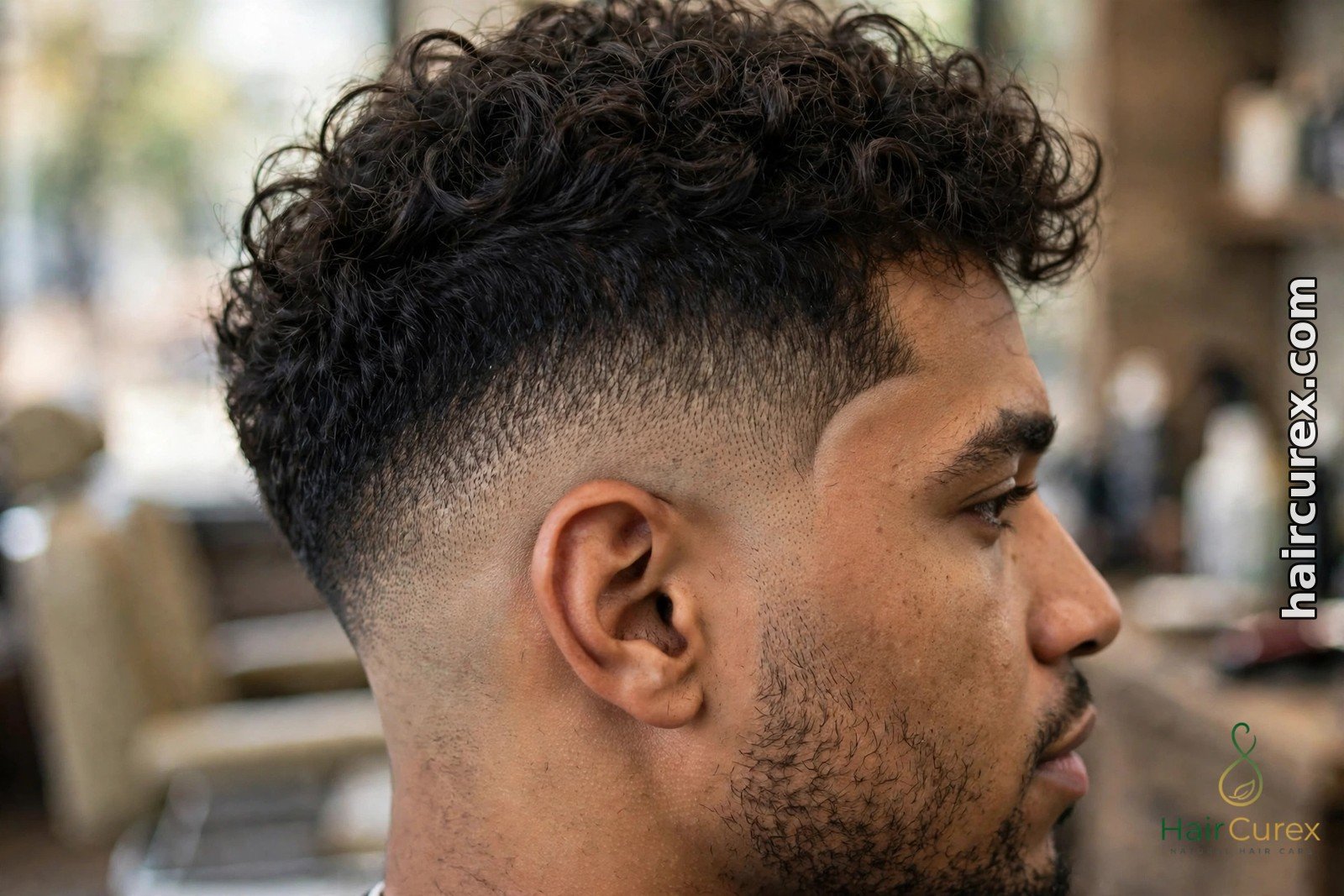
On curly hair, the burst shape removes bulk where curls tend to puff out above the ear, so the sides look tidy without thinning the top, and it leaves a clear frame around the curls, which makes the texture on top look fuller.
The back is the key detail: a true burst fade keeps length at the back and around the neck, rather than fading the nape away to skin. Most barbers start with a foil shaver or zero guard at the lowest point of the arc, then work up through a 0.5, 1, and 1.5 or 2 guard. A skin burst fade has the strongest contrast; a taper burst keeps a little more shadow at the bottom and grows out more softly.
The top should be left long enough for curls to clump, usually at least 2 to 3 inches for looser curls and 3 to 5 inches for tighter curls, and it should be cut curl by curl or dry, because curly hair shortens as it dries.
Burst Fade vs. Low Taper, Mid Fade, High Fade, and Drop Fade
The names sound similar, but the fade line, the back, and the upkeep are different. The table below is the fastest way to tell them apart before you sit in the chair.
| Cut | Fade line | Back and neckline | Best for | Upkeep |
|---|---|---|---|---|
| Burst fade | Rounded arc around the ear | Length left at the back and nape | Showing curl on top with clean, curved sides | Touch-up every 2 to 3 weeks |
| Low taper fade | Low, straight line near the sideburns and neck | Gradual taper, natural neckline | A subtle, office-friendly tidy-up | Touch-up every 3 to 4 weeks |
| Mid fade | Halfway up the sides, fairly straight | Faded at the back | Strong contrast and a sharper outline | Touch-up every 2 weeks |
| High fade | High on the sides, near the top | Faded high at the back | Maximum contrast and a bold, short look | Touch-up every 1 to 2 weeks |
| Drop fade | Curves down behind the ear toward the nape | Drops lower at the back | A curved look that follows the head shape | Touch-up every 2 to 3 weeks |
The closest comparison is the low taper fade for curly hair, which is a different fade shape: the low taper follows a low, mostly straight line and keeps the sides more conservative, while the burst fade makes a clear rounded curve around the ear and leaves more length at the back. If you want the quietest change, choose the low taper. If you want the curve to be the feature, choose the burst fade.
A drop fade is the other curved option, but its line drops down behind the ear toward the nape, so the back is shorter than in a burst fade. Mid and high fades take the fade higher and straighter, which can make curly hair on top look smaller by comparison and need more frequent clean-ups.
Who Does a Burst Fade Suit?
A burst fade for curly hair suits most curl types, but the details change with the curl. Loose waves and 2C to 3A curls usually need less length on top to show their pattern, and the curve reads clearly because the hair lies flatter at the sides. Tighter 3B to 3C curls get the most benefit, because the burst removes the side bulk that can make the head look wide, while the top keeps its volume.
Coily 4A to 4C hair also works well, especially with a slightly longer top and a softer blend, so the fade does not cut into the coil pattern at the edges. If you are not sure of your curl type, our guide to curly hair types, from 2A to 4C explains how to tell them apart and how each type behaves when it is cut short at the sides.
Face shape matters less than most people think, because the burst fade is flexible. On a round face, keeping the top a little longer and the sides tighter adds height. On an oval face, almost any version works. On a square face, a burst fade softens the jaw by keeping the corners rounded rather than squared off. On a longer face, avoid taking the top too high.
Hair density matters too: thick, dense curls can handle a skin burst fade, while fine or thinner curls usually look better with a taper burst, where the shortest part is a 1 guard rather than skin, so the scalp does not show through. If your hair is thinning at the crown, keep the top longer and do not let the fade climb too high.
What to Ask Your Barber: Exact Wording, Guards, and the Curve
Walk in with a short script for a burst fade for curly hair, not just a photo. Say this, and adjust the numbers to your hair:
“I would like a burst fade for curly hair. Skin fade at the lowest point around the ear, blended up to a 2 on the sides, with the curve staying rounded around the ear and the back left longer, with a natural neckline. Leave about 3 inches on top, cut curl by curl, and keep the lineup light, not too sharp.”
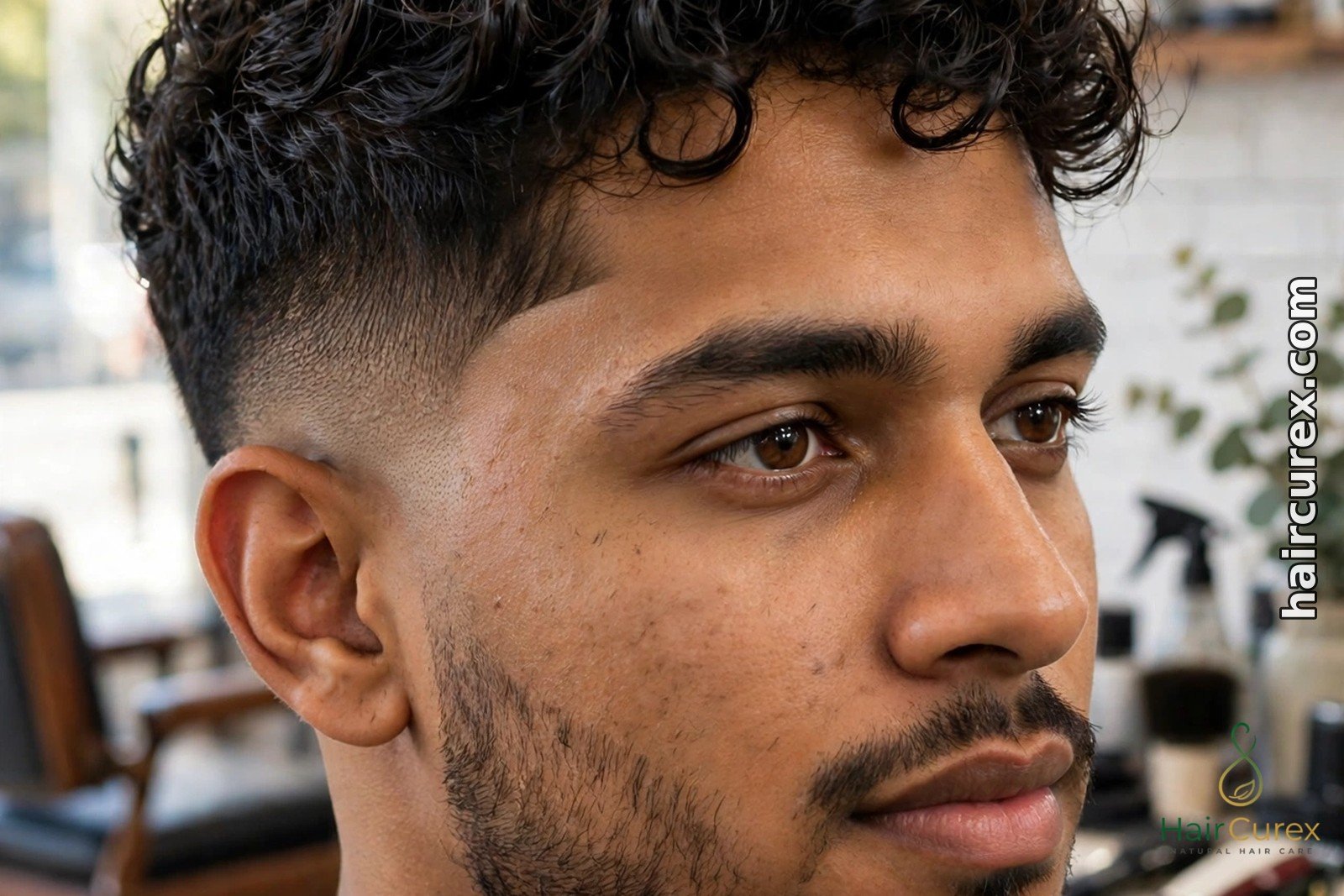
Then add the three details most people forget. First, name the guard at the bottom and at the top of the blend: a common starting point is 0 or skin at the bottom, 0.5 and 1 in the middle, and a 2 or 3 where the fade meets the curls. Second, say where the curve should sit: just above the ear at its highest point, curving down behind the ear, and not climbing toward the temple.
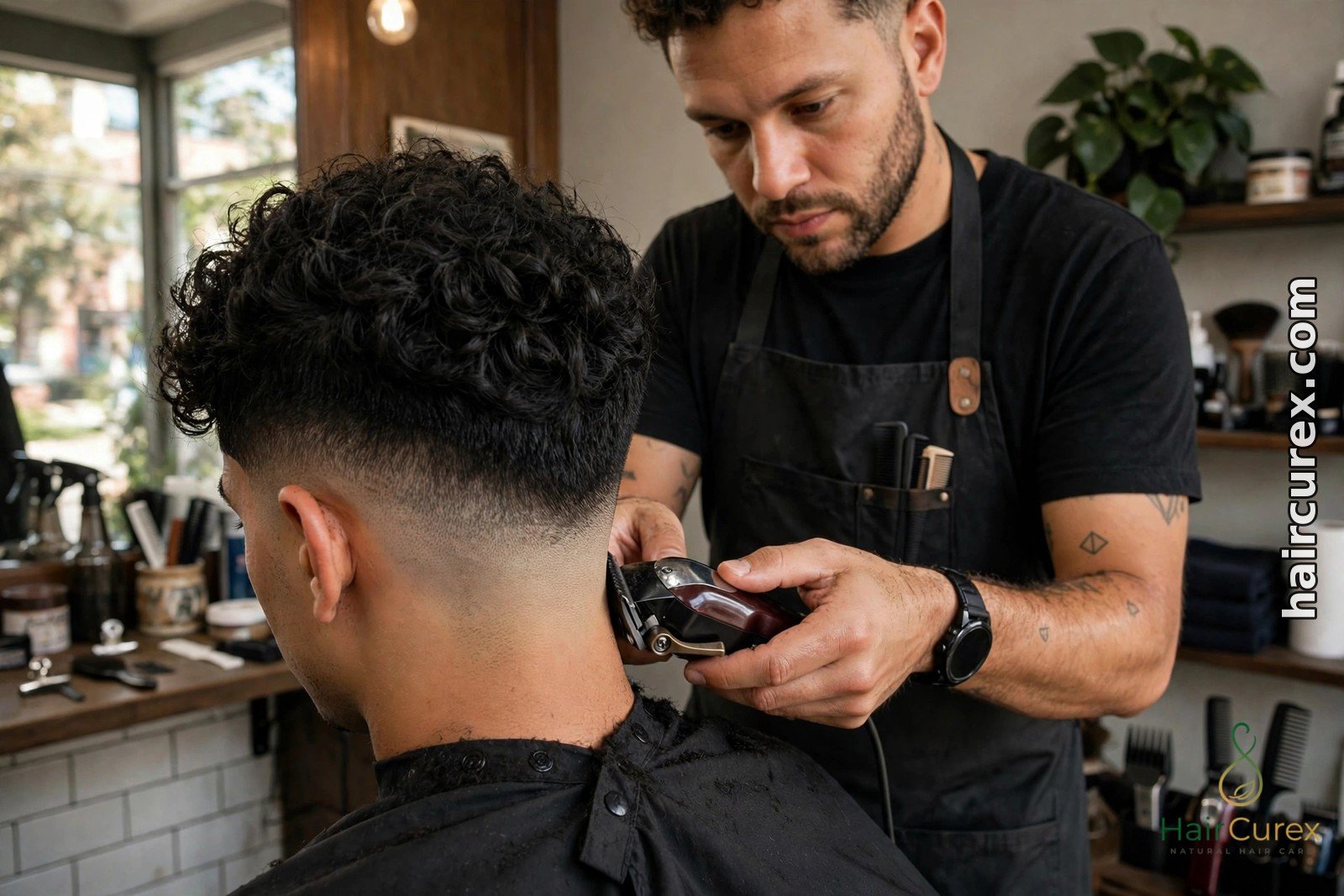
Third, say what to do at the back: leave the length, taper the nape naturally, and do not square off the back or fade it high. Before the clippers start, ask the barber to trace the curve with a comb or a finger so you can see it in the mirror. That ten-second check prevents the most common mistake: a curve that is too high, too flat, or different on the two sides.
- Fade: Skin or zero at the bottom of the arc, blended to a 1.5 or 2 guard. Ask for a taper burst (1 guard at the bottom) for a softer grow-out.
- Curve: A rounded semicircle around the ear, highest just above the ear, lowest behind it. No straight line from temple to nape.
- Top: State the length in inches, not just “leave it long.” For most curls, 2 to 4 inches works, and tighter curls need the longer end.
- Back: Keep length at the back and use a natural, tapered neckline. Say “do not fade the back up high” if that is what you want.
- Lineup: Ask for a light, natural lineup, or none at all, if your hairline is uneven or you prefer a softer edge.
- Sideburns and beard: Say whether you want sideburns tapered into the fade, and ask the barber to blend the fade into a beard, not cut a gap between them.
How to Show a Reference Photo
Bring two or three photos for a burst fade for curly hair, not ten: one front view, one side view, and one back view, all of people with a curl type and hair density close to yours. When you show the photo, say what you like and what you do not like, for example: “I like the curve in this side photo, but I want the top a little longer, and I do not want the back faded as high as in this photo.”
If the barber says your hair will not do exactly what the photo shows, listen: curl pattern, head shape, and growth direction change the result. Take a photo of your own cut from the side and the back after the appointment, while the fade is fresh, and bring it next time with a note of what grew out well.

Styling Curly Hair on Top After a Burst Fade
Style the top while it is damp, not soaking wet. Work a pea-sized amount of curl cream through the curls, scrunch upward, and let the hair air-dry or use a diffuser on low heat. A diffuser helps define curls without blowing them apart, as explained in our guide to how to use a hair diffuser for defined, frizz-free curls.
Avoid heavy wax or pomade on top after a burst fade for curly hair, because it weighs curls down. For product choice, see our guide to the best curly hair products and how to choose the right ones. Dermatologists also advise washing curly hair only when needed, keeping it moisturised, and detangling it while wet, in the American Academy of Dermatology’s curly hair care tips.
On non-wash days, refresh curls with water and a little leave-in conditioner, then scrunch again, and do not brush dry curls. If you use heat, keep it low and use a heat protectant, as the American Academy of Dermatology advises in its guide to hair styling without damage. For more cut ideas, see our round-up of haircuts for men for straight, wavy and curly hair.

Maintenance, Cost, and How Often to Get It Touched Up
A burst fade for curly hair looks sharpest for the first two weeks, then softens as the shortest hair grows. Book a touch-up every two to three weeks if you want the curve to stay crisp, or every three to four weeks if you chose a taper burst and are happy with a softer look. Between cuts, keep the neckline tidy with a trimmer only if your barber showed you how; otherwise, leave it, because a home trim can easily cut into the curve.
Cost varies by city, but in most US shops a burst fade costs about the same as any other fade, typically $25 to $60, with a skin fade, lineup, or beard blend adding $5 to $15. Ask for the full price before the cut. If you are growing the cut out, ask for a taper burst at the next visit, then a low taper, so the transition looks planned rather than overgrown.
Common Mistakes to Avoid
- Asking for a “burst fade” without saying where the curve should sit, and ending up with a high or straight fade instead.
- Letting the barber fade the back high, which removes the length that makes a burst fade a burst fade.
- Cutting the top wet and straight, so it springs up much shorter than expected when dry.
- Choosing a hard lineup on a hairline that is already uneven, which makes the line grow out in a visible step.
- Using heavy product on top, which flattens the curls and makes the sides look too wide by comparison.
- Waiting five or six weeks between cuts, then expecting a quick touch-up to restore a sharp curve.
Frequently Asked Questions
How do I ask my barber for a burst fade for curly hair?
Ask for a skin or zero fade at the lowest point of the arc around the ear, blended up to a 2 guard, with the curve rounded around the ear, the back left longer with a natural neckline, and 2 to 4 inches left on top. Show side and back photos, and ask the barber to trace the curve before cutting.
What is the difference between a burst fade and a low taper fade?
A burst fade curves in a rounded arc around the ear and leaves length at the back, while a low taper fade follows a low, mostly straight line and is more subtle. The burst fade is the bolder, more visible curve; the low taper is the quieter tidy-up.
Does a burst fade work for tight curls?
Yes. A burst fade for curly hair often suits tight 3B to 4C curls well, because it removes bulk above the ear while keeping volume on top. Keep the top longer, usually 3 to 5 inches, and ask for a softer blend for a gentler grow-out.
How often should I get a burst fade touched up?
Every two to three weeks for a crisp skin burst fade, or every three to four weeks for a softer taper burst. The curve softens first, so book before it disappears completely.
How much does a burst fade cost?
In most US barbershops it costs about the same as other fades, typically $25 to $60, with a lineup or beard blend adding $5 to $15. Prices are higher in major cities, so confirm the full price before the cut.
Will a burst fade make my curls look thinner on top?
No, if the top is left long enough. A burst fade for curly hair removes bulk at the sides, which usually makes the curls on top look fuller. It can look thinner only if the top is cut too short or the fade is taken too high.