


Quick answer: The most common curly hair problems are frizz, dryness, tangles, breakage, flat roots, an uneven curl pattern, shrinkage, curls that fall flat by day two, and product build-up. Almost all of them come from the same root cause: curly hair is naturally drier than straight hair, because the scalp’s natural oils cannot travel easily down a curved hair shaft. The fix is a routine built around moisture — gentle washing, deep conditioning, detangling only when wet, and sealing in hydration with a leave-in and a styler — plus a few habit changes, like sleeping on silk and leaving curls alone while they dry.
Curly hair is not difficult hair. It is hair with different needs, and most of the frustration comes from treating it like straight hair: brushing it dry, washing it every day, towel-drying it roughly, and expecting it to behave. Once you understand why each problem happens, the fix is usually simple. This guide covers the nine problems curly-haired people complain about most, what causes each one, and exactly how to fix it — so you can stop fighting your curls and start working with them.
Common Curly Hair Problems at a Glance
| Problem | Main cause | The fix in one line |
|---|---|---|
| Frizz | Dry, raised cuticle + humidity | Seal in moisture with leave-in and gel on soaking-wet hair |
| Dryness | Oils cannot travel down curved shafts | Deep-condition weekly; condition all of your hair, not just the ends |
| Tangles and knots | Curly strands wrap around each other | Detangle only when wet, with conditioner and a wide-tooth comb |
| Breakage and split ends | Fragile bends in the shaft + rough handling | Gentle handling, less heat, regular trims |
| Flat roots, no volume | Heavy products and gravity | Lightweight products, root clipping, diffusing upside down |
| Uneven curl pattern | Heat damage, different textures, breakage | Stop heat, trim damaged ends, style in sections |
| Shrinkage | Curls springing up as they dry | Stretch while drying; accept some shrinkage as healthy |
| Curls falling flat by day two | Friction and moisture loss overnight | Pineapple, silk pillowcase, morning refresh |
| Product build-up, itchy scalp | Heavy products and infrequent washing | Clarifying shampoo every 1–2 weeks, wash the scalp properly |
1. Frizz: The Number One Complaint
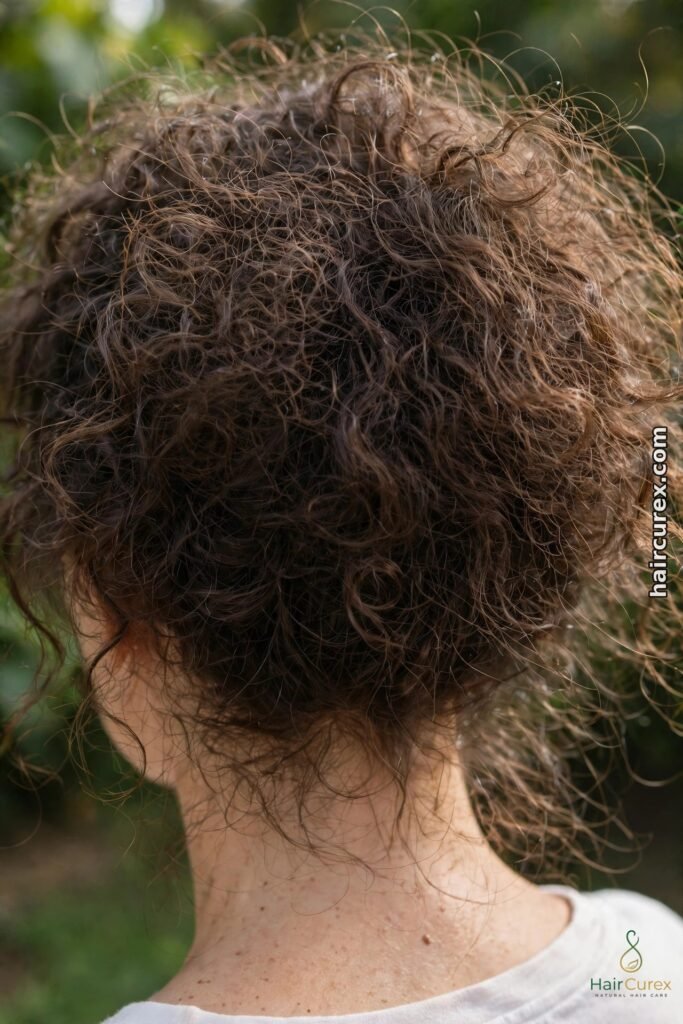
Frizz happens when the outer layer of the hair, the cuticle, lifts up instead of lying flat. Dry curly hair is especially prone to this, because the bends in each strand leave parts of the cuticle exposed, and humid air then pushes moisture into the hair shaft, swelling it and breaking up curl clumps. The result is a halo of flyaways and undefined, puffy curls.
The fix starts in the shower. Apply your styling products to soaking-wet hair, not damp hair: water helps the product spread evenly and locks the curl pattern in before frizz can form. Smooth a leave-in conditioner over your curls first, then a gel or cream to seal it in. Once you have applied your products, do not touch your hair while it dries — every touch breaks up curl clumps and creates new frizz. Rough towel drying is another common cause; blot gently with a cotton T-shirt or microfiber towel instead of rubbing with a regular towel. For a full step-by-step routine, see our guide on how to get rid of frizzy hair.
On humid days, a strong-hold gel makes the biggest difference, because it forms a film around each curl that keeps outside moisture out. If frizz is your main problem, check your products too: shampoos with sulfates strip natural oils and make frizz worse, and heavy silicones can build up and block moisture from getting in.
2. Dryness: Curls That Feel Like Straw
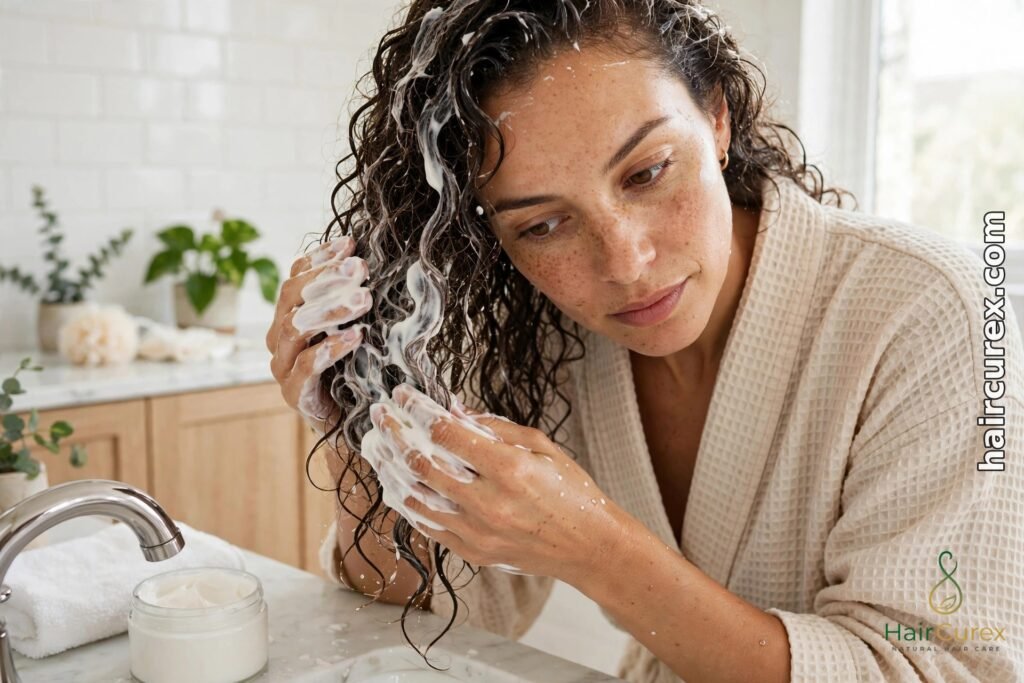
Curly hair is drier than straight hair by design. The scalp produces sebum, a natural oil that conditions the hair, but on a curly strand that oil has to travel around bends and curves, so it rarely reaches the ends. That is why the ends of curly hair are almost always the driest part — they are the oldest and the farthest from the scalp. Dermatologists at the American Academy of Dermatology point out that curly and coily hair is more prone to dryness and breakage than other hair types, and their advice is to condition all of your hair, not just the ends. Their 6 curly hair tips from dermatologists are a useful check against your own routine.
The fix is to put moisture back in on a regular schedule. Use a thick, moisturising conditioner every time you wash, and add a deep-conditioning mask once a week if your hair is very dry or damaged. Leave-in conditioner after washing helps too — look for products with glycerin, argan oil, or a fatty alcohol such as cetyl or stearyl alcohol, which the AAD recommends for curly hair. Wash less often: shampooing every day strips the oils your curls need, so most curly-haired people do best washing once or twice a week. Hot water also strips moisture, so keep the water warm rather than hot. Our roundup of the best leave-in conditioners for curly hair covers the products that add the most moisture without weighing curls down.
3. Tangles and Knots: The Wash-Day Battle
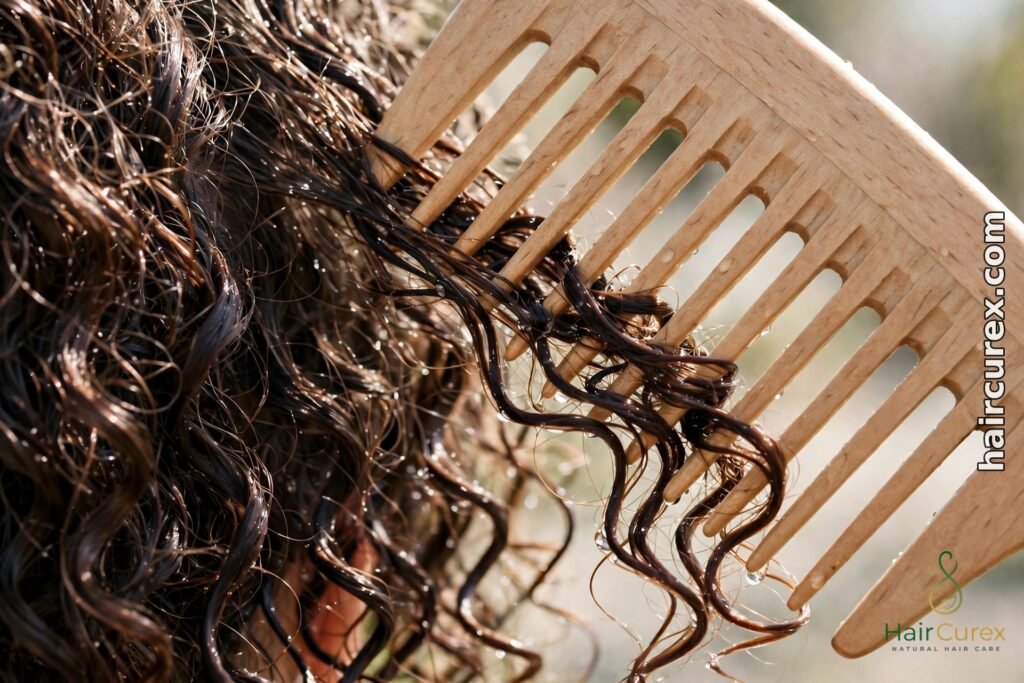
Curly strands naturally wrap around each other, so tangles are not a sign that you are doing something wrong — they are a normal feature of curly hair. But the wrong detangling method turns small tangles into painful knots and breakage. Brushing dry curly hair is the worst offender: it rips through knots, snaps strands, and turns defined curls into a frizzy cloud.
The fix is simple and non-negotiable: detangle only when your hair is wet and coated in conditioner. Work in sections, starting at the ends and moving up toward the roots, using your fingers first and then a wide-tooth comb or a brush designed for curly hair. Never yank through a knot — hold the hair above the tangle so you are not pulling on the root, and work the knot out gently. Detangling in the shower, while conditioner is still in your hair, gives the most slip and the least breakage. If your hair tangles badly between washes, a small amount of leave-in conditioner on dry ends before bed helps, and a loose braid keeps strands from wrapping around each other overnight.
4. Breakage and Split Ends
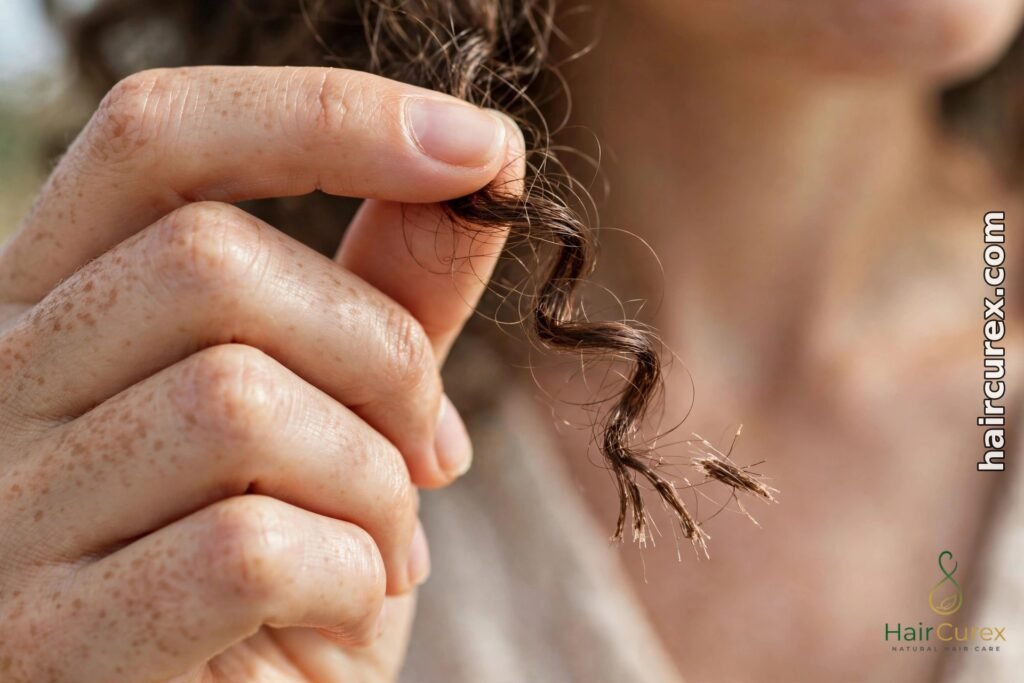
Curly hair breaks more easily than straight hair. Each bend in the strand is a weak point, and the same dryness that causes frizz also makes the hair less elastic, so it snaps instead of stretching. Rough handling — brushing dry hair, tight ponytails, rough towel drying, and frequent heat styling — adds up over time, and the damage shows up as split ends, short broken pieces around the crown, and curls that will not grow past a certain length.
The fix is mostly about being gentler. Stop brushing dry curls, switch to a wide-tooth comb on wet hair, and dry with a T-shirt or microfiber towel instead of a rough bath towel. Cut back on heat: let your hair air dry when you can, and when you do use a dryer, use a diffuser on low heat with a heat protectant. Avoid tight hairstyles that pull on the same spot every day, and give your hair a break from chemical treatments such as relaxers and bleach, which weaken the hair structure. Regular trims every 8 to 12 weeks remove split ends before they travel up the strand — skipping trims does not make hair grow faster, it makes breakage worse. If breakage is severe or sudden, our guide on hair breakage explains the warning signs that mean it is time to see a professional.
5. Flat Roots and No Volume
Curly hair can have plenty of volume at the ends and none at the roots, especially for people with fine or wavy-curly hair. Heavy creams and oils weigh the roots down, and gravity pulls wet curls flat against the scalp while they dry. The result is curls that look great from the ears down and limp on top.
The fix is to keep weight off the roots. Apply conditioner and styling products mainly to the mid-lengths and ends, and use only a tiny amount near the roots. Choose lightweight products — a light leave-in and a mousse or light gel rather than heavy butters — if your hair is fine. While your hair dries, clip the roots up with small clips, or diffuse upside down so the roots dry lifted away from the scalp. A shorter cut with layers also helps: layers remove weight from the ends and let the curls spring up, which lifts the roots naturally. And if your hair is fine, avoid overloading it with product — a little, applied often, works better than a lot at once.
6. Uneven Curl Pattern: Some Curls, Some Straight Pieces
Almost nobody has one uniform curl pattern. Most people have two or three different patterns on one head — tighter curls at the nape, looser waves on top, or a straight section where the hair is damaged. Heat damage is the most common cause of a section that will not curl at all: repeated flat-ironing breaks the bonds that make the curl shape, and the damaged section stays straight or wavy while the rest curls.
The fix depends on the cause. If heat damage is the reason, the only real cure is time and trimming: stop using heat, protect the hair while the damaged part grows out, and trim it away gradually. If the difference is natural — and for most people it is — style in sections instead of treating the whole head the same way: finger-coil the looser pieces while they are wet to encourage them to curl, and use a little more product on the sections that need help holding their shape. A good curly cut, where the stylist cuts the hair dry and curl by curl, also makes an uneven pattern look intentional rather than messy. Finding your pattern helps too — our curly girl method guide explains how to build a routine around your curl type.
7. Shrinkage: Curls That Look Much Shorter Than They Are
Shrinkage is the difference between your hair’s length when wet and stretched out, and its length when dry and curled. Tight curls can shrink by half or more, which is normal and even a sign of healthy, elastic curls. It only becomes a problem when you want length to show — for example, when a style you expected to reach your shoulders sits at your ears.
The fix is to stretch the curls gently while they dry. Braid-outs, twist-outs, and banding (tying loose bands down the length of the hair while it dries) all stretch the curl pattern without heat. Diffusing with tension — gently pulling each section down while you dry it — also adds length. Heavier creams and leave-ins can weigh curls down a little, which reduces shrinkage but can also reduce volume, so experiment to find the balance you like. And remember: shrinkage itself is not damage. If your curls spring up a lot, it means they are healthy and elastic — the goal is to manage it, not eliminate it.
8. Curls That Fall Flat by Day Two

Fresh wash-day curls look great, and then you wake up to flattened, frizzy, misshapen curls. The cause is friction and moisture loss overnight: cotton pillowcases absorb moisture from your hair and rub against it all night, breaking up curl clumps and creating frizz.
The fix has two parts: protect the curls at night, and refresh them in the morning. Before bed, gather your hair into a loose, high ponytail on top of your head — the “pineapple” — or a loose braid, which keeps the curls from being crushed. Sleep on a silk or satin pillowcase, or wear a silk bonnet, to cut down on friction. In the morning, do not re-wash: mist your hair lightly with water mixed with a little leave-in conditioner, scrunch the curls back into shape with your hands, and let it air dry for a few minutes. That refresh is usually enough to bring second- and even third-day curls back to life. For the full night routine, see our guide on how to sleep with curly hair.
9. Product Build-Up and an Itchy Scalp
Curly hair routines use a lot of product — leave-ins, creams, gels, oils — and curly-haired people often wash less frequently. That combination leaves residue on the scalp and the hair: curls look dull and limp, products stop working the way they used to, and the scalp gets itchy or flaky. Heavy silicones and butters are the usual culprits, and going too long between washes makes it worse.
The fix is to clarify regularly. Use a clarifying shampoo once every one to two weeks to remove build-up, and focus the shampoo on your scalp, massaging it in with your fingertips rather than your nails. After clarifying, always follow with a good conditioner or a deep-conditioning mask, because clarifying shampoos are drying by design. Between clarifying washes, keep products off your scalp — apply styling products to the lengths, not the roots. If itching, flaking, or soreness does not improve after a few weeks of proper washing, or if you notice bald patches or sores, see a dermatologist: that can be a scalp condition that products alone will not fix. Healthline’s guide to how to take care of curly hair covers the same washing and clarifying routine, including the once-a-week hair mask habit for dry curls.
A Simple Routine That Prevents Most of These Problems
Most curly hair problems share one fix: a consistent, gentle routine built around moisture. Wash once or twice a week with a sulfate-free shampoo, condition every time you wash, and deep-condition once a week if your hair is dry. Detangle only when wet and coated in conditioner. Apply leave-in and styler to soaking-wet hair, and do not touch your curls while they dry. Protect them at night with a pineapple and a silk pillowcase, and clarify every one to two weeks. That routine will not solve every problem overnight — damaged hair takes months to grow out — but within two or three wash days most people see less frizz, softer curls, and easier detangling.
Start with the problem that bothers you most. Fix that one first, give it two or three wash days, and then move on to the next. Changing everything at once makes it impossible to tell what worked. And be patient with your curls: they respond to consistency, not to the most expensive product on the shelf.
When to See a Professional
Most curly hair problems are styling and routine problems, and the fixes above will sort them out. But some signs need a professional. See a dermatologist if you notice sudden or patchy hair loss, bald spots, severe itching, sores, or flaking that does not improve after a few weeks of gentle washing. See a curly-hair specialist stylist if one section of your hair never forms curls, if breakage is severe despite gentle handling, or if you want a cut that works with your curl pattern rather than against it.
Frequently Asked Questions
Why is my curly hair always frizzy?
Curly hair frizzes because it is dry and the cuticle lifts, letting humid air swell the hair shaft and break up curl clumps. The fix is moisture and sealing: condition well, apply leave-in and gel to soaking-wet hair, and do not touch your curls while they dry.
How often should I wash curly hair?
Most curly-haired people do best washing once or twice a week. Washing every day strips the natural oils your curls need, while going too long between washes can cause build-up and an itchy scalp. Dermatologists recommend washing at least every two to three weeks as a minimum for scalp health.
Should I brush curly hair?
Never brush curly hair when it is dry — that breaks curls apart, causes breakage, and creates frizz. Detangle only when your hair is wet and coated in conditioner, using your fingers or a wide-tooth comb, working from the ends upward.
Why do my curls fall flat on the second day?
Friction against a cotton pillowcase overnight flattens curl clumps and absorbs moisture from your hair. Protect curls with a loose pineapple or braid and a silk or satin pillowcase, then refresh in the morning with a light mist of water and leave-in conditioner.
Can curly hair problems be fixed without cutting my hair?
Most can — frizz, dryness, tangles, flat roots and build-up all respond to routine changes. But heat damage and split ends cannot be repaired by products; damaged ends need to be trimmed away gradually while the healthy hair grows in.
Is shrinkage a sign of damaged hair?
No — shrinkage is a sign of healthy, elastic curls that spring back as they dry. Tight curls can shrink by half or more. You can stretch curls while drying with braid-outs, twist-outs or banding if you want more length to show, but some shrinkage is normal and healthy.