
Hair extensions are extra strands of human or synthetic hair attached to your own hair to add length, volume, or both — and the honest answer to the question everyone asks first is that they do not have to damage your hair, but they can. The result depends on the method you choose, how skilled the stylist is, how heavy the extensions are for your natural hair, and how well you look after them. Clip-in and halo extensions are the gentlest because you take them out every day, while tape-ins, sew-ins, micro-links, and keratin bonds stay in for weeks or months and carry a real risk of breakage and traction alopecia — hair loss from constant pulling — if they are fitted too tightly, left in too long, or removed the wrong way. This guide compares all six main types, how long each lasts, what each typically costs, and how to wear extensions without wrecking the hair underneath.
Hair Extensions: The 6 Types at a Glance
The six main types of hair extensions differ in how they attach, how long they stay in, and how much risk they carry. Clip-ins snap in and out at home in minutes. Tape-ins are thin wefts glued to your hair with adhesive tape by a stylist. Sew-ins (weaves) are wefts sewn onto cornrow braids. Micro-links use tiny metal beads to clamp small strands to your hair. Keratin bonds (fusion) fuse individual strands to your hair with heated keratin. Halo extensions sit on a hidden wire that rests on your head like a headband. The table below gives the short version; the sections after it explain each method in full, including who it suits and what can go wrong.
| Type | How it attaches | How long it lasts | Best for | Damage risk |
|---|---|---|---|---|
| Clip-in | Small clips snap onto your hair | Hair lasts 6–12+ months; worn only when you want it | Beginners, special occasions, fine hair | Low |
| Halo | Hidden wire rests on the head, hair falls over it | Hair lasts 6–12+ months; worn only when you want it | Quick volume with no attachment | Low |
| Tape-in | Adhesive tape sandwiches thin sections of your hair | 6–8 weeks before move-up | Fine to medium hair, natural look | Medium |
| Sew-in (weave) | Wefts sewn onto cornrow braids | 6–8 weeks | Thick or coarse hair | Medium to high |
| Micro-link | Tiny beads clamp strands to your hair | 3–4 months | Medium to thick hair | Medium |
| Keratin bond (fusion) | Heated keratin fuses strands to your hair | 3–6 months | Long-term wear, very natural movement | Medium to high |
Clip-In Extensions: The Safest Way to Start
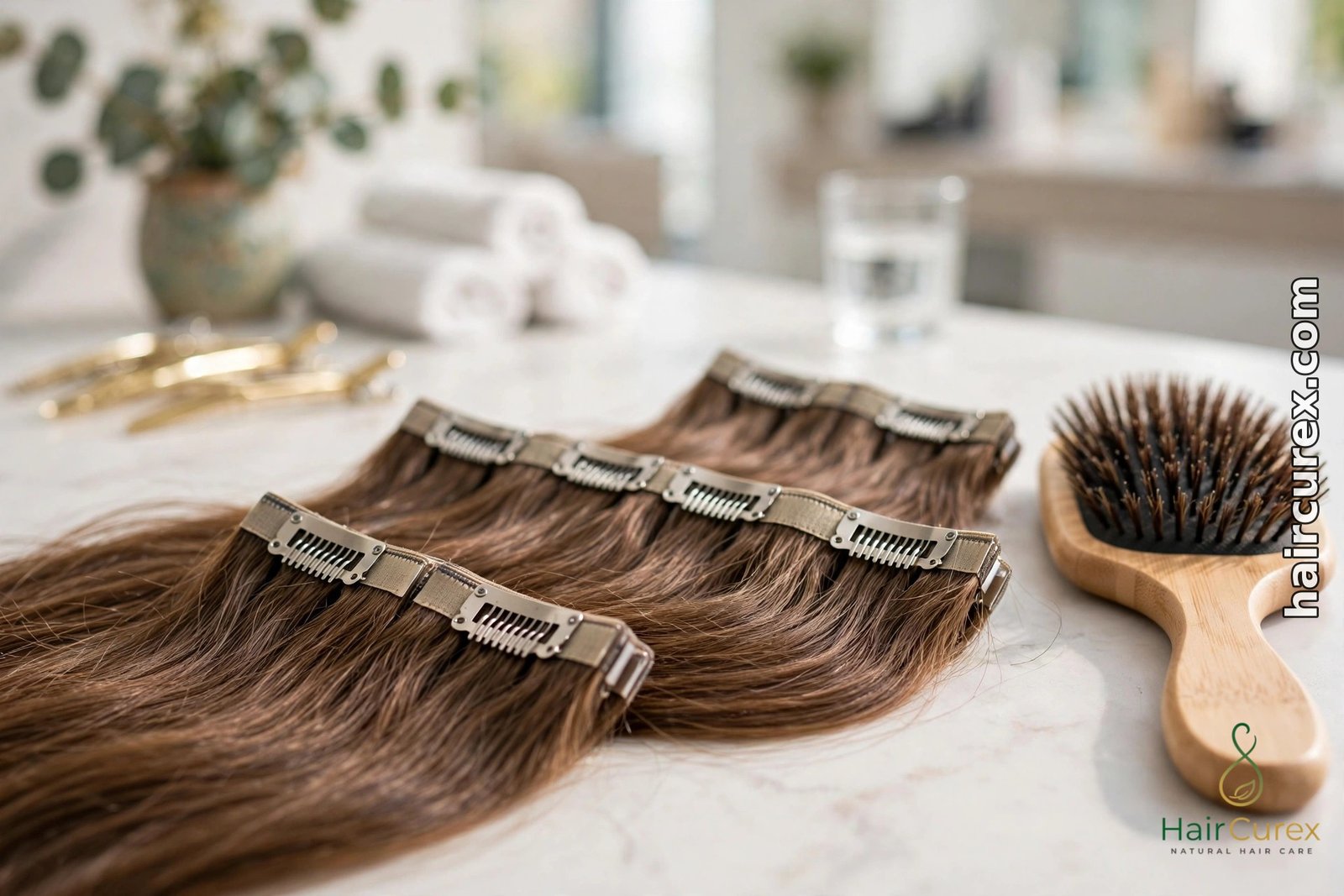
Clip-in extensions are wefts of hair with small clips sewn along the top edge. You section your hair, snap the clips in near the roots, and let your own hair fall over the top to hide them. A full head takes five to ten minutes at home, needs no stylist, and comes out every night, which is exactly why clip-ins are the lowest-risk type of hair extensions: there is no glue, no heat, no braiding tension, and no constant pull on your roots while you sleep. Good-quality human-hair clip-ins last 6 to 12 months or longer with proper care, because they are only worn part of the time, while synthetic clip-ins are cheaper but usually last only a few months and cannot take high heat.
Clip-ins suit almost everyone, including fine hair, as long as the clips are not fastened too tightly in the same spot every day and the wefts are not too heavy for the hair carrying them. The main downsides are practical: they can slip if your hair is very silky or freshly washed, the clips can show if the wefts are placed too high, and they are not a swim-or-sleep solution. Choose a set that matches your hair colour and texture closely, buy human hair if you want to curl or straighten them, and store them brushed and dry. A layered cut such as the butterfly haircut also helps clip-in wefts blend invisibly into your own hair, because the layers break up the line where your hair ends and the extensions begin. If you are trying extensions for the first time, start here — clip-ins let you test the length and volume before you commit to anything semi-permanent.
Tape-In Extensions: Flat, Natural, and Popular
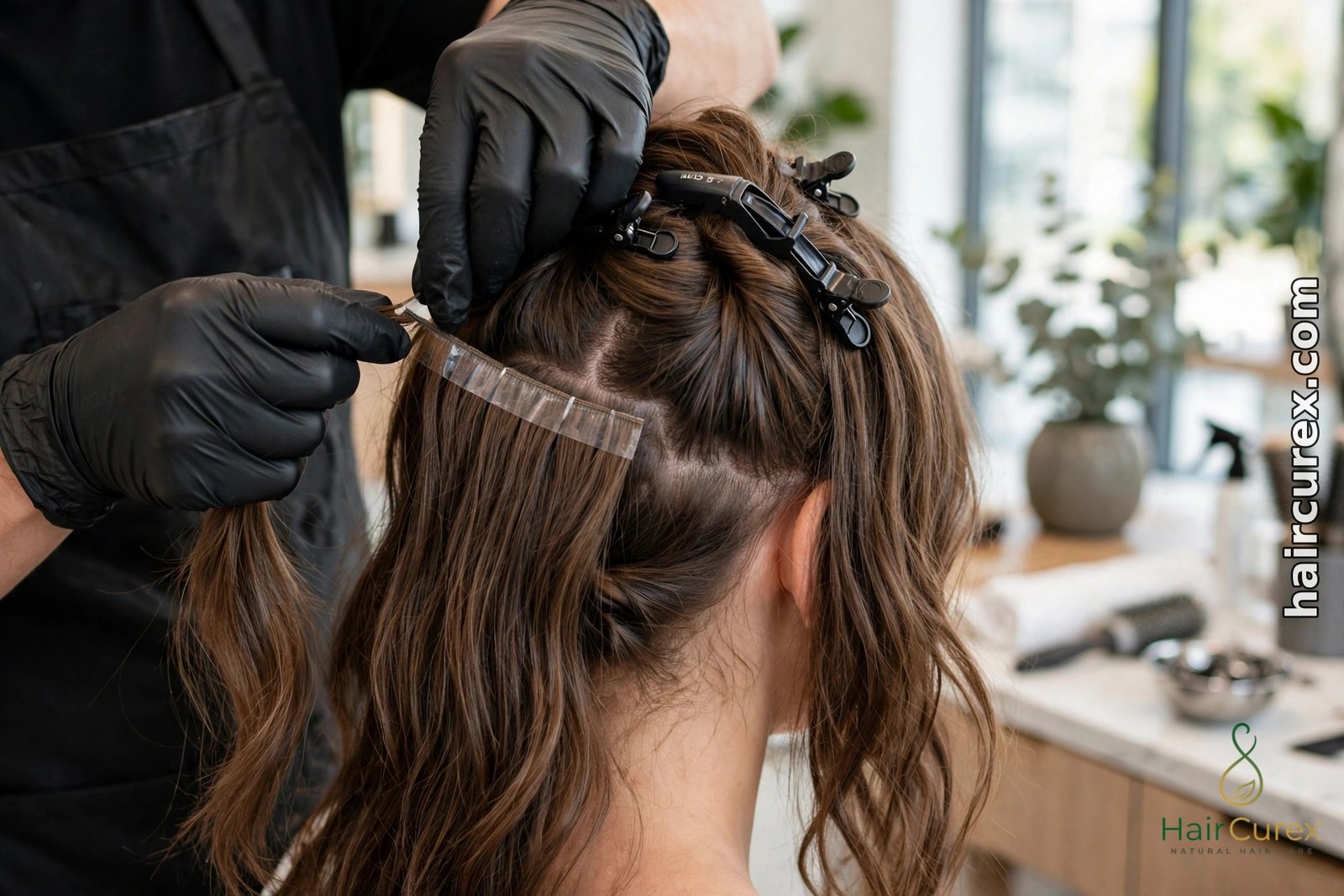
Tape-in extensions are thin wefts with a strip of medical-grade adhesive tape along the top. A stylist sandwiches a thin slice of your natural hair between two taped wefts, close to the scalp. They lie very flat, which makes them one of the most discreet methods — hard to spot even in fine hair or an updo — and application takes 30 to 45 minutes. Tape-ins typically need to be moved up or re-taped every 6 to 8 weeks as your hair grows out, and the hair itself can be reused for several months if it is good-quality human hair.
The main risks are adhesive-related. Tape residue can build up if the wrong products are used, and damage usually happens at removal: pulling taped wefts out without the proper solvent can rip out your own hair with them. Oil-based products, heavy conditioners, and silicone serums applied near the bonds can loosen the tape early, so stylists advise keeping oils and heavy products away from the roots. Tape-ins suit fine to medium hair well, but they are not ideal for very oily scalps, heavy sweating, or frequent swimming, because moisture and oil weaken the adhesive. Always have them removed by a professional, and never try to peel them out yourself.
Sew-In Extensions (Weaves): Best for Thick Hair
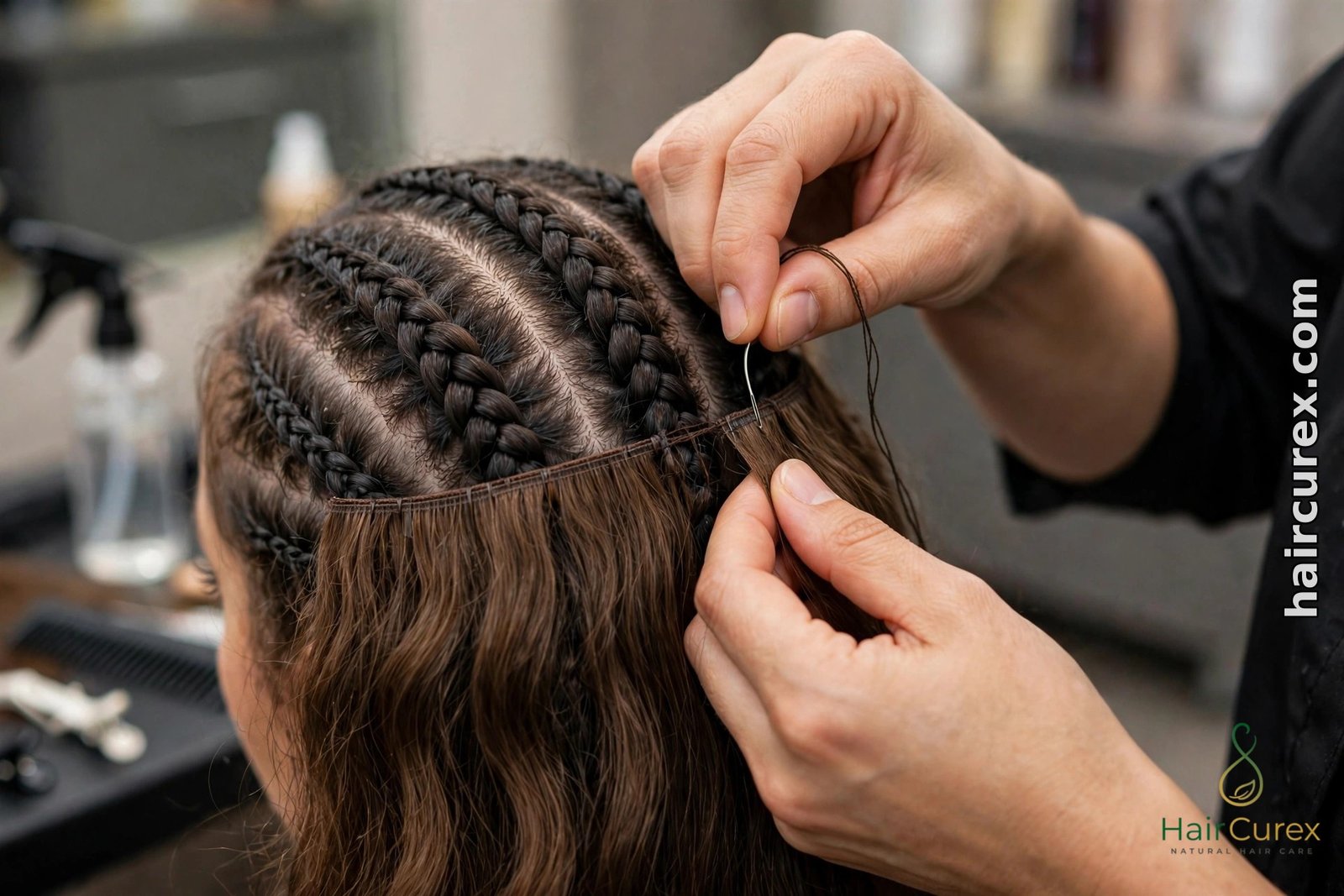
A sew-in, or weave, starts with your natural hair braided into cornrows, and wefts of extension hair are then sewn onto the braids with thread. It is one of the oldest extension methods and gives a very secure, long-lasting result with lots of styling freedom — you can wear ponytails, braids, and updos without worrying about the extensions shifting. Sew-ins usually last 6 to 8 weeks before the braids grow out and need redoing. Our hair braiding guide explains the braid patterns used as the base for this method and why the braids themselves matter as much as the wefts.
The risk with sew-ins is tension. Tight braids pull constantly on the follicles, and heavy wefts add weight on top of that pull. Healthline’s protective hairstyles guide explains the same mechanism for braids and weaves generally: extension hair adds tension to the scalp, which can increase the risk of traction alopecia, and styles should never be painful. Sew-ins suit thick or coarse hair best, because it can carry the weight and the braids hold well. They are a poor choice for fine, fragile, or thinning hair, and if your scalp hurts, itches, or develops bumps after fitting, the braids are too tight — go back and have them loosened rather than waiting it out.
Micro-Link Extensions: No Glue, No Heat
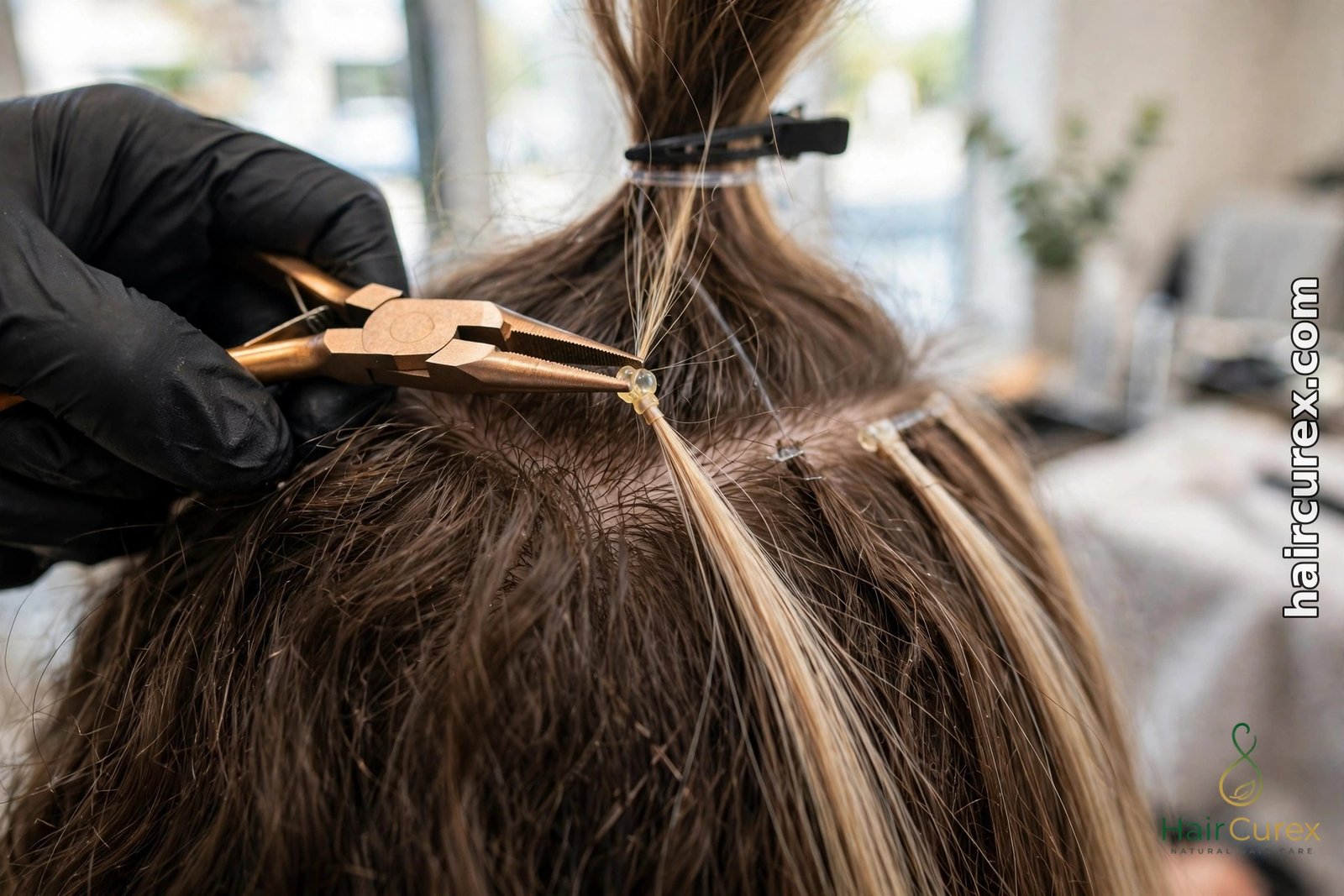
Micro-link extensions — also called micro-bead or I-tip extensions — attach small bundles of hair to your own hair with tiny metal or silicone-lined beads, which the stylist clamps shut with pliers. There is no glue and no heat, which appeals to people who want to avoid adhesives, and the strands move naturally because each one is attached individually. They typically last 3 to 4 months, with maintenance appointments every 6 to 8 weeks to move the beads up as your hair grows.
The beads themselves are the weak point. A bead clamped too tightly can crush and snap the hair inside it, beads can slip down the hair shaft if they are not secured well, and the weight of many individual strands adds up. Micro-links suit medium to thick hair; on very fine hair the beads can show through and the weight can be too much. Brushing needs care — a loop brush that glides over the beads rather than catching on them — and you should never try to squeeze a bead open yourself. Done well, they are a good middle ground between temporary and bonded methods; done badly, they cause the same breakage as any other tension method.
Keratin Bond (Fusion) Extensions: The Most Natural — and the Most Demanding
Keratin bond extensions, also called fusion extensions, attach individual strands to your hair with a small blob of keratin — the same protein your hair is made of — melted with a heat tool. Because each strand moves on its own, they look and behave the most like natural hair, and they last the longest of the semi-permanent methods, typically 3 to 6 months. They also take the longest to fit, often two to three hours for a full head, and they are usually the most expensive.
Heat and chemicals are the trade-offs. The bonding process uses heat on your hair, the bonds can be felt and can catch when you brush, and removal needs a special solvent and a professional — pulling bonds out by force breaks the hair at the attachment point. Keratin bonds suit people who want long-term, very natural-looking extensions and are willing to pay for proper fitting, maintenance, and removal. They are not a good first choice for fine or fragile hair, and anyone with a sensitive scalp should patch-test the keratin and the removal solvent first, because the glues and chemicals used in extension application can cause contact dermatitis in some people — a risk Consumer Reports documented in its report on the dangers of hair extensions.
Halo Extensions: Instant Length With Nothing Attached
Halo extensions are the simplest concept of all: a weft of hair attached to a thin, nearly invisible wire that sits on your head like a headband, with your own hair pulled over the top to hide the wire. Nothing is glued, taped, sewn, or clamped to your hair, so there is no tension on your roots at all. They go on in under a minute and come off at night, like clip-ins. Human-hair halos last 6 to 12 months or more with care, and they are the easiest option for anyone who only wants extra length or volume for a day, a photoshoot, or an event.
The limits are fit and styling. Halos can shift if they are not sized correctly, and they do not suit very short hair, because there is not enough of your own hair to cover the wire. High ponytails and tight updos are also tricky, since the wire can show. But for everyday volume and length with effectively no damage risk, a halo is hard to beat — and for many people it is the only extension type their stylist will recommend if their natural hair is fine or recovering from damage.
Human Hair vs Synthetic Hair: Which Is Worth It?
The hair itself matters as much as the method. Human hair extensions — ideally “Remy” hair, where the cuticles all face the same direction — look natural, can be washed, heat-styled, and coloured like your own hair, and last far longer: 6 to 12 months or more with good care. They cost more, typically several hundred dollars for a full head of good-quality hair before fitting. Synthetic hair is much cheaper and holds a curl well straight out of the packet, but most synthetic fibres melt or frizz under high heat, tangle more easily, and usually need replacing after a few months. Synthetic is a reasonable choice for clip-ins you wear occasionally; for anything semi-permanent that you will wash and style for months, human hair is the better investment. Either way, match the colour and texture to your own hair — a perfect colour match hides the join better than any fitting technique.
How Much Do Hair Extensions Cost?
Prices vary widely by salon, city, hair quality, and length, so treat these as typical U.S. ranges, not quotes. Clip-in sets cost roughly $100 to $500 for the hair, with no fitting fee because you apply them yourself. Halo extensions run roughly $100 to $400 for the hair. Tape-ins typically cost $200 to $800 or more including fitting, plus $100 to $300 per move-up appointment. Sew-ins usually run $300 to $1,000 or more including the braiding and fitting. Micro-links typically cost $300 to $900, and keratin bonds $500 to $1,500 or more for a full head. Consumer Reports notes that a typical full-head application can involve 100 to 200 extensions and can cost hundreds to thousands of dollars as well as many hours in the salon chair. The hair is only part of the price: budget for maintenance every 6 to 8 weeks, professional removal, and the aftercare products your stylist recommends. Cheap hair and cheap fitting are the two most common reasons extensions end up damaging the hair underneath.
Do Hair Extensions Damage Your Hair? The Honest Answer
Hair extensions can damage your hair, and the damage comes from three things: tension, weight, and bad removal. Constant pulling on the roots causes traction alopecia, a form of hair loss that is reversible in the early stages — the hair grows back once the pulling stops — but can become permanent if the tension continues for months, because the follicles can scar. Healthline’s protective hairstyles guide lists the warning signs dermatologists watch for: flaking or redness on the scalp, thinning around the hairline, scalp tenderness or itching, and small bumps near the attachment points. If you notice any of these, loosen or remove the style straight away and let your scalp recover.
Weight matters too: extensions that are too heavy for your natural hair cause breakage where the strands are attached, and the longer and heavier the extensions, the greater the strain. The third cause is removal — ripping out bonds, tape, or beads without the right solvent or tools pulls your own hair out with them. Allergic reactions to glues and adhesives are less common but real, ranging from itching and redness to, in rare cases, serious reactions. None of this means extensions are always harmful: millions of people wear them without lasting damage, because they chose a method suited to their hair type, used a skilled stylist, kept the weight reasonable, maintained them on schedule, and had them removed professionally. The risk is manageable — but only if you respect it.
How to Care for Hair Extensions So They Last
Good care starts with washing. Wash extensions less often than your own hair — two to three times a week is enough for most people — using a gentle, sulfate-free shampoo, and keep conditioner, oils, and masks away from bonds, tape, and beads, because they loosen adhesives. Our gentle shampoo guide explains what makes a formula truly mild and when a stronger wash is the right tool. Wash with your head upright rather than flipped over, which tangles the attachment points, and rinse thoroughly so no product builds up at the roots.
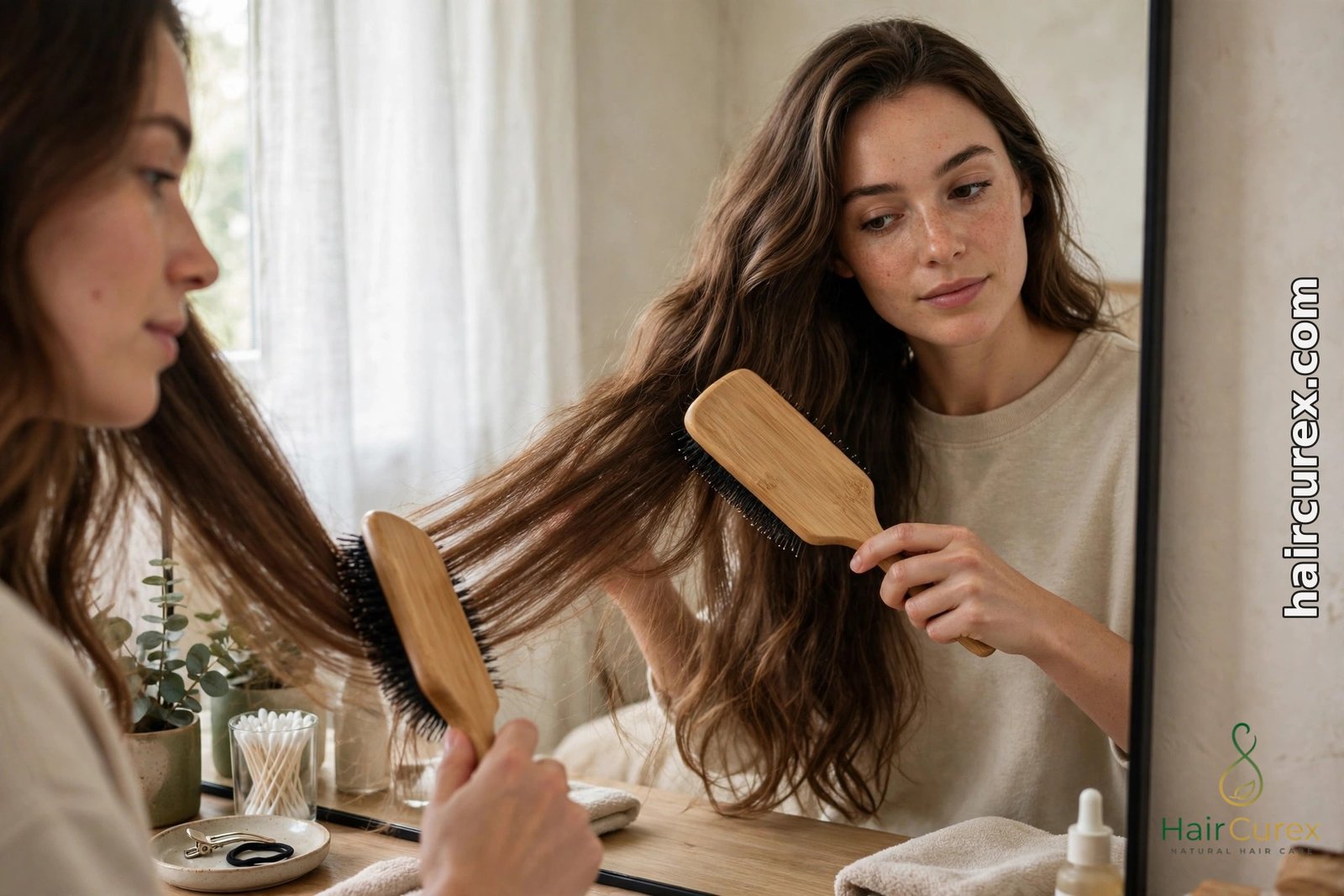
Brushing is the second daily habit. Use a loop brush or a soft-bristle extension brush, hold the roots with one hand so you are not pulling on the attachments, and brush from the ends upward in small sections. Never brush wet extensions roughly — detangle gently with your fingers or a wide-tooth comb first. At night, loosely braid the hair or tie it in a low, loose ponytail, and never go to sleep with wet extensions, because damp hair tangles and mats far more easily. Healthline’s guide to matted hair makes the same point: extension hair tangles with your own hair if it is not maintained, and extensions need a professional visit every 6 to 8 weeks for upkeep even when the hair itself can last 6 months to a year. Heat-styling is fine on human hair with a heat protectant, but keep hot tools away from bonds and tape, and skip the top heat setting. Our hair ingredients to avoid guide lists the drying alcohols and harsh cleansers that damage both extensions and the hair underneath.
How to Remove Hair Extensions Safely
Removal is where most extension damage actually happens, so treat it as part of the fitting, not an afterthought. Clip-ins and halos come out at home in minutes — unclip, slide out, done. Every other method should be removed by a professional: tape-ins need a solvent that dissolves the adhesive, keratin bonds need a bond remover, micro-links need the beads opened with pliers, and sew-ins need the thread cut and the braids taken down gently. Never pull, peel, or cut extensions out yourself, and never cut close to the bonds, because one wrong snip can take a chunk of your own hair with it. After removal, give your hair a break of at least two to four weeks before the next set — wash it gently, deep-condition it, and trim any split ends. If you see thinning at the hairline, broken hairs at the attachment points, or a sore scalp after removal, extend the break and see a dermatologist if it does not improve within a few months.
Who Should Avoid Hair Extensions?
Some people should skip extensions or wait. If your hair is already thinning, shedding heavily, or breaking easily, extensions add weight and tension to hair that cannot carry it — our best hair growth oils for hair fall guide covers gentler ways to support thinning hair first. Active scalp conditions such as psoriasis, eczema flare-ups, folliculitis, or an infection are also reasons to wait, because attachments trap sweat and product against an already irritated scalp. Anyone with a known allergy to adhesives, latex, or keratin products should patch-test before any bonded method. And if your hair is severely damaged from bleach or chemical treatments, fix the condition first: extensions can hide damage, but they also pull on weakened hair and make it worse. A good stylist will turn you away if your hair is not ready — if yours does not, find another stylist.
The Bottom Line on Hair Extensions
Hair extensions are a genuine shortcut to length and volume, but they are not free of consequences. Clip-ins and halos give you the look with almost no risk, because they come out every day. Tape-ins, sew-ins, micro-links, and keratin bonds look more natural and last longer, but they put constant tension and weight on your hair, and they only stay safe when a skilled stylist fits them, you keep up maintenance every 6 to 8 weeks, and a professional removes them. Choose the lightest method your goal allows, match the hair quality to how long you will wear it, never ignore pain or itching, and always take breaks between sets. Do that, and hair extensions can be a tool you enjoy for years — skip those steps, and the hair underneath pays for it.
Frequently Asked Questions About Hair Extensions
Do hair extensions damage your hair?
They can, but they do not have to. Damage usually comes from tension and weight that cause traction alopecia, or from bad removal that pulls your own hair out. Clip-ins and halos are the lowest-risk types because they come out daily, while tape-ins, sew-ins, micro-links and keratin bonds need a skilled stylist, regular maintenance and professional removal to stay safe.
How long do hair extensions last?
It depends on the type. Clip-in and halo hair lasts 6 to 12 months or more because you only wear it when you want it. Tape-ins need moving up every 6 to 8 weeks, sew-ins last 6 to 8 weeks, micro-links last 3 to 4 months, and keratin bonds last 3 to 6 months. All types need a professional check every 6 to 8 weeks.
Which type of hair extensions is best for fine hair?
Clip-ins and halos are usually best for fine hair because they add no constant tension and come out every day. Tape-ins can also work well because they lie flat and are light. Sew-ins and heavy keratin bonds are generally too heavy for fine hair and are more likely to cause breakage.
Can you wash your hair with extensions in?
Yes, but wash less often — two to three times a week — with a gentle, sulfate-free shampoo, keeping conditioner and oils away from the bonds, tape or beads. Wash with your head upright, rinse thoroughly, and never go to sleep with wet extensions, because damp hair tangles and mats much more easily.
How much do hair extensions cost?
Typical U.S. ranges are $100 to $500 for clip-ins, $200 to $800 or more for tape-ins, $300 to $1,000 or more for sew-ins, $300 to $900 for micro-links, and $500 to $1,500 or more for keratin bonds, plus maintenance every 6 to 8 weeks. Prices vary widely by salon, hair quality and length.
Can hair extensions cause hair loss?
Yes — the main way is traction alopecia, hair loss caused by constant pulling on the roots. Early traction alopecia is usually reversible once the pulling stops, but if the tension continues for months the follicles can scar and the loss can become permanent. Pain, itching, bumps, or thinning at the hairline are warning signs to remove the extensions and let your scalp recover.