


Quick answer: A hair length chart names your hair by where the ends fall on your body: ear (4–6 inches), chin (7–9 inches), shoulder (10–12 inches), armpit (14–16 inches), bra strap (16–18 inches), mid-back (18–20 inches), waist (22–24 inches), hip (26–28 inches), tailbone (30–32 inches) and classic (34–38 inches). Measure from the crown of your head down the back to the longest ends, with the hair pulled straight — and if your hair is curly, measure it stretched, because shrinkage can hide several inches.
“How long is my hair?” sounds like a simple question, but most people answer it wrong. They guess from how it looks in the mirror, compare it to someone else’s hair, or measure from the wrong starting point — and end up a whole length name off.
A hair length chart fixes that: it gives every length a name, a number in inches and centimeters, and a body landmark you can actually check in the mirror. Whether you are growing your hair out, telling a stylist exactly what you want, ordering extensions, or just curious where you stand, the chart is the shared language that makes the answer clear. This guide gives you the full chart, shows you how to measure correctly, explains why curly hair needs a different method, and works out how long each step of the journey really takes.
Hair Length Chart: Inches, Centimeters and Length Names
This hair length chart measures hair from the crown of your head — the highest point at the top — straight down the back to the longest ends, with the hair dry and pulled straight. That is the convention most charts, stylists and extension sellers use, so lengths measured this way are comparable. The numbers below are approximate ranges: bodies differ in height and torso length, so the same 16 inches of hair can sit at bra-strap length on one person and mid-back on another. Use the body landmark as your main guide and the inches as the check.
| Length name | Inches (from crown) | Centimeters | Where the ends fall |
|---|---|---|---|
| Ear length | 4–6 in | 10–15 cm | Ends at the earlobe |
| Chin length | 7–9 in | 18–23 cm | Ends at the chin or jawline |
| Shoulder length | 10–12 in | 25–30 cm | Ends graze the top of the shoulders |
| Armpit length (APL) | 14–16 in | 36–41 cm | Ends reach the armpits |
| Bra-strap length (BSL) | 16–18 in | 41–46 cm | Ends reach the bra strap at the back |
| Mid-back length | 18–20 in | 46–51 cm | Ends fall halfway down the back |
| Waist length | 22–24 in | 56–61 cm | Ends reach the natural waist |
| Hip length | 26–28 in | 66–71 cm | Ends reach the top of the hips |
| Tailbone length | 30–32 in | 76–81 cm | Ends reach the tailbone |
| Classic length | 34–38 in | 86–97 cm | Ends reach the upper thigh |
Two of these names deserve a note because they cause the most confusion. Armpit length and bra-strap length are often used interchangeably online, but they are not the same: armpit length is where the ends first reach the armpit, usually around 14 to 16 inches, while bra-strap length is a couple of inches further down, where the ends sit on the bra strap at the back. And “classic length” is the traditional name for hair that reaches the upper thigh — beyond tailbone, and the longest length on most charts. Past classic length, hair is usually just described by its measurement, since very few people grow it further.
Keep this hair length chart in mind the next time you look at a style photo or an extension listing. Extension sellers quote lengths in inches measured the same way — from the top of the weft to the ends, straight — so a 22-inch extension will sit around waist length on most people, while a 16-inch one lands near bra-strap length. Knowing your own number first means you buy the right length instead of guessing from a photo.
How to Measure Your Hair Length Correctly
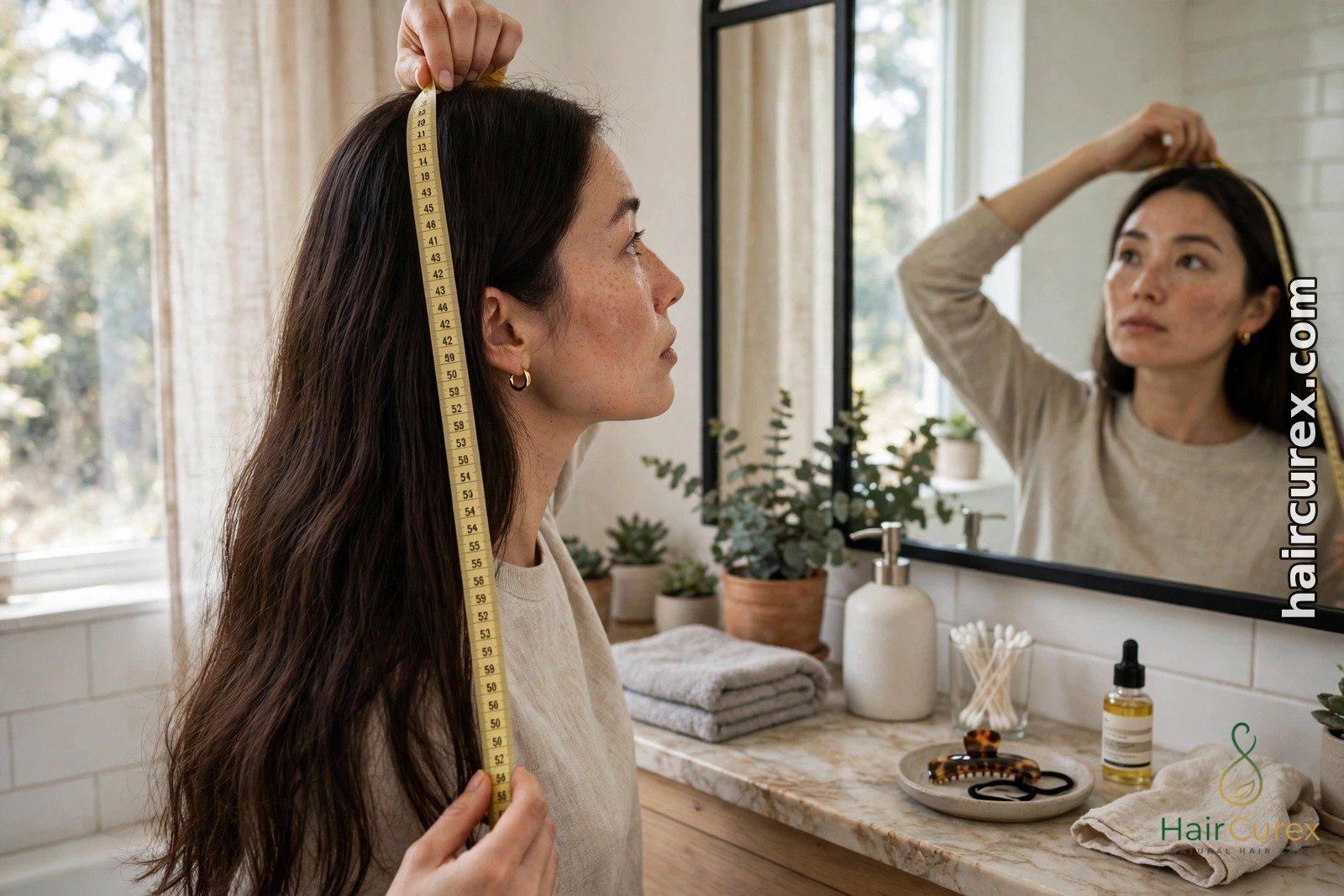
Measuring your hair length takes two minutes and one soft tape measure — the flexible tailor’s kind, not a metal one. Start with clean, dry hair, because wet hair stretches longer than it really is and will give you a false reading.
Part your hair in the middle, bring it all over to the back, and hold the end of the tape at the crown — the highest point on top of your head. Run the tape straight down the back of your head and down your back, keeping it flat against your hair, until you reach the very longest ends. That number is your hair length. If your hair is layered, measure to the longest layer, since that is the length the chart is describing.
A few details make the measurement accurate. First, keep the tape on the surface of the hair rather than buried inside it, and do not pull the hair tight — gentle tension is enough.
Second, if your ends are uneven, measure to the longest point but note the shortest too, since a stylist will want to know both. Third, measure on a day when your hair is in its normal state: freshly straightened hair reads longer than your everyday texture, and a wash-day blowout can add an inch that disappears by the next morning. For the most consistent tracking, measure the same way every time — same starting point, same dryness, same tape — and write the number down with the date. That record is what turns “I think it’s growing” into proof.
If you do not have a tape measure, a piece of string and a ruler work just as well: mark the string at the crown and at the ends, lay it flat, and measure it. Phone apps that claim to measure hair from a photo are not reliable, because they cannot tell where your crown is or how much your hair is stretching in the picture. The tape-and-mirror method is simple, repeatable and free — and it is the method behind every number in the hair length chart above.
How Curly Hair Measures Differently (Shrinkage)
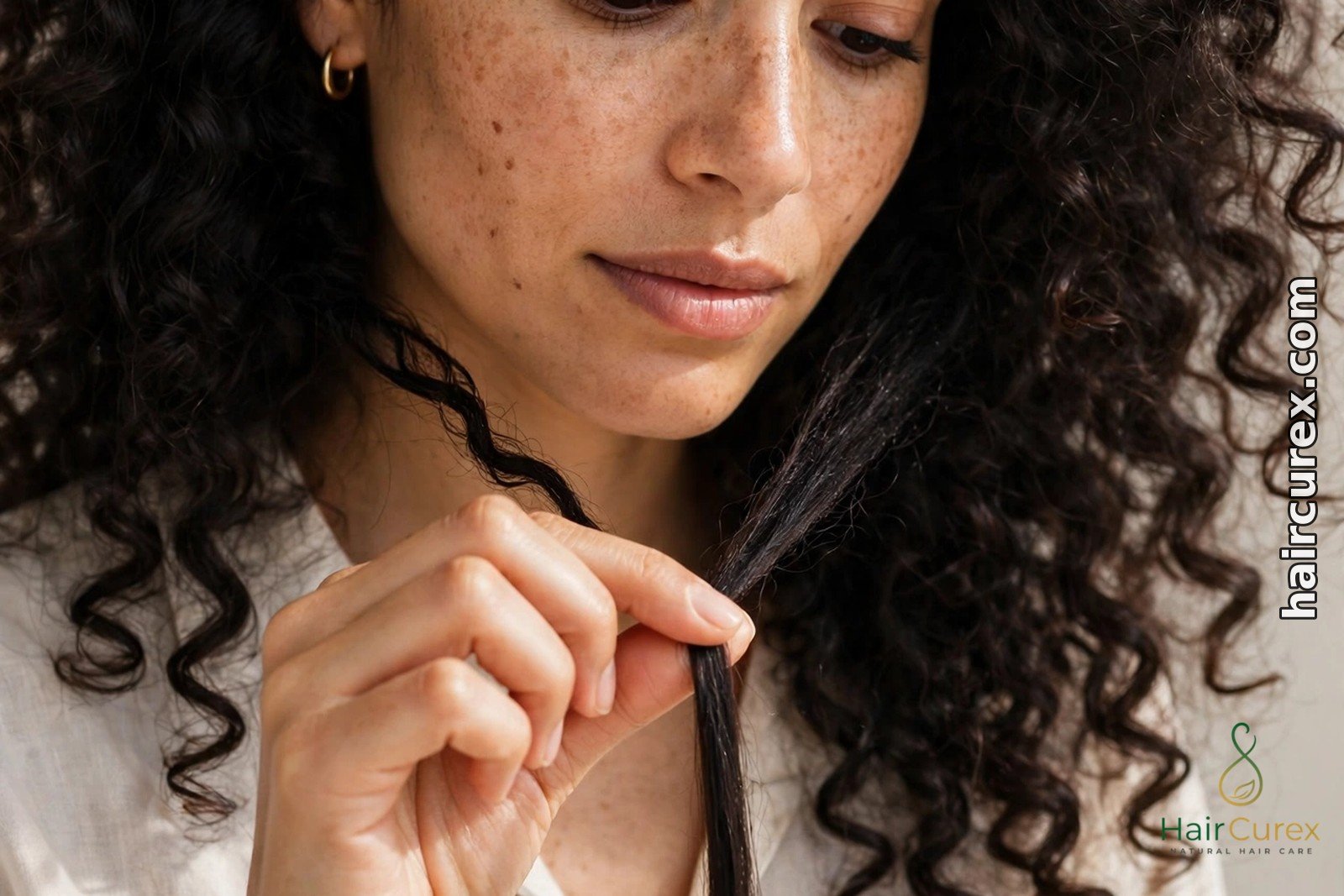
Curly hair breaks the hair length chart unless you measure it the right way, because of shrinkage: the difference between how long a curl looks when it sits naturally and how long it actually is when pulled straight. A curl that measures 8 inches in its natural state can stretch to 12 or 14 inches when pulled — that is 4 to 6 inches of length hiding in the curl pattern.
The tighter the curl, the more shrinkage: loose 2C waves may shrink only 10 to 20 percent, 3A curls around 20 to 30 percent, 3B and 3C curls roughly 30 to 50 percent, and tight 4A to 4C coils can shrink 50 to 75 percent, meaning coily hair can look half its true length. Those are typical ranges, not exact figures — every head of curls is a little different — but they explain why two people with the same measured length can look like they have completely different amounts of hair.
To find your real length on the hair length chart, measure your curly hair stretched. Take a single curl from the back of your head, pull it gently straight down without tugging hard, and measure from the crown to the end of the stretched curl. Do this in a few spots — the crown, the sides and the nape — because curl patterns vary across the head, and take the longest stretched reading as your length.
Never measure curly hair in its natural, unstretched state and compare that number to the chart, or you will think you are at chin length when you are really at shoulder length, and every growth goal you set will be wrong. Our guide to curly hair types explains the 2A to 4C scale in full, and if your curls are on the tight end, our guide to coily hair covers the care routine that keeps coils defined and healthy as they grow.
Shrinkage is not a flaw — it is what makes curly hair look full and voluminous. But it does change how you plan a cut and how you judge growth.
When you ask a stylist for a length, say the stretched length you want, not the shrunken length you see: “I want it to sit at my shoulders when dry” is clearer than “cut two inches off,” because two inches off a stretched curl can look like four inches gone once it springs back. And when you track growth, always compare stretched to stretched. A curl that stretched to 12 inches six months ago and stretches to 15 inches now has grown 3 inches, even if it looks the same length in the mirror every morning.
How Long Does It Take to Grow to Each Length?

Hair grows about half an inch per month — roughly 6 inches a year — according to the American Academy of Dermatology, and that rate is fairly consistent across healthy adults. That single number lets you work out how long any jump on the hair length chart will take, as long as you remember it is the ideal rate before trims: every trim takes length off, so real progress is growth minus what you cut. The table below assumes you start from the length in the first column and grow to the next milestone without cutting, so treat the months as a best case and add a few months for normal trims.
| From | To | Inches to grow | Time at ½ inch/month |
|---|---|---|---|
| Chin (8 in) | Shoulder (12 in) | ~4 in | ~8 months |
| Shoulder (12 in) | Bra strap (18 in) | ~6 in | ~12 months |
| Bra strap (18 in) | Waist (24 in) | ~6 in | ~12 months |
| Waist (24 in) | Hip (28 in) | ~4 in | ~8 months |
| Hip (28 in) | Tailbone (32 in) | ~4 in | ~8 months |
| Shoulder (12 in) | Waist (24 in) | ~12 in | ~2 years |
The most useful line in that table is the last one: shoulder to waist is about two years of steady growth. That is why growing long hair feels slow — it is a multi-year project, not a few months, and the early stages feel the slowest because each new length name takes the better part of a year.
Two things make the wait shorter in practice. First, hair does not grow at exactly the same rate for everyone: some people grow closer to ¾ inch a month, and growth is often a little faster in summer. Second, keeping the length you grow matters more than the rate: hair that breaks at the ends never gets longer no matter how fast it grows from the root, so protecting the ends is what turns growth into visible length. If you want the full picture of products that support the journey, our guide to the best curly hair products and our guide to hair growth shampoo both explain what helps and what is mostly marketing.
One honest caveat: there is a natural limit to how long hair can grow. Each hair grows for a set period — typically 2 to 7 years — then sheds and is replaced. At half an inch a month, a 7-year growth phase allows up to about 42 inches, which is past classic length; a 2-year phase allows only about 12 inches, which is shoulder length.
Most people fall somewhere in between, which is why some people reach waist length easily and others stall at bra-strap length no matter how careful they are. If your hair has stopped getting longer despite good care, you have probably reached your terminal length, and the best move is to keep the length you have healthy and full rather than chasing a number your hair cannot reach.
How to Grow Your Hair to the Next Length

Growing to the next step on the hair length chart is mostly about keeping the hair you already have. The growth happens at the roots whether you do anything or not — about half an inch a month, as the American Academy of Dermatology notes — so the work is stopping the ends from breaking off at the same rate. Trim the ends every 10 to 12 weeks, just a quarter to half an inch, to remove split ends before they travel up the hair shaft; skipping trims does not make hair grow faster, it makes the ends thinner until they snap.
Wash gently with a sulfate-free shampoo, condition every time, and detangle with a wide-tooth comb starting from the ends and working up, never ripping down from the roots. The AAD’s healthy-hair guidance covers these basics well: American Academy of Dermatology healthy hair tips.
Heat is the biggest threat to length retention. Research on hair dryers found that heat can damage the hair shaft, with higher temperatures causing more damage — which is why the ends, the oldest and most fragile part of the hair, are the first to break when heat is overused: Lee et al. (2011) on hair shaft damage from heat and drying.
Use the lowest heat setting that gets the job done, keep the dryer moving instead of parked on one spot, always use a heat protectant, and let hair air-dry when you have the time. The same goes for hot tools: flat irons and curling wands at high temperatures weaken the hair with every pass, so use them less often and at the lowest effective heat while you are growing.
Sleep and styling matter too. A silk or satin pillowcase reduces the friction that roughs up the cuticle overnight, and a loose braid or a silk scrunchie keeps long hair from tangling while you sleep — tight elastic bands break hair at the same spot every night.
Avoid tight ponytails and heavy extensions during a growth phase, since constant tension can cause breakage and, in severe cases, traction hair loss. And be patient with the awkward stages: the months between chin and shoulder, and between shoulder and bra strap, are when most people give up and cut. A few well-chosen styles carry you through — our guide to hairstyles for long hair has easy everyday options that work at every length on the chart, so you do not have to wait until you arrive to enjoy the hair you have.
Choosing a Length That Suits You
The best length on the hair length chart is not the longest one — it is the one that suits your face, your hair texture and the amount of upkeep you are willing to do. Shoulder length is the most popular length for a reason: it suits almost every face shape, works with straight, wavy and curly hair, dries quickly, and needs the least styling.
Chin and ear lengths are sharp and modern, and they suit strong jawlines and fine hair especially well, because short hair makes fine hair look thicker. Bra-strap and mid-back lengths are the sweet spot for most people who want long hair without the weight and the long drying time of waist length — they read as clearly long while staying easy to manage.
Waist length and beyond is a commitment, not just a length. Hair at waist length takes much longer to wash and dry, tangles more easily, needs more product, and catches on bag straps, seatbelts and zips. It suits thick hair best, because fine hair at waist length can look thin at the ends.
Before you commit to growing past bra strap, try the length first with a long-layered cut that keeps the ends full, and be honest about whether you enjoy the daily care. The right length is the one you will actually look after — a healthy, shiny bra-strap length beats a damaged, split-ended waist length every time, and the hair length chart is a guide, not a ladder you have to climb to the top.
Hair Length Chart FAQs
What is the most common hair length?
Shoulder length is the most common hair length. It suits most face shapes and hair textures, dries quickly, needs little styling, and sits at the point where hair first starts to read as medium-long rather than short. Bra-strap length is the next most common, especially among people actively growing their hair out.
How do I know my hair length?
Measure from the crown of your head — the highest point on top — straight down the back to the longest ends, with dry hair pulled straight. Compare that number to the hair length chart: 10–12 inches is shoulder length, 16–18 inches is bra-strap length, 22–24 inches is waist length. If your hair is curly, measure it stretched, because shrinkage hides several inches.
How long is bra-strap length hair in inches?
Bra-strap length hair is about 16 to 18 inches long, measured from the crown to the ends with the hair pulled straight — roughly 41 to 46 centimeters. The ends sit on the bra strap at the back. It is about 4 to 6 inches past shoulder length, which takes roughly 8 to 12 months of growth.
How long does it take to grow hair from shoulder to waist?
About two years. Shoulder length is around 12 inches and waist length is around 24 inches, so you need to grow about 12 inches, and hair grows roughly half an inch per month. Trims slow that down, so expect closer to two and a half years if you trim every 10 to 12 weeks — and the ends must stay healthy, or breakage will cancel out the growth.
Why does curly hair look shorter than it is?
Because of shrinkage: curls spring up as they dry, so the visible length is much shorter than the actual length of the hair strand. Loose waves may shrink 10 to 20 percent, while tight 4A to 4C coils can shrink 50 to 75 percent, making coily hair look half its true length. Pull a curl straight to measure its true length against the hair length chart.
What is classic length hair?
Classic length is hair that reaches the upper thigh, about 34 to 38 inches measured from the crown — roughly 86 to 97 centimeters. It is the longest length on most hair length charts, past tailbone length (30 to 32 inches). Reaching it takes many years of growth, and it needs careful end care to keep the ends from breaking before they get there.