

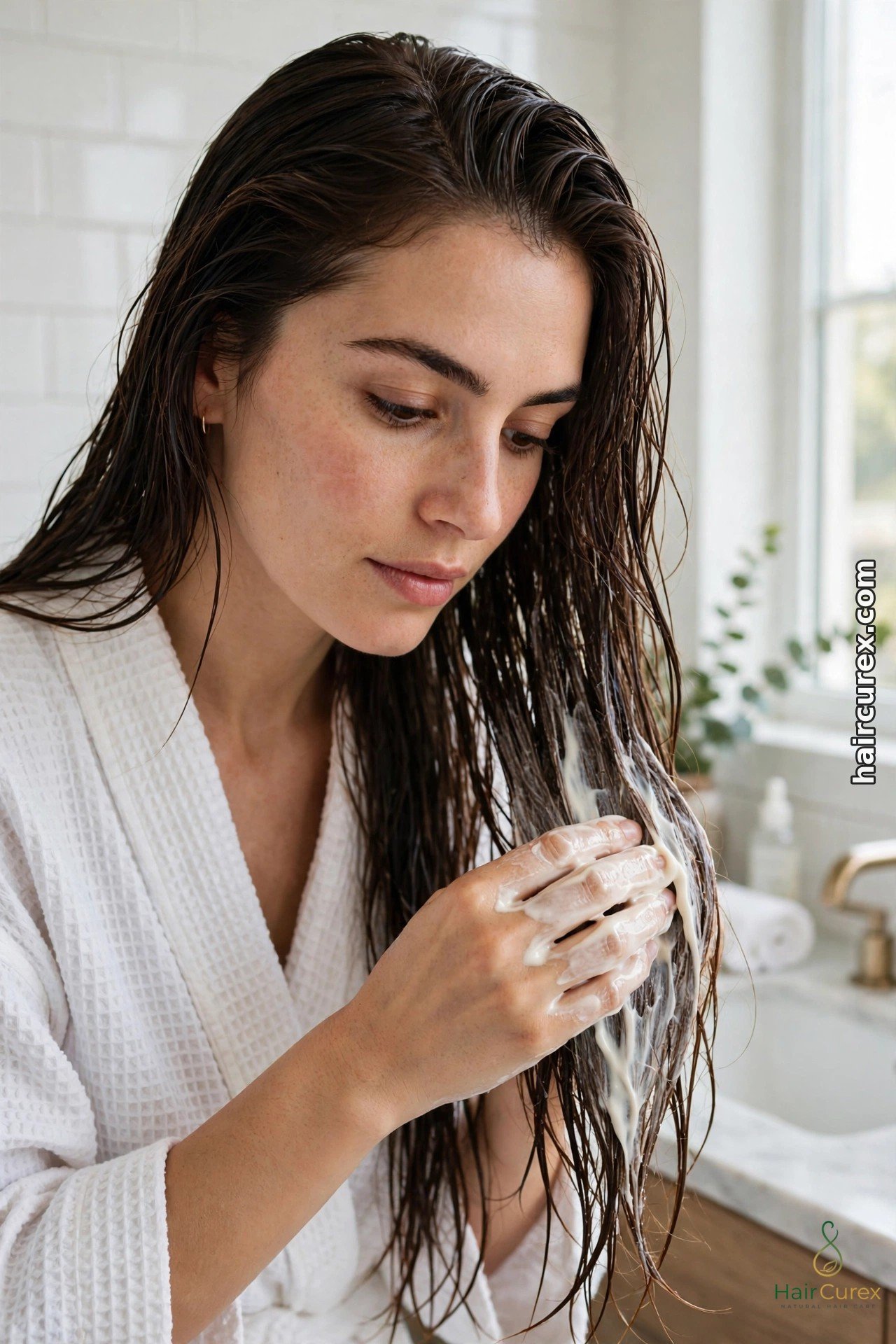
Quick answer: Learning how to deep condition hair at home is simple: shampoo and rinse, work a deep conditioner through the lengths and ends of damp hair, cover it with a shower cap for 20 to 30 minutes, then rinse thoroughly with cool water. Most people should deep condition once a week; dry, curly, or chemically treated hair may need it twice a week, while fine or healthy hair may only need it once or twice a month. The product label’s time beats any general rule — if it says 10 minutes, 10 minutes is enough.
Regular conditioner works in two or three minutes and mostly smooths the surface of your hair. A deep conditioner is a thicker, richer treatment with a higher concentration of conditioning ingredients, and it needs 10 to 30 minutes to do its job. That extra time is the whole point: it gives the ingredients longer contact with the hair shaft, so hair comes out softer, smoother, and easier to detangle than a regular conditioner can manage. This guide covers the full routine step by step, how often each hair type should do it, how long to leave the treatment on, what to look for on the label, and the mistakes that waste a perfectly good treatment.
What Is Deep Conditioning?
Deep conditioning is a weekly or twice-weekly treatment that restores moisture and flexibility to hair that regular conditioner cannot keep up with. A deep conditioner — often sold as a hair mask — contains the same kinds of ingredients as a normal conditioner, such as fatty alcohols, silicones, and humectants like glycerin, but in higher concentrations and in a thicker base that clings to the hair instead of sliding off. The longer contact time lets those ingredients coat the hair shaft more completely, smoothing the cuticle layer so strands reflect light better, feel softer, and tangle less.
It helps to be clear about what deep conditioning can and cannot do. It can make hair feel softer, look shinier, detangle more easily, and break less during styling, because well-moisturized hair bends instead of snapping.
It cannot repair split ends, close them back together, or undo chemical damage — once the hair shaft is damaged, no rinse-out product repairs it; only a trim removes the damaged part. It also cannot make hair grow faster, because growth happens at the scalp, not along the lengths. What it does, honestly, is keep the hair you already have in the best condition possible, so it stays long and healthy instead of breaking off. Our guide to hair breakage explains the other causes of snapping and how to tell them apart from simple dryness.
Deep conditioners fall into two broad types, and knowing which one you are using matters. Moisture masks are built around hydrating ingredients — glycerin, aloe vera, shea butter, and fatty alcohols — and suit most people most of the time. Protein masks contain hydrolyzed proteins or keratin and are meant for damaged, bleached, or very porous hair that has lost structural strength. Using a protein mask every week when your hair does not need protein can leave it stiff and brittle, the opposite of what you wanted. Our guide to protein overload explains the signs and the fix. Unless your hair is clearly damaged, start with a moisture mask.
That moisture-first approach is the simplest way to learn how to deep condition hair at home without overloading your hair with protein.
How to Deep Condition Hair at Home: Step by Step
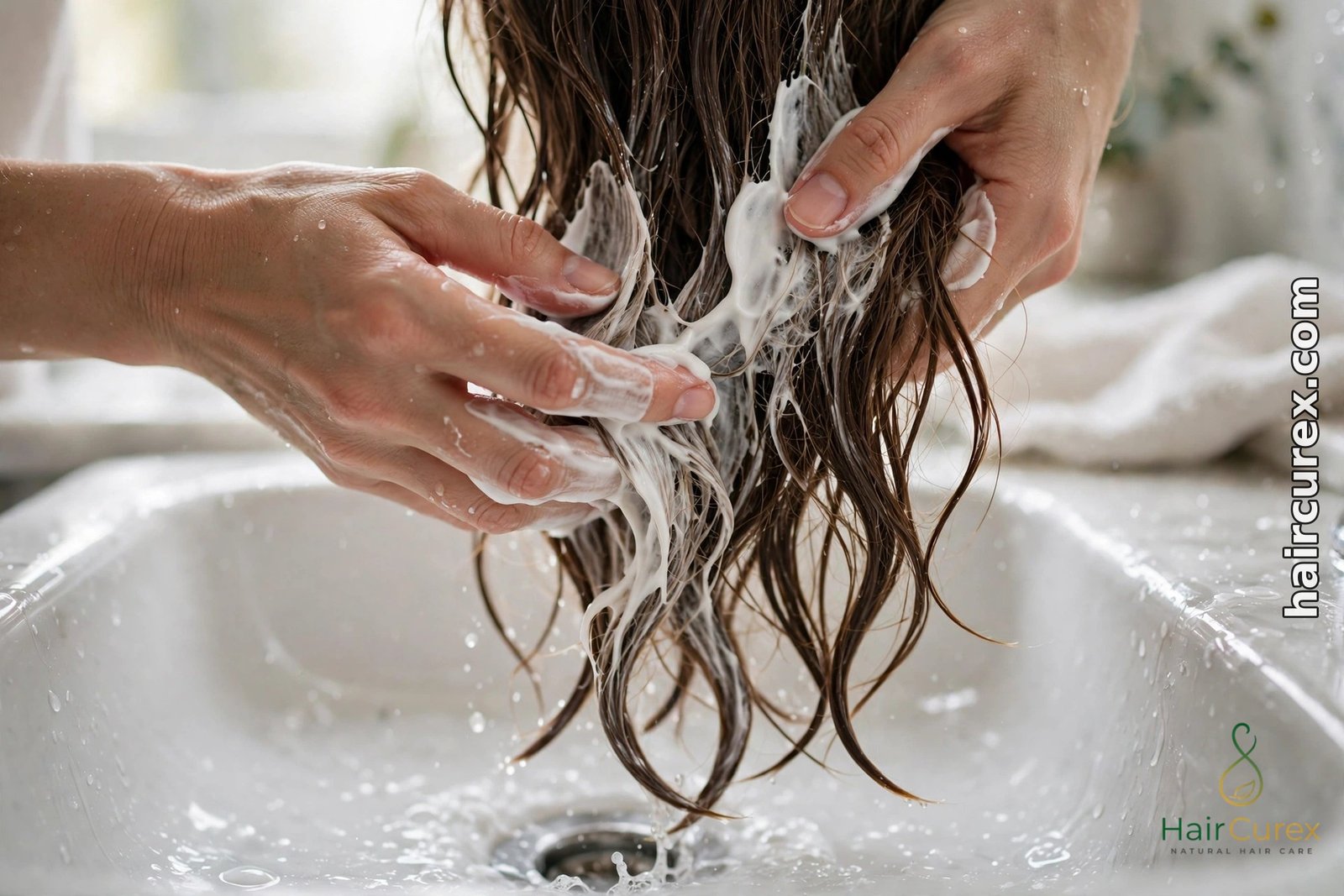
You need nothing special: a deep conditioner, a wide-tooth comb, a shower cap or plastic wrap, and optionally a warm towel. Here is the routine, in order.
Step 1: Shampoo and rinse first. Deep conditioner works best on clean, damp hair. Shampoo as usual and rinse thoroughly. Shampooing removes the oils, styling products, and buildup sitting on the hair, which leaves the hair more able to take up the conditioning ingredients. Skip this step and the treatment sits on top of a layer of buildup instead of reaching the hair itself.
Step 2: Squeeze out the extra water. Gently squeeze your hair with your hands or a soft towel until it is damp, not dripping. Too much water dilutes the mask and makes it slide off; too little water makes it hard to spread evenly. Damp hair is the sweet spot.
Step 3: Section your hair. Divide your hair into four or more sections and clip them aside. Sectioning takes a minute and is the difference between an even treatment and a treatment that only reached the top layer. Work one section at a time.
Step 4: Apply from the ends upward. Take a generous amount of deep conditioner and work it through each section from the mid-lengths to the ends first, then up toward the roots only if your roots are dry. The ends are the oldest and most fragile part of your hair, and they need the most product. The American Academy of Dermatology makes the same point in its hair care guidance — the ends need the most care because they are the oldest hair on your head: AAD healthy hair tips. Use a wide-tooth comb to distribute the product evenly and detangle gently while the hair is coated and slippery.
Step 5: Cover with a shower cap. Tuck your hair under a shower cap or plastic wrap. The cap traps your body heat and keeps the treatment from drying out while it works. For extra warmth, wrap a warm towel over the cap, or sit under a hooded dryer on low for 10 to 15 minutes. Heat helps most for low porosity hair, whose tightly closed cuticle resists absorbing product — our guide to hair porosity explains how to test your own porosity and what it changes.
Step 6: Wait the right amount of time. Leave the treatment on for the time on the label, usually 10 to 30 minutes. More time is not automatically better — after about 30 minutes most rinse-out treatments have done everything they are going to do, and the extra time adds nothing but a chance of limp, over-softened hair.
Step 7: Rinse thoroughly with cool water. Rinse until the water runs clear and your hair no longer feels slippery. Cool water helps the cuticle lie flat, which adds shine. Then style as usual. A light leave-in conditioner on damp hair keeps the softness going between treatments — our guide to the best leave-in conditioners for curly hair includes options that work for other hair types too.
Once you have done it a few times, how to deep condition hair at home becomes a quick weekly habit rather than a long routine.
How Often Should You Deep Condition Your Hair?
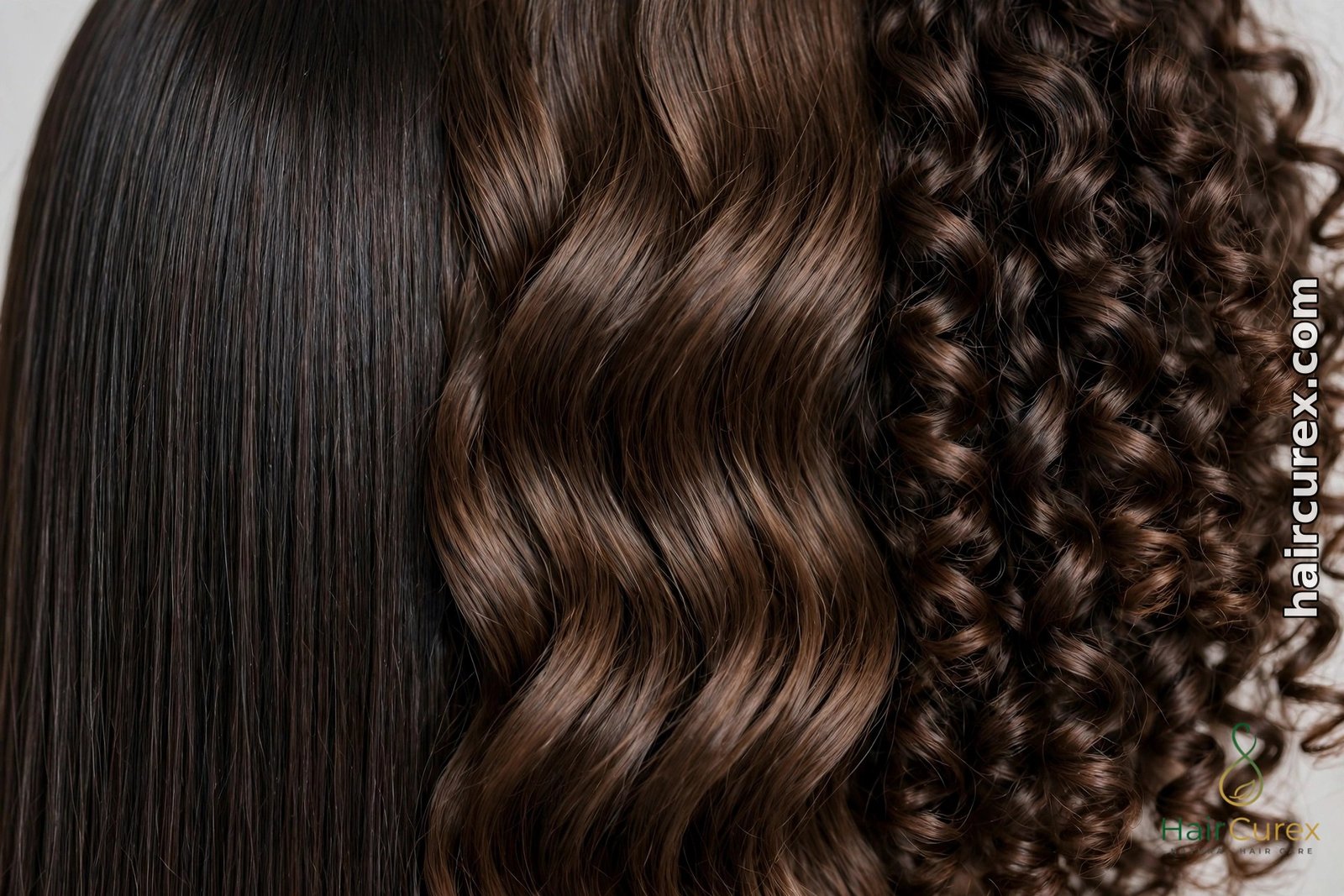
Once a week is the right starting point for most people. From there, adjust to your hair type and how your hair feels. The table below gives a starting frequency for each hair type — treat it as a baseline, then move up or down based on results.
| Hair type / condition | How often | Notes |
|---|---|---|
| Fine, straight hair | Once every 2 weeks | Use a lightweight mask; heavy treatments weigh fine hair down |
| Healthy, normal hair | Once a week | A maintenance dose — keeps softness and shine without buildup |
| Wavy hair | Once a week | Focus on the ends; skip the roots if hair goes flat |
| Curly hair | Once a week | Curls are naturally drier; a weekly mask keeps them defined |
| Coily / kinky hair | Once or twice a week | Very dry by nature; benefits most from regular deep conditioning |
| Color-treated or bleached hair | Once a week | Chemical processing raises porosity, so moisture escapes faster |
| Heat-styled daily | Once a week | Pair with a heat protectant; the mask repairs the feel, not the damage |
| Very damaged hair | Twice a week | Short-term only; drop back to weekly once hair feels softer |
The honest test is how your hair feels a day after the treatment. If it still feels dry and rough by the next wash, increase the frequency or the time. If it feels limp, heavy, or coated, you are doing it too often or using too heavy a product — cut back to once every two weeks or switch to a lighter formula. Hair that is over-moisturized feels soft and mushy and stretches too far instead of snapping, which is the opposite problem from dryness. Balance is the goal: soft and flexible, not stiff and not limp.
Season matters too. Winter air and indoor heating dry hair out faster, so many people need an extra treatment a month in cold weather. Summer humidity can make hair feel softer on its own, so you may need less. And if you swim regularly, deep condition after swimming — chlorine strips moisture from hair, and a weekly mask is the simplest way to keep up.
Whatever frequency you choose, how to deep condition hair at home stays the same: clean, damp hair, a mask on the lengths and ends, and a thorough rinse.
How Long Should You Leave Deep Conditioner On?
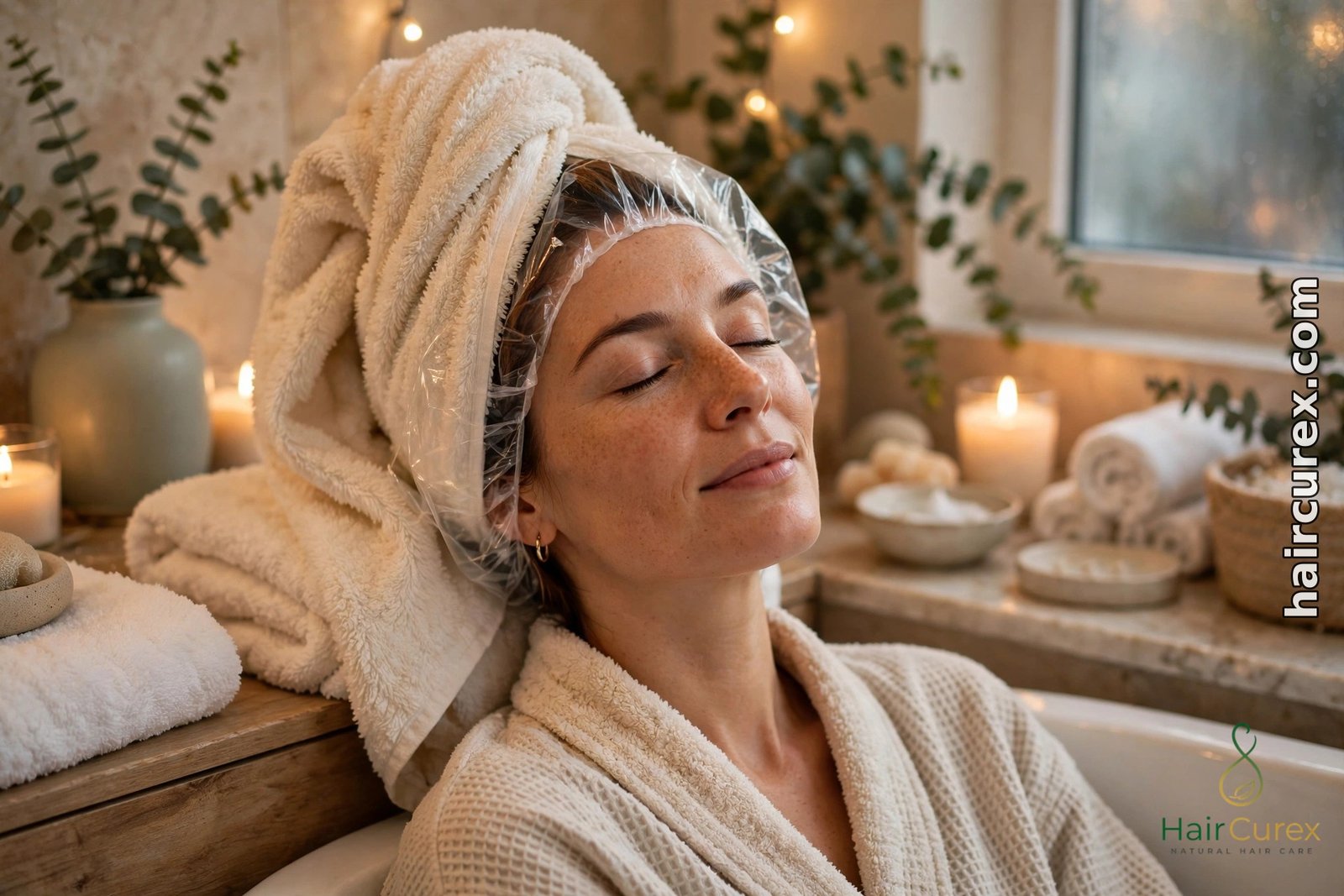
Most deep conditioners work in 10 to 30 minutes. The exact time depends on your hair type, the product, and whether you are using heat. Here is a practical guide:
10 to 15 minutes is enough for fine or healthy hair, or for a mask labelled as a quick treatment. Fine hair absorbs product fast and goes limp if you leave a heavy mask on too long, so shorter is safer.
20 to 30 minutes is the standard range for normal, wavy, curly, or damaged hair. This is the window most product labels recommend, and it is where most of the benefit happens. With a shower cap and gentle heat, 20 minutes is usually plenty.
30 to 45 minutes suits coily or very dry hair, especially with heat. The extra time plus warmth helps the treatment reach the inner layers of thick, porous hair that resists absorbing product at room temperature.
Longer than 45 minutes rarely adds anything. The ingredients in a rinse-out conditioner have a limit to how much they can do in one session, and once the hair is fully coated, extra time just keeps wet hair swollen and fragile for longer. Overnight deep conditioning is popular on social media, but it is generally unnecessary: most labels do not recommend it, sleeping in a wet cap can irritate the scalp, and protein-based masks left on overnight can leave hair stiff rather than soft.
The one exception is a product whose label specifically says it is safe overnight — follow the label, not the trend. Curl Centric’s deep conditioning guide gives the same practical advice: shampoo first, apply from the ends up, cover with a cap for 20 to 30 minutes, and let the label override any general rule: Curl Centric deep conditioning guide.
For most people learning how to deep condition hair at home, 20 to 30 minutes with a shower cap is the sweet spot.
What to Use: How to Choose a Deep Conditioner
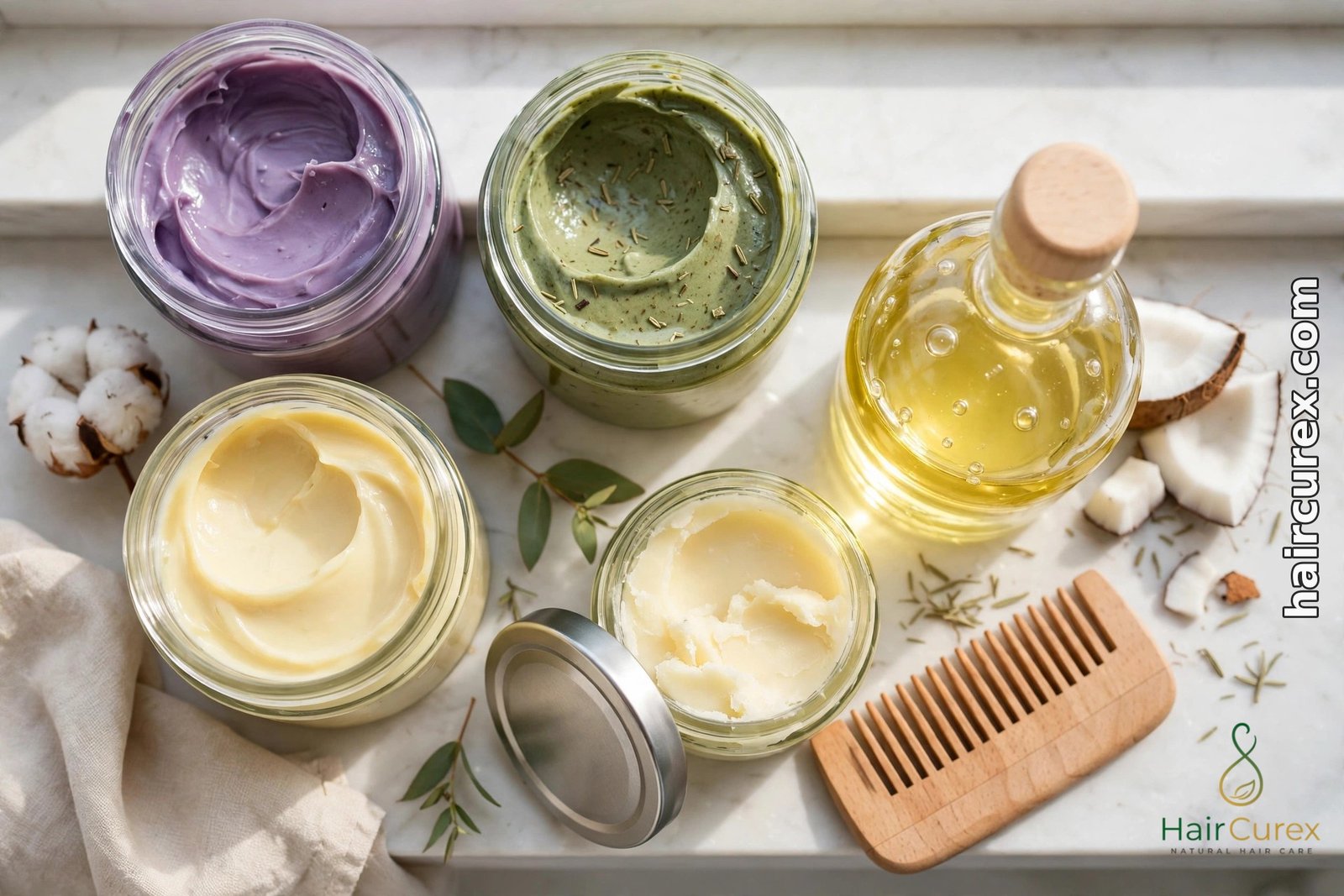
Start with your hair type, then read the label. The right product is the one that matches what your hair actually needs, not the one with the prettiest jar.
For dry or normal hair, look for a moisture mask with glycerin, aloe vera, shea butter, ceramides, or fatty alcohols such as cetyl or stearyl alcohol. These ingredients soften and smooth without adding protein your hair does not need. Avoid products whose first ingredients are silicones if your hair is fine — they can build up and weigh it down.
For damaged, bleached, or very porous hair, look for a mask that combines moisture with a small amount of protein — hydrolyzed keratin, wheat protein, or amino acids. Protein fills in weak spots along the hair shaft, and moisture keeps it flexible. But use protein masks once every few weeks, not every wash, and stop if your hair starts feeling stiff.
For fine hair, choose a lightweight mask labelled “lightweight,” “weightless,” or “for fine hair,” and use less product than you think you need. Apply it only from the mid-lengths down, never on the roots, and rinse thoroughly. A heavy shea-butter mask on fine hair is the fastest way to flat, greasy-looking roots.
For curly and coily hair, richer is better. Thick butters and oils — shea butter, coconut oil, avocado oil — help seal in moisture on hair that loses it quickly. Curly hair also benefits from masks with plenty of slip, so detangling with a wide-tooth comb is easy while the treatment is on.
For low porosity hair, heat is more important than the product. Your cuticle resists absorbing anything, so a shower cap plus a warm towel, or a few minutes under a hooded dryer, makes a bigger difference than switching brands. Choose lighter, water-based masks and avoid heavy butters that sit on the surface.
Price is not a reliable guide. Drugstore masks from brands like SheaMoisture, Aussie, or L’Oréal work well for most people, and expensive salon masks are not automatically better. What matters is the ingredient list and whether the formula suits your hair type. Buy the smallest size first and test it twice before committing to a large tub.
When you are choosing products for how to deep condition hair at home, match the mask to your hair type first and worry about the brand second.
DIY Deep Conditioning at Home
You can make a workable deep conditioning treatment from kitchen ingredients, and it costs almost nothing. The classic options are simple: mashed avocado mixed with a tablespoon of olive oil, plain yogurt, or a banana mask blended smooth. Apply the same way as a store-bought mask — on damp hair, ends first, shower cap, 20 to 30 minutes, rinse thoroughly. Rinse very well: food masks leave residue if you rush, and banana in particular is hard to wash out if it is not blended completely smooth.
A few honest limits. DIY masks mostly coat the hair rather than penetrating it, so the softness often washes out faster than a formulated mask. Coconut oil is popular as a pre-wash treatment, but it can leave fine or low porosity hair feeling coated and heavy — use a small amount and shampoo it out properly. Rice water is sometimes recommended as a deep conditioning rinse, but it contains starch and protein-like material, and used too often it can leave hair stiff — our guide to rice water for hair covers the safe frequency. And homemade egg masks are real protein treatments, so do not combine them with a protein mask in the same week.
DIY is a good option if you want to try deep conditioning before buying a product, or if your hair reacts to fragrances and preservatives in commercial masks. For a regular weekly routine, a formulated mask is more consistent — the ingredients are balanced, the results are repeatable, and you do not have to blend a banana every Sunday.
Whether you use a store-bought mask or a kitchen treatment, how to deep condition hair at home follows the same steps: damp hair, ends first, cover, wait, rinse.
Deep Conditioning Mistakes to Avoid
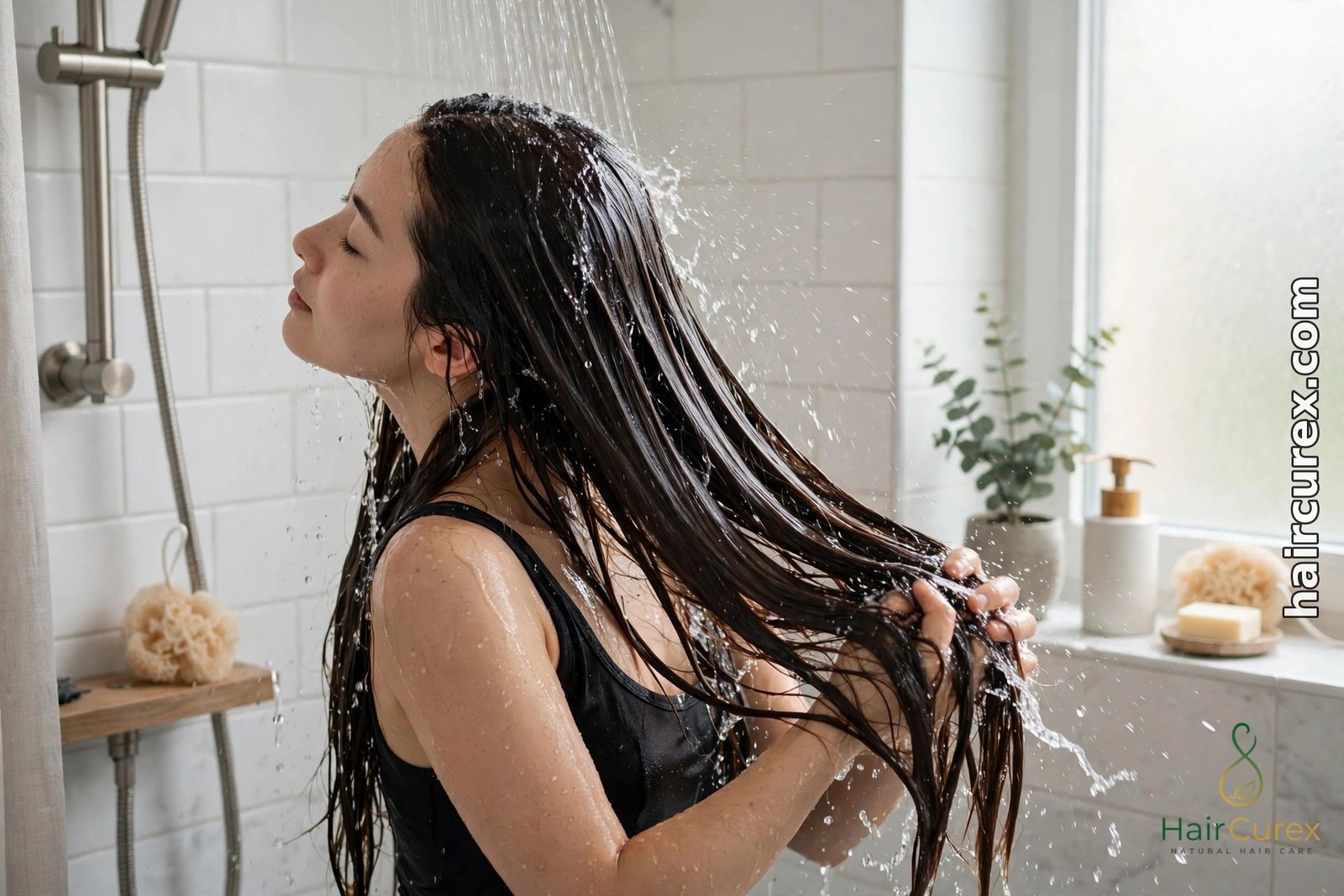
Most deep conditioning failures are not the product’s fault. They are small mistakes in how the treatment is used.
Applying it to the scalp. Deep conditioner belongs on the lengths and ends, not the scalp. On the scalp it clogs follicles, leaves roots greasy, and can cause itching or buildup. If your roots are dry, use a tiny amount and rinse extra well — or skip the roots entirely.
Skipping the shampoo. Deep conditioning dirty hair wastes the treatment. Product buildup, oil, and styling residue sit between the mask and your hair, so the conditioning ingredients never reach the shaft. Always shampoo first.
Using too much product. More is not better. A thick layer that does not rinse out leaves hair coated, heavy, and dull. Start with a coin-sized amount per section and add more only if the hair still feels dry while you work it through.
Leaving it on too long. As covered above, more than 30 to 45 minutes adds little, and overnight treatments can leave hair limp or irritate the scalp. Set a timer and rinse on time.
Using a protein mask every week. Protein is a repair tool, not a weekly moisturizer. A protein mask every wash day can make hair stiff and brittle — the protein overload problem described earlier. Moisture masks are the weekly default; protein is the occasional extra.
Rinsing with hot water. Hot water reopens the cuticle you just smoothed down and can wash away more of the treatment. Rinse with cool or lukewarm water instead.
Expecting it to fix split ends. No mask repairs a split end. If your ends are splitting, the fix is a trim, not a longer treatment. Deep conditioning keeps healthy ends from splitting in the first place, which is a different and more honest promise.
Avoiding these mistakes is half of learning how to deep condition hair at home well.
Deep Conditioner vs Regular Conditioner vs Hair Mask
The three products overlap, and the labels do not always help. Here is how they actually differ.
| Product | How long it stays on | How often | What it does |
|---|---|---|---|
| Regular conditioner | 2–3 minutes | Every wash | Light surface smoothing and detangling |
| Deep conditioner | 10–30 minutes | Once a week | Deeper moisture and softness for dry or damaged hair |
| Hair mask | 10–30 minutes | Once a week | Same as a deep conditioner — “mask” is usually just the marketing name |
| Leave-in conditioner | Stays in | Every wash | Light ongoing moisture and heat protection between washes |
In practice, “deep conditioner” and “hair mask” are the same kind of product sold under two names. If a jar says “mask” and the instructions say to leave it on for 10 to 30 minutes and rinse, it is a deep conditioner. The Shampoo Lounge’s guide to deep conditioning makes the same distinction — a deep conditioner is a heavier moisturizer meant for occasional use, not every day, and the routine is the same whether the jar calls it a mask or a treatment: Shampoo Lounge deep conditioning guide.
Whatever the jar calls it, how to deep condition hair at home means the same routine: a thick treatment, 10 to 30 minutes, then rinse.
When to See a Professional
Deep conditioning is a home treatment, and most dryness clears up with a weekly mask and gentler habits. But see a dermatologist or trichologist if your hair does not improve after a month of proper care, if you are losing hair in patches, if shedding is sudden or heavy, or if your scalp is red, itchy, blistered, or sore. Those symptoms point to something a mask cannot fix — a scalp condition, a nutritional deficiency, a hormonal change, or a reaction to a product — and they need a proper diagnosis.
See a hairdresser if your hair is severely damaged from bleach, color, or heat, or if you cannot tell whether your problem is dryness, protein overload, or damage. A good stylist can feel the difference in your hair, check its elasticity, and tell you whether a trim, a professional treatment, or a break from chemical services is the right next step. Bring your current products with you — the ingredient lists tell a stylist more in a minute than a description of your routine ever will.
Frequently Asked Questions
How often should you deep condition your hair?
Once a week is right for most people. Dry, curly, coily, or chemically treated hair may need it twice a week, while fine or healthy hair may only need it once every two weeks. Adjust based on how your hair feels a day after treatment — still dry means more often, limp or coated means less often.
How long should you leave deep conditioner in your hair?
Most deep conditioners work in 10 to 30 minutes: 10 to 15 minutes for fine or healthy hair, 20 to 30 minutes for normal, wavy, curly, or damaged hair, and up to 45 minutes with heat for very dry or coily hair. Always follow the time on the product label first.
Can you leave deep conditioner in overnight?
It is generally not recommended unless the product label specifically says it is safe overnight. Most deep conditioners finish working within 30 minutes, and leaving one on overnight can leave hair limp or irritate the scalp. Protein masks left on overnight can leave hair stiff instead of soft.
Should you deep condition before or after shampooing?
After shampooing. Shampoo first to remove buildup and oil so the conditioning ingredients can reach the hair shaft, then apply the deep conditioner to clean, damp hair. Deep conditioning dirty hair wastes most of the treatment.
Can deep conditioning fix split ends?
No. No rinse-out product can repair a split end or close it back together. Deep conditioning keeps healthy hair soft and flexible so ends split less often, but split ends that already exist need a trim.
Is a hair mask the same as a deep conditioner?
Yes, in practice. A hair mask is usually just the marketing name for a deep conditioner — both are thick, concentrated treatments left on for 10 to 30 minutes and rinsed out. If the instructions say to leave it on and rinse, it is a deep conditioner whatever the jar calls it.