


Quick answer: The secret to how to moisturize wavy hair without weighing it down is to use lightweight, water-based products in small amounts, applied to damp hair from the mid-lengths down — never on the roots. Wash with a gentle sulfate-free shampoo, condition with a light rinse-out conditioner, then layer a pea-sized amount of leave-in conditioner and a lightweight mousse or gel. Scrunch the products in, let your waves air-dry or diffuse on low heat, and refresh between washes with a light water mist instead of more product.
Heavy butters, oils, and silicone-rich creams are what flatten waves; moisture itself is not the problem — the weight of the product carrying it is.
Wavy hair lives in an awkward middle ground. It is drier than straight hair, because the bends in each strand slow the scalp’s natural oils on their way down — but it is much finer and lighter than curly hair, so the rich creams and butters that work beautifully on curls will drag waves flat within an hour. That is the whole puzzle of how to moisturize wavy hair: your waves genuinely need moisture, and at the same time they cannot carry heavy moisture.
The answer is not to skip conditioner or to load on more product, but to change the type of product, the amount, and where you put it. This guide covers why waves dry out, which products actually moisturize without weight, the wash-day routine step by step, how to refresh waves between washes, and the mistakes that turn soft waves into limp, stringy hair.
Why Wavy Hair Dries Out So Easily
Wavy hair — type 2A, 2B, and 2C — is naturally drier than straight hair for a simple physical reason. The oils your scalp produces travel easily down a straight strand, but every bend in a wave slows them down, so the mid-lengths and ends of wavy hair get far less natural moisture than the roots. The ends are usually the driest part, which is why wavy hair so often looks fine at the roots and frizzy or straw-like at the ends.
Add in washing, heat styling, sun, and colour, and the dryness gets worse. That dryness is real, and it is why “just use less product” is bad advice on its own — under-moisturized waves go frizzy, lose definition, and tangle.
The second half of the problem is that wavy hair is fine. Even thick wavy hair is usually made of fine individual strands, and fine strands cannot support heavy products. A thick shea-butter mask or a rich curl cream coats each strand in a heavy layer, and the weight pulls the wave pattern open — first at the roots, where the hair is heaviest, and then all the way down.
The result is hair that feels soft but looks flat, stringy, and greasy at the roots. If you have ever moisturized your waves and ended up with hair that looked worse than before, that is almost certainly what happened: the moisture was fine, the delivery system was too heavy. That weight is the main obstacle when you learn how to moisturize wavy hair.
Understanding both halves explains the whole approach of this guide. You need moisture that arrives in a light form — water-based leave-ins, foams, and light gels — applied where the hair is driest (mid-lengths and ends), in amounts small enough that the wave pattern can still hold its shape. Everything else is detail: the wash-day order, the drying method, and the refresh routine all serve that one principle. Learning how to moisturize wavy hair is mostly learning to keep the moisture light.
Choose Lightweight Products: What Actually Moisturizes Waves
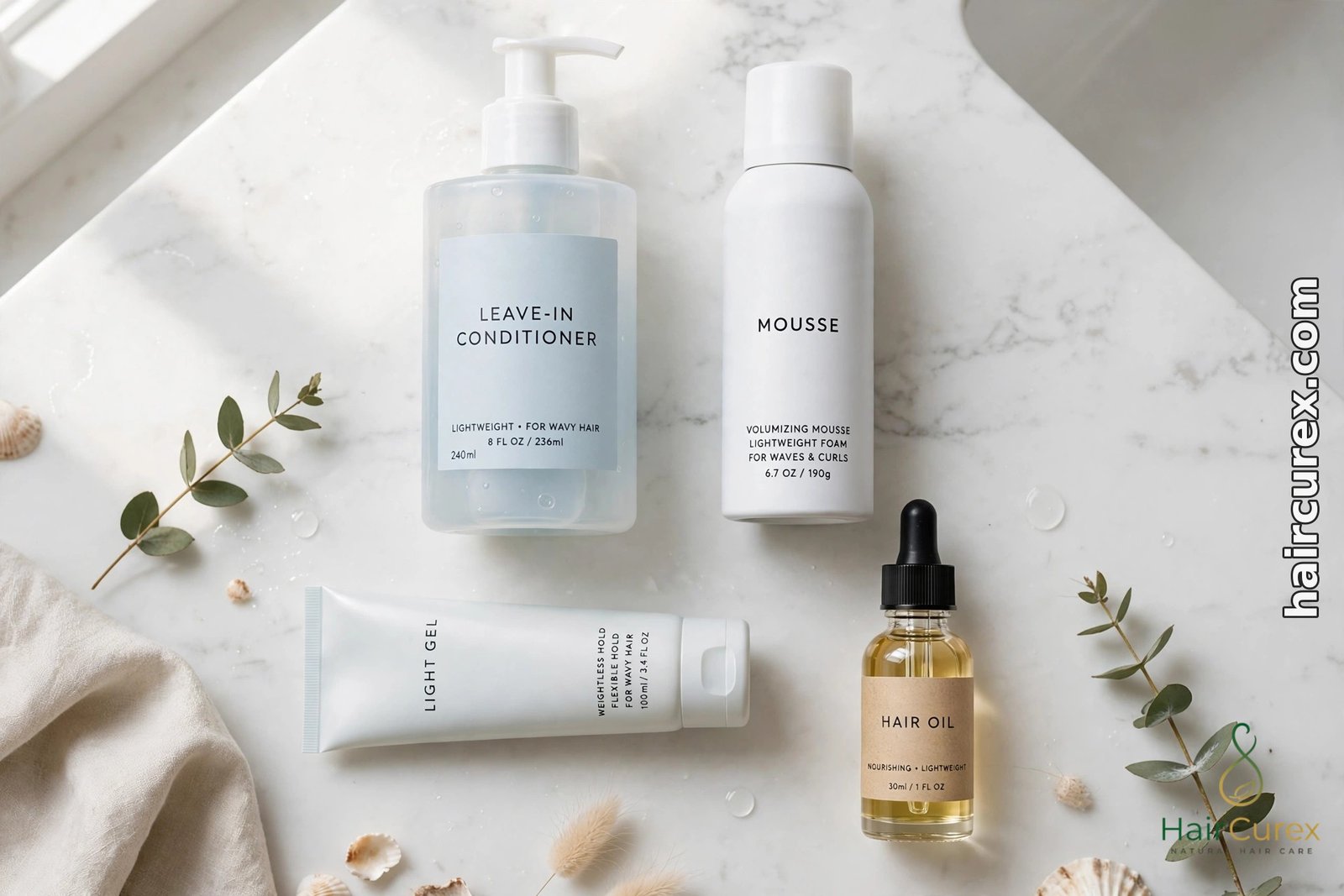
Product choice matters more for wavy hair than for any other hair type, because the wrong product undoes everything else you do right. The rule is simple: if the first ingredients are water, glycerin, aloe vera, or a light humectant, the product will probably moisturize without weight. If the first ingredients are shea butter, coconut oil, or heavy silicones like dimethicone, it will probably flatten your waves.
Read the label before you buy, and be suspicious of any product marketed for “curly hair” without a “lightweight” or “for wavy hair” claim — curly-hair formulas are usually built for much thicker, drier hair than yours. That is the first rule of how to moisturize wavy hair without weighing it down: the product must be light enough that the wave can still hold its shape after it dries.
Start with the shampoo. A gentle, sulfate-free shampoo cleans without stripping the oils your waves do have, and it leaves the hair ready to absorb conditioner. You do not need a “moisturizing shampoo” specifically — the shampoo’s job is to clean. Wash 2–3 times a week rather than every day if your scalp allows it: overwashing strips natural oils and leaves waves drier, while too little washing lets buildup sit on the scalp and flatten the roots.
If you are not sure where to start with a routine at all, our hair care routine for beginners walks through wash frequency, product order, and the basics in one place. This gentle wash is a simple first step in how to moisturize wavy hair without stripping it.
For conditioner, choose a light rinse-out conditioner and use it only from the mid-lengths down. A good test: if the conditioner feels like a thick body butter in your hand, it is too heavy for daily use on waves. Save rich masks for a weekly treatment, and even then rinse them out thoroughly — a mask left in the hair is just a heavy leave-in by another name.
Choosing a light conditioner is central to how to moisturize wavy hair without weight. Faith in Nature’s wavy-hair guide makes the same point: keep products lightweight and silicone-free, because heavy curly-hair formulas weigh waves down and leave them dull: Faith in Nature on how to care for wavy hair.
The leave-in is where most of the moisturizing happens, so choose it carefully. A lightweight leave-in conditioner — a thin lotion or a spray, not a thick cream — gives you moisture you can layer without weight. Use a pea-sized amount for short waves and a coin-sized amount for long waves, and add more only if the ends still feel dry after the first layer has absorbed.
A mousse or a light gel then goes on top to hold the wave pattern while it dries; the gel cast — the slightly crunchy coating gel leaves as it dries — is a good sign, and you scrunch it out once the hair is fully dry. Our roundup of the best curl creams explains which formulas give moisture and hold without heaviness, and why a light cream beats a rich butter on wavy hair.
Oil has a place, but it is a small one. A few drops of a light oil — argan or jojoba — smoothed over the ends after the hair is dry adds shine and seals in moisture.
More than a few drops, or oil applied to damp hair near the roots, will weigh waves down and make them look greasy. Think of oil as a finishing step, not a moisturizer: it seals moisture in, but it does not add moisture on its own, so it only works after a water-based product has done the hydrating. Used this way, a light oil finish is a small part of how to moisturize wavy hair well.
| Product | Weight on waves | What it does | How much to use |
|---|---|---|---|
| Lightweight leave-in conditioner | Light | Adds moisture and slip without weight | Pea-sized (short) to coin-sized (long) |
| Mousse or foam | Very light | Moisture plus light hold and volume | A golf-ball-sized puff, scrunched in |
| Light gel | Light | Defines waves, holds the pattern while drying | A coin-sized amount, ends first |
| Light hair oil (argan, jojoba) | Light if used sparingly | Seals in moisture, adds shine | 2–3 drops, ends only, on dry hair |
| Rich mask or butter | Heavy | Deep moisture, but flattens waves | Weekly treatment only, rinse out fully |
| Heavy curl cream or silicone serum | Heavy | Softness, but drags waves flat and builds up | Avoid for daily use on waves |
How to Moisturize Wavy Hair: The Wash-Day Routine

The order you apply products matters as much as the products themselves. The wash-day routine below is the core of how to moisturize wavy hair, and it works because each step adds moisture in a light layer before the next one seals it in. Do it the same way every wash day for two or three weeks before you judge it — wavy hair takes a few washes to show what a routine can do, and changing products every wash makes it impossible to tell what is working.
Step 1: Wash gently. Wet your hair fully with lukewarm water — hot water strips oils and roughs up the cuticle, which makes waves frizz. Massage a sulfate-free shampoo into the scalp with your fingertips, not your nails, and let the suds run down the lengths as you rinse. You rarely need to scrub the lengths themselves; the shampoo running down is enough to clean them, and scrubbing the ends dries them out.
Step 2: Condition mid-lengths to ends. Squeeze out excess water, then work a light rinse-out conditioner through the mid-lengths and ends only. Keep it off the roots entirely — the roots get enough oil from your scalp, and conditioner there is the fastest route to flat, greasy-looking waves. Leave it on for 2–3 minutes while you finish showering, then rinse with cool water, which helps seal the cuticle and adds shine.
Step 3: Deep condition once a week. A weekly deep-conditioning treatment is the one place where a richer product earns its place on wavy hair, because you rinse it out fully. Apply a mask to damp hair from the mid-lengths down, leave it on for 10–20 minutes — a shower cap and a warm towel help it absorb — then rinse thoroughly. Our guide to how to deep condition hair at home covers timing, how long to leave a mask on, and which products to use for each hair type.
Step 4: Apply leave-in to damp hair. Get out of the shower and blot — do not rub — with a microfibre towel or an old cotton T-shirt. While the hair is still damp, about 70 percent dry, smooth a pea-sized amount of lightweight leave-in conditioner through the mid-lengths and ends. Use your fingers or a wide-tooth comb to distribute it evenly. If the ends still feel dry after a minute, add a tiny bit more to the ends only.
Step 5: Add hold, then leave it alone. Scrunch in a golf-ball-sized puff of mousse or a coin-sized amount of light gel, working from the ends upward. Then stop touching your hair. Every touch while waves are drying breaks the pattern and adds frizz. Let the hair air-dry if you have time, or diffuse on low heat with the dryer held still against each section (see below). Once the hair is completely dry, scrunch out the gel cast with your hands and shake the roots gently for volume.
Squish to Condish: The Technique That Locks Moisture In
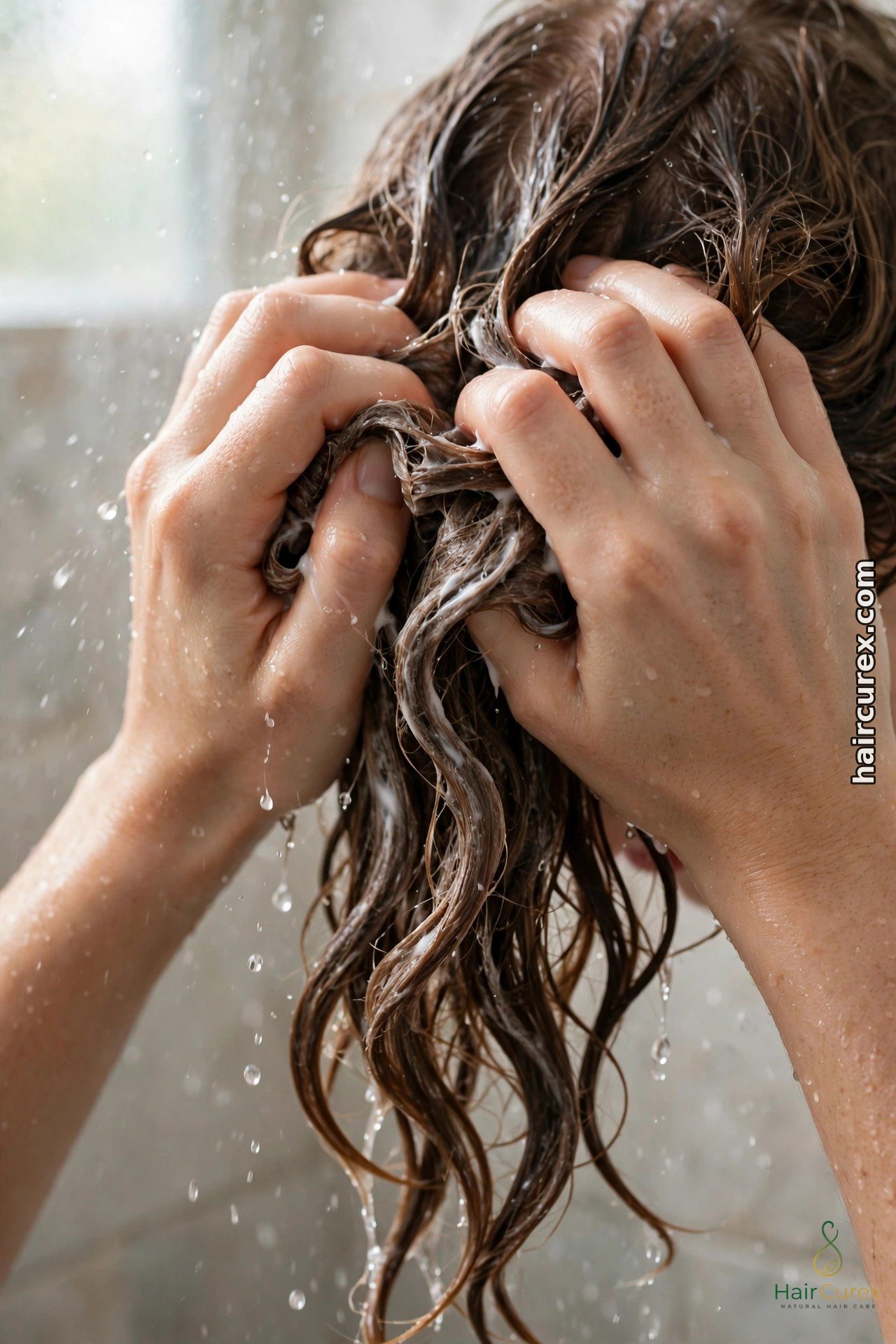
“Squish to condish” sounds like a gimmick, but it is one of the most useful techniques in wavy hair care, and it costs nothing. After you apply rinse-out conditioner to soaking-wet hair, cup a section of hair in your palm and squash it upward toward your scalp, squeezing the conditioner and water into the strand. You will hear a squelching sound — that is the point. The squishing forces water and conditioner into the hair shaft instead of letting it run off, and it encourages the wave pattern to form at the same time.
Do it in sections across the whole head, then rinse lightly — you want to leave a little conditioner in, not wash it all out. The same squishing motion works with your leave-in and gel: after applying each product to damp hair, scrunch upward a few times to push the product in and wake up the wave. Faith in Nature’s guide recommends exactly this for wavy hair: squishing ensures maximum moisture gets into the hair shaft and helps the natural wave pattern take shape: Faith in Nature on how to care for wavy hair.
If squish to condish feels strange at first, try it on one wash day and compare the result with your normal routine. Most people with wavy hair see softer, more defined waves the first time, because the technique solves the exact problem waves have: moisture sitting on the surface instead of getting inside the strand.
It works best on very wet hair, so do it in the shower before you towel-dry, not after. If you want to know how to moisturize wavy hair on a budget, squish to condish is the cheapest trick in this guide — it uses the conditioner you already own, and it works because it puts water and product inside the strand instead of on top of it.
Drying Without Losing Moisture
How you dry your waves decides how much of that moisture survives to the finished style. Knowing how to moisturize wavy hair also means knowing how to dry it, because the wrong drying method can undo a perfect wash day in ten minutes.
Air-drying is the gentlest option: blot with a microfibre towel or T-shirt, scrunch in your products, and leave the hair alone until it is fully dry. It takes longer, but it disturbs the wave pattern least, and it costs your hair nothing in heat damage. If you air-dry, resist the urge to keep checking the waves — touching wet waves is the quickest way to turn them into frizz.
If you need to dry faster, diffuse on low or medium heat. Place the diffuser bowl against your head, gather a section of hair into it, and hold it still for 30–60 seconds before moving to the next section. Do not wave the dryer around like a normal blow-dryer: the point is to hold each wave still while it dries in its shape.
Dry to about 80–90 percent, then let the rest air-dry. Drying completely with hot air is what leaves waves feeling dry and looking frizzy, even after a good conditioning routine. Diffusing gently is part of how to moisturize wavy hair without losing the moisture you just added.
Two small habits protect moisture while you dry. First, dry with your head tipped to one side or upside down for a minute or two — it lifts the roots, so the waves dry with volume instead of lying flat against the scalp. Second, sleep on a silk or satin pillowcase: cotton absorbs moisture from your hair overnight and roughs up the cuticle, while silk lets waves slide and keeps more moisture in. It is a small change, but on wavy hair the difference shows up the next morning.
How to Moisturize Wavy Hair Between Washes

Most wavy hair looks its best on wash day and gets drier and flatter by day two or three. The fix is a refresh, not another wash: learning how to moisturize wavy hair between washes is what keeps the routine working all week. Overwashing strips the oils your waves need, so a good refresh routine saves both your waves and your wash-day effort.
Start with water. Lightly mist the lengths with plain water from a spray bottle — just enough to dampen, not soak — then smooth a tiny amount of leave-in conditioner over the driest ends. Scrunch the waves upward a few times and let them air-dry.
Water is the actual moisturizer here; the leave-in just helps the hair hold on to it. Moptop’s guide to keeping waves moisturized makes the same point for Type 2 hair: use small amounts, focus on the ends where dryness lives, and distribute evenly with your fingers or a wide-tooth comb: Moptop on keeping waves moisturized without weighing them down.
If the waves have gone flat overnight, a loose pineapple — a high, loose ponytail with a silk scrunchie — before bed keeps the pattern from being crushed while you sleep. In the morning, take it down, shake the roots, mist lightly, and scrunch. Do not re-wet the whole head, and do not brush: a brush drags the wave pattern out and turns soft waves into a frizzy cloud. If a section has gone completely straight, dampen just that section and twist it around your finger for a few seconds while it dries.
Refresh products exist, but you rarely need a dedicated one. A spray bottle of water with a drop or two of leave-in conditioner mixed in does the same job for almost nothing. Save your money for the wash-day products that do the heavy lifting, and keep the refresh simple: water, a little leave-in on the ends, a scrunch, and patience while it dries. That simplicity is the point of how to moisturize wavy hair between washes.
Mistakes That Weigh Your Waves Down

Most weighed-down waves come from a short list of avoidable mistakes, and the most common reason how to moisturize wavy hair goes wrong is not the moisture at all — it is the weight of the products carrying it.
Too much product is the most common: if your waves look flat and stringy, use half as much leave-in next wash day and see what changes before you buy anything new. Product on the roots is the second — conditioner, leave-in, and oil all belong on the mid-lengths and ends, never on the scalp, where they flatten the roots and make hair look greasy by midday.
Heavy butters and oils as daily products are the third. Shea butter, coconut oil, and thick curl creams are made for hair much drier and thicker than wavy hair; on waves they coat the strand, add weight, and build up over washes until the waves barely form at all. If your waves have slowly gone flatter over weeks, buildup is the likely cause — a clarifying wash once every few weeks removes it, and the waves usually spring back on the next wash.
Skipping conditioner to avoid weight is the mistake in the other direction. Dry waves frizz, tangle, and lose definition, and no amount of gel will fix hair that has not been moisturized. The answer is lighter conditioner, not none. Brushing dry waves is another quiet culprit: a brush breaks the wave pattern and creates frizz, so use fingers or a wide-tooth comb on damp hair only. And washing with very hot water strips moisture and roughs up the cuticle — lukewarm for washing, cool for the final rinse.
If your waves still look limp after you fix the product weight, check the cut. A blunt, heavy cut with no layers drags waves down, while long layers remove weight from the ends and let the wave pattern spring up.
A wolf cut, for example, is built around exactly that idea — layers that take weight out and let texture show. Our guide to the wolf cut for wavy hair explains which layer lengths suit wavy hair and how the cut changes the way waves fall. And if your waves are frizzy, breaking, or dry no matter what you try, our guide to common curly hair problems covers frizz, breakage, and dryness, and how to tell which problem your hair actually has. A good cut supports how to moisturize wavy hair by removing weight.
When to See a Professional
A stylist is worth booking if your waves will not hold their shape no matter how carefully you follow a light routine — that can mean the hair is over-processed, damaged, or cut in a shape that fights the wave pattern. A good cut makes moisturizing easier, not harder: layers remove weight from the ends, so the waves are not dragged open, and a stylist who understands wavy hair can cut layers that support the pattern instead of fighting it. Getting the cut right makes learning how to moisturize wavy hair much easier.
See a professional if your hair is shedding heavily, breaking off in pieces, or your scalp is red, itchy, or sore — those are signs of damage or a scalp condition, and no moisturizing routine will fix them.
If you have tried every method for how to moisturize wavy hair in this guide and your waves still fall flat within an hour, a stylist can check whether damage, buildup, or the cut itself is the real problem.
The American Academy of Dermatology’s healthy hair guidance covers the same basics — gentle handling, washing to suit your hair type, and protecting hair from heat and harsh treatments: AAD healthy hair tips. Book a consultation with a stylist who works with wavy hair before you try a perm, a keratin treatment, or any chemical service — those change the hair’s structure, and on wavy hair the wrong treatment can flatten the pattern for months.
Frequently Asked Questions
How do I moisturize my wavy hair without making it greasy?
Use lightweight, water-based products in small amounts, applied to damp hair from the mid-lengths down — never on the roots. A pea-sized amount of leave-in conditioner and a light mousse or gel is enough for most wavy hair. If your hair looks greasy, you are almost certainly using too much product or putting it too close to the scalp, not moisturizing too often. That is the short version of how to moisturize wavy hair without weighing it down: light products, small amounts, ends only.
Should wavy hair use leave-in conditioner every wash day?
Yes — a lightweight leave-in is the single most useful product for wavy hair, because it adds moisture without the weight of a cream. Use a small amount on damp hair after every wash, and skip it only if your waves feel over-soft and flat, which usually means the leave-in is too heavy rather than unnecessary.
How often should I deep condition wavy hair?
Once a week is enough for most wavy hair. Apply a mask to damp hair from the mid-lengths down, leave it on for 10–20 minutes, and rinse it out thoroughly. More often than that, or leaving a mask in, usually weighs waves down rather than helping them.
Why does my wavy hair feel dry even after conditioning?
Usually because the moisture is sitting on the surface instead of getting inside the strand. Try squish to condish — scrunching conditioner into soaking-wet hair so the water and product are pushed into the shaft — and check for buildup from heavy products or silicones, which can block moisture. A clarifying wash every few weeks often fixes it.
Can I use hair oil on wavy hair?
Yes, but only a few drops of a light oil such as argan or jojoba, smoothed over the ends after the hair is dry. Oil seals moisture in; it does not add moisture on its own. More than a few drops, or oil on damp hair near the roots, will weigh your waves down and make them look greasy.
How do I refresh wavy hair on day two without washing it?
Mist the lengths lightly with water, smooth a tiny amount of leave-in conditioner over the driest ends, scrunch the waves upward, and let them air-dry. Do not re-wet the whole head and do not brush. A loose pineapple with a silk scrunchie the night before keeps the wave pattern from being crushed while you sleep.