

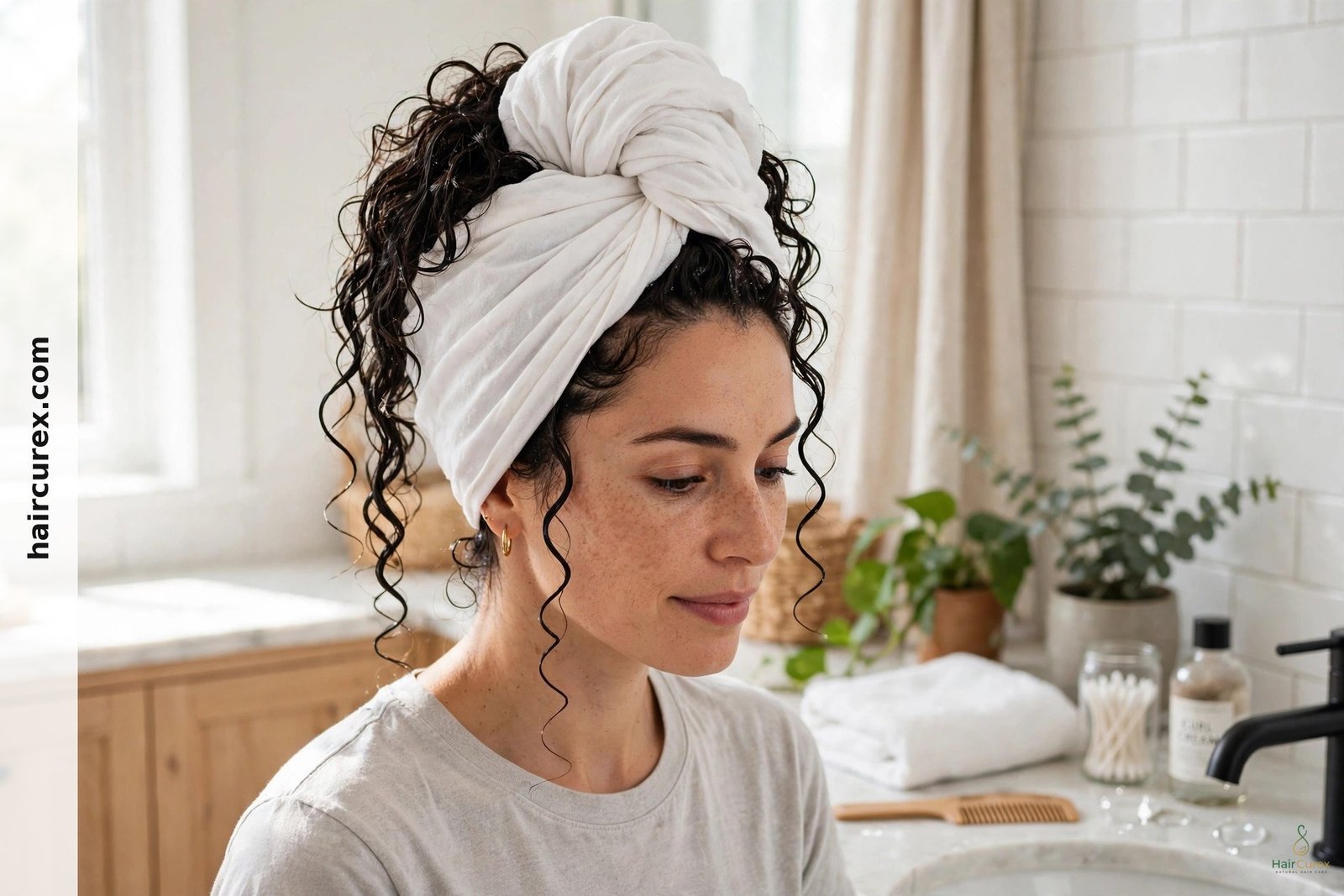
Quick answer: Learning how to plop curly hair is one of the simplest ways to get defined, frizz-free curls without heat. After washing, apply your styling products to soaking-wet hair, flip your head forward, and lower your curls onto a flat cotton T-shirt. Wrap the shirt around your head, leave it for 15 to 45 minutes, then unwrap and let your curls finish drying untouched. The fabric absorbs excess water while your curls dry in their natural shape instead of being stretched out by gravity or roughed up by a regular towel.
What Is Hair Plopping?
Hair plopping is a heat-free drying technique for curly and wavy hair. Instead of rubbing your hair with a towel or letting heavy, wet curls hang straight down while they dry, you “plop” them onto the top of your head inside a soft fabric wrap. The curls dry scrunched up in their natural pattern, which is why plopping usually delivers more definition, more volume at the roots, and noticeably less frizz than towel-drying.
The technique became popular through the curly hair community, and for good reason: it costs nothing, needs no special equipment beyond a T-shirt you already own, and takes only a few minutes of active effort. Plopping does not fully dry your hair. Think of it as a setting step. It removes the dripping excess water and holds your curl pattern in place during the early part of drying, when the curl shape is decided. After you unwrap, your hair still needs time to air-dry or be diffused to fully dry.
Plopping works because of two simple facts about curly hair. First, friction is the enemy of definition: the loops of a terry towel catch and separate curl clumps, which is how frizz starts. A smooth cotton T-shirt or microfiber towel has no loops to snag hair, so curl clumps stay intact. Second, wet curls are heavy. Left hanging, water weight pulls the curl pattern straight, especially near the roots. Piled on top of your head, curls are compressed and supported, so they dry with bounce and lift instead of falling flat.
Once you understand how to plop curly hair, the rest of the routine becomes much easier to repeat on every wash day.

What You Need to Plop Your Hair
You do not need to buy anything special to start plopping, and that is part of its appeal. Knowing how to plop curly hair starts with having the right fabric ready before your hair begins to dry. Gather these before you shower so everything is ready when your hair is wet:
- A long-sleeved cotton T-shirt — the classic choice. The sleeves become the ties that hold the wrap in place, and the smooth jersey fabric is gentle on curls. A short-sleeved shirt works too, but you will need to tie the corners instead.
- Or a large, flat microfiber towel — a good alternative if you prefer something more absorbent. Use a flat sheet-style towel, not a turban-style twist towel, which is shaped for a different wrapping method.
- Your usual styling products — leave-in conditioner, curl cream, or gel, applied before plopping, never after.
- A flat surface at a comfortable height — a bed or chair works well, since you will bend forward and lower your head onto the fabric.
Do not use a regular terry bath towel for plopping. Its rough loops create exactly the friction and frizz you are trying to avoid, and it absorbs so aggressively that it can leave curls dry and puffy before they have set.
How to Plop Curly Hair Step by Step
Follow these steps on wash day, starting with freshly washed, soaking-wet hair. These steps show how to plop curly hair from wash to unwrap, and timing matters: plopping works best when your hair is still very wet and your products are freshly applied, because the curl pattern sets as the water leaves.
Step 1: Wash and condition as usual
Wash and condition your hair normally. In the shower, gently squeeze out the worst of the dripping water with cupped hands, scrunching upward from the ends. Do not rub with a towel at any point. Your hair should still be wet enough that it drips slightly when you tilt your head.
Step 2: Apply your styling products first
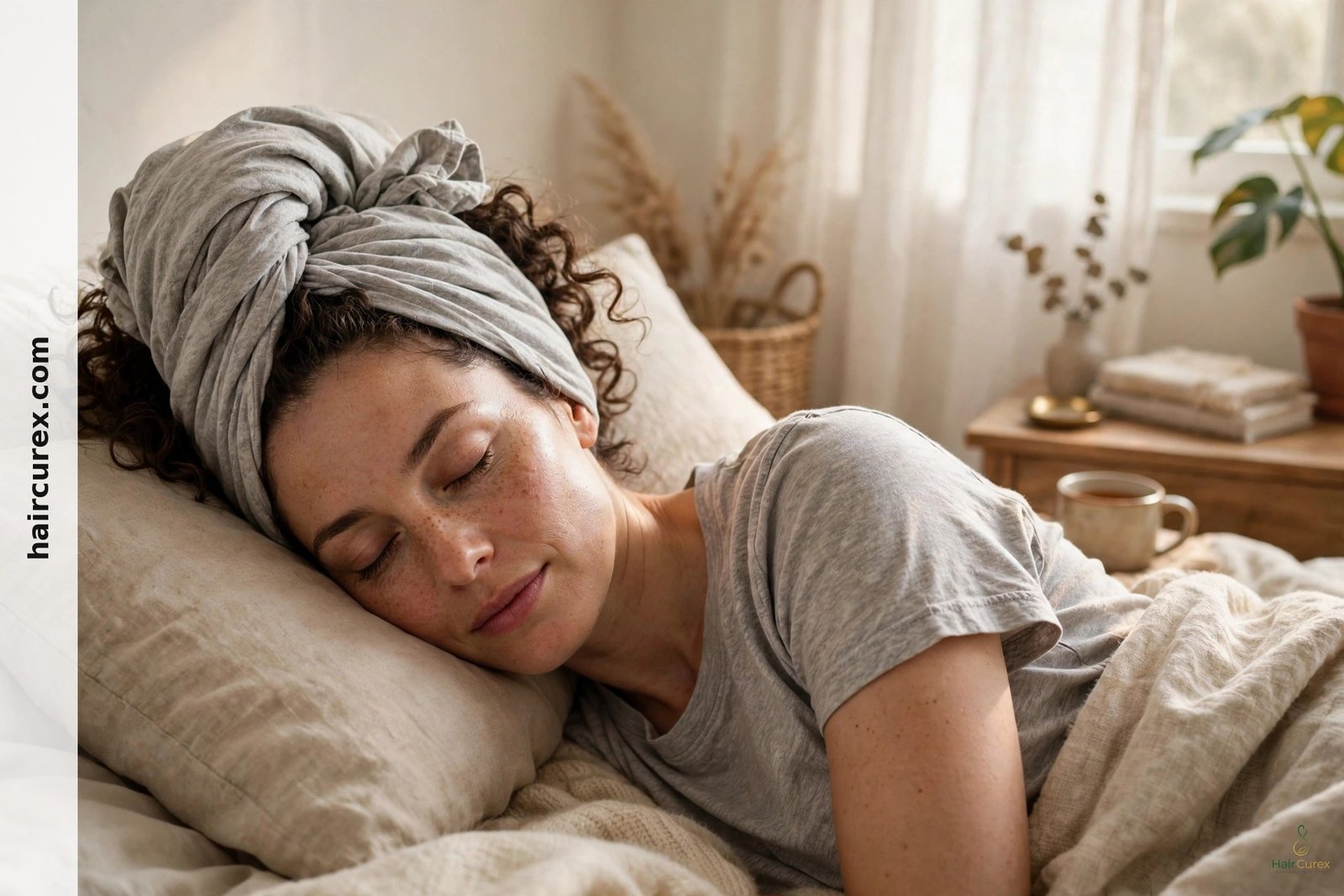
Apply leave-in conditioner, then your curl cream or gel, while your hair is still soaking wet. Work the product through in sections, then scrunch upward to encourage clumps to form. This order matters: products applied after plopping sit on top of partly dried hair and cannot distribute evenly, which leads to patchy definition and crunch. If you are still building your wash-day routine, our step-by-step curly hair routine walks through the full order of products for defined, frizz-free curls. This is a key step in learning how to plop curly hair, because product placement determines how well your curl clumps hold their shape.
Step 3: Lay your T-shirt flat
Spread the T-shirt flat on the bed or chair, with the sleeves nearest to you and the body of the shirt stretching away from you. If you are using a microfiber towel, lay it flat in the same way. Smooth out wrinkles so your curls land on an even surface.
Step 4: Flip forward and lower your curls onto the shirt
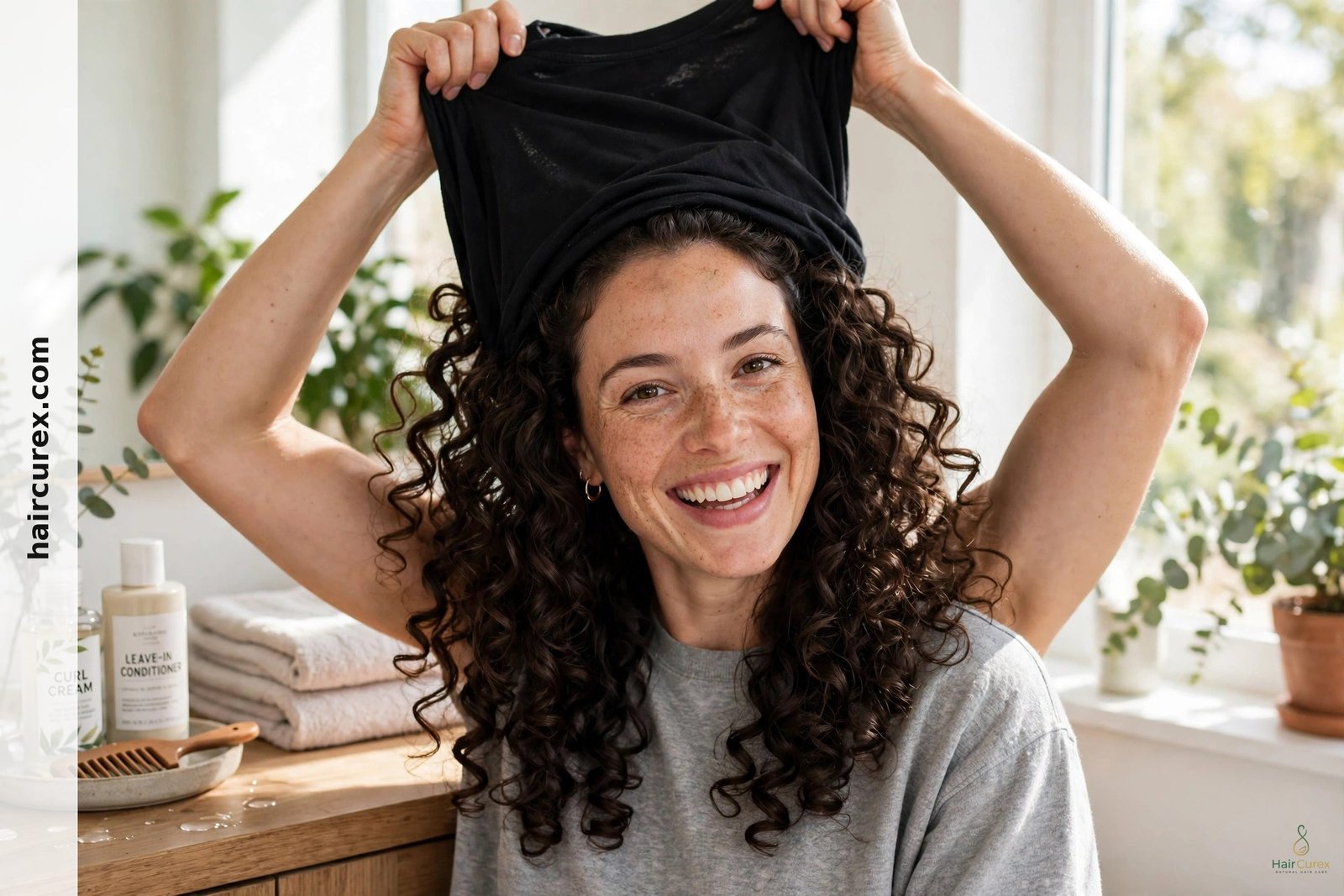
Bend forward at the waist so your hair hangs down toward the fabric. Lower your head slowly so the ends of your hair touch the center of the shirt first, then keep lowering so the lengths fold and pile on top of themselves. This accordion-style folding is the whole point of plopping: curls stack on top of each other instead of hanging straight down. Do not drop straight down onto your crown, which flattens the curls instead of stacking them.
Step 5: Fold the fabric up and tie it
Take the far edge of the shirt — the part farthest from you — and fold it up over the back of your head to the nape of your neck. Then take the sleeves, bring them around your head, and tie them at the nape or forehead, snug enough to stay put but not tight. Tight is not better here: a wrap that compresses your hair against your skull flattens roots and can leave dents. If you are using a towel, fold the corners up the same way and secure them with a hair tie or clip.
Step 6: Leave it for 15 to 45 minutes
Go about your morning — get dressed, do your skincare — and leave the plop alone. Most people get the best results between 15 and 45 minutes. Less than 10 minutes barely removes any water, while leaving it for hours can over-dry the outer layer and make curls feel stiff. Use the timing guide below as a starting point and adjust based on your hair.
Step 7: Unwrap gently and finish drying
Untie the wrap and lift the fabric away from your hair without rubbing or shaking it out. Tilt your head back upright slowly and let your curls fall where they want to. Then do not touch them. Let your hair finish air-drying, or diffuse on low heat and low speed if you are short on time. Touching curls while they are still damp breaks up clumps and invites frizz back in. If you use gel, you may feel a light cast once fully dry; scrunch it out gently with a drop of oil or bare hands for soft, touchable curls. Mastering how to plop curly hair also means resisting the urge to touch your curls until they are completely dry.
How Long Should You Plop? Timing by Curl Type
There is no single perfect plopping time, because fine hair dries faster than thick hair and loose waves set faster than tight coils. When you are learning how to plop curly hair, timing is one of the first things to adjust for your curl type. Use this table as a starting point, then adjust by 5 to 10 minutes in either direction based on your results.
| Hair type | Suggested plopping time | Notes |
|---|---|---|
| Wavy (2A–2C) | 10–20 minutes | Waves set quickly and can go limp if left too long; unwrap sooner and let waves finish in the air. |
| Curly (3A–3C) | 20–30 minutes | The sweet spot for most curl types; enough time to set definition without over-drying. |
| Coily (4A–4C) | 30–45 minutes | Denser hair holds more water, so a longer plop helps remove excess before styling finishes. |
| Fine or low-density hair | 10–15 minutes | Fine hair dries fast and loses volume if compressed too long. |
| Thick or high-density hair | 30–45 minutes | Expect the plop to still feel damp at unwrap; that is normal. |
If your curls come out flat at the roots, you probably plopped too long or tied the wrap too tightly. If they come out frizzy, you may have unwrapped too early, rubbed the fabric on removal, or touched your hair while it was still damp. Change one variable at a time and you will find your timing within two or three wash days.
T-Shirt vs Microfiber Towel vs Regular Towel
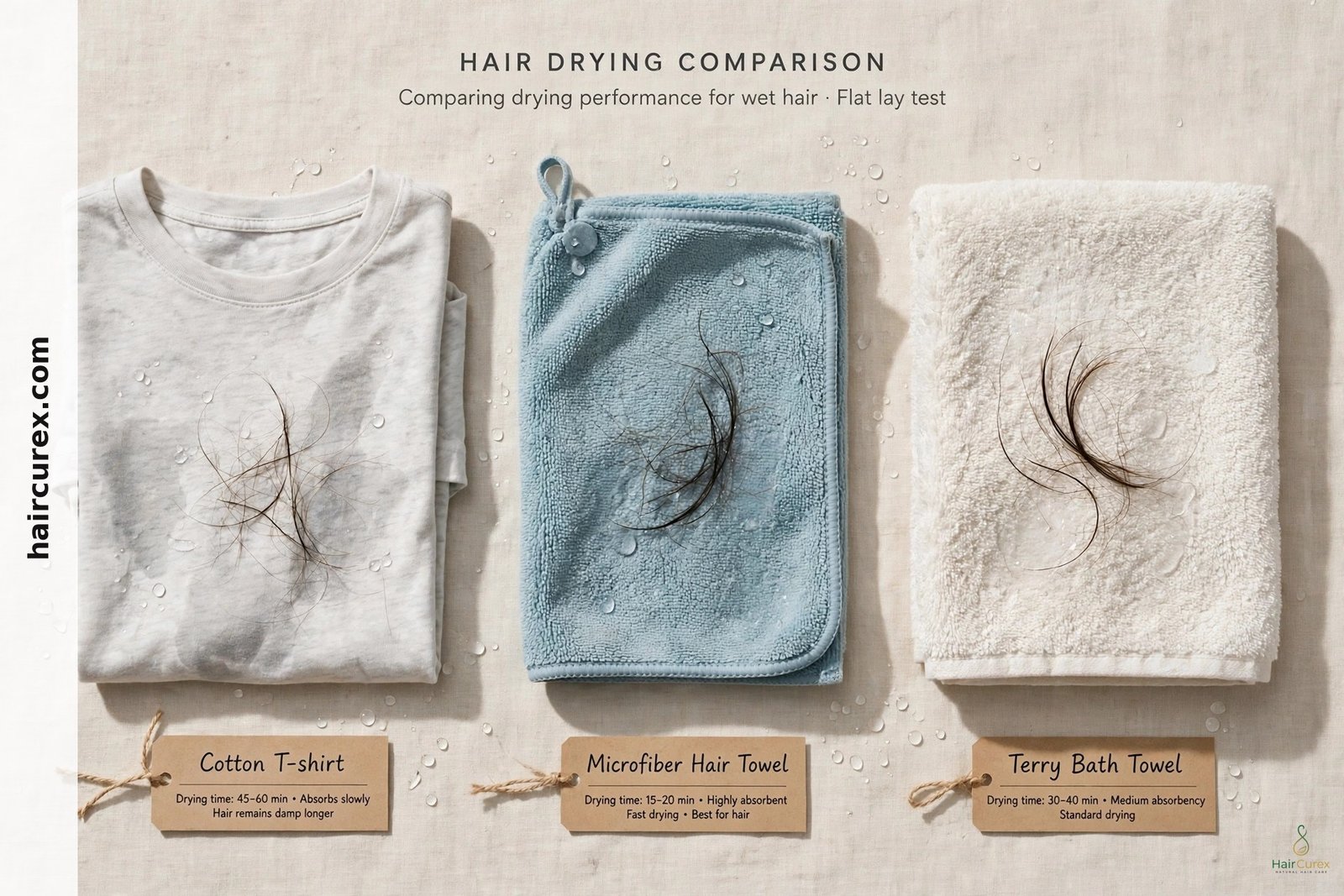
The fabric you choose changes the result more than most people expect. Choosing the right fabric is part of learning how to plop curly hair without frizz. A cotton T-shirt is the default recommendation for a reason: its smooth jersey knit has nothing for hair to catch on, and its moderate absorbency removes excess water without over-drying. A microfiber towel absorbs faster, which suits thick hair or anyone in a hurry, but it can pull out too much moisture from fine hair. A regular terry towel should stay out of the routine entirely.
| Fabric | Best for | Watch out for |
|---|---|---|
| Cotton T-shirt | Almost everyone; the cheapest, gentlest starting point | Less absorbent, so thick hair may need the full 45 minutes |
| Flat microfiber towel | Thick or dense hair; faster water removal | Can over-dry fine hair; avoid twist-style turban towels for plopping |
| Terry bath towel | Not recommended for plopping | Rough loops snag curls, cause frizz and breakage |
For more on gentle drying, see our guide to drying curly and wavy hair without frizz, which covers diffusing and air-drying after the plop.
Plopping for Wavy Hair: What Changes
Wavy hair benefits from plopping too, but with a lighter touch. Waves are easily weighed down, so use less product than you think you need — a light curl cream is usually enough — and keep the plop short, around 10 to 20 minutes. Long plops can stretch waves out or leave them limp at the roots. Learning how to plop curly hair for waves is a little different, because waves need less compression than tighter curls.
If your waves fall flat after plopping, try micro-plopping instead: scrunch sections of wet hair upward with the T-shirt for a few seconds per section, rather than wrapping your whole head. You still get the frizz-reducing benefit of smooth fabric without the extended compression. If you are learning how to plop curly hair with wavy hair, start with the shortest time in the table and work upward only if your waves need more definition. Our complete wavy hair guide covers wave types and product choices in more detail, and if you need help choosing a styler, see our picks for the best curl cream for wavy hair.
Overnight Plopping: Does It Work?
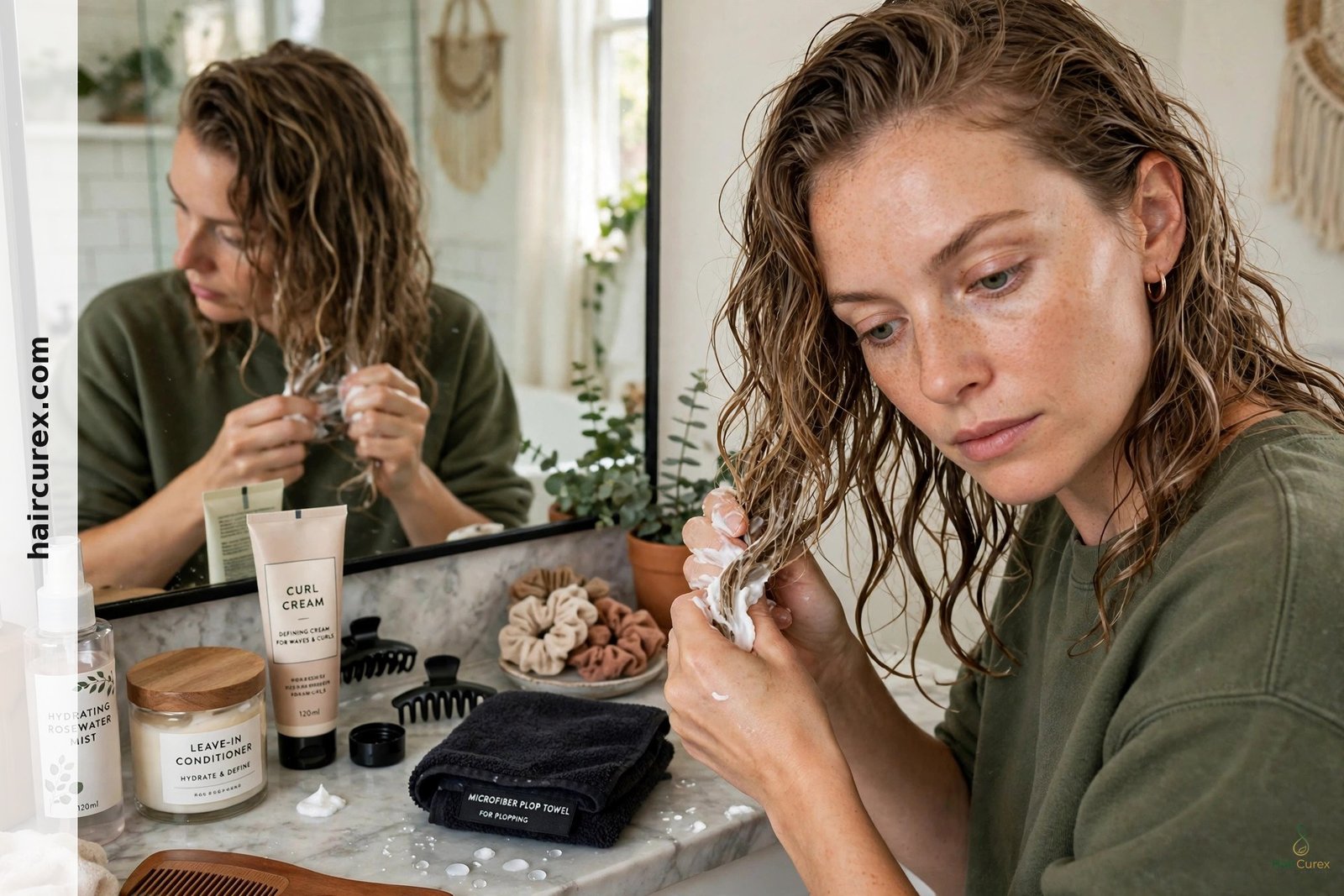
Overnight plopping sounds convenient — wrap your hair at night and wake up to dry, defined curls — but it is not ideal for most people. Sleeping in a tight wrap for eight hours over-dries the outer layer, flattens roots, and can leave dents or an uncomfortable, damp scalp. It can also trap moisture against the scalp for too long, which is not good for scalp health. If you are wondering how to plop curly hair overnight, the short answer is to keep the wrap loose and comfortable.
If you do want to try it, use a loose, soft wrap, keep it comfortable enough to sleep in, and unwrap as soon as you wake up. For most curl types, a 20 to 30 minute daytime plop followed by air-drying gives better, more consistent results than an overnight wrap. Most people find that learning how to plop curly hair during the day gives more reliable results than an overnight wrap. If your goal is next-day hair, you will usually do better by plopping in the morning and refreshing with a light mist and scrunch the next day.
Common Plopping Mistakes (and How to Fix Them)
- Plopping on damp instead of wet hair. The curl pattern sets as water leaves. If your hair is already half dry, the plop has little left to set. Start with soaking-wet, freshly styled hair.
- Applying products after plopping. Products must go on before the wrap, while hair is wet, so they distribute evenly through the clumps.
- Tying the wrap too tight. A tight wrap flattens roots and leaves dents. Snug enough to stay on is enough.
- Rubbing the fabric when unwrapping. Lift the fabric away gently. Any rubbing separates clumps and creates frizz.
- Touching curls while they dry. Hands off until hair is fully dry. This is the hardest rule and the most important one.
- Using a terry towel. Smooth fabric only — cotton T-shirt or flat microfiber towel.
- Plopping for hours. More time is not more definition. Beyond 45 minutes you risk stiffness, flat roots, and over-dried ends.
Many mistakes happen because people rush learning how to plop curly hair, so slow down on your first few wash days and change only one thing at a time.
Plopping also pairs well with knowing your curl pattern: if you are unsure of yours, our guide to 3C hair care shows how curl type changes product and drying choices, and the same logic applies when you adjust plopping time for your own pattern.
Plopping vs Diffusing vs Air-Drying
Plopping is not a replacement for drying; it is the step before it. Air-drying alone gives the gentlest result but takes the longest, and gravity can stretch out curls while they dry. Diffusing is faster and adds volume, but heat and airflow can disturb clumps if you move the diffuser too much. The combination most curl routines rely on is plop first for 15 to 45 minutes, then finish with air-drying or a gentle diffuse.
Plopping first removes the heaviest water, so the finishing step is shorter and your curls hold their shape better either way. External guides agree on the same sequence: Living Proof’s plopping guide recommends leaving hair plopped for at least 15 minutes before finishing drying, and Keune’s guide notes that plopping time varies by curl type, starting at just a few minutes for looser patterns (Living Proof: How to Plop Hair; Keune: How to Plop Your Hair).
The Bottom Line
Hair plopping is a free, simple, heat-free step that genuinely improves curl definition and reduces frizz for most wavy, curly, and coily hair — as long as you start with wet, freshly styled hair, use smooth fabric, and unwrap gently. Once you know how to plop curly hair, it quickly becomes a simple two-minute habit that makes the rest of your routine work better. Try 20 to 30 minutes first, adjust the timing to your curl type, and keep your hands off your curls until they are fully dry.
Frequently Asked Questions
How long should you plop curly hair?
Most curly hair does best with 20 to 30 minutes of plopping. Wavy hair usually needs only 10 to 20 minutes, while thick or coily hair may need 30 to 45 minutes. Leaving hair plopped for hours can over-dry the outer layer and flatten roots.
Can you plop hair with a regular towel?
It is not recommended. Regular terry towels have rough loops that snag curls, separate clumps, and cause frizz. Use a smooth cotton T-shirt or a flat microfiber towel instead.
Do you apply products before or after plopping?
Before. Apply leave-in conditioner, curl cream, or gel to soaking-wet hair, scrunch to form clumps, and then plop. Products applied after plopping cannot distribute evenly through partly dried curls.
Does plopping work for wavy hair?
Yes, with a shorter plop of 10 to 20 minutes and lighter products. If full plopping weighs your waves down, try micro-plopping: scrunch sections upward with a T-shirt for a few seconds each instead of wrapping your whole head.
Can you sleep with your hair plopped overnight?
You can, but it is not ideal for most people. Overnight plopping often over-dries the outer layer, flattens roots, and leaves dents. A 20 to 30 minute daytime plop followed by air-drying usually gives more consistent results.
Why is my hair frizzy after plopping?
The most common causes are plopping on hair that was already too dry, rubbing the fabric when unwrapping, tying the wrap too tight, or touching curls while they are still damp. Fix one variable at a time, starting with unwrapping gently and keeping hands off until fully dry.