

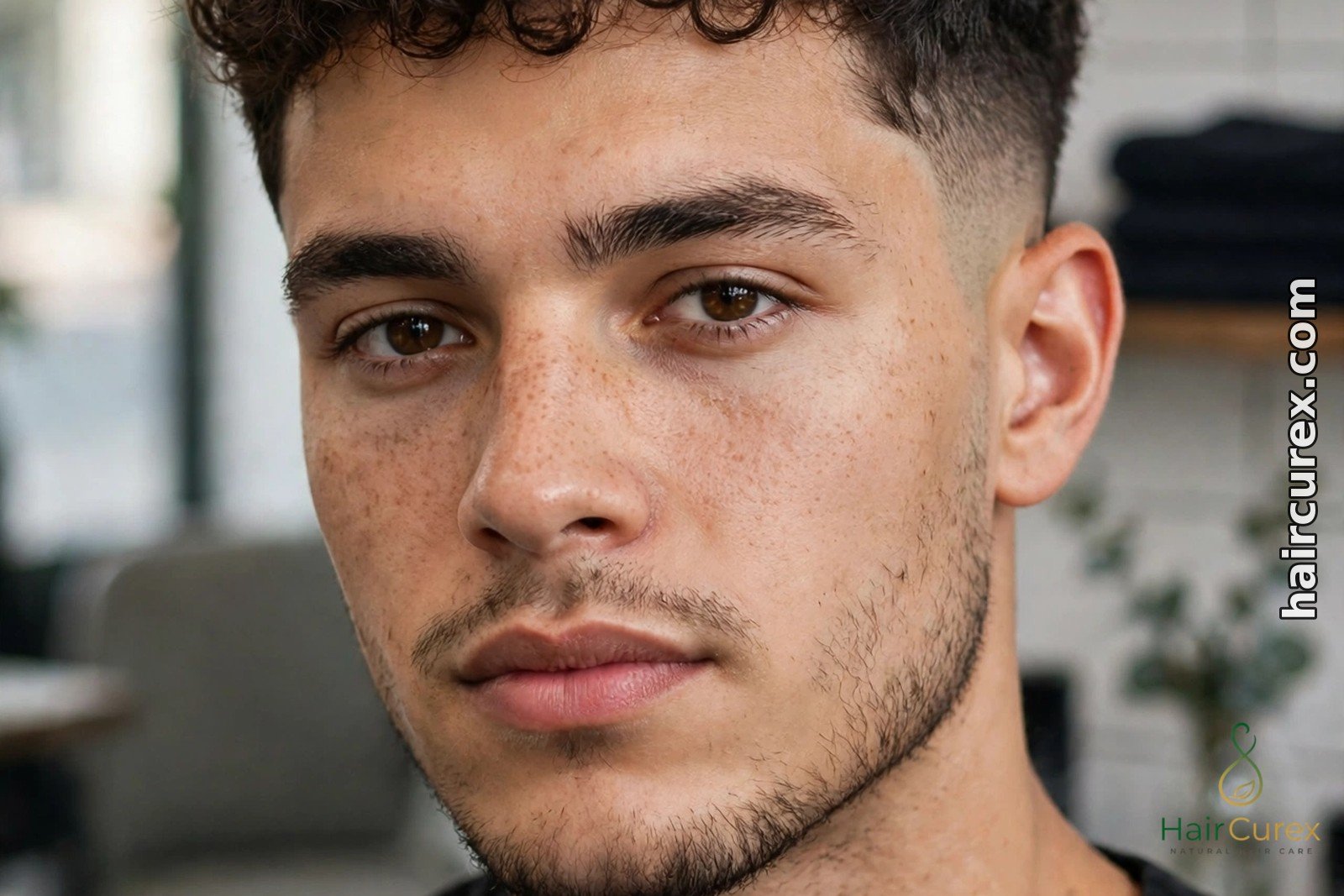
Quick answer: Short curly hair for men means about 1 to 3 inches of curl on top (measured stretched), with the sides faded, tapered or kept short. The styles that work best are the curly crop, the curly fade, the burst fade, the curly French crop, the curly Caesar, the curly undercut and the short afro fade — all of them keep the curls defined on top while the short sides do the work of looking neat. Most of these cuts take about 5 minutes to style in the morning and need a trim every 3 to 5 weeks.
Curly hair is an advantage that a lot of men try to fight instead of using. Cut short, curls give you volume, texture and shape without any effort — no blow-drying, no heavy product, no trying to force straight hair to do something it cannot do. The problem is that the wrong short cut can make curls look puffy, uneven or shapeless, and that is usually why men with curls either grow their hair out or buzz it all off. The right short cut sits in between: enough length on top for the curl pattern to show, and short, clean sides so the shape stays sharp as it grows. This guide covers the seven styles that actually work, how to pick one for your curl type and face shape, how to style it in five minutes, and exactly what to say to your barber.
What Is Short Curly Hair for Men?
Short curly hair for men is hair kept to roughly 1 to 3 inches on top when a curl is pulled straight, with the sides and back shorter than the top. That measurement matters because curls shrink as they dry: 3 inches stretched can sit only 1 to 2 inches from the scalp once dry. Anything under about 1 inch on top stops reading as curly at all — it becomes a buzz cut with texture — while anything over 3 inches moves into medium-length curly territory, which needs a different routine and a different cut. If you want the full picture of men’s cuts beyond curly hair, our general guide to haircuts for men covers the classic styles; this guide stays focused on short cuts made for curls.
Short curly cuts suit almost every curl type, from loose 2C waves through 3A to 3C ringlets to tight 4A to 4C coils, but the details change with the curl. Loose curls need a little more length on top to show their pattern, so a crop at 2 to 3 inches works better than a buzz-length cut. Tight curls and coils hold their shape at shorter lengths and can go as short as 1 inch on top and still look deliberately curly. Knowing your curl type before you sit in the chair is the single most useful thing you can do: it tells the barber how much length to leave and whether to cut the hair wet or dry. Our guide to curly hair types explains the 2A to 4C scale, and if your curls are on the tight, coily end, our guide to coily hair covers the care routine that keeps them defined.
7 Short Curly Hairstyles for Men That Work
These seven styles cover the full range of short curly hair, from the easiest cut to maintain to the sharpest fade. They all share the same idea: short sides, defined curls on top, and a shape that still looks good three weeks after the cut. The table below is the fastest way to compare them, and each style is explained in detail underneath.
| Style | Length on top | Best curl type | Upkeep |
|---|---|---|---|
| Curly crop | 1–2 inches | 3A–3C | Low — trim every 4–5 weeks |
| Curly fade | 2–3 inches | 2C–3C | Medium — fade needs upkeep |
| Curly burst fade | 2–3 inches | 3A–4A | Medium — shape fades fast |
| Curly French crop | 1–2 inches | 2C–3B | Low — grows out evenly |
| Curly Caesar cut | 1–1.5 inches | 3A–3C | Low — shortest of the crops |
| Curly undercut | 2–3 inches | 3B–4A | Medium — sharp contrast to keep |
| Short afro fade | 1–2 inches | 4A–4C | Medium — needs regular shaping |
1. The Curly Crop
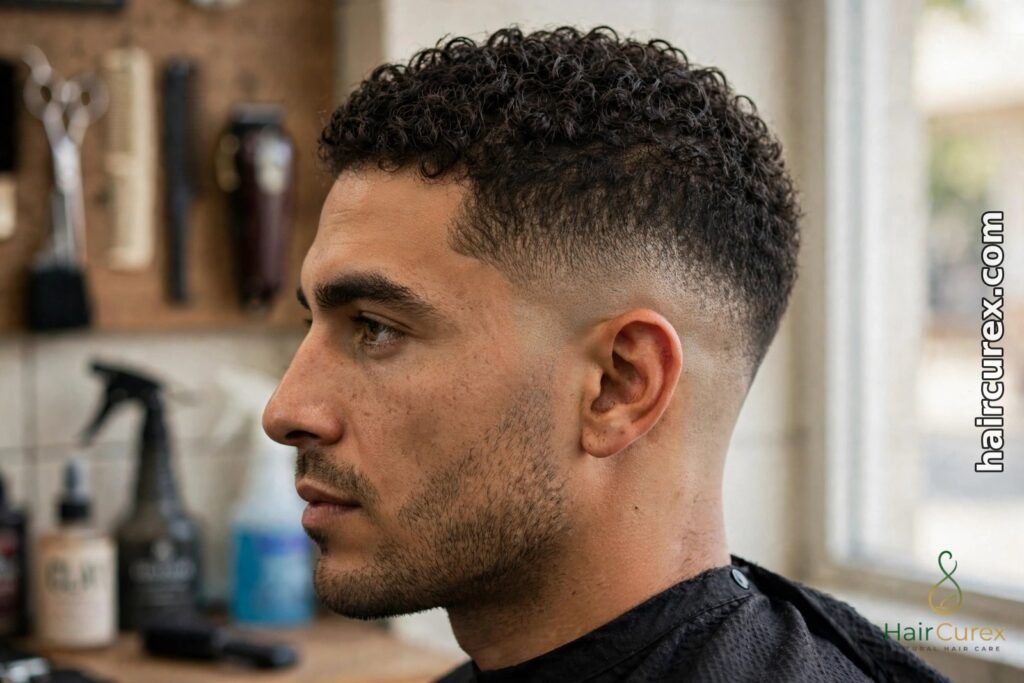
The curly crop is the safest short curly cut there is, and the one most barbers will suggest first. About 1 to 2 inches of curl is left on top and shaped into an even, rounded mass, with a low taper keeping the sides neat — a #2 guard on the sides is a good starting point. The curls are cut dry, or at least finished dry, so the barber can see how each curl actually sits instead of guessing how it will shrink. It suits oval, round and square faces, and it works best on 3A to 3C curls. Style it with a pea-sized amount of curl cream scrunched through damp hair and left to air dry — that is the whole routine, and it takes about two minutes.
2. The Curly Fade
The curly fade is the most popular short curly style for a reason: the clean fade on the sides makes the curls on top look intentional instead of accidental. The top is kept at 2 to 3 inches so the curl pattern is clearly visible, while the sides fade from skin or a #0 at the bottom up into the curls. A low fade is the most forgiving and the easiest to grow out; a mid fade is sharper and suits square and oval faces; a high fade is the boldest and needs the most upkeep, because the line grows out visibly within two weeks. Ask for the fade to be blended into the curls rather than cut as a hard line, so there is no shelf where the short sides meet the long top. Our guide to the burst fade for curly hair explains the rounded version of this fade in detail, including what to ask for and how the taper should sit behind the ear.
3. The Curly Burst Fade
The burst fade is a rounded fade that curves around the ear and drops down at the back of the neck, leaving the curls on top to fall naturally. Unlike a regular fade, which runs in a straight line around the head, the burst fade follows the curve of the ear, so it frames the curls instead of cutting across them. It suits 3A to 4A curls and works especially well on men with a strong jawline or a square face, because the curved fade softens the outline. It is a barber-skill cut: the blend has to be smooth and the curve even on both sides, so find a barber who has done burst fades on curly hair before. Expect to be back in the chair every 3 to 4 weeks, because the curved shape loses its outline faster than a straight taper.
4. The Curly French Crop
The French crop takes the curly crop and adds a short fringe, with the curls at the front pushed slightly forward over the forehead. The top stays at 1 to 2 inches, the sides are tapered short, and the fringe is cut straight across or slightly textured, never blunt and heavy. It is one of the best short curly styles for men with a high forehead or a receding hairline, because the forward fringe covers the hairline instead of exposing it. It also suits 2C to 3B curls well, since looser curls fall forward naturally and form the fringe without much styling. The French crop grows out more evenly than a fade, so it is a good choice if you cannot get to the barber every three weeks.
5. The Curly Caesar Cut
The Caesar cut is the shortest of the crop family: the top is kept to about 1 to 1.5 inches, the sides are short and even, and a short, straight fringe sits across the forehead. On curly hair it reads as a neat, textured cap of curls rather than the flat Roman look the cut is named after, and the tight curls give it far more character than the same cut on straight hair. It is the lowest-maintenance style on this list — wash, a little curl cream, done. The trade-off is that it shows the curl pattern the least, so if your curls are your favourite feature, one of the longer styles here will show them off better.
6. The Curly Undercut
The undercut keeps 2 to 3 inches of curl on top and takes the sides and back down to one short, even length, with no blending between the two — the contrast is the point. It suits 3B to 4A curls, which have enough body to sit up and forward over the disconnected sides, and it works best on thick hair, because thin curls can look sparse when they are the only long hair on the head. Style the top forward or swept to one side with a little curl cream, and keep the sides sharp with a trim every 2 to 3 weeks. It is the boldest style on this list, but it is also the one that gets the most compliments.
7. The Short Afro Fade
For tight 4A to 4C coils, the short afro fade is the classic short curly cut: 1 to 2 inches of coiled hair on top, shaped into a rounded afro silhouette, with a clean fade on the sides and back. The shape is everything — the top should be picked out evenly so the afro reads as a deliberate, rounded shape rather than a random puff, and the fade should be crisp enough to frame it. A low or mid fade works best; a skin fade is sharper but needs a touch-up every two weeks. Moisture matters more here than for any other style on the list, because tight coils dry out faster: a leave-in conditioner after every wash and a light oil on the ends keeps the coils defined instead of frizzy.
How to Choose the Right Short Curly Cut
Choosing short curly hair for men starts with your curl type, then your face shape, then how much time you are willing to spend. Loose 2C to 3A curls look best with a little more length on top — the curly fade or the French crop at 2 to 3 inches — because cutting them too short removes the wave pattern entirely. Tight 3B to 3C curls can go shorter and still look curly, so the crop or the Caesar works well. Coils at 4A to 4C need the afro fade or a tapered crop that respects the coil pattern instead of fighting it. Face shape is the second filter: oval faces suit almost everything on this list; round faces look better with height on top and short sides, so the curly fade or the quiff-style undercut; square faces suit the burst fade and the crop, which soften the jawline; and a longer face suits the French crop or Caesar, where the fringe shortens the face visually. Lifestyle is the third filter, and the honest one: if you will not visit the barber more than once a month, pick the crop, the French crop or the Caesar, which grow out gracefully, and skip the high fade and the undercut, which need a trim every two to three weeks. A good round-up of the same styles from another angle is the MenHaircuts guide, which groups 35 cuts by shape, fade and curl type: MenHaircuts on short curly hairstyles for men.
How to Style Short Curly Hair for Men
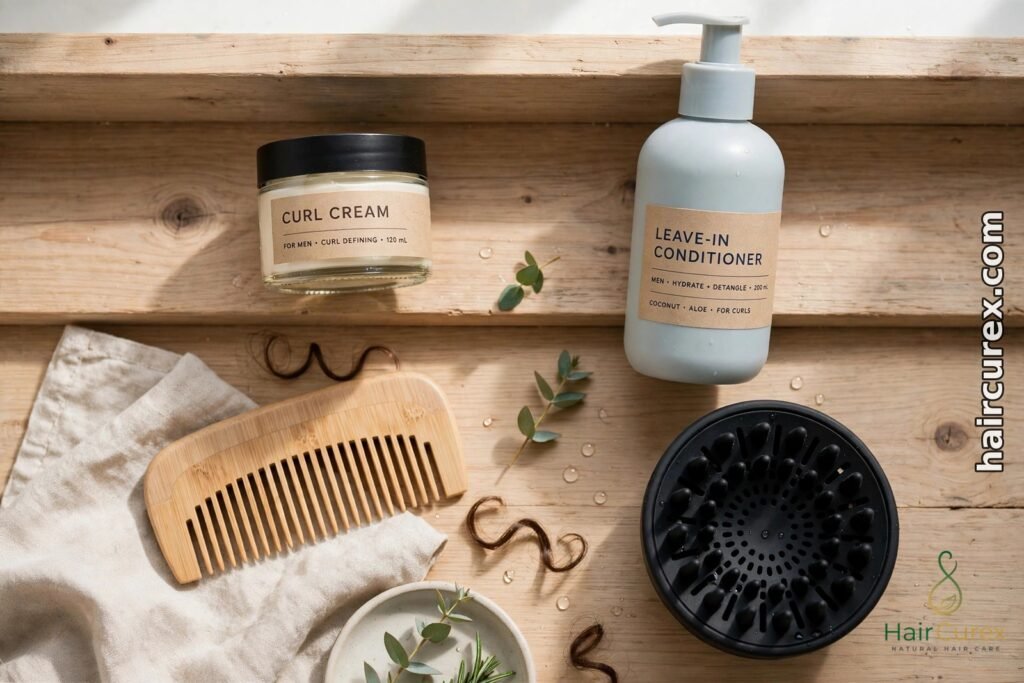
Styling short curly hair takes about five minutes, and most of that is waiting for it to dry. Wash with a sulfate-free shampoo 2 to 3 times a week — curly hair dries out easily, and daily shampooing strips the natural oils that keep curls defined. After washing, squeeze the water out with a microfibre towel or an old T-shirt instead of rubbing with a rough towel, which breaks curls apart and creates frizz. While the hair is still damp, work a pea-sized amount of curl cream or leave-in conditioner through the curls with your fingers, then scrunch gently upwards to encourage the curl pattern. That is the whole styling step for most short curly cuts: no brush, no comb, no blow-dryer. If you want more volume, a diffuser on the lowest heat setting, held still against the curls rather than moved around, adds lift without blowing the curls apart.
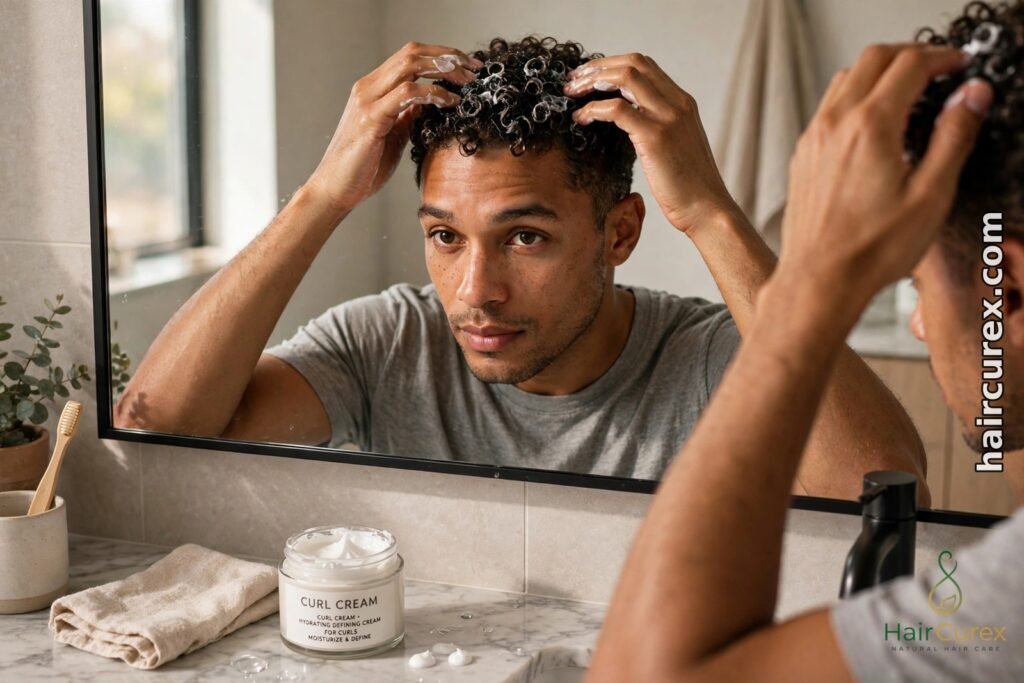
What not to do matters as much as what to do. Do not brush dry curly hair — a brush pulls curls into a frizzy cloud; the only time a brush should touch curly hair is in the shower, with conditioner in it, using a wide-tooth comb. Do not use heavy wax or pomade on short curls: they weigh curls down and are hard to wash out. A light curl cream or mousse is the right weight for short curly hair for men; gel works too for a firmer hold, but use a small amount and scrunch out the crunch once it dries. And do not skip conditioner — curly hair needs it more than straight hair, because scalp oils travel slowly down a curly strand. Our guide to the best curly hair products explains how to choose a curl cream, a leave-in and a shampoo that match your curl type, so you are not guessing at the shelf. The American Academy of Dermatology’s healthy-hair guidance covers the same gentle-washing basics that matter most for curly hair: American Academy of Dermatology healthy hair tips.
What to Ask Your Barber
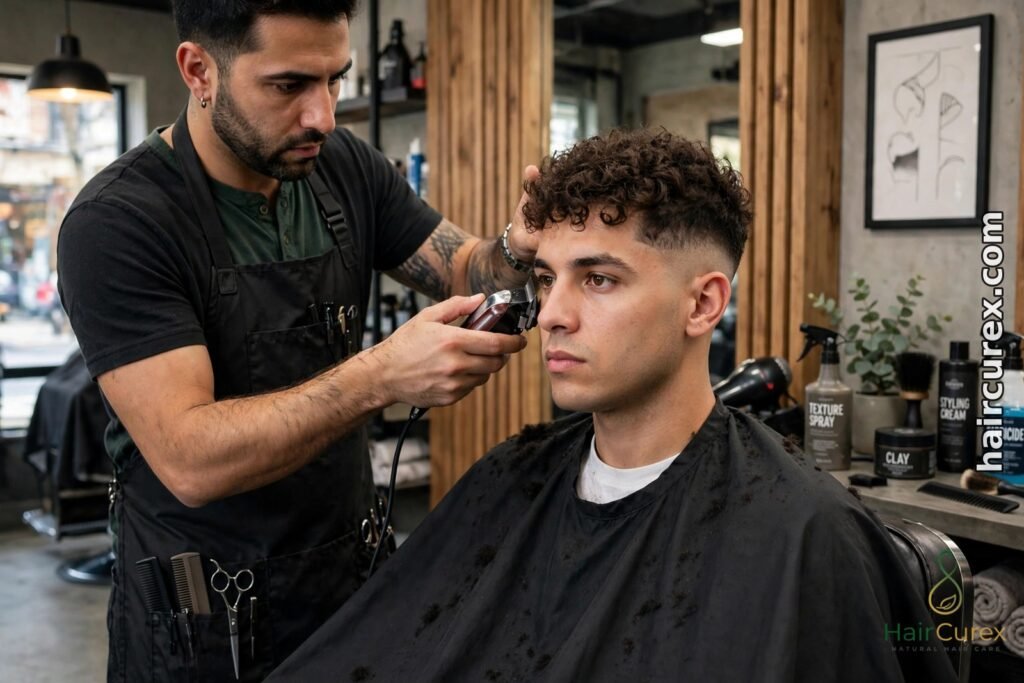
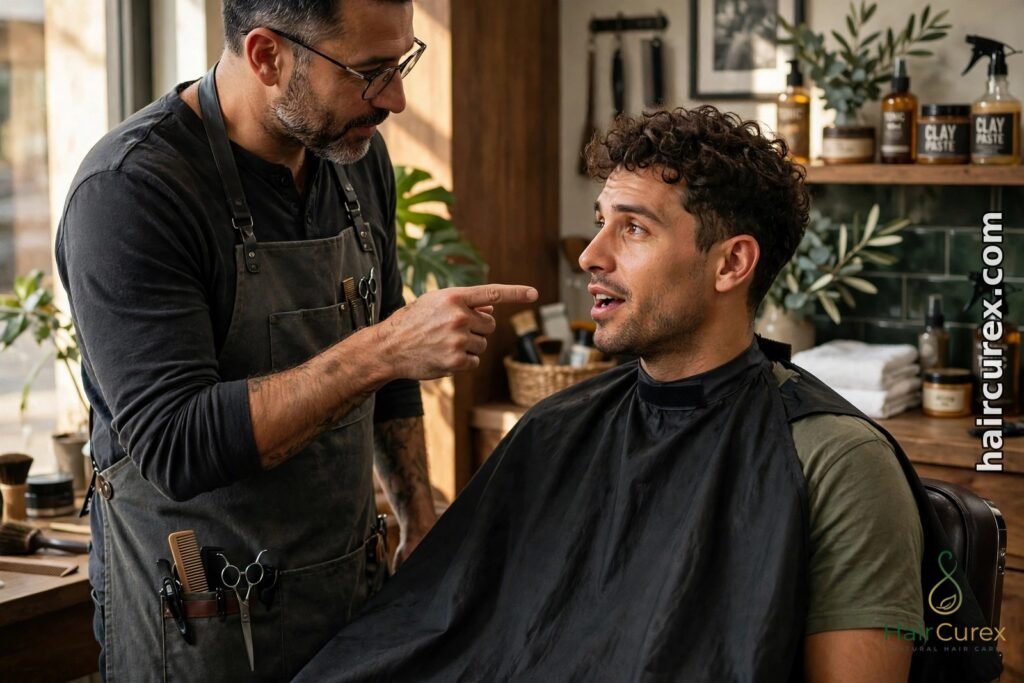
Most bad curly haircuts happen because the barber and the client meant different things by the same words. “Short on the sides” can mean a #1 guard or a scissor taper, and “leave the top curly” can mean 1 inch or 4 inches. Bring a photo of the exact cut you want, taken in daylight, and bring two or three photos rather than one, so the barber can see the cut from the front and the side. Then say the specifics out loud: the guard number for the sides, the length you want on top in inches, whether you want a fade or a taper, and whether the top should be cut wet or dry. Cutting curls dry is usually better for short styles, because the barber can see the finished shape — wet curls shrink as they dry, so a cut that looks right when wet can end up an inch shorter than expected.
Ask three questions before the clippers start. First, “Have you cut curly hair like mine before?” — if the answer is no, find another barber, because curly hair needs a different technique. Second, “Will you cut the top dry or finish it dry?” — the right answer for short curly styles is usually dry, or wet cut followed by a dry check. Third, “How should I ask for this cut next time?” — a good barber will give you the exact words, the guard numbers and the length, so you can repeat the cut without the photos. And one thing never to say: “just thin it out.” Thinning shears on curly hair create uneven lengths inside the curl, which makes the hair frizz instead of lying in defined curls.
How Often Should You Trim Short Curly Hair?
Short curly hair for men loses its shape faster than longer hair, because there is less length to hide the growth. A crop or a French crop needs a trim every 4 to 5 weeks; a fade, a burst fade or an undercut needs one every 3 to 4 weeks, and a skin fade every 2 to 3 weeks. Between cuts, the top grows faster than it looks — curls spring up, so growth stays hidden until the shape suddenly goes puffy, usually around week four. Book the next cut when you leave the barber’s chair, so the shape never grows out far enough to need a full re-cut. Do not try to trim the curls yourself between visits: cutting curly hair is a dry-cut skill, and an at-home trim almost always takes off more than intended.
Short Curly Hair for Men FAQs
What is the best short curly hairstyle for men?
The curly crop with a low taper suits most men: it keeps about 2 inches of curl on top, looks neat from every angle, and needs only a trim every 4 to 5 weeks. If you want something sharper, the curly fade with 2 to 3 inches on top is the most popular choice, and the burst fade is the best option for 3A to 4A curls on a square face.
How short should curly hair be for men?
About 1 to 3 inches on top, measured with the curl pulled straight, is the short range for curly hair. Under 1 inch the curl pattern disappears and the cut reads as a buzz cut; over 3 inches the hair moves into medium-length territory and needs a different cut and routine. Loose curls need the longer end of that range to show their pattern, while tight curls and coils can go shorter and still look curly.
How do I style short curly hair in the morning?
Wash 2 to 3 times a week with a sulfate-free shampoo, squeeze water out with a T-shirt instead of rubbing with a towel, and scrunch a pea-sized amount of curl cream through damp hair, then leave it to air dry. Do not brush dry curls. The whole routine takes about 5 minutes, and on non-wash days a little water and a dab of leave-in conditioner is enough to refresh the curls.
Should curly hair be cut wet or dry?
Dry is usually better for short curly styles, because the barber can see the finished shape and how each curl actually sits. Wet curls shrink as they dry, so a cut that looks right when wet can end up shorter than expected. Many good curly-hair barbers cut wet and then check and finish the cut dry — either way, ask your barber to finish the top dry.
How often should men with short curly hair get a haircut?
Every 3 to 5 weeks, depending on the style. Crops, French crops and Caesar cuts last 4 to 5 weeks; fades, burst fades and undercuts need a trim every 3 to 4 weeks, and skin fades every 2 to 3 weeks. Book the next cut when you leave the barber so the shape never grows out far enough to need a full re-cut.
Does short curly hair suit a receding hairline?
Yes — the French crop and the Caesar cut are two of the best short curly styles for a receding hairline, because the forward fringe covers the hairline instead of exposing it. A textured crop with the curls pushed forward works the same way. Avoid slicked-back short curly styles, which pull the hair away from the hairline and make recession more visible.